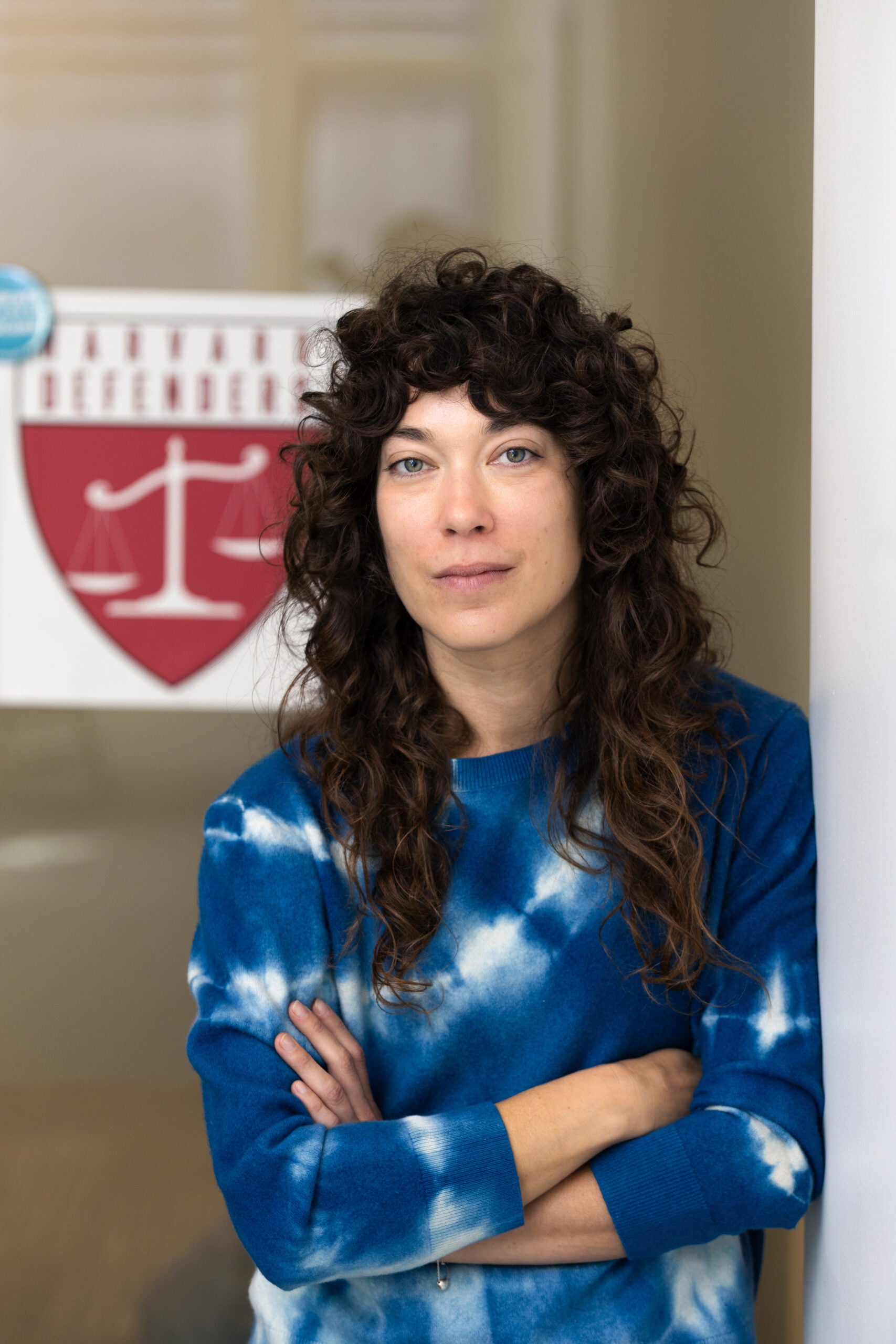
This fall, Harvard Defenders welcomed a familiar face back to its office. Rebecca Chapman ’15, who spent her own law school years arguing show-cause hearings as a Defenders student attorney, has returned to the student practice organization (SPO) as its new Clinical Instructor, succeeding John Salsberg, who guided Defenders students through their casework for more than four decades.
Founded in 1949, Defenders is the only legal services organization in Massachusetts that represents low-income people for free in criminal show-cause hearings before clerk-magistrates. Each year, a cohort of students take on that work, many of them 1Ls meeting their first clients just weeks into law school. For Chapman, that early responsibility was formative: it’s in no small part because of Defenders, she says, that she became a public defender. As a student, she also represented clients through the Criminal Justice Institute and co-founded the HLS Feminist Collective.
After graduating, Chapman joined the Criminal Defense Practice at The Bronx Defenders, where she represented hundreds of clients facing felony and misdemeanor charges. After moving to Boston in 2018, she practiced criminal defense and civil rights litigation at the boutique firms Fick & Marx and J.W. Carney & Associates, took on cases as a bar advocate in Suffolk County, and litigated activist defense cases at the Civil Liberties Defense Center. In 2021, a love of teaching drew her to Northeastern University School of Law, first as a Social Justice Teaching Fellow and, since 2023, as an Assistant Teaching Professor in its Legal Skills in Social Context program.
We spoke with Chapman about returning to Defenders, the lessons from her student days that still shape her practice and teaching, and why she believes the skills students build in the Defenders office are ones that no textbook, or AI, can replace.
Office of Clinical and Pro Bono Programs (OCP): You were a Defenders student yourself when you were a student at HLS. What’s it like to return to the program now as Clinical Instructor? What do you remember most vividly about your own time as a student attorney?
Rebecca Chapman: Returning to Harvard Defenders as Clinical Instructor—attempting to fill the shoes of John Salsberg—is a truly surreal and wonderful experience. It was my time as a student attorney at Defenders that set me on the path I’m still on today. It’s in no small part because of Defenders that I became a public defender, and to come back now and help create that same experience for a new generation of students is a profound honor.
I remember most vividly is the stark contrast between being a 1L in class and being a 1L student attorney with Defenders—the difference between somewhat passively sitting in class, trying make sense of my doctrinal courses (figuring out what Civil Procedure even is, for example), worrying about being cold-called, and then going to the Defenders office for my intake hours or prepping a case and talking to clients and having real responsibility with real-world consequences. Being able to immediately learn about and practice what lawyers actually do – the real-world labor of lawyering – is the most valuable and meaningful part of Defenders, and it’s what I remember most vividly. I was a student who came to law school for the practical benefits. I wanted to be able to practice as an attorney, and when I discovered Defenders as a 1L I was so happy to be able to supplement my law school intellectual experience with some real practical experience as well.
OCP: Walk us through your career to this point. What have you been up to since graduating from HLS?
Chapman: After graduating from HLS, I spent my first several years as a staff attorney in the Criminal Defense Practice at The Bronx Defenders in New York. In 2018 I relocated to Boston, and over the next few years I moved through a few different settings that let me broaden my practice. I was an associate at two boutique firms doing criminal defense and civil rights litigation—including working on Commonwealth v. Carter and a civil rights case involving a police killing—and I also worked as a bar advocate representing indigent defendants in Suffolk County. Then, from 2020 to 2021, I worked at the Civil Liberties Defense Center, where I did activist defense and civil rights work—drafting and litigating Bivens and Section 1983 lawsuits, and supporting activists with trainings and litigation support.
I’ve always loved writing, and I’ve always loved teaching writing—and that, combined with the collaborative, peer-supervision culture I first experienced at Defenders and carried with me as a public defender, pulled me toward legal academia. So in 2021 I joined Northeastern University School of Law as a Social Justice Teaching Fellow, and in 2023 I was appointed Assistant Teaching Professor, teaching Legal Skills in Social Context—Northeastern’s first-year legal research and writing program, with a clinical component where students work on real projects for partner organizations.
OCP: What lessons from your time as a Defender are shaping how you want to teach and lead now?
Chapman: The first lesson that has always shaped my teaching philosophy is the importance of support and collaboration. It is so important, especially when dealing with criminal cases, to rely on other attorneys for their advice and ideas rather than trying to carry a case alone. Case conferencing, moot arguments, asking questions big and small are all aspects of practice that I saw for the first time as a Defender, and continued to rely on throughout my career.
Another lesson that I learned for the first time at Defenders that I’ve carried with me is that as someone’s attorney, you are not the main character in the story. As a student attorney, every case feels like the biggest thing in the world—it’s the focus of your every waking hour for weeks leading up to a hearing. But that’s not always true for the client. Their case might be, at that moment, the least important thing happening in their life. That was my first real introduction to a principle that now defines how I think about all community lawyering: the lawyer is not the protagonist. This is a critical lesson that guides all my teaching.
OCP: The SPO centers on lifting the narratives of clients who might otherwise be processed by the criminal justice system without anyone hearing their stories. How do you help students understand that principle in their first cases, especially when they’re learning the technical side of the work?
Chapman: This is also where I bring in movement lawyering principles: clients are the experts on their own lives and their own stories. Our job is not to invent a narrative for them, it’s to center their voice and help them tell the story of the case as effectively as possible. Obviously our job is also to advise them on strategy, to give them insight into potential outcomes and consequences, and support them as they make decisions, but we can do all that without imposing our own judgment or desires onto them. It’s a truism that many students and attorneys (and social workers, and anyone who does direct services for minoritized and oppressed communities) often hear, but it’s a lesson I learned for the first time in Defenders and try to pass on to all my students: for many clients, this case might be the first time in their entire experience with the criminal legal system that someone has stood next to them and advocated for them, wholeheartedly told their story, and was unequivocally on their side. No matter what happens with a case, showing a client that you are the person in the room with them, standing next to them, fighting for them is always a win.
OCP: What’s your approach to feedback and mentorship with students? What do you love about working directly with law students?
Chapman: Law school can be an overwhelming and non-individuated experience for many people. The wonderful thing about Defenders (and my work at Northeastern) is that I get to work with smaller groups of students. Working with a smaller group allows me to watch as concepts begin to make sense and they are able to find their path and their voice. The “aha” moment is such a wonderful thing to see.
I approach feedback with students as if I am their supervising attorney in practice. I give written feedback and in-person feedback that is direct, and also treats students as peers and colleagues, rather than subordinates.
OCP: What do you hope students take away from Defenders that they won’t learn in any classroom?
Chapman: You cannot teach, in a classroom, what it feels like to have a real person’s liberty, or their case, or their story depending on you. Additionally, being a direct service provider in any context requires comfort with a certain amount of uncertainty. However, most importantly, especially in this age of Generative AI, are the “soft” skills, or the interpersonal skills. Learning to sit with a client, build real trust with someone who has every reason not to trust the system or anyone in it, and listen to their stories, and craft a legal argument that is not only authoritative and persuasive, but also centers the client’s perspective and takes their desires and opinions into account, those are skills that can’t be taught in a classroom, and can’t be replaced by AI. You only learn it by doing it, with a real client, with real stakes. That combination is what I hope every Defenders student walks away with, because it’s the foundation of everything else they’ll do as lawyers.
OCP: What are your priorities for the program this year, as someone who both knows it as a student and is seeing it now with fresh eyes as an instructor?
Chapman: Honestly, my first priority is to not mess it up. Defenders is an incredible SPO, it’s been running incredibly smoothly for many decades, and that’s due in no small part to decades of excellent student leadership and supervision, and to the support the program has from the clinical staff. I don’t come into this wanting to reinvent anything—I’m here to help carry that legacy forward.
That said, there is one area where I’d like to explore: potentially expanding the availability of virtual hearings for clients who want them. Historically, although since COVID courts have been theoretically allowing all hearings to proceed virtually, Defenders has been understandably hesitant to pursue virtual hearings, assuming that outcomes would be worse when the client isn’t physically present in front of the clerk. While I absolutely understand that perspective (and do think it’s a real concern), given the current climate—specifically rising concerns about ICE presence at courthouses—I think it’s important that we help clients understand and pursue that option more readily where it’s available, so that appearing in court doesn’t carry risks beyond the case itself. And I’d like us to actually track outcomes on that front—to know, concretely, whether virtual appearances do lead to different outcomes.
OCP: What would you tell a current 1L who’s on the fence about joining Defenders?
If the student is on the fence about joining because of the responsibility of representing someone in court as a 1L I would say just do it! You have so much support here you will never do anything that you aren’t prepared (indeed, likely over-prepared) for. If the student is on the fence because they’re not sure if they want to do direct client-facing work, then I’d say talk to some upper-level student Defenders, maybe explore some other SPOs like PLAP and see how you like that client work. Direct client work isn’t for everyone and that’s OK! But the support and mentorship of Defenders makes it so everyone will always feel prepared and able to do scary small stuff like talking on the phone or intimidating big stuff like cross examining a police officer.
To learn more about Harvard Defenders, visit their website.
Filed in: Clinical Voices
Tags: Harvard Defenders