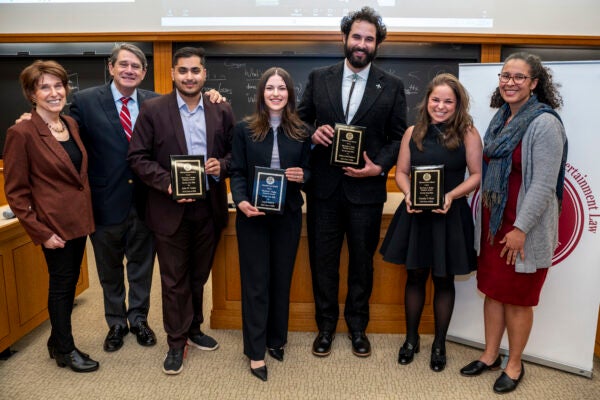
During the Harvard Committee on Sports & Entertainment Law’s annual Harvard Sports Law Symposium, four students were celebrated for their contributions and dedication to the sports law community at Harvard Law School.
Jackson Faulkner ’26, Layla Galeck ’26, JJ Gobin ’26, and Cassidy Hunt ’26 received the Paul C. Weiler Scholar Awards, established in 2008 in honor of the late Paul C. Weiler, Henry J. Friendly Professor of Law Emeritus at Harvard Law School. Professor Weiler is considered to be the founder of American sports law and one of America’s foremost labor law scholars, and he began the sports law program at Harvard Law School. In honor of his legacy, the recipients of the Weiler Awards have displayed a deep commitment to and investment in the sports law courses, writing projects, and clinical placements at Harvard Law.
We caught up with the awardees to learn about their hands-on work in the Sports Law Clinic and how it has shaped their law school experience and future aspirations.
Office of Clinical and Pro Bono Programs (OCP): What sparked your interest in taking the Sports Law Clinic?
Layla Galeck ‘26: Sports have always been a central part of my life. My dad would take me to NBA games growing up, and I was captivated by the energy and excitement surrounding the industry. I knew I wanted a career that carried that kind of cultural weight.
Growing up in Los Angeles naturally drew me toward the intersection of sports and entertainment, and talent representation has long been an area of interest for me. My 1L summer at Hirsch Wallerstein in LA gave me hands-on transactional experience representing entertainment and sports clients, which deepened that interest and motivated me to pursue the sports law curriculum at HLS, culminating in the Sports Law Clinic as a natural next step.
JJ Gobin ‘26: Rather, it’s the Sports Law Clinic that sparked my interest in Harvard Law School. Professor Carfagna has cultivated an unparalleled clinical program that has exponentially expanded my professional network in the sports industry. My experiences were the highlights of my law school journey and have sparked my career interest in the sports labor field.
Cassidy Hunt ‘26: I have always wanted to work in sports. In college, I was a sports journalist, and I knew I wanted to attend law school to break into sports law. Harvard Law’s Sports Law Clinic is unmatched in the experiential learning components it offers. Whereas most other clinics at HLS are on-site, the Sports Law Clinic is unique in that it allows students to work in-house offsite, which I think really lends itself to powerful learning in such a niche, or at least sometimes elusive, area of the law. After taking Professor Carfagna’s sports law classes, I became sure that I wanted to give the Sports Law Clinic a try.
OCP: Where have your clinical placements through the Sports Law Clinic been? What type of work did you do during your externships? What did you enjoy about it?
Galeck: During my 2L year, I was placed at NFL headquarters in New York City, where I worked on intellectual property enforcement, litigation research, and reviewed official sponsor contracts. Being embedded in an organization that sits at the center of American sports culture—and contributing to its work—was a remarkable experience.
In my 3L year, I was placed at UCFB Wembley, where I worked across various sports law firms and organizations throughout London on both transactional and litigation matters. It was an incredible opportunity to see how sports law is practiced on an international scale.
Gobin: My first clinical placement was working with the LA28 Organizing Committee for the 2028 Summer Olympics to be held in Los Angeles. While wildfires impacted my time there, it was an honor to play a part in organizing arguably the largest sporting event in the world, especially in representation of my Canadian citizenship and Guyanese heritage.
My second clinical placement was with the International Sport and Economic Zone Agency in Dubai, UAE. Located in the Dubai World Trade Centre, I joined the team operating and growing the first free-zone solely dedicated to sports and entertainment investment in Dubai. I am very appreciative of the Sport Law Clinic’s global scope.
Hunt: I have been placed at the MLB, Barking Owl Music, Disrupt the Game, and (currently) at Special Olympics International. So, I have been at a league, a music licensing company, a sports agency, and an international sports nonprofit. What a broad range of experiences! I have very grateful to have gotten to try so many different things.
The work at each externship varied pretty widely. At the MLB, I worked on research for the 2026 CBA and helped my team create presentations to take to player arbitrations during the offseason. Working in the MLB legal department is my dream job, and I am thrilled that I got to give it a try while in law school. At Barking Owl, I helped with commercial music licensing agreements and did patent research (this was out of my comfort zone, but very cool!). At Disrupt the Game, I did research relating to the increasing popularity (and value) of women’s sports and worked on marketing players from the other side of the negotiating table. Finally, at Special Olympics International, I attended their annual “Hill Day” lobbying event in Washington, D.C. where I got to advocate for more funding for the Special Olympics, and I co-authored an article about the Special Olympics’ unique accreditation structure.
OCP: What were your biggest takeaways from the experiential learning of the Sports Law Clinic?
Galeck: The Sports Law Clinic taught me that the legal profession extends far beyond traditional settings. Practically, I gained experience in how transactional and litigation work operate within major sports organizations and sports law firm practices, but the broader takeaway was just as valuable: that you can build a meaningful legal career in dynamic, exciting spaces at the intersection of law and the industries you care most about.
Hunt: I leave the Sports Law Clinic with a much deeper understanding of and appreciation for the complexity of sports law. There are many, many factors that go into each decision in the sports law sphere. Seeing this up-close helped me refine my attention to detail. I also learned how far-reaching sports law is—ranging from opening charities for players, defending a stadium against a run-of-the-mill tort lawsuit, as well as trading players and negotiating their contracts. Overall, although sports law can seem intimidating, my time exploring sports law at HLS has shown me that it’s not as daunting as it seems.
OCP: What does the Weiler Scholar Award mean to you?
Galeck: Receiving the Weiler Scholar Award is one of the greatest honors of my academic career. I began my undergraduate studies at a local community college before transferring to UCLA and ultimately arriving at Harvard, and recognition like this serves as a reminder of how far that journey has come. I am deeply grateful for the mentorship of Professor Carfagna and the exceptional sports law program at HLS, which made this possible.
Gobin: Fellow Canadian Professor Paul Weiler was one of, if not the, foremost scholars of sports and labor law. As a champion of labor everywhere, it means so much to accept this award in his name. The Clinic and the entire industry rests on the backs of the athletes that we cheer and scream for. Advocacy in this field is a commitment to ensuring that the immense value generated by the industry is shared equitably with its indispensable foundation: the players who, regardless of their league, gender, age, or nationality, deserve a seat at the table where their futures are decided. To fight for sports labor is to uphold the principle that whether on a global stage or in a minor league dugout, the person in the jersey is a worker first, entitled to the same dignity and fair share of the prosperity they create as any other laborer.
Hunt: It is a great honor to received the Weiler Scholar Award. Professor Weiler made the sports law offerings at HLS, and the broader sports law community, what it is today. I am deeply grateful to Professor Carfagna, the rest of the sports law community at HLS, and the Weiler Scholarship Fund donors for their support. The sports law program has hands-down been the standout part of my HLS experience, and it is something I will miss very much after I graduate. I will carry this award into my professional life with much pride.
Filed in: Events
Tags: Class of 2026, Sports Law Clinic