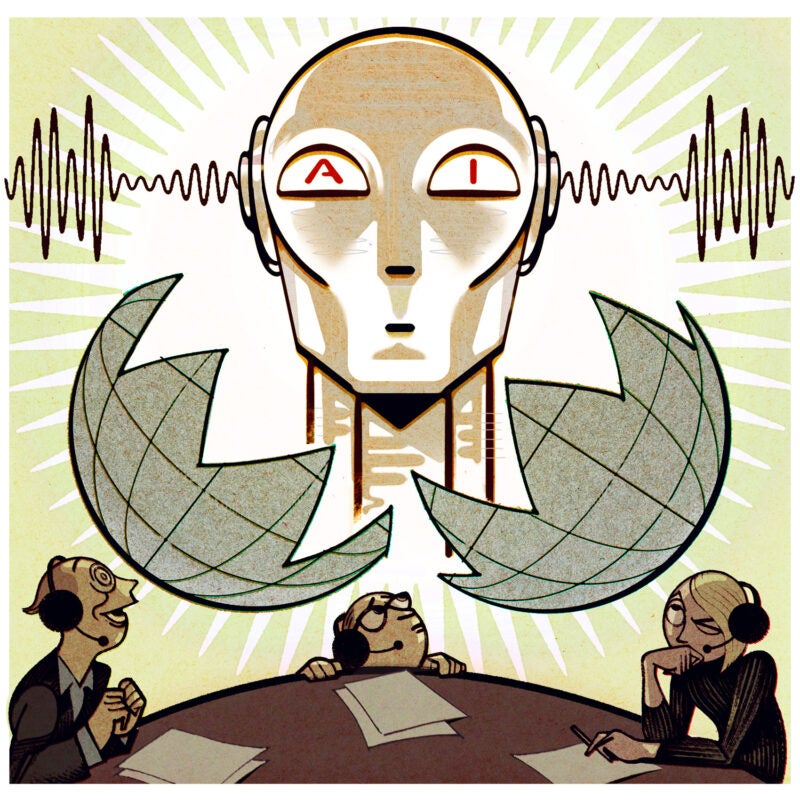
In September, Evan Hubinger, a top researcher at Anthropic—the leading AI company behind the chatbot Claude—caused a stir with a post on X, formerly Twitter, warning that he believes there is more than a one-in-10 chance that AI could result in human extinction within the next decade.
“We really do earnestly believe AI could kill all humans,” the post read.
But while technologists like Hubinger worry that AI is progressing so quickly that it could disrupt life as we know it in painful—even existential—ways, others believe that it could create material abundance and revolutionize our everyday lives. Still others wonder if dramatic debates about the future of AI are getting in the way of addressing problems the technology is already creating.
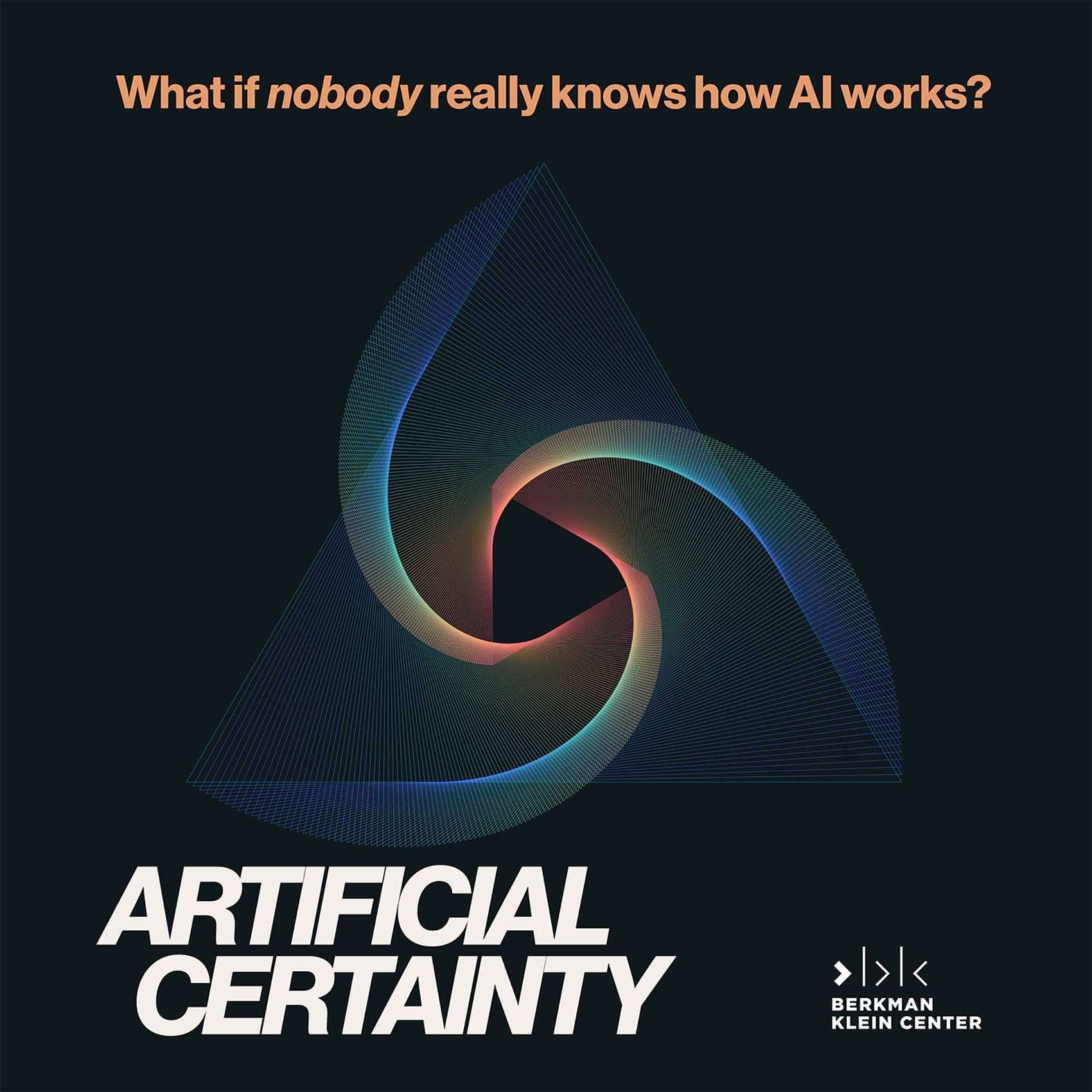
A new podcast hosted by Harvard Law School Professor Jonathan Zittrain ’95, “Artificial Certainty,” will explore the wide range of views on the impact AI will have on our lives, nation, and world—and what we can and should do about it.
Available on major platforms in January 2027—including Apple Podcasts, Spotify, Amazon Music, and YouTube—the podcast will feature Zittrain in conversation with prominent tech industry and legal experts, whose assessments on the prospects of AI range from idealistic to skeptical to alarmist, three schools of thought on AI that Zittrain calls the “AI Triad.”
“I want to understand why brilliant, well-intentioned people can look at the same technology and see such radically different things as salvation, extinction, or distraction,” says Zittrain, the George Bemis Professor of International Law and co-founder of Harvard’s Berkman Klein Center for Internet & Society.
The podcast will give listeners an opportunity to engage in many of the ideas and debates that Zittrain will tackle with law school students in a course he is co-teaching this spring focused on the AI Triad. He says the technology is poised to dramatically alter the way we work, live, and socialize in the coming years, raising issues that law will be called upon to address. It’s not just a thought exercise, he insists.
“This could be one of the most consequential debates of our time,” he says. “We’re at an inflection point in AI development where these questions about acceleration, safety, and societal impact are going to shape governance frameworks, corporate practices, and the lives of our children for decades.”
Zittrain says his goal with both the podcast and the class is to dig deeper beneath disagreements to understand the incentives and values underlying AI companies and the tools they are developing. What he’s discovered so far is somewhat surprising, he says.
“It’s a show about human flourishing, how we think about risk, and our fundamentally different understandings of what artificial intelligence is and can be.”
Jonathan Zittrain
“These are experts at the highest level, many of whom are creating this tech. They’re reading the same papers and writing their own. Some of them work in the same buildings. You might think they’re on the same page,” he says. “They’re not.”
Split into six installments, “Artificial Certainty” will feature leaders who believe that AI technology will solve many of the problems that have plagued humanity for millennia, such as hunger, disease, and material scarcity, as well as experts who fear the tech could escape containment and wreak havoc on our lives and institutions in ways that can’t be taken back.
Other installments will highlight thinkers who contend that AI will have a profound impact on our ways of life, but also that a misplaced focus on imagined futures—dystopian or otherwise—prevents us from confronting real, immediate problems the technology is causing.
“We will also spend a fair amount of time in the places where lines blur, which, it turns out, is most places,” Zittrain says.
At its core, he says, “Artificial Certainty” is about how our systems and institutions can and should respond to a technology that in some ways resembles what has come before—promising change and threatening disruption—but that may operate on an unprecedented scale and time frame.
“It’s a show about human flourishing, how we think about risk, and our fundamentally different understandings of what artificial intelligence is and can be,” Zittrain says.