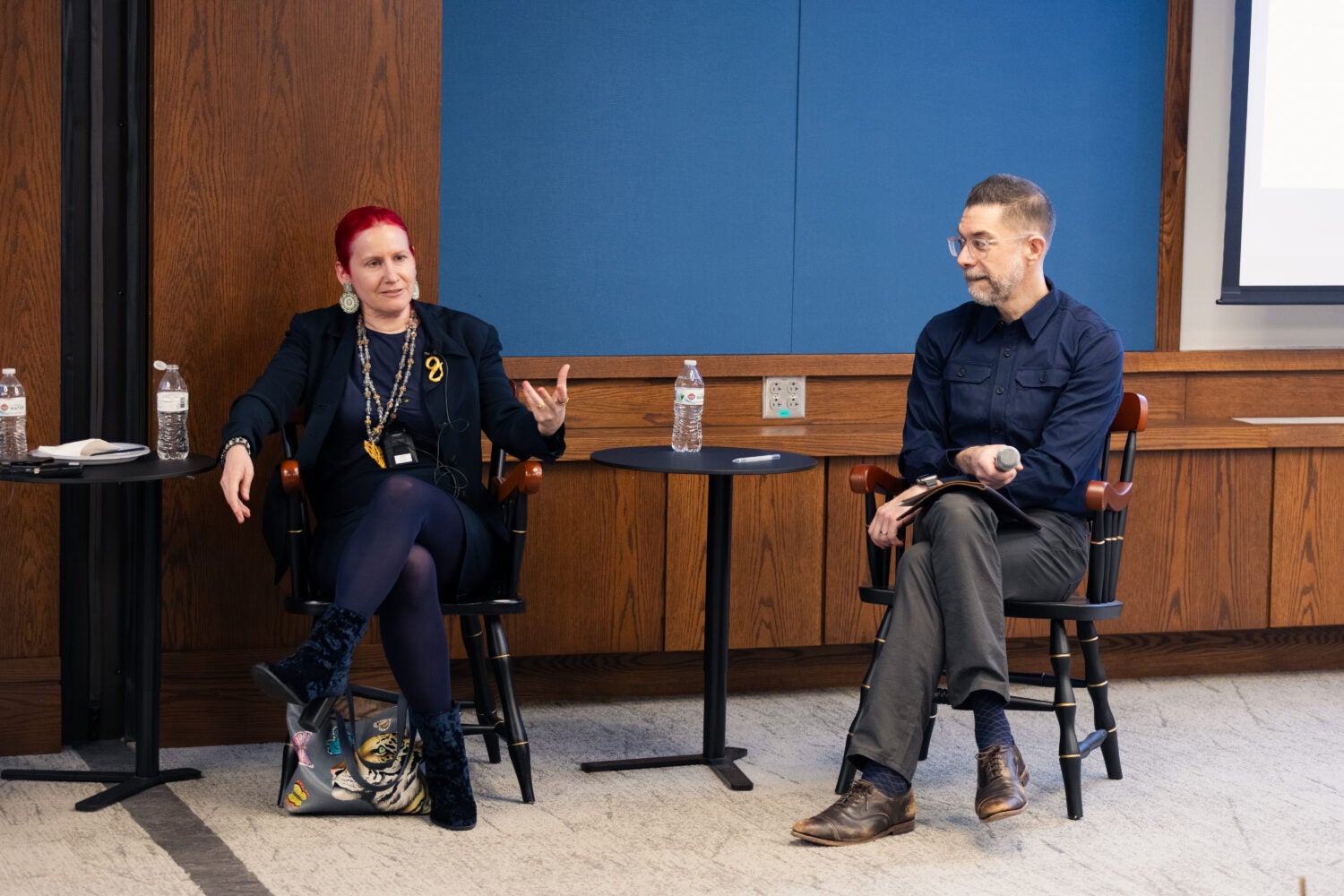
Deferring hard decisions about which kinds of machine-assisted creative works can be copyrighted over nearly 250 years has made it harder to ascertain whether works produced with the help of artificial intelligence can receive legal protection, according to Harvard Law School Professor Rebecca Tushnet.
Using as examples the copyright protections available in some cases for security camera footage and real estate photographs, Tushnet pointed to the “technical debt” acquired by the U.S. Copyright Office by “accepting ever more products of machine-human combos without really requiring the human to do much, ultimately.”
“Because we decided to stop thinking about what level of human-machine interaction leaves the human in charge enough to deserve copyright, that’s why we’re struggling now,” she said.
Tushnet, the Frank Stanton Professor of the First Amendment, spoke as part of a panel discussion, “Copyright in AI Outputs: Who Owns AI-Created Works?,” that was presented by HLS Beyond in the wake of the U.S. Supreme Court’s March decision to deny certiorari in Thaler v. Perlmutter, a case in which lower courts upheld the Copyright Office’s decision not to issue a copyright to an AI-generated image because “copyright law … requires human authorship.” Matt Kristoffersen ’27 moderated the discussion, which included Boston University School of Law Professor Jessica Silbey, Harvard Law Professor Christopher T. Bavitz, and an extensive Q&A session with audience members.
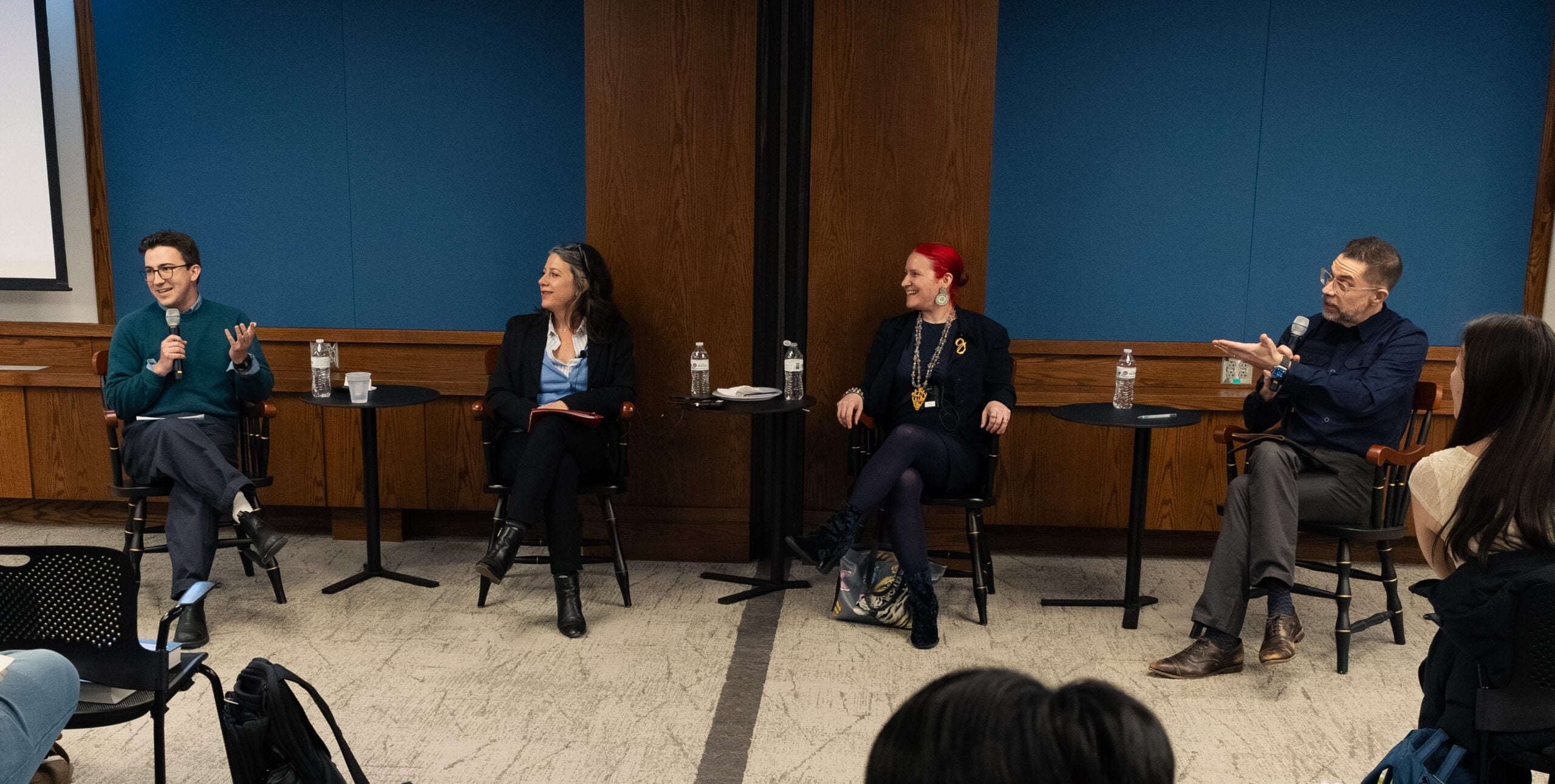
The professors discussed several of the most high-profile cases involving artificial intelligence to come out of the Copyright Office, including one in which a comic book writer sought to register her book “Zarya of the Dawn,” which used AI-generated images. The Copyright Office held that the author could register the text of her book as well as the “selection, coordination, and arrangement” of the images. But because the pictures in the book “are not the product of human authorship,” the office declined to award copyright to them. In another case, the office awarded copyright protection to a piece of art called “A Single Piece of American Cheese” for which the human creator made 35 rounds of edits.
Explaining the reluctance to extend protections to AI-generated works, Silbey said the original intent of copyright law — first passed in 1790 — was to promote progress by incentivizing humans to create important works. The office now requires potential registrants to disclose if any part of their work was made with generative AI.
“If you admit to using generative AI, I’m going to predict that — although maybe not in the current circumstance when they are so understaffed, but in the future they will be asking more detail about disclaiming,” Silbey said.
She pointed to the evidence submitted by the human creator of “A Single Piece of American Cheese.”
“This was an amazing lawyering moment,” she said. “It’s an example of what the Copyright Office might be starting to care more about.”
Bavitz, the WilmerHale Clinical Professor of Law who is managing director of the Cyberlaw Clinic and faculty co-director of the Berkman Klein Center for Internet & Society, said decisions limiting the copyrightability of AI-generated works were a good thing.
“Some protection incentivizes me to create things,” he said. “The flip side is, if I’m going to create things … it is helpful and beneficial for me and probably helps the progress of science and the arts if I have a corpus of things that I can draw upon like the great public domain works … Striking that balance between some level of protection … and a corpus of public domain works on which I can draw is kind of the name of the game.”
The professors agreed that certain industries — including the entertainment business — might come up with their own norms and standards based on ideas outside the intellectual property domain. In May, Hollywood studios agreed to certain limits on AI-generated content in a four-year deal reached with SAG-AFTRA, the labor union that represents more than 150,000 actors, dancers, and media professionals.
“Those are copyright-motivated industries. They’re money-motivated industries, and copyright is the way they make their money,” Tushnet said. “That’s a perfectly reasonable labor policy.”
Silbey agreed, adding that she had recently reviewed a contract for a model who was concerned about the use of AI with her images.
“We might start seeing practice-driven specificity,” she said. “In music, in video games, in movies, the industries are going to start deciding before the law does what kind of AI we are going to say is creative and is acceptable and what is not.”
Silbey said concerns about the use of AI go far beyond copyright.
“We might ask ourselves hard questions about: Do we want our world full of stuff that impersonates a human mind but is not produced by a human mind?” “Copyright is not going to solve that problem — that mysterious, philosophical problem. We can either grant it all copyright or not grant it all copyright. It still may be produced and it’s still mysterious … I don’t feel like giving it copyright or not giving it copyright answers the interesting questions.”
Want to stay up to date with Harvard Law Today? Sign up for our weekly newsletter.