It looked like the credits might roll on AMC Entertainment. At the beginning of 2020, the nearly century-old movie theater chain was already saddled with debt and hemorrhaging audiences to the streaming revolution—and then the pandemic hit. With it came shutdowns, skittish patrons, and a public feud with Universal Pictures. By October, a collapse seemed imminent as the beleaguered company announced that it could soon run out of cash.
But then something unexpected happened: Instead of filing for bankruptcy, AMC and its lawyers orchestrated a sweeping financial overhaul outside of the courtroom. Just three years later, signs of recovery were hard to miss, as the chain posted its highest-ever weekly revenue during the “Barbenheimer” (Barbie-Oppenheimer) movie craze.
Call it a Hollywood ending—one that might have turned out differently in a previous era, when Chapter 11 was still the go-to option for distressed companies, says Jared Ellias, the Scott C. Collins Professor of Law at Harvard.
But today, he says, “bankruptcy law has become less central to the life of a bankruptcy lawyer.”
That’s why Ellias created Corporate Restructuring, a course at Harvard Law School that serves as a companion to traditional courses in bankruptcy. His aim, he says, was to spotlight a rapidly growing area of corporate law in which formal bankruptcy is giving way to debt renegotiation and swaps, equity infusions, and other creative legal maneuvers designed to give troubled companies “more runway to succeed.”
“I think this is the future of debtor-creditor education,” he says.
Ellias began his legal career as a bankruptcy lawyer during the Great Recession and says he started noticing changes in the work that restructuring attorneys—lawyers who help businesses or creditors navigate financial distress—were doing not long after he left private practice for academia in 2011. Yet, this transformation wasn’t always reflected in how bankruptcy law was being taught, he says.
“Bankruptcy law has become less central to the life of a bankruptcy lawyer.”
—Jared Ellias
“It was clear to me that something important had changed in the way that the law was practiced, and I felt like it was too big for just one or two class periods within the usual bankruptcy course,” he says.
Before creating his Harvard Law class, Ellias surveyed 500 high-level bankruptcy lawyers from across the United States. The results confirmed his own intuition: that these lawyers were increasingly focused on pre-bankruptcy scenarios. Their work, he learned, centered on issues in contract law, fiduciary duty law, receiverships, and a state-level process called “assignment for the benefit of creditors”—rather than bankruptcy.
“That data ensured that this class would be very well aligned with the type of work that young restructuring lawyers are doing at the highest level,” he says.
Ellias says there are a few reasons companies are ever more eager to avoid bankruptcy. For one, it is time-consuming and expensive. More importantly, he says, private equity sponsors—now more common and often influential in the businesses they back—sit at the bottom of the capital structure and stand to lose the most in a formal bankruptcy process.
As a result, corporate lawyers have become more sophisticated—and aggressive—with financial restructuring efforts, Ellias says.
“Until the mid-2010s, a company needed bankruptcy law to borrow new money that would be senior to existing debt,” he says. “But in the last decade or so, lawyers have figured out how to do that by using flexibility under existing loan contracts.”
Ellias considers Harvard Law an ideal setting for his course and says he tailors his teaching to be accessible even to students who have no background in corporate financial distress.
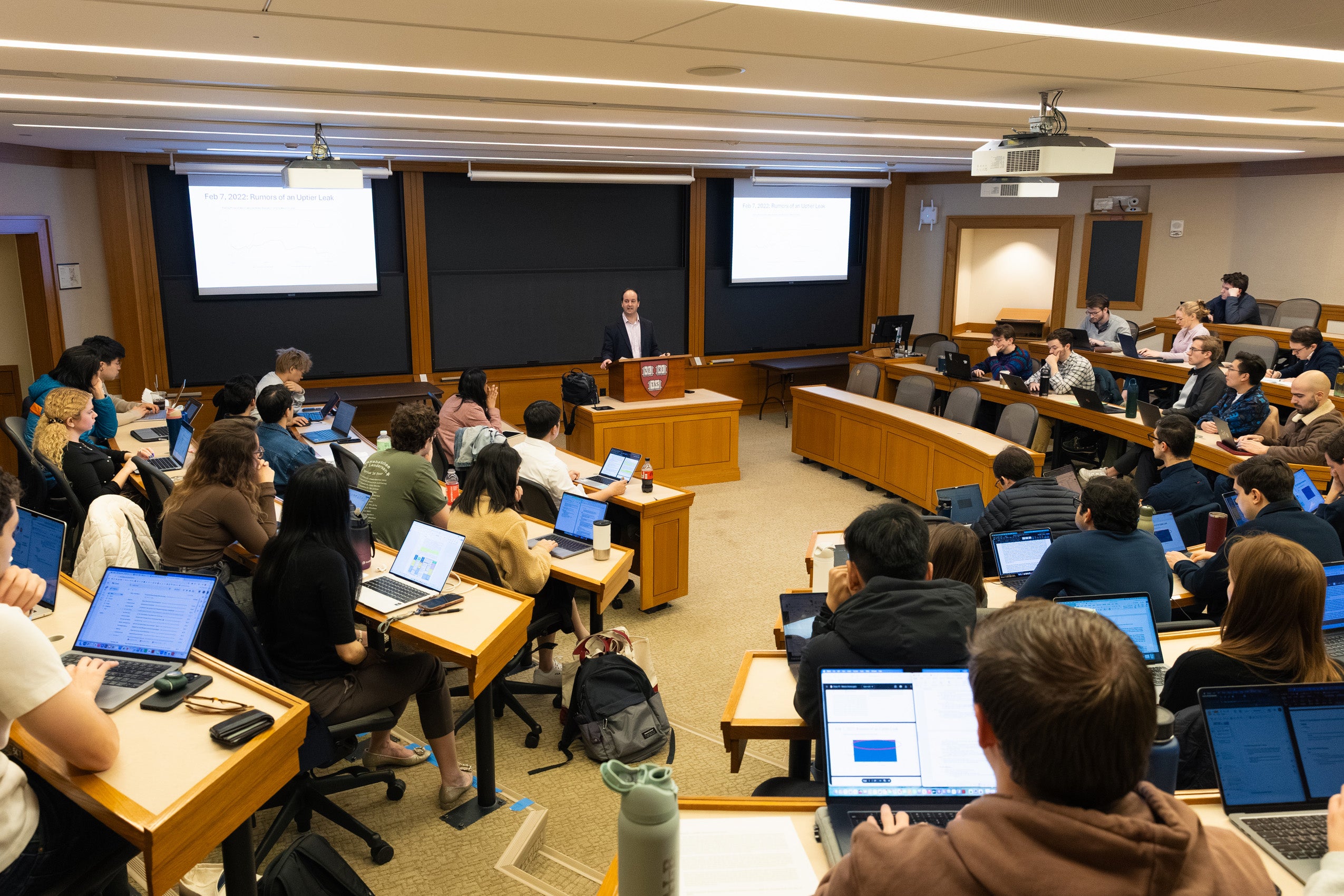
“We have many students who are interested in becoming debtor, creditor, or bankruptcy lawyers, or who want to represent lenders. We also have students going to work at hedge funds or as investment bankers,” Ellias says. “All of those roles are ones in which you’d benefit from taking this class.”
As a former investment banking analyst, Annabelle Hutchinson ’26 used to work on deals that involved large amounts of debt. She was interested in Ellias’ course, she says, because it “sits at the center of an untidy collection of legal doctrines which clash in dramatic ways when businesses start to degenerate, and it is one of the most exciting areas of the law to explore for students interested in corporate matters.”
Hutchinson says the class ended up being her favorite at Harvard Law—and her favorite course in business, period—thanks to Ellias’ “phenomenal teaching” and approach, which mixes case law with practice-oriented exercises, like reading and discussing real credit agreements.
The course is also au courant, Hutchinson adds.
“Open up The Wall Street Journal or play your favorite business podcast, and there’s a solid chance you’ll find something about liability management or the cases that we covered,” she says. “It is one of those things that you don’t notice until you are introduced to the field but then crops up everywhere you look.”
That timeliness is evident in the custom casebook that Ellias created for the class, which “reflects the volume of good judicial opinions from great judges tackling interesting recent debt transactions,” he says.
But while most of the cases his students read are contemporary, Ellias says that the legal conflicts at the heart of these disputes are often much older.
“These same questions recur time and time again,” he says, adding that he included at least one decision from the late 19th century. “What should courts do to help minority creditors who are taken advantage of by shareholders or by majority creditors? What should the law do to help creditors when things go wrong? These are things we’re still debating.”
Beyond harm to individual creditors who may lose out, Ellias says these newly popular restructuring tactics can have other, broader downsides. His students also learn how restructuring runs the risk of enabling moribund companies to “limp along forever,” neither thriving nor completely failing.
“One of the main worries is that companies aren’t restructuring quickly and deeply enough—that they are just forestalling bankruptcy,” Ellias says, adding that it’s also not entirely clear what impact hundreds of these “zombie” companies could have on the economy in a downturn.
What is certain, however, is that troubled businesses increasingly prefer non-bankruptcy financial restructuring options, he says.
That makes courses like his especially critical, he argues, for law schools like Harvard “that are serious about training students to represent lenders and debt investors, and to represent distressed companies, in the future.”
Law students need to be prepared to explore all options for their clients, Ellias says, because ultimately, the goal is the same: “We want these companies to be in a position to succeed in their business, to be an attractive employer, and to be competitive again.”