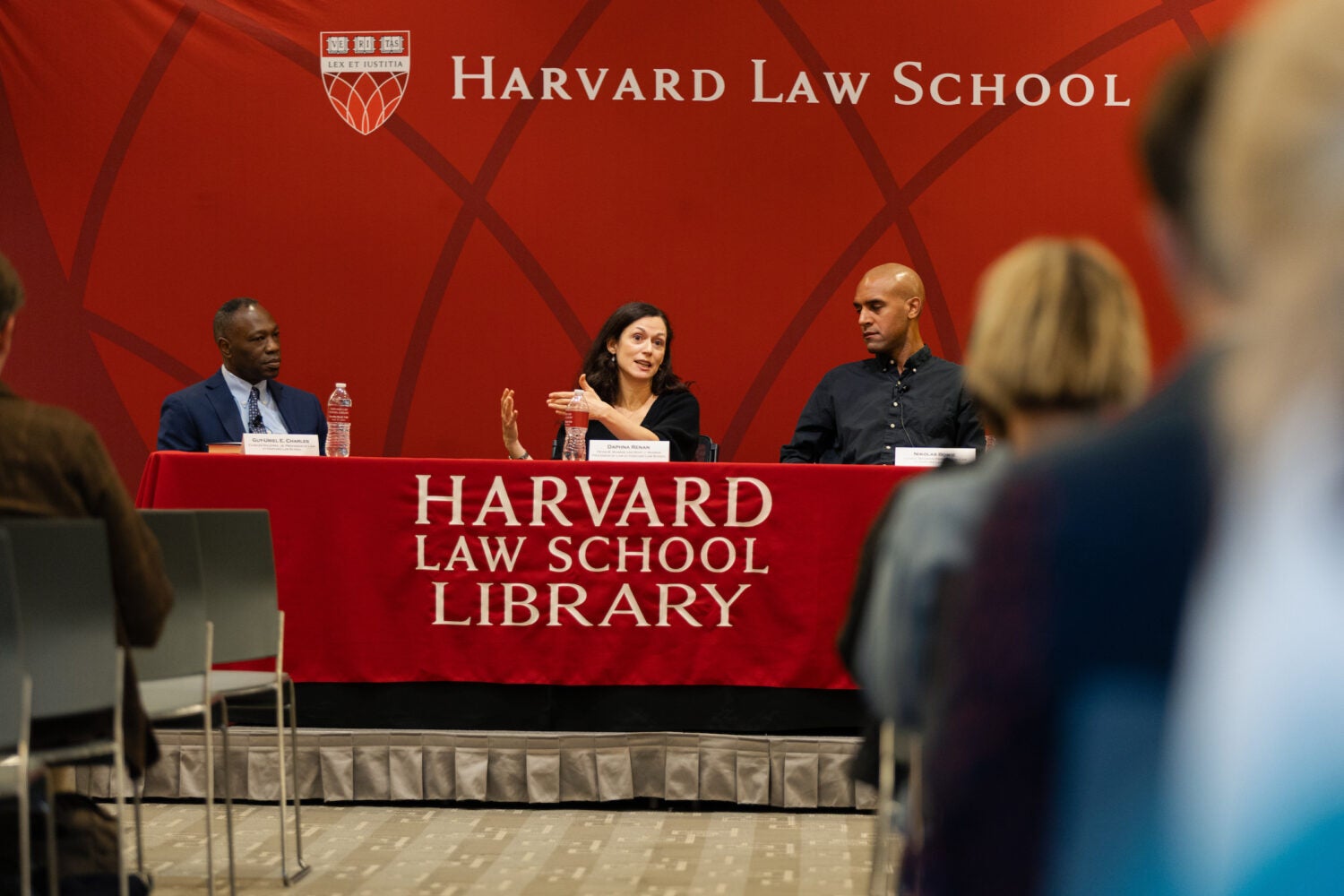
If you subscribe to the conventional wisdom that the U.S. Supreme Court is the ultimate preserver of democracy, you may need to think again, say Harvard Law Professors Daphna Renan and Nikolas Bowie ’14. They make an opposing argument in their new book “Supremacy: How Rule by the Court Replaced Government by the People.”
In a book talk on Oct. 5, 2026, the authors made their case that “judicial supremacy” has run counter to the American constitutional ideal of government by the people. And they offered as an alternative the concept of “democratic constitutionalism,” which interprets the Constitution through federal statute and civic activism, and dates back to the abolitionist movement.
As pointed out at the outset by moderator Guy-Uriel E. Charles, the Charles Ogletree Jr. Professor of Law and faculty director of the Charles Hamilton Houston Institute for Race & Justice, these two “young guns” of academic scholarship are challenging a lot of prevailing legal thought, including some of his own.
“I was trained in law school, especially as a person who cared about civil rights, to think about the role of the Court … [I thought that] everything that’s good in the world — apple pie, vanilla ice cream, all of it — is the Court and judicial supremacy. And so, as I was working my way through this book, I also had to work my way through everything that most of us were taught.”
The Supreme Court’s power over democracy
Bowie, the Louis D. Brandeis Professor of Law, replied that current history alone is enough to challenge that view. He said the nation is approaching the fall midterm elections without the stability of dozens of laws that citizens voted for and that Congress enacted — including the Affordable Care Act, the Voting Rights Act, and various gun laws.
This is playing out, he said, without the prospect of a legislative veto over presidential misconduct, and without the campaign finance laws in force that Congress has passed since the early 20th century to limit the influence of the vastly wealthy in elections.
“For each of these laws,” he said, “five or six or seven justices have claimed the power to disagree with these laws, and therefore in effect defy them.”
Still, he said, the situation is not unique to the present day, since early antislavery efforts were undermined by the Dred Scott v. Sandford decision in 1857.
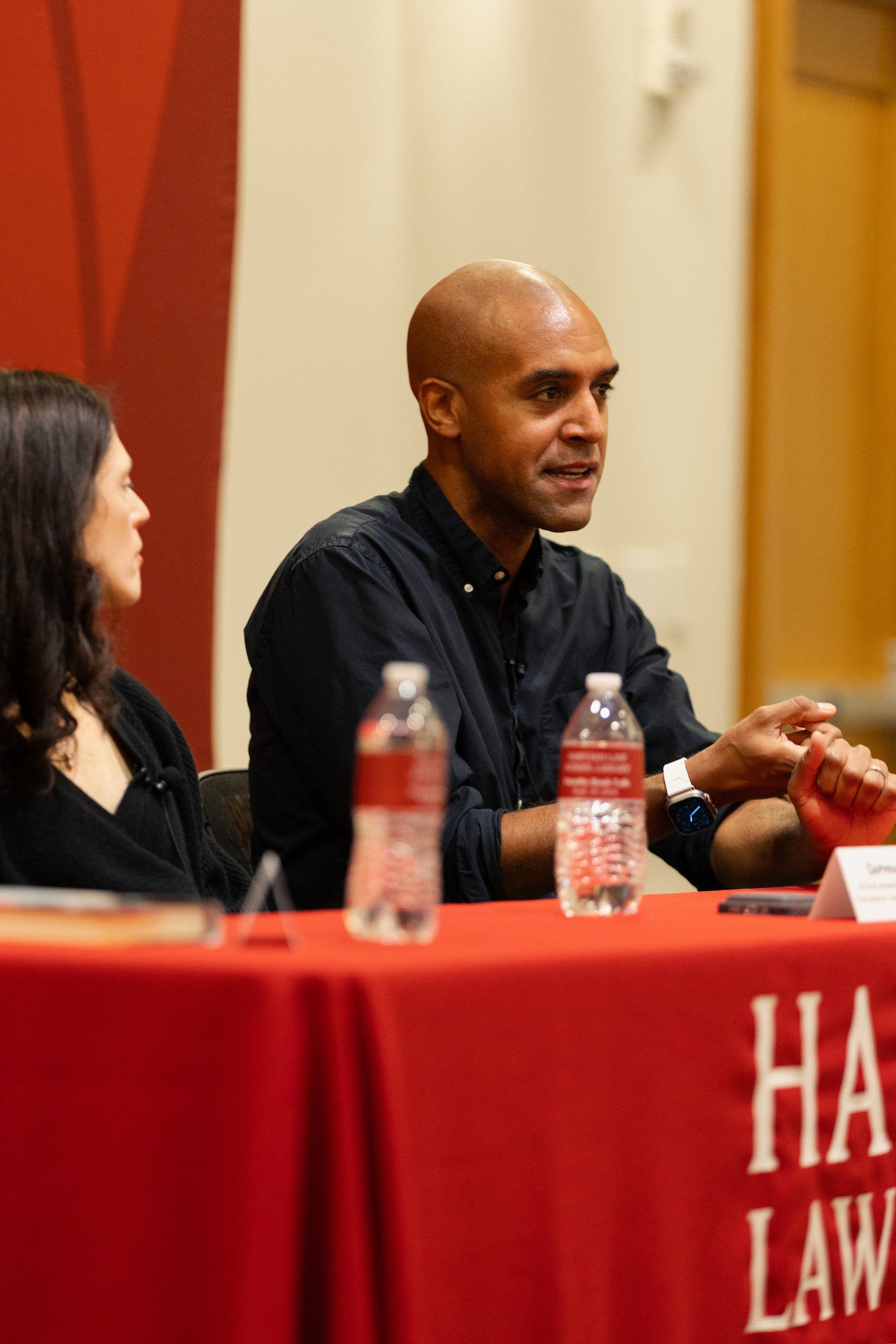
Renan, the Peter B. Munroe and Mary J. Munroe Professor of Law, expanded on the slavery debate that began well before the Civil War. Pro-slavery factions thought the Dred Scott case settled the question, while abolitionists said that the Constitution was a pro-slavery document and wanted to throw it out.
“Democratic constitutionalists” such as abolitionists Gerrit Smith and Frederick Douglass offered a different vision. “There is an interpretation that the Supreme Court has put on the document, but that is not what the document means. We through our organizing and where possible our voting … can turn it into an antislavery document.”
The ultimate result, she suggested, was the first civil rights legislation during Reconstruction.
The Voting Rights Act: Challenging the ‘will of the majority’
Renan cited the history of the Voting Rights Act as one case where a popular movement was undermined by the judiciary. “It’s a statute that a generation marched to, to put the promise of the 15th Amendment into federal law.” Yet its protection against voting discrimination was weakened by Court decisions in 2013 and again in the most recent term.
“And so, the law can no longer do what it was enacted to do … [That’s] supremacy because it puts the preferred interpretation of a majority of the justices above any law the people can elect their representatives to enact. It doesn’t matter how misguided, how problematic, maybe even how dangerous the Court’s interpretation of the Constitution is.”
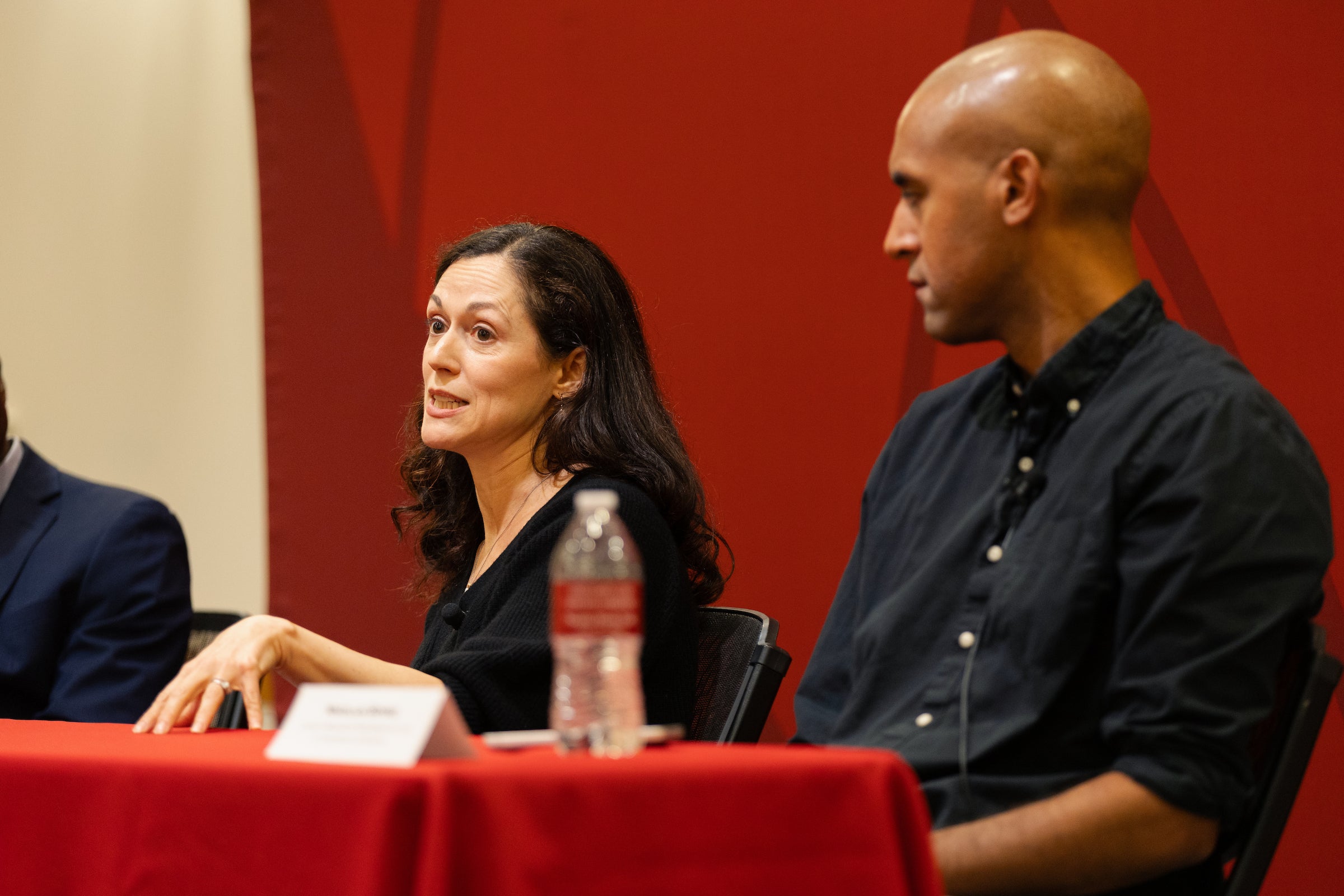
Bowie further said that the Supreme Court has consistently been committed to the rights of a particular minority, namely the wealthy. He quoted Associate Justice Davis J. Brewer, who said in the late 19th century that the Court was protecting property owners against the will of the majority — the will to tax them, regulate them or “otherwise make them treat other people as equals.”
Even today, Bowie said, judicial supremacy can challenge the will of the majority. “When the Court treats a different minority as the one to be respected — the billionaires who want to spend all the money, or the presidents who want to go to war in contrast to what federal law authorizes, then everyone else is stuck with nowhere to go.”
Reimagining who interprets the Constitution
The authors stressed that they didn’t write their book simply to examine history. They wrote “this book so that all of you, and people outside of HLS, feel empowered,” said Renan. “The Constitution is what people make it through making our politics and our Congress functional and representative, and doing the hard work of enacting the laws that we think are necessary to build a robust multiracial democracy that builds a just political economy, that limits the role of big money in elections … We offer that vision to all of you.”
Bowie recalled his own studies at Harvard Law, and the weight that was given to arguing before the Supreme Court. “Every class I took … [made me think] at the time, ‘What would Justice [Anthony] Kennedy think?’ Frankly, that’s just a weird way of understanding a democracy.” The Constitution, he said, should belong to everyone.
“We cannot move in this direction if the Court has a veto over every single law or interpretation of the Constitution we can offer. It’s only by taking that veto away that it’s possible to even imagine a different way of living under a Constitution,” rather than “what the swing justice on the current Court believes.”
Want to stay up to date with Harvard Law Today? Sign up for our weekly newsletter.