The Declaration of Independence, signed 250 years ago, has many of the hallmarks of a legal complaint, said Harvard Law School’s Morgan and Helen Chu Dean and Professor of Law John C.P. Goldberg.
There is an allegation of wrongdoing — tyranny — on behalf of complainants (certain colonists) and even a proposed remedy: recognition as an independent nation. Goldberg said that the document’s similarities with a lawsuit are no surprise: Its principal drafter, Thomas Jefferson, had served as a legal apprentice, a position comprised mostly of copying complaints.
“Jefferson copied a lot of complaints, including complaints against English officials alleging that they had violated the rights of English citizens or colonists,” Goldberg said. “He even used words like ‘tortfeasor,’ my favorite word.”
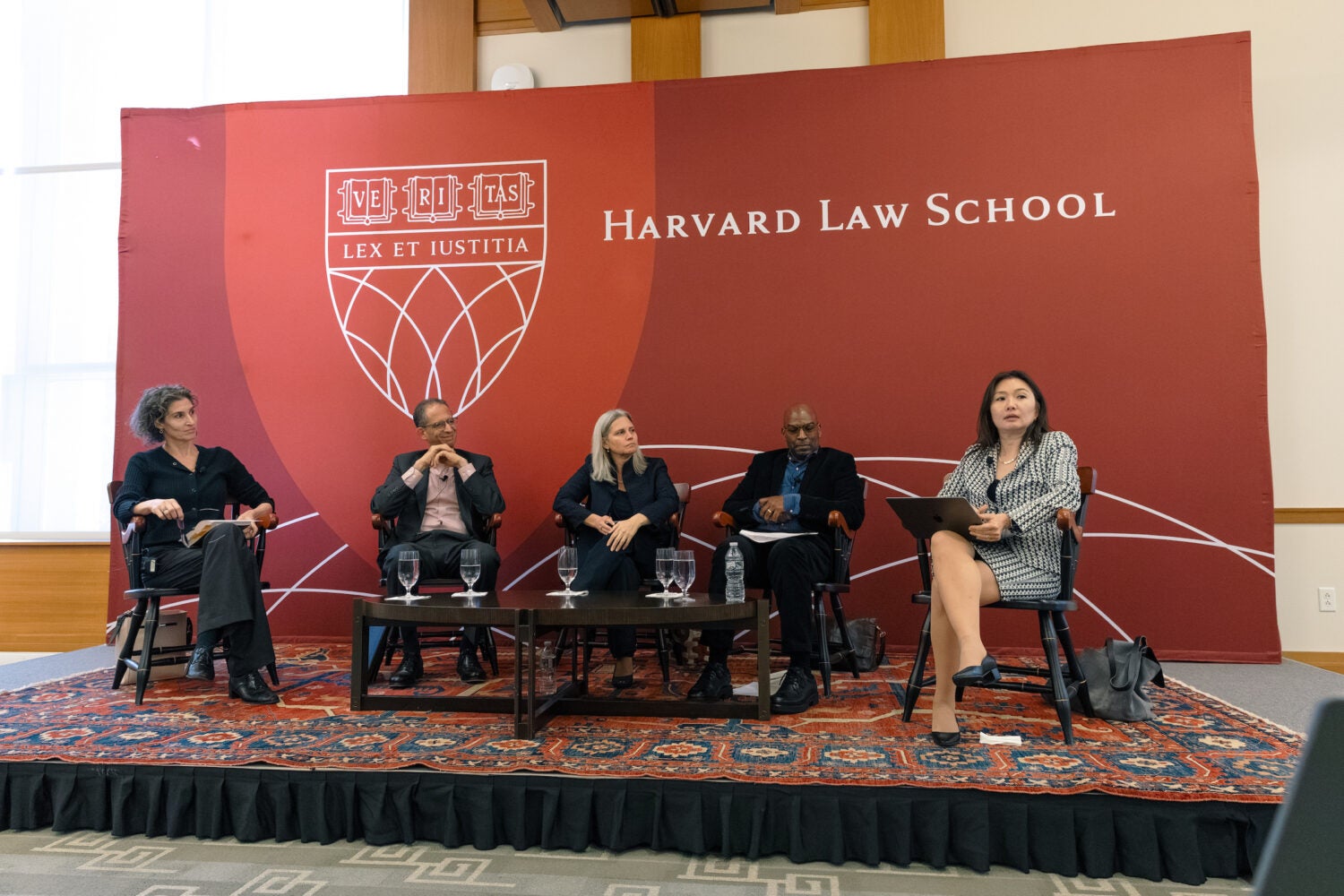
But what role do legal complaints — and the law more generally — serve in American democracy today? Those were some of the questions animating “The American Experiment at 250: Democracy and Legal Theory after 250 Years,” a panel discussion hosted by the Dean’s Office. Goldberg was joined in the conversation by John H. Watson, Jr. Professor of Law Jeannie Suk Gersen ’02; Lawrence D. Biele Professor of Law Kenneth W. Mack ’91; and Clinical Professor of Law Rachel A. Viscomi ’01. The panel, part of a series of events marking the 250th anniversary of the Declaration of Independence, was moderated by Lee S. Kreindler Professor of Law Alexandra Natapoff.
The discussion was prompted in part by publication of “America Unfinished: 250 Years of Law and Governance,” a collection of more than 60 essays from Harvard Law School faculty co-edited by Natapoff and Charles Ogletree Jr. Professor of Law Guy-Uriel E. Charles. The book and the Nov. 16 panel sought to address “what it is we should be grappling with at this moment in our legal governance, structure, and in our democracy,” explained Natapoff, a former assistant federal public defender and an award-winning legal scholar and criminal justice expert.

Goldberg — citing the late, longtime Harvard Law School Dean Roscoe Pound and the sociologist Max Weber — said he argues in his essay that the legal complaint serves an important role in a modern liberal democracy.
“A lot of what modern life is about is rationalization, bureaucratization, mass society, the loss of the individual, for better or worse,” he said. “One of the things that complaints do … is they are moments when individuals assert themselves and are empowered to assert themselves … to say, you know what, what happens to me, one person … matters.”
From individual rights to collective responsibility
Viscomi directs the Harvard Negotiation & Mediation Clinical Program, including the Dispute Systems Design Clinic, which helps communities and organizations create systems to address conflict more effectively and equitably. She agreed with Goldberg that the Declaration of Independence reads like a lawsuit and served an emerging nation well at the time of its founding.
But today’s world calls for different strategies, she said.
Viscomi compared America at its founding to teenagers asserting independence from parents.
“That was perfect for that moment,” she said. “And that moment looks really different from this moment … the task of an adult is really not to individuate in that way but to be really conscious of the ways in which one’s behavior has impact on other people.”
In an increasingly interconnected world, a narrow focus on individuality and independence is “self-defeating folly,” she said. What’s needed instead is an expansive view of whose rights need protecting.
“In your garden variety case, a lot of what you’re doing is carving things away,” she said. “Who has standing? Whose views are relevant? Whose experiences are relevant? … When we’re doing systems work, we’re really drawing a much broader lens… what stakeholders might be affected…whose voices are we not hearing and why?… If we move away from a grievance-focused lens…what does it look like for us to recognize that we’re a part of all of the systems that we exist within?”

Who belongs in American democracy?
Mack described his essay, “What Is America?” as an examination of questions that have arisen time and again in the country’s history: Who belongs and who counts? The answers to the questions have evolved — and continue to evolve to this day: Mack cited essays from Benjamin Franklin, decades apart, that took opposing positions about the role of immigrants in the United States; the efforts by free Black citizens to push the country from the Dred Scott decision to passage of the 14th Amendment; and the recent U.S. Supreme Court decision blocking President Trump’s attempt to end birthright citizenship. But at every asking, the stakes are high.
“America would be a very different country if those questions had been answered a different way,” he said. “If they are answered in a certain way in the present, America will be a different country going forward.”
Gersen, a contributing writer to the New Yorker who has taught and written in a variety of areas, including sexual assault and domestic violence, drew back from specific cases and laws to offer a bigger-picture view. She noted that the Declaration of Independence cited authority from “the Laws of Nature and Nature’s God” and that the U.S. Constitution a decade later instead offered “we the people” as the relevant power.
“Does the fundamental law of our country come from we the people who created it or, does it come from, as the Declaration said, nature and nature’s god?” she asked.

Over history, appealing to morality and natural law has been effective for expanding rights and freedoms, she said, despite conservatives’ often successful efforts to use that framework to restrict rights for women or queer people or other marginalized members of society.
The 250th anniversary “should be an occasion to reclaim arguments about natural law principles of equality and liberty that underpin the legal tradition going back to the Declaration of Independence,” she said. “Over the long haul, if you look at the time that we’ve had as a country, I think we’ve fared pretty well in reading the Constitution in light of high principles of fundamental justice as opposed to thinking that what we can do is look at the words of the Constitution and limit ourselves to what those words say.”
When the rule of law falls short
Natapoff opened up the Q&A portion of the discussion by asking how the rule of law features in existential questions about democracy.
Gersen answered with one of the greatest failures of rule of law in history: the Holocaust.
“One of the most provocative debates in legal theory in the 20th century is that the Nazi regime was entirely done through lawful means, if you think of it as positive law,” Gersen said. “Of course, we think of that regime as entirely lawless and not in keeping with the rule of law because of the actual ends that it was trying to, and did, accomplish.”
Using a legal system to pass laws allowing immoral actions is an inherent problem with the rule of law, Gersen said. “Moral principles and natural law are going to have to do the work.”
Natapoff wrapped up the discussion with a call to action for the future lawyers in the room.
“One response to legal injustice is to become the kind of lawyer who … can look at a law and see where the thumb has been placed on the scale,” she said. “It’s not enough to just know what the law is,” she added. A good lawyer must “read its contributions or its injustices.”
Want to stay up to date with Harvard Law Today? Sign up for our weekly newsletter.