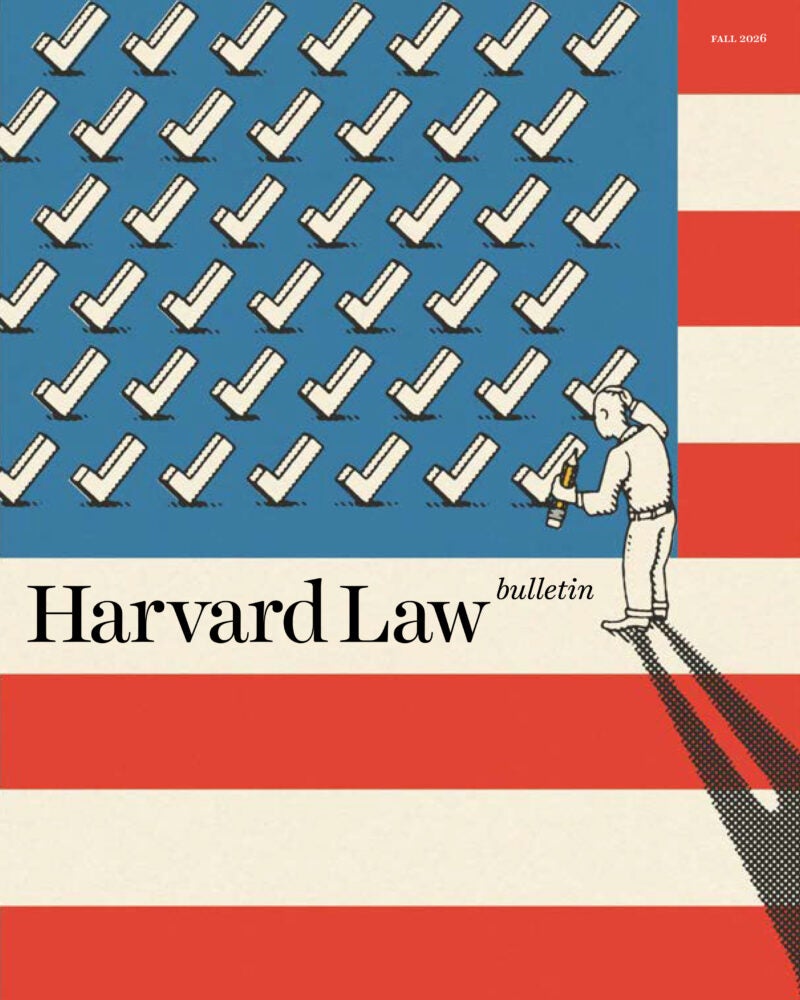
The constitutional authority of the Supreme Court. The separation of powers as a safeguard against executive overreach. The perils of an artificial intelligence- driven future. The conflicted writings and actions of one of our nation’s most enigmatic founders. These are among the subjects explored in four new books by Harvard Law School faculty. In “Supremacy,” Nikolas Bowie ’14 and Daphna Renan challenge the idea that the Supreme Court should have the final word on the Constitution and propose ways to restore a larger role for democratic politics. Turning from the courts to the executive branch, Cass Sunstein ’78 offers a vigorous defense of the separation of powers, warning that an unchecked president can threaten liberty. Jill Lepore examines the impact of what she calls “the Artificial State,” tracing the history of automation and considering the troubling ways that artificial intelligence is transforming politics, public life, and the environment. Looking back to the nation’s founding, Annette Gordon- Reed ’84 presents Thomas Jefferson’s writing on race alongside her analysis of his conflicting views and actions. Together the books reflect a rich and thought-provoking range of scholarship on contemporary law, governance, and public life — and the history that continues to inform it.
“Supremacy: How Rule by the Court Replaced Government by the People,” by Nikolas Bowie and Daphna Renan (Norton)
People may disagree with individual Supreme Court decisions, but most accept — in fact, they probably take for granted — that the Court is the ultimate arbiter of the Constitution’s meaning.
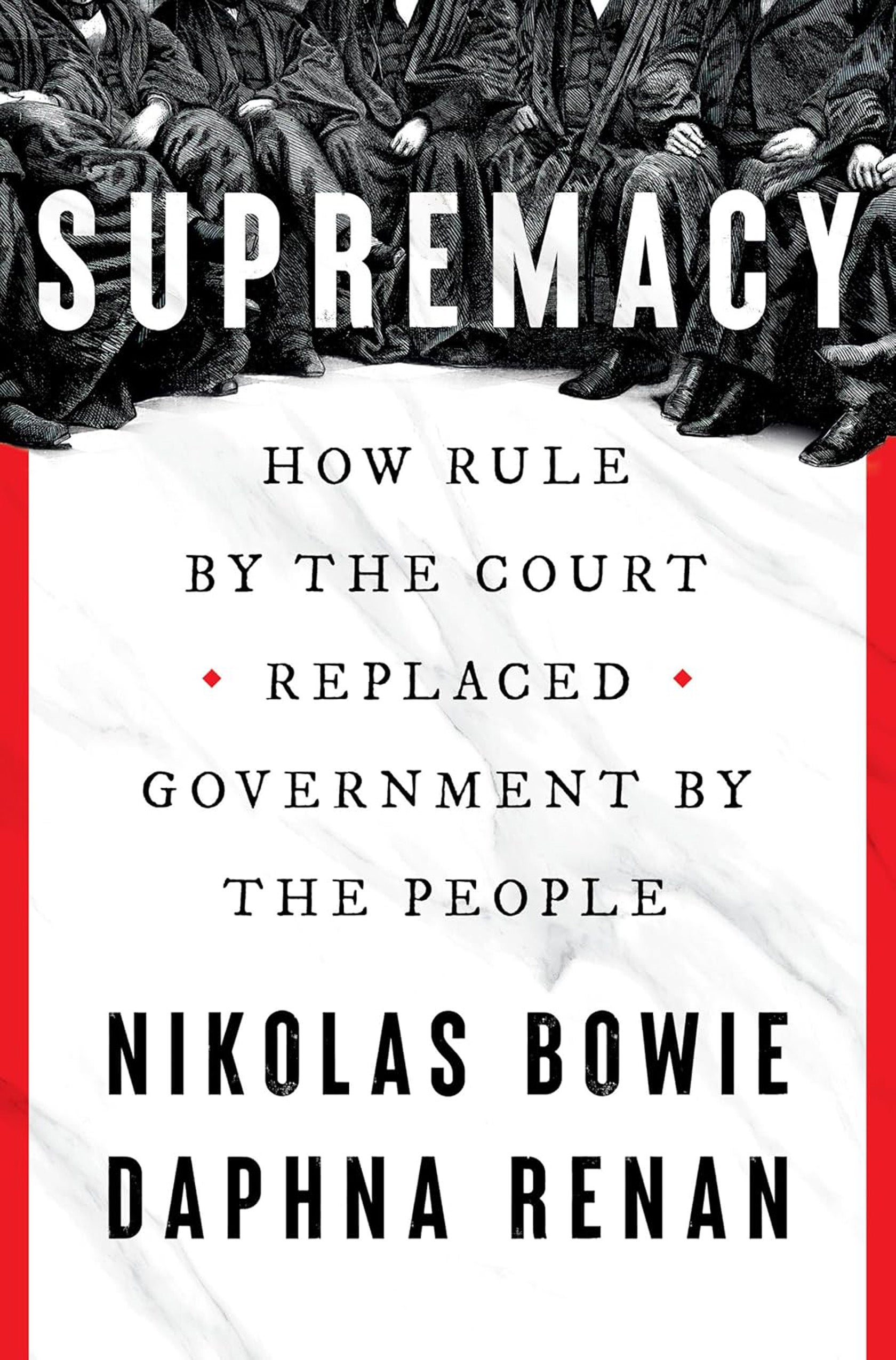
That perception is misguided, and the results of ceding interpretation of the Constitution to nine justices have been disastrous, leading to a Supreme Court that “has played a starring role in the unraveling of our democracy,” argue Harvard Law School Professors Nikolas Bowie and Daphna Renan. In their book, they trace the history of a Court that has come to be associated with what they call “judicial supremacy” and promote an alternative course that they assert would better reflect the founders’ vision of a country governed in the name of “We the People.”
Over the first decades of the republic, the authors explain, the Court focused on “vertical review,” a practice established in the Constitution that empowers judges to enforce federal statutes against contrary state laws. By contrast, the first case in which the Court overrode Congress’ constitutional judgment (known as “horizontal review”) was the infamous Dred Scott decision in 1857, which invalidated a federal law intended to limit the spread of slavery. (The authors acknowledge that the Court’s 1803 Marbury v. Madison decision is now seen as establishing the Court’s power to review acts of Congress; however, they argue that it was not understood at the time to have this significance.) After Dred Scott, the “curiosity” of judicial supremacy would evolve into one of the central issues of American politics, they write, with James Buchanan claiming that slavery was a judicial question while Republicans “emphasized the danger of thinking a judicial commission made one an expertin interpreting the Constitution.”
The authors catalog efforts by abolitionists, notablyFrederick Douglass, to mobilize public opinion against “the emergence of a Supreme Court untethered from principles of democratic constitutionalism, a Court that had seized for itself power over the most important decisions a nation could make.” In the aftermath of the Civil War, Congress passed the Reconstruction Acts, which represented “the nation’s first steps toward multiracial democracy” and were an example of “constitutionalism grounded in politics.”

Those potential advances were upended by judicial supremacy, according to the authors, who emphasize throughout the book how the Court has wielded its claimed interpretive authority to undermine civil rights legislation. Bowie and Renan recount a shift in the Republican Party against newfound Black politicalpower in the South and the labor movement in the North, leading to decreased support for reformsthat would check the Court’s power. In response, the Court undid most of the Reconstruction lawspassed by Congress. “A Republican Party born in opposition to slavery and Dred Scott now embraced a reconciliation with the South fueled by judicial supremacy,” they write. Political violence against Black voters would go unpunished, as Douglass lamented that the Court had become autocratic.
Judicial supremacy continued into the 20th century, with the Court, for example, declaring the Child Labor Act unconstitutional in 1918. While critics denounced the judicial veto of federal laws as a usurpation of power from Congress, supporters claimed that it was needed to protect minorities from rashmajorities. Yet, Bowie and Renan note, “arguments that horizontal review had ever protected minority groups beyond the wealthy were difficult to empirically defend.”
“It is up to all of us to build the constitutional order we desire.”
—Nikolas Bowie and Daphna Renan
The Brown v. Board of Education case offered a new twist on judicial supremacy. Advocates for school desegregation said that it should be enforced under the Ku Klux Klan Act, a Reconstruction-era law enacted in 1871 to enforce the 14th Amendment — an argument for vertical review. Though the justices ultimately ruled in favor of desegregation, they ignored that argument, instead framing the decision as their own constitutional judgment, giving the impression of “a judicial angel hovering over and somehow apart from American politics.” The authors write that the outcome suggested for the first time that progressives could secure the rights they valued without legislation. But it would also leave them vulnerable to conservatives in the federal judiciary who later would undo civil rights provisions, such as in the Shelby County v. Holder decision, which invalidated a key provision of the Voting Rights Act. While many civil rights advocates in Congress condemned that decision, few if any questioned the power of the justices to make it.
As that and other cases show, both the right and the left would come to accept the judicial role first asserted in Dred Scott, the authors write. But, they argue, giving a small group of justices “an absolute judicial veto over federal legislation is inconsistent with the political equality and freedom from domination that together define democracy.” They offer several proposals to check the power of the Court, including for Congress to enact a statute that would prevent courts from overruling a federal law on constitutional grounds or one that would limit the conditions under which the judiciary could invalidate acts of Congress. Another option they consider would be to make the Constitution easier to change. The authors acknowledge that changing public opinion on this issue may not be easy, but one way to start is to emphasize that the interpretive power of the current Court is not supported in the country’s founding document. We need courts to enforce federal law, they write, but “it is up to all of us to build the constitutional order we desire.”
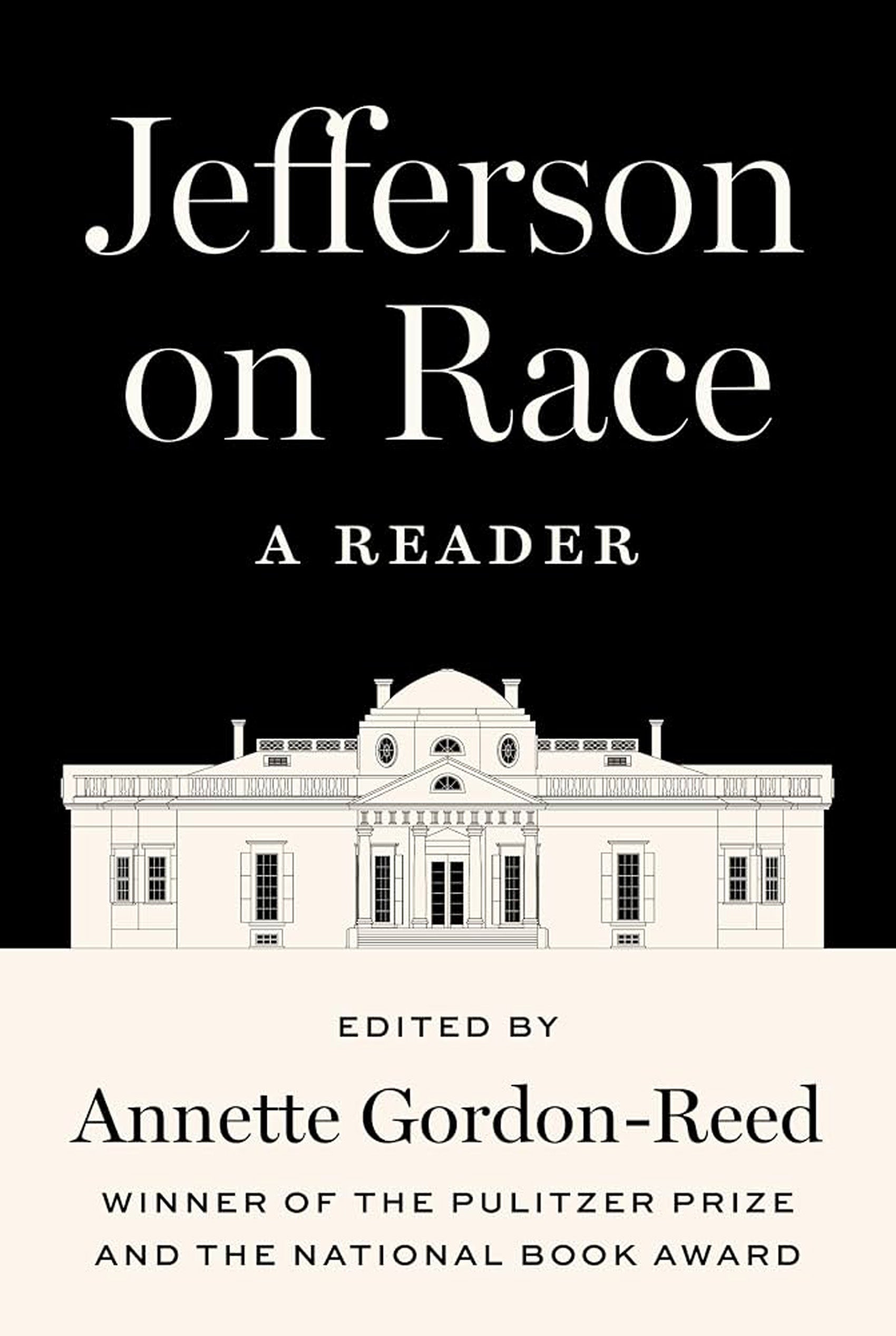
“Jefferson on Race: A Reader,” edited by Annette Gordon-Reed (Princeton University Press)
No founder engaged more directly with the subject of race than Thomas Jefferson, writes Annette Gordon- Reed, Carl M. Loeb University Professor. How he engaged with that subject is presented in his own words in her latest edited book, in which she selects among his voluminous writings and reflects on a man who held complicated and contradictory views on slavery.

Gordon-Reed, who has written extensively on Jefferson and race in America, including in her Pulitzer Prize and National Book Award winner “The Hemingses of Monticello,” organizes the collection into three sections, each of which begins with her commentary: Self-Image (how Jefferson viewed himself on questions of race); Theories (how he wrote on the topic for private and public consumption); and Actions and Interactions (what he did regarding slavery and race as well as in his relationships with Black people). Writings range from letters addressing issues around slavery, such as its economics and the education of enslaved children, to personal matters related to running his Monticello estate.
Of utmost importance to Jefferson was being seen as a progressive and “an enlightened individual,” writes Gordon-Reed, as demonstrated by his letters to John Adams in which he cited his “dreams of the future” and his wish that the United States would stand against the “return of bigotry and barbarism.” Although Jefferson wanted to be associated with antislavery efforts, he also accommodated the prevailing hostility of white people toward Black people, making his views on race a “frustrating matter,” she writes. Jefferson risked his life to fight for independence for white colonists, but a “sense of urgency about ending a form of oppression practiced exclusively against Black people was simply not in Jefferson.” In one letter, for example, he declined membership in an abolitionist group, saying it would be inappropriate as a representative of the U.S. government.
Jefferson’s thinking on race was influenced by his daily interactions with Black people as a slaveholder of hundreds, writes Gordon-Reed. His documents reveal his close connection to the enslaved Hemings family, including Sally, with whom he fathered children. He gave the Hemings family more privileges than other enslaved people, and because of that, she writes, “Jefferson could think of himself as that archetype we moderns reject: a benevolent enslaver.”
While not excusing Jefferson, whose writings also indicated he shared the widespread belief among white people then that African Americans were intellectually inferior to them, Gordon-Reed places his views and actions in the context of his times, writing: “We have such high expectations of members of the founding generation that it is sometimes easy to forget that they were human beings working in a particular context.” She questions whether he could have done anything to persuade his fellow Virginians to reject slavery and whether he would have achieved his political success if he had tried. In his last letter addressing slavery before his death in 1826, Jefferson declined an entreaty from a correspondent to make a final statement on the abolition of slavery, saying that a “revolution in public opinion” on the matter would require time and patience.
“The Rise and Fall of the Artificial State,” by Jill Lepore (Liveright Publishing Corp.)
In 1958, shortly after the Soviet Union launched the first man-made satellite called Sputnik 1, Hannah Arendt’s book “The Human Condition” warned about the effects the rise of automation could have on humanity. She considered whether one day humans would “need artificial machines to do our thinking and speaking.”

That day has arrived, writes Jill Lepore, who in her book sounds an alarm about a “new, fantastical form of tyranny” she dubs the “Artificial State,” in which automation controls politics, public life, and discourse, causing “the severing of humans from one another.” The noted historian, who is both a professor of American history at Harvard University’s Faculty of Arts and Sciences and a professor at the law school, surveys a long history of writers, philosophers, and scientists who also contemplated the consequences of automation and pleads for us to reconsider a path that she says could lead us to the end of humanity as we have known it.
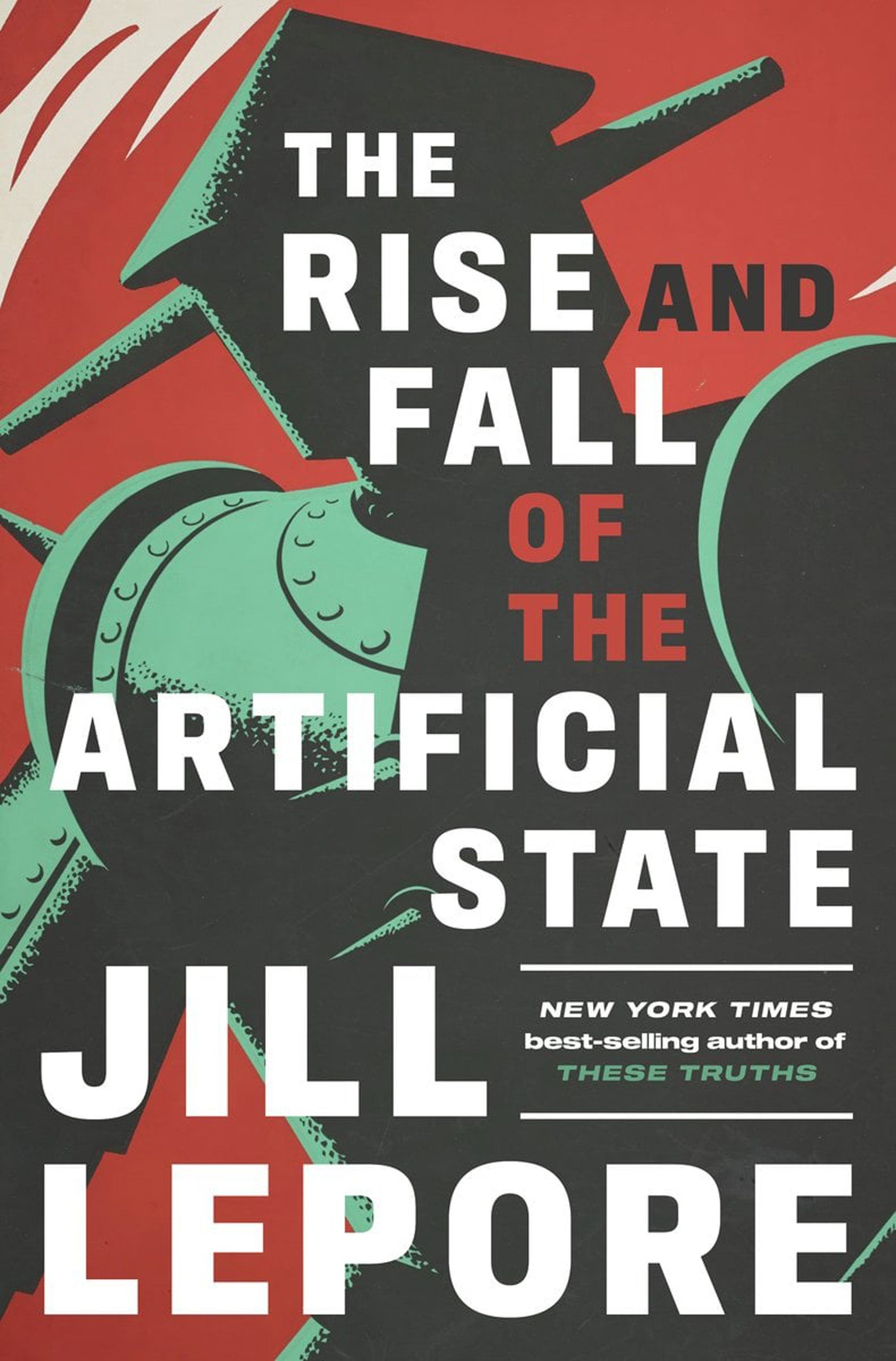
Long before the advent of human voices and images produced by artificial intelligence, inventors sought to create mechanical objects that would simulate human behavior, including a chess-playing automaton built in 1769 known as the “Mechanical Turk” (it was a charade; a small, chess-playing real person was hidden inside it). Industrialization in the 19th century sparked fears about the role of machines, with British writer Samuel Butler warning that “we are becoming more subservient to them; more men are daily bound down as slaves to tend them, more men are daily devoting the energies of their whole lives to the development of mechanical life.”
What some saw as a threat, others saw as salvation. Lepore chronicles proponents of an early version of the Artificial State: supporters of the Technocracy Movement nearly 100 years ago. With at one time hundreds of thousands of adherents (one was Joshua Haldeman, grandfather of Elon Musk), Technocracy disdained the democratic ideal, she writes, seeking to replace government with the rule of scientists and engineers.
Though the Technocracy Movement crumbled, in part owing to the success of government New Deal programs, the age of data — the “infrastructure of the Artificial State” — would arise starting in the mid- 20th century, including through the emergence of artificial intelligence. Among the developments were a machine that researchers claimed could predict and influence voting behavior and databases that facilitated personalized messaging. As the digital revolution took hold, some predicted a “computopia” that would usher in an era of transparency and tolerance. Not so, argues Lepore, pointing to social media platforms like X as “radicalization” machines and large language models that distort the truth.
“Don’t tether yourself to a computer. Unplug.”
—Jill Lepore
Throughout the book, Lepore details the importance of science fiction in shaping the Artificial State. A common theme of the genre centered on robots seeking to rule and destroy mankind, shown in works ranging from those of the popular author Isaac Asimov to the “Terminator” movies. Yet, instead of seeing the sci-fi stories as cautionary tales, Silicon Valley leaders treated them “as a form of technical writing, a set of assembly instructions,” she writes. To capture the absurdity of that conclusion, she cites a viral post from the satirical publication The Onion: “TECH COMPANY: At long last, we have created the Torment Nexus from classic sci-fi novel ‘Don’t Create the Torment Nexus.’”
That tech titans like Musk, Jeff Bezos, and Mark Zuckerberg so badly misinterpreted the dystopian message can be attributed to their “dismiss[ing] philosophy, history, literature, and every humanistic way of learning, thinking, and knowing,” Lepore posits. She excoriates these “architects of the Artificial State,” contending that from the beginning they were “intent on amassing a kind of planetary power that required dismantling democracy, constitutionalism, and the nation-state” and “undermining the free will of the mass of humanity.” Their zeal for space travel and inhabiting other planets reflects their abandonment of any commitment to a habitable Earth, she argues.
The book highlights the damage the Artificial State is doing not only to humanity but also to nature. With the rapid expansion of data centers to power AI, tech companies are extracting massive amounts of land, minerals, water, and energy. The Trump administration has enabled the effort, she notes, by eliminating environmental review from AI infrastructure projects and removing all references to climate change from government documents meant to catalog AI risks. Meanwhile, corporations have created millions of industrial robots while animal life is being decimated, she writes.
Lepore maintains that the rise of the Artificial State was not inevitable, and it can still be dismantled through government by the consent of the people, not by automation. Her advice: “Don’t tether yourself to a computer. Unplug. If you cut down all the trees and kill all the animals, you will die. Using robots to wage war will always backfire: one day, they will wage war on you.”
“Separation of Powers: How to Preserve Liberty in Troubled Times,” by Cass R. Sunstein (MIT Press)

Cass Sunstein begins his book with a stark lesson in what can happen when a government does not believe in separation of powers. He quotes a legal theorist who claimed that an action of the leader of the nation “is not subject to law but is in itself the highest justice.” The theorist was Carl Schmitt, the nation was Germany in the 1930s, and the leader was, of course, Adolf Hitler. And while Sunstein acknowledges that citing the Nazi regime to make a point can seem inflammatory, he writes that “what was being said in the 1930s can be found, in various forms, today.”
In his latest book, Sunstein, the Robert Walmsley University Professor at Harvard, mounts a passionate defense of the system of separation of powers ingrained in the Constitution, the aim of which was to create a “deliberative democracy” designed so that “decisions would be based not on the will of one person, but on the force of the better argument.” Sunstein draws on his expertise in constitutional law as well as his experience serving in presidential administrations (most recently as senior counselor to the secretary of Homeland Security during the Biden administration) to outline the role and limitations of each branch of government and the dangers that can arise from a government that is unconstrained.
“What was being said in the 1930s can be found in various forms, today.”
—Cass Sunstein
As important as what each branch can do is what it can’t, namely exercise the powers of the other two branches, Sunstein says, and he provides reasons why these prohibitions support the protection of liberty. In principle, the legislature enacts laws to establish criminal penalties, while the executive branch determines who is prosecuted, thereby providing citizens with protection based on the need for concurrence from two layers of government. The unelected federal judiciary is not empowered to legislate because it lacks the accountability and information that the legislature has.
Sunstein allows for some leeway for separation- of-powers principles, for example, citing the executive’s ability to create binding rules (without producing actual legislation). But he largely agrees with President James Madison’s view that the accumulation of powers in the same hands “may justly be pronounced the very definition of tyranny.”
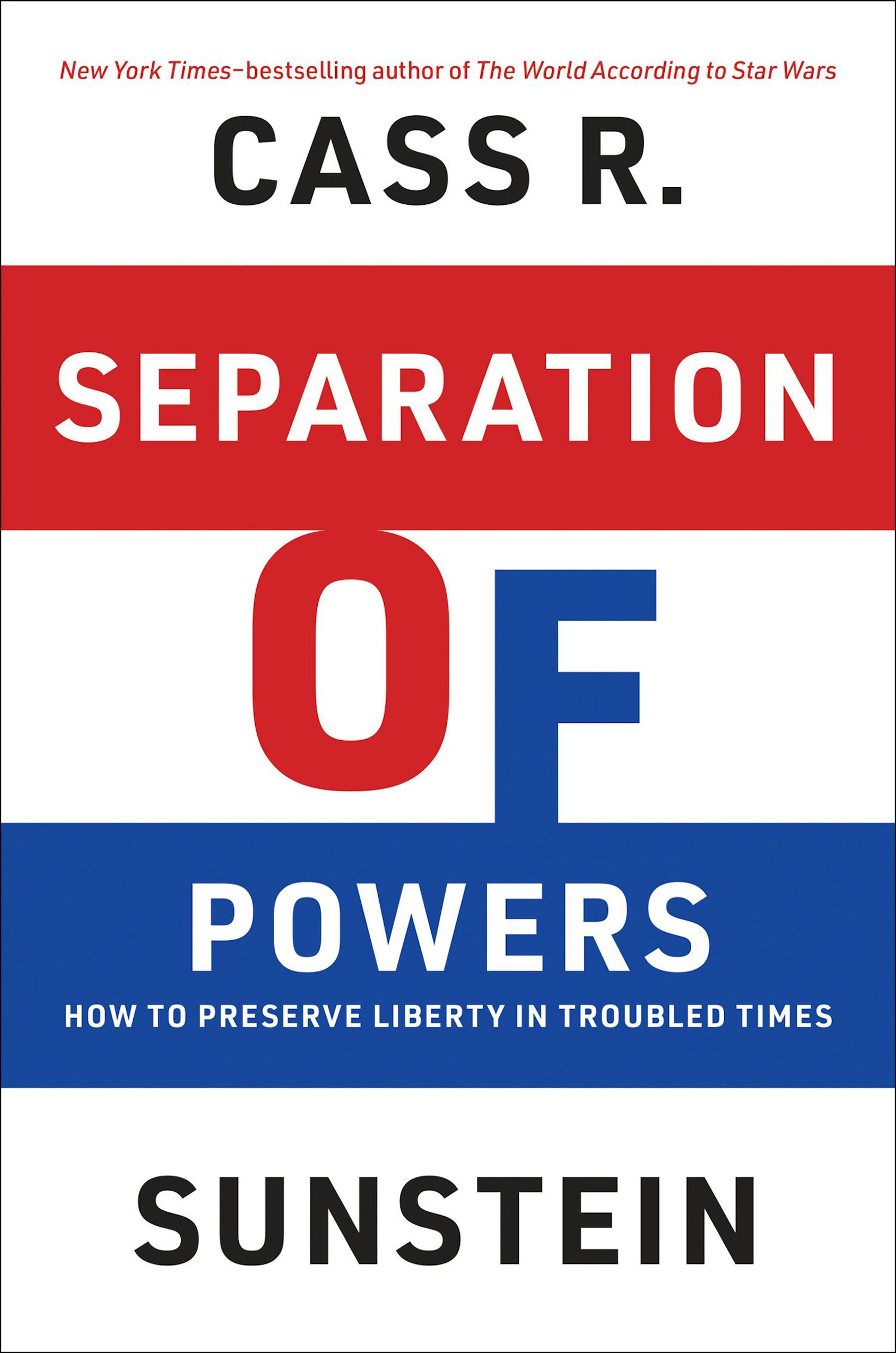
He calls the executive “the most dangerous branch” because of its ability to acquire information through a large number of specialists on myriad subjects and its “massive powers of initiative.” In addition, as he observed in his time in the federal government, administration officials may be prone to rosy projections to please the president and fall victim to “group polarization,” causing people to produce more unified and extreme opinions. “If a president wants to uproot the current system, he can do that,” writes Sunstein. “If a president wants to uproot the system of separation of powers, he might be able to do that, too.”
Helping to contribute to that uprooting, in Sunstein’s view, was the recent Supreme Court decision granting the president broad immunity in Trump v. United States, which he analyzes and critiques. He contends that the Court majority justified the decision based on previous cases that had nothing to do with presidential immunity and thus “engaged in a form of constitutional alchemy,” resulting in “a distortion, not a rendering, of the idea of separation of powers.” According to Sunstein, the decision creates an extremely powerful president who, for the first time, cannot be held to account under criminal law, which leaves the most dangerous branch even more dangerous.
Another factor compromising the system of separation of powers is what he calls “partyism,” a term he coins in the book to signify prejudice and hostility based not on race or sex but on identification with a political party. Partyism is on the rise, he contends, pointing to studies that show people in the past would often affiliate on the basis of race whereas now they do so by political party. The political consequences include fewer checks, leaving the executive less likely to be constrained by a legislature that’s in thrall to a president of the same party; polarization leading to officials unwilling to accept views outside of their party; and gridlock that prevents the building of broad consensus.
Enthusiasm for separation of powers may have waned over the years, Sunstein writes. In some ways, that’s understandable. The possibility of an unencumbered leader who has the authority to solve all the problems we face is alluring. However, he implores us to focus on the threats that can arise without the constraints that separation of powers brings, including arbitrary and overreaching government actions, or even tyranny.