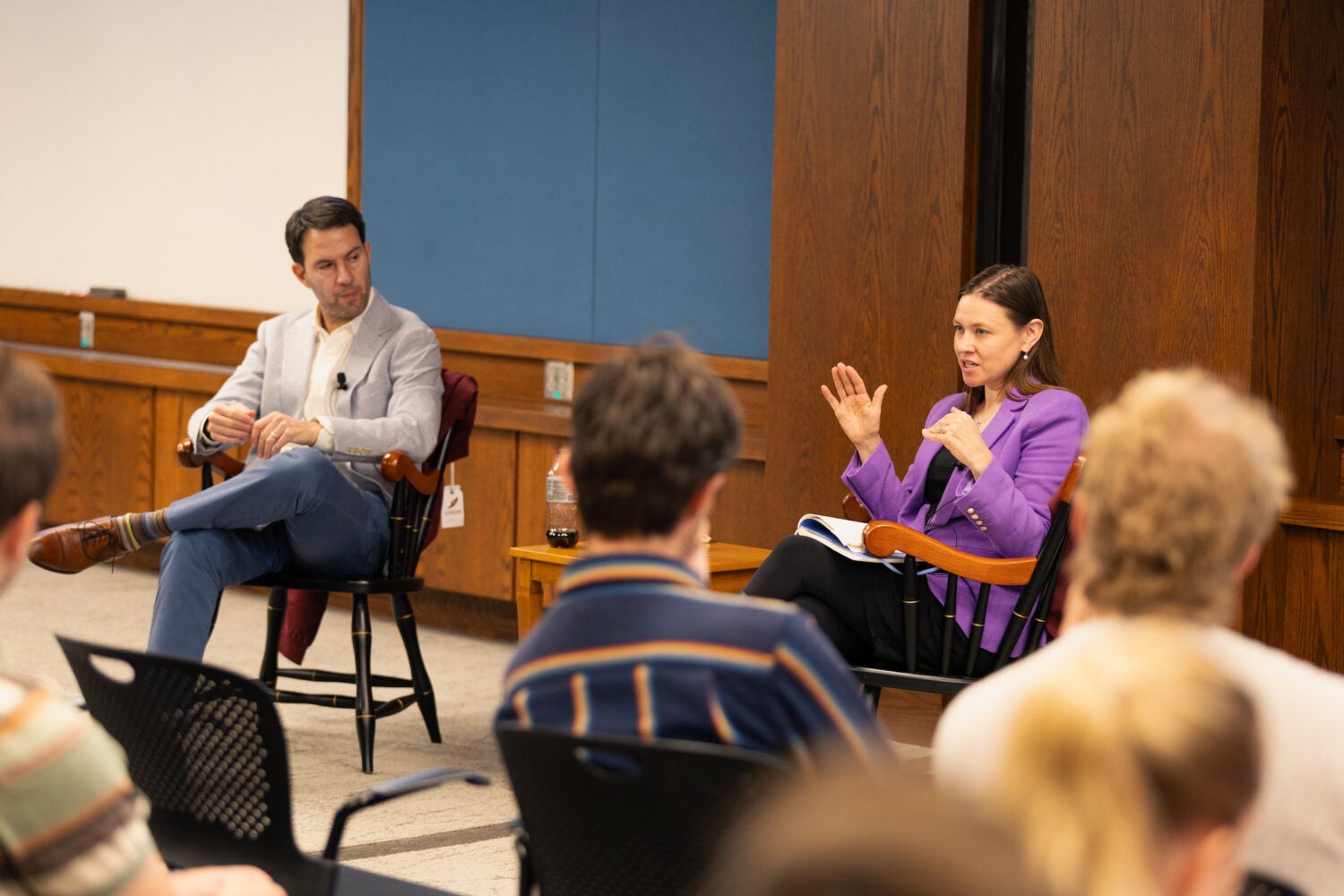
Despite a wave of state efforts to redraw congressional maps to gain partisan advantage in races across the United States, the practice’s overall effects on the upcoming midterm elections should be relatively muted, said Professor Nicholas O. Stephanopoulos.
“It now appears that we’re in a sufficiently lopsided electoral environment that it’s beyond the power of redistricting to affect,” said Stephanopoulos, the Kirkland & Ellis Professor of Law and director of strategy for Harvard Law School’s Election Law Clinic. “We’re looking at what polls expect to be something like a seven- or eight- or nine-point Democratic advantage … That’s a big enough advantage that an extra nine Republican seats are not going to be decisive.”
Still, neither Stephanopoulos nor Assistant Clinical Professor of Law Ruth Greenwood expect the partisan gerrymandering wars to wane.
“Wouldn’t it be nice if people learned that it would have been so much better to draw a fair plan than gerrymander?” Greenwood asked the audience. “I guarantee that is not what they will learn with this; they will learn how to draw a better gerrymander next time.”
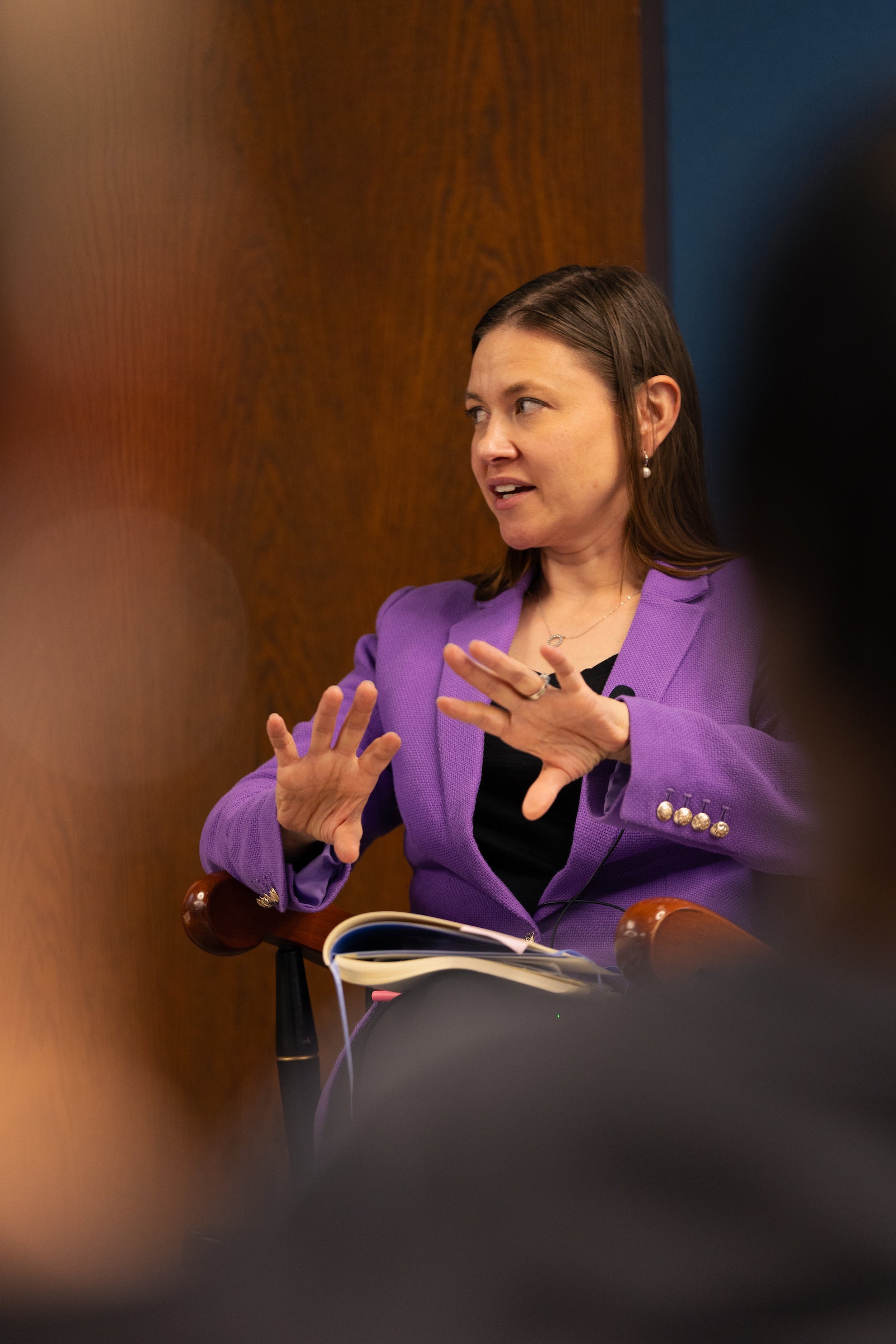
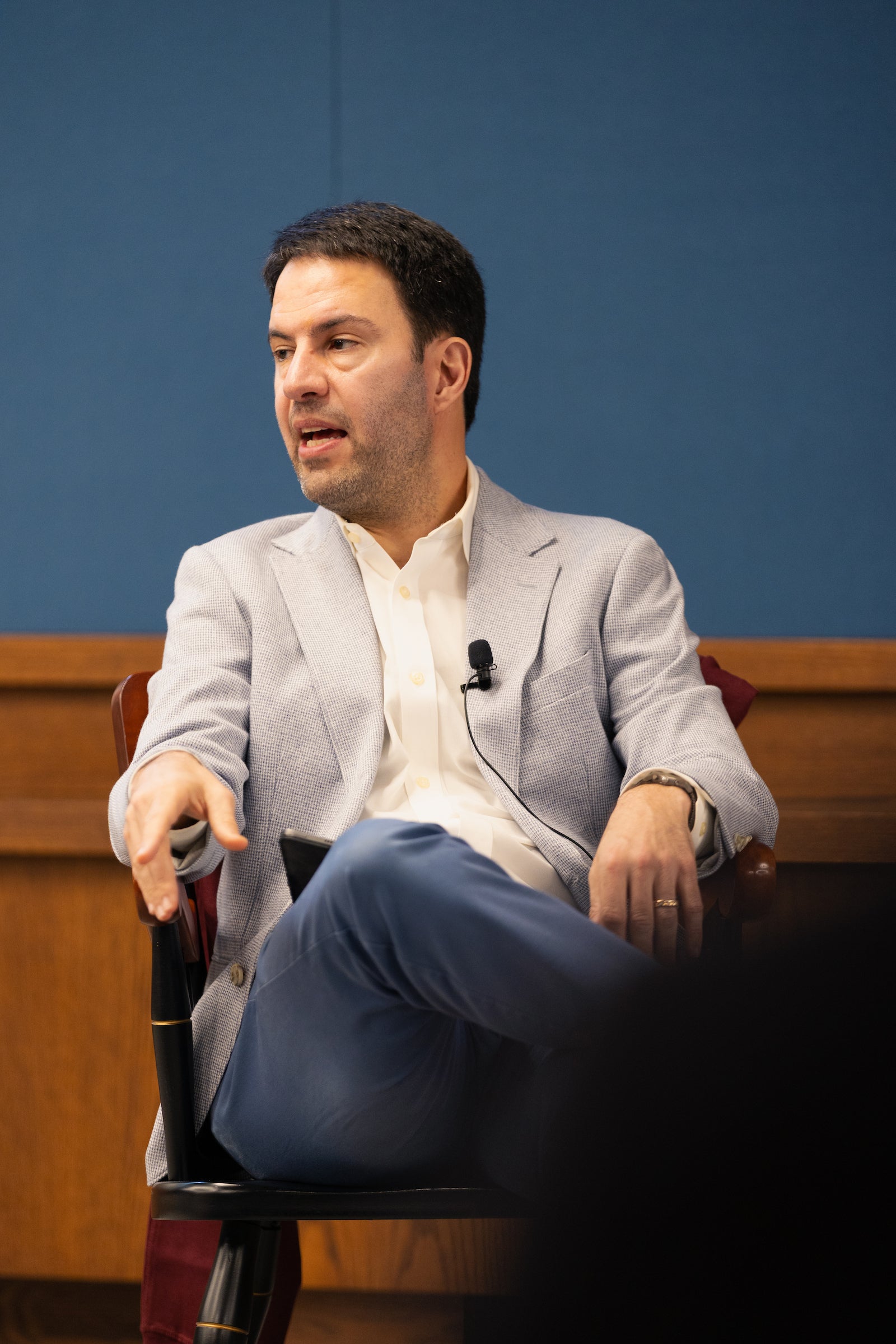
Stephanopoulos and Greenwood, who directs the clinic, spoke as part of an Oct. 5 event hosted by HLS Beyond examining the effects of gerrymandering on the midterms and on future election cycles. HLS Beyond is an initiative of the Harvard Law School Library.
Greenwood joked that the discussion was an extension of conversations she and Stephanopoulos, who are married, have over dinner. Both have litigated gerrymandering cases before the U.S. Supreme Court, which ruled in 2019 that claims of excessive partisan gerrymandering present political questions that federal courts cannot adjudicate.
Although Republicans may not immediately reap broad rewards from the midterm redistricting battle that President Donald Trump urged states to undertake, they still may have given themselves an advantage. Several Republican-led states have voluntarily redrawn their maps compared with just one Democratic-led state, Stephanopoulos noted.
“It’s not that the pro-Democratic wave is obliterating Republican gerrymanders,” he said. “It’s just that in competitive states … the gerrymanders might be yielding a few fewer Republican seats than hoped for, but they are still really biasing the system.”
Mid-decade redistricting may be here to stay
Mid-decade redistricting is not unprecedented. Stephanopoulos gave a brief history describing another era in which the practice was rampant: the late 19th century, when Ohio redrew its congressional map in six straight elections. But after that period, a “really strong norm” against voluntary, mid-decade redistricting dominated until the current wave kicked off in 2025.
As long as the practice is allowed, more Democratic states are likely to redraw their maps, Stephanopoulos and Greenwood agreed.
“The ideal would be that we have neither side gerrymander,” Greenwood said, “but the worst is one side gerrymandering … It is better to have both sides doing these terrible things than to just have one side doing it because, yes, the voters lose out either way, but this [way], voters from all sides lose.”
If broader gerrymandering runs its course, ultimately the U.S. House will be “reasonably fair … in aggregate,” Stephanopoulos said, but representation within states will be less aligned with voters, and competition within districts will all but disappear. One of the clinic’s cases in Wisconsin is based on claims that the state’s congressional map is an anti-competitive gerrymander.
Greenwood and Stephanopoulos are also part of the team behind PlanScore, an online tool that enables users to check election maps for partisan, demographic, racial, and geometric features.
Stephanopoulos said one longstanding legal norm — to have districts that are geographically contiguous — remains important. “If you open the door to non-contiguous districting, any outcome you want is within reach,” he said. “Geography stops being any kind of constraint.”
What could curb partisan gerrymandering?
Greenwood addressed an April decision from the U.S. Supreme Court in Louisiana v. Callais, which sharply limited the use of race in drawing districts to comply with Section 2 of the Voting Rights Act. Greenwood said the decision could “potentially destroy minority representation across the country.”
In addition to taking questions from the audience, the pair discussed possible reforms to the current system, including a 2022 bill, dubbed the Freedom to Vote Act, that Stephanopoulos worked on that would have banned partisan gerrymandering at the federal level.
Stephanopoulos published an article this year in the Columbia Law Review, “Redistricting Without Tradeoffs,” in which he argued that maps redrawn to improve one aspect of elections — such as partisan fairness — don’t necessarily mean that some other aspect — such as geographic compactness or minority representation — must be compromised.
Greenwood discussed a growing movement in favor of proportional representation, an idea she laid out in a recent op-ed in the Boston Globe with the headline, “Gerrymandering won. It’s time to change the rules.” Proportional representation, she argued, would eliminate the negative consequences of gerrymandering for either party.
“By tying seats to votes, gerrymandering is stripped of its effectiveness, because the minority party can still pick up wins,” she wrote.
Still, she said, “I don’t see that as the change that’s going to happen in the next 12 months. Probably we’re stuck with mid-decade gerrymandering.”
Want to stay up to date with Harvard Law Today? Sign up for our weekly newsletter.