Did you hear the one about the pilot who nearly lost his plane trying to fly beer to thirsty residents in an isolated Alaska town? It sounds like the set up for a bad joke, but for Ken Jouppi, it is no laughing matter.
In 2012, Air Force veteran Jouppi was preparing his eponymous KenAir flight from Fairbanks to Beaver, Alaska, a dry town which can’t be accessed by road during Alaska’s cold winter months, when a state trooper inspected the cargo and discovered the illicit beverages in a passenger’s luggage. At trial, Jouppi was found guilty, sentenced to 180 days (177 of which were suspended), and had to pay $1,500 of a $3,000 fine. Worse still, state officials have tried ever since to seize his plane via criminal forfeiture, valued at $95,000.
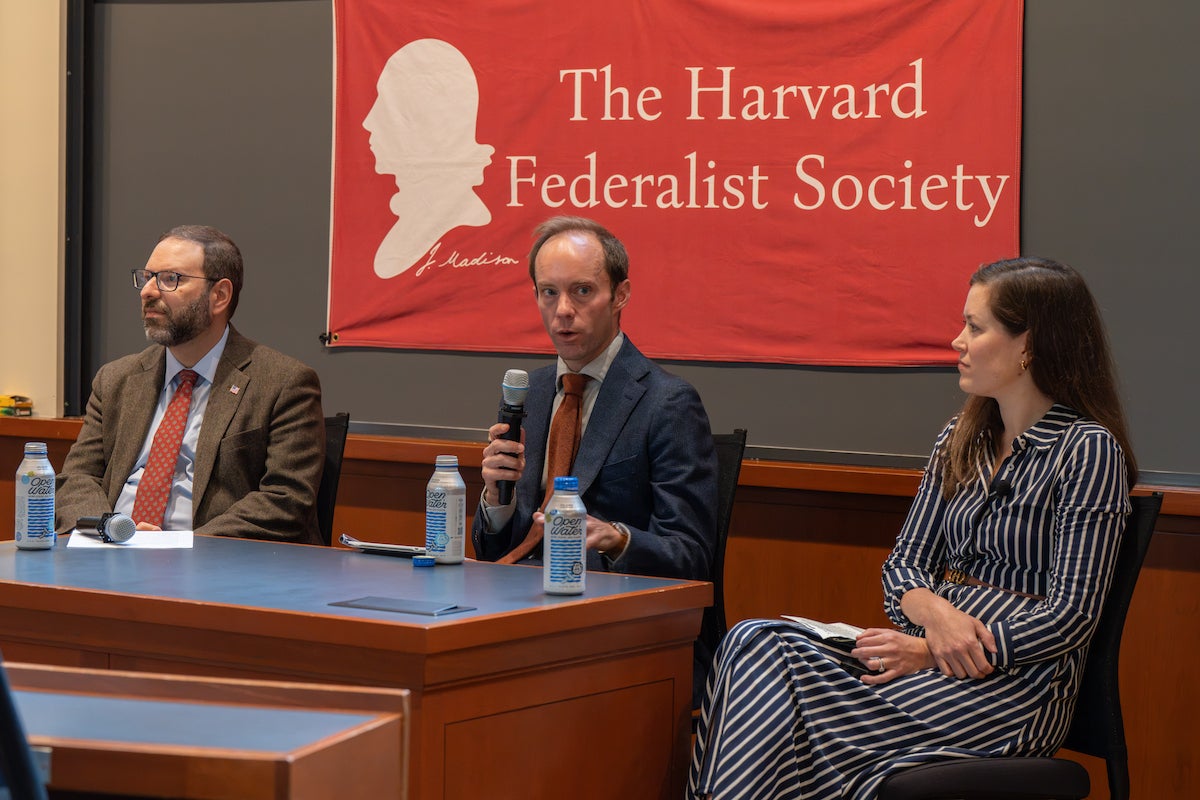
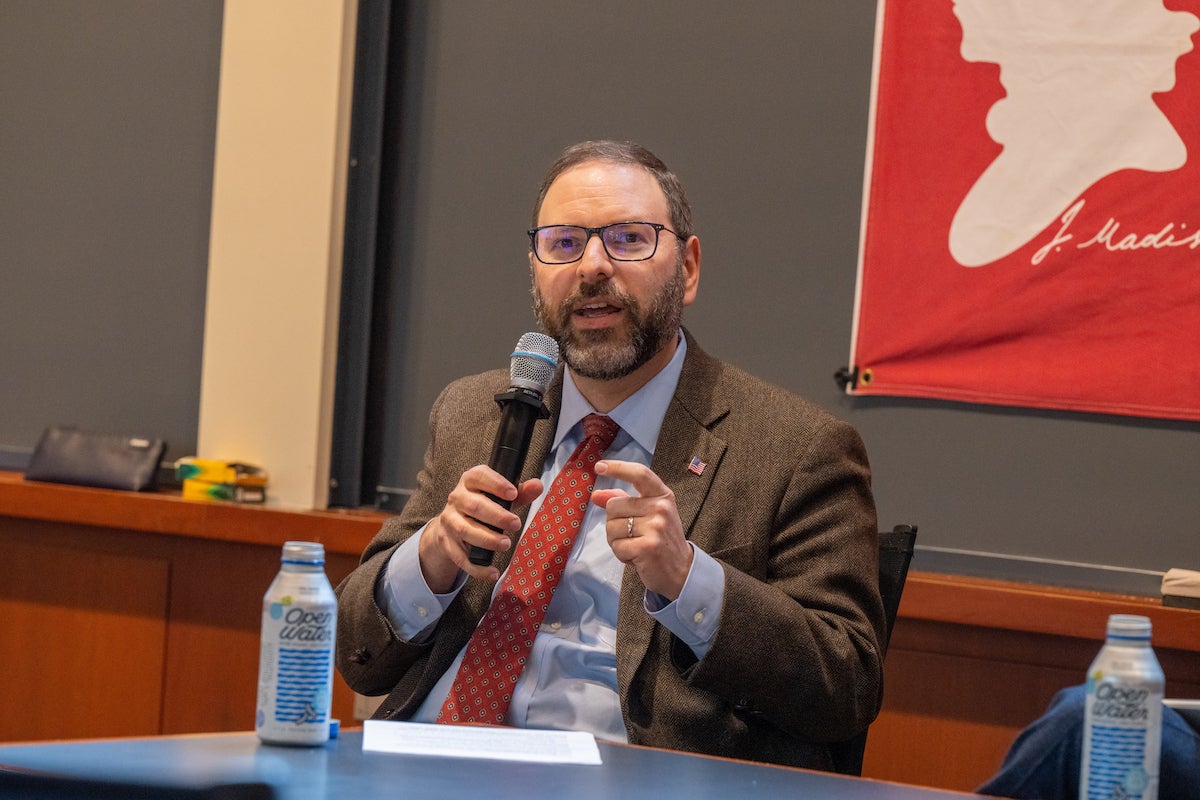
Jouppi’s ongoing legal battle to keep his Cessna is one of eight cases discussed at length on Sept. 29 at an event hosted by the Federalist Society at Harvard Law School to preview the upcoming Supreme Court’s October Term 2026. This year’s discussion featured Jeffrey Redfern ’12 and Kirby Thomas West ’15, senior attorneys at the non-profit public interest law firm, Institute for Justice, and Stephen Sachs, Harvard’s Antonin Scalia Professor of Law.
The event was structured around a series of trivia questions Redfern posed to the audience of law students and panelists about the term’s docket, followed by the panelists naming a docket case and a pending petition for certiorari — or request for the Court to hear a case — they find particularly interesting.
Discussing Jouppi v. Alaska, on which the Court is scheduled to hear arguments on Dec. 1, West distinguished criminal forfeiture cases like Jouppi from the civil forfeiture cases the institute often handles, noting that criminal forfeiture requires a conviction. She said the institute’s position is not that Jouppi should face “no consequences whatsoever” for violating the law, but that forfeiture of the plane would be excessive in addition to jail time and the fine already imposed.
Sachs noted that forfeiture statutes were as old as English Common Law. “I majored in medieval history as an undergrad because that’s the future,” Sachs joked, explaining that forfeiture laws have roots dating back to the medieval period, where it was legal custom for a deodand, an animal or object that caused human death, to be forfeited to the Crown or Church. The term comes from deo dandum in Latin, which means “to be given to God.”
Can a federal prisoner sue prison officials?
On Nov. 9, the Court will hear arguments in Nielsen v. Watanabe, which concerns whether a federal prisoner may seek damages from prison medical officials for allegedly deliberate indifference to serious medical needs. After the district court dismissed the prisoner’s claim, the Ninth Circuit revived it because the allegations resemble those in Carlson v. Green, a 1980 Supreme Court decision recognizing a damages remedy under the 1971 case Bivens v. Six Unknown Named Agents. The Supreme Court is expected to decide whether the Ninth Circuit improperly recognized a Bivens cause of action.
Redfern asked the room whether the plaintiff’s claim could constitute a new Bivens context or whether it falls within one of the three contexts the Supreme Court has already recognized under the Fourth, Fifth, and Eighth Amendments. While West suggested that this case represents the best opportunity in a while for the Supreme Court to recognize a new Bivens cause of action, Sachs considered a larger question: Why is the Court “in the business of implying causes of action straight out of the Constitution” at all?
Changes in federal law, Sachs explained, have foreclosed some of the state-law mechanisms that might have once provided remedies against federal officials, which has produced what he called the “weird world” we are currently in of implying a federal cause of action “ex nihilo” from the Constitution.
Can the U.S. Department of Labor use in-house administrative law judges to collect money from employers who violate worker contracts?
The discussion also turned to Department of Labor v. Sun Valley Orchards, which is represented by the Institute for Justice, concerning whether the Labor Department can require an employer to pay monetary remedies through an administrative proceeding rather than federal court. West connected the case to the institute’s forfeiture work, where she said property is often taken through agency adjudication. The distinction between an agency proceeding and a federal court, she argued, is “more important than just a labeling game.” When the executive branch serves as both prosecutor and judge, “you’re cutting out one entire branch of government” from a constitutional structure designed to protect individual liberties.
What movies did Robert Bork rent from his local Blockbuster, anyway?
Redfern wrapped up trivia with a question related to Salazar v. Paramount Global. Salazar subscribed to an online newsletter, watched videos on the affiliated website, and Facebook tracking software shared information about what he had watched. The question in the case is whether his newsletter subscription makes him a consumer under the Video Privacy Protection Act, which required video rental stores, like Blockbuster Video, to keep their patrons’ rental history private.
Redfern asked the audience to name the event that prompted Congress to enact the Video Privacy Protection Act. A student correctly answered, “reporters getting Robert Bork’s video rental history,” during Bork’s unsuccessful 1987 Supreme Court confirmation battle. (The list of 146 videos, which was acquired and published by the Washington City Paper, included classics such as Alfred Hitchcock, James Bond, and Cary Grant, along with several teen comedies directed by John Hughes.)
Redfern reflected that he likes Salazar v. Paramount Global because it’s an interesting case about text, purpose, and context, and that Congress “had no concept of the kind of world we would be living in.” He also noted that the case is “a lesson about legislation and regulation” persisting “long after whatever harm it’s designed to address is noticeably no longer an issue.”
Can local communities sue oil companies over climate change?
Following the trivia round, Redfern invited Sachs and West to reflect on a merits case on the docket and a pending petition.
Sachs began by discussing Suncor Energy Inc. v. County Commissioners of Boulder County, which will determine whether federal law prevents states from suing under their own laws for harm they say was caused by greenhouse-gas emissions from across the country and around the world. Sachs explained that the case raises questions about whether federal law precludes state-law claims seeking relief for injuries allegedly caused by interstate and international greenhouse-gas emissions. He emphasized broader constitutional and federalism concerns related to whether Boulder can impose liability for emissions across state borders and warned of a potential cascading effect if other cities and states can bring similar claims under their own laws, which could expose companies to large, and potentially conflicting liabilities.
Sachs pointed to an amicus brief of University of Virginia School of Law Professor Saikrishna Bangalore Prakash, which argues that a win for Boulder could allow local governments to seek damages for conduct occurring far beyond their borders. He offered a hypothetical in which Boulder sought damages from a Massachusetts driver for contributing to climate change to illustrate sweeping implications.
“It just seems weird that every city in America would get to do that all at once, in their own courts, under their own law,” said Sachs. More broadly, he said, “there are lots of cross-state questions that you would think would have been worked out at some point in the last 200 and some odd years but have not.”
Before the event concluded, Sachs noted late-breaking news that Supreme Court Justice Alito had recused himself from the Suncor case. “It’s possible that that one might turn out to be a 4-4,” Sachs surmised, “which means it would be just affirmed by an equally divided court and head back down to Colorado.”
You can read more about Harvard Law Today’s coverage of the Suncor case here.
Can someone sue in one state for damages that occurred in another?
For the petition he selected, Sachs discussed Norfolk Southern v. Mallory, a follow-up to the Supreme Court’s earlier 2023 decision in Mallory v. Norfolk Southern. In the underlying case, a former Norfolk Southern Railroad employee, Robert Mallory, sued his former employer for alleged exposure to asbestos working on the railroad in Virginia. Although Mallory lived in Virginia when he filed suit, he argued that Pennsylvania courts had jurisdiction because Norfolk Southern had registered to do business in the state — a precedent set in 1917 in Pennsylvania Fire Ins. Co. v. Gold Issue Mining Co.
In Norfolk Southern v. Mallory, the railroad company has filed a petition for a writ of certiorari, arguing that Pennsylvania violated the dormant Commerce Clause. Sachs suggested the Court could apply the Pike balancing test, from its 1970 decision in Pike v. Bruce Church, weighing the state’s local interests against the burden that its registration requirement puts on commerce. But, he said, Norfolk Southern may face an uphill battle proving Pennsylvania doesn’t have a legitimate interest in the dispute because the company operates in the state and the plaintiff sought a remedy there.
Sachs presented arguments for both sides.
“On the one hand,” he said, “it seems like any result for Norfolk Southern would have to do a lot of fancy dancing to explain why tag jurisdiction is still okay for individuals.” Pennsylvania, he added, could argue “that there is a local interest here, namely local interest in seeing justice done.” He concluded by saying, “Under current doctrine, it’s not necessarily a slam dunk either way.”
Must Massachusetts provide special ed services at private schools, including religious ones?
West began her two cases with what she called a brief history of the institute’s school choice work, decades of litigation that has set the stage for the petitions case, Hellman v. Craven. In Zelman v. Simmons-Harris, a landmark 2002 decision, the Court determined that it is not a violation of the Establishment Clause for public benefits to reach religious schools through families’ own choices. West characterized a series of later Supreme Court decisions — Trinity Lutheran Church of Columbia Inc. v. Comer (2017), Espinoza v. Montana Department of Revenue (2020), and Carson v. Makin (2022) — as establishing that excluding families from receiving public education benefits because of their choice to attend a religious school would be a violation of the Free Exercise Clause.
Hellman v. Craven, a petition for certiorari brought by the institute on behalf of Ariella and David Hellman and other parents, involves a Massachusetts program that provides special education services to children with disabilities. Because the Massachusetts constitution bars public funds from benefiting private educational institutions, regardless of whether they are religious, the state generally does not provide publicly funded special education services on the premises of private schools. Children attending private schools must receive state-funded services at a nearby public school or other neutral location.
West explained that, while the previous cases focused on sectarian institutions, rather than all private institutions, there is still a potential constitutional problem because the Court ruled in Pierce v. Society of Sisters (1925) that states cannot require all children to attend public schools.
“There’s a fundamental right of parents to control the education and upbringing of their children,” West said, including, “the right to choose to educate your child in a private school.” The institute’s clients in the case chose to educate their children in a Jewish day school and, because they chose a private school, their children are not eligible to receive the special education services they would be able to receive otherwise.
West had less time to discuss her merits case, St. Mary Catholic Parish v. Roy, which she described as raising questions about what happens when the Court’s school-choice precedents intersect with Employment Division v. Smith, the 1990 ruling that the Free Exercise Clause generally does not excuse compliance with a generally applicable law, even if the law burdens a religious practice. Although the Court did not accept that issue as one of the questions presented, West said the case could raise a broader question about “what remains of Employment Division v. Smith.”
Want to stay up to date with Harvard Law Today? Sign up for our weekly newsletter.