Can communities sue companies like ExxonMobil for their alleged role in climate-related harms?
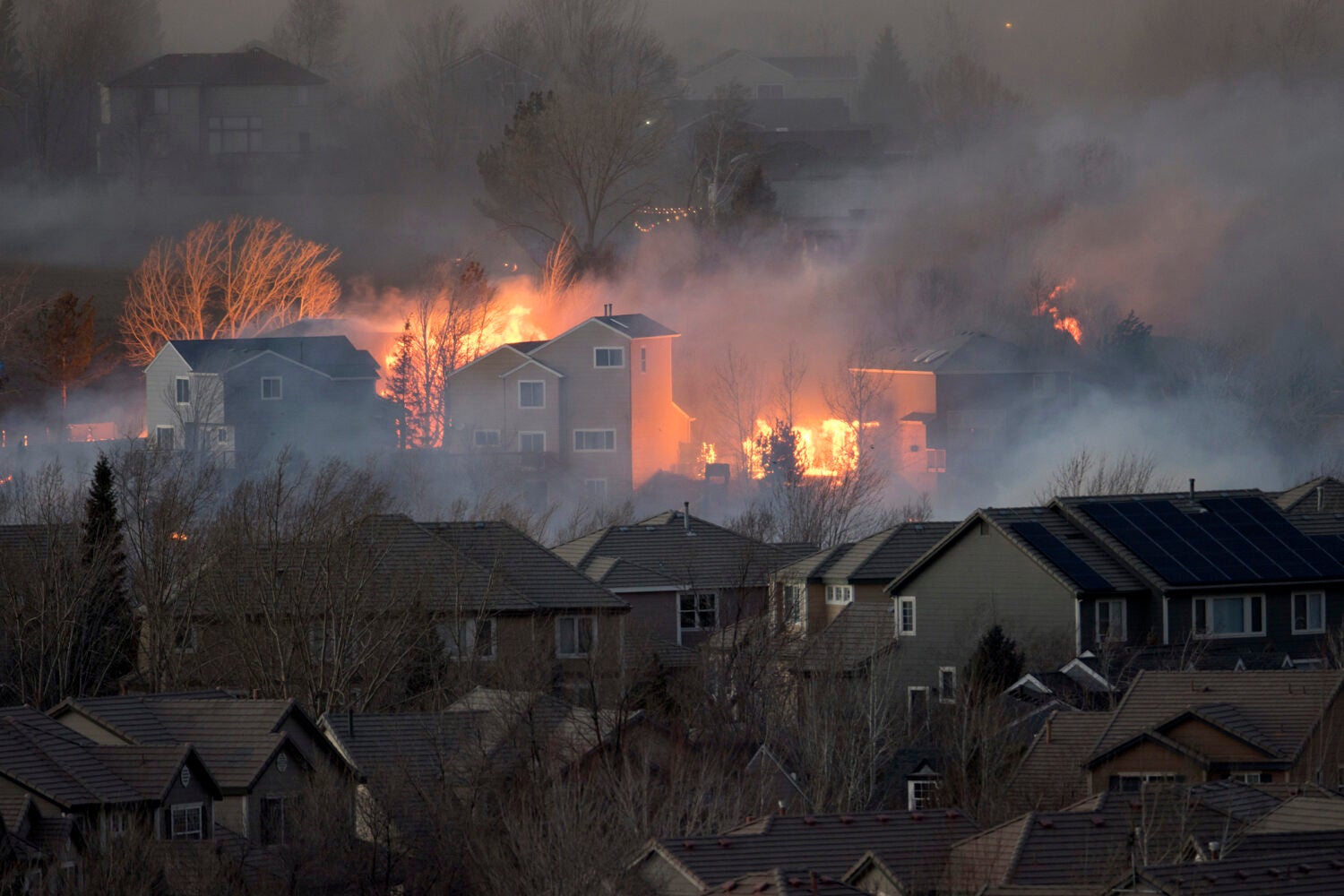
In 2018, Boulder County, Colorado set out to test that question in a lawsuit against oil giant Suncor and other producers of fossil fuels. Citing costs from rising local temperatures, increasingly erratic patterns of precipitation and drought, and greater threats to ecosystems and public health, Boulder’s suit likely took its inspiration from the Big Tobacco litigation of the 1990s, says Richard J. Lazarus ’79, the Charles Stebbins Fairchild Professor of Law at Harvard.
“State tobacco litigation was hugely successful,” he says. “It resulted in settlements that yielded billions of dollars for the states. The plaintiff states and local governments in their pending climate lawsuits hope to replicate that earlier success.”
Instead of trying to stop Suncor from operating, the lawsuit contends that the company and others like it should be held financially responsible under deceptive marketing and public nuisance theories. The suit alleges that the businesses worked together and “intentionally misled the public about the impacts of climate change,” according to Boulder’s brief to the Supreme Court.
But Suncor argues that climate change is a national — even global — problem, one that the U.S. government is best equipped to address. In addition, the defendants contend that federal law, including the Clean Air Act, already sets the framework for greenhouse gas emissions. To allow states or municipalities to establish conflicting climate rules would violate principles of federalism, exceed constitutional limits, and undermine national energy policy, Suncor argues.
In the eight years since it was filed, the case has bounced from state court to federal court, then back again, with the defendants arguing that Boulder is barred from pursuing its claims under state law. Last year, the Colorado Supreme Court disagreed and allowed the lawsuit to move forward in the trial court.
Then the Supreme Court of the United States agreed to hear the case. On October 5, the Court will hear oral arguments on whether Boulder’s lawsuit is precluded by federal law. It will also consider a second question: whether it has the authority to decide the preemption issue at all, given that the underlying lawsuit has not yet reached a final judgment on the merits.
While the questions before the Court are procedural, the outcome of Suncor will have important implications for communities dealing with the fallout of climate change, including the future of dozens of similar lawsuits pending across the country, Lazarus says.
And the Court will have to decide the case shorthanded, after Associate Justice Samuel A. Alito Jr. recused himself in a brief announcement on Monday. If the eight participating justices split 4–4, the Colorado Supreme Court’s ruling would stand, allowing Boulder’s case to continue in state court.
Harvard Law Today: Zooming out, is Suncor really a climate change case, or is the Supreme Court being asked to resolve questions about federalism, preemption, jurisdiction, and the proper forum before anyone reaches the merits?
Richard Lazarus: Suncor is at bottom a climate change case. The gist of the industry constitutional claim that the Supreme Court should order dismissal of Boulder’s lawsuit is that the exceedingly global nature of climate change — the worldwide sources of greenhouse gas emissions causing climate change and the worldwide consequences of climate change — render inapplicable state common and statutory law. Industry is not claiming that the plaintiff’s state law can never apply to activity occurring in another state that harms the plaintiff state within its own borders. They rest instead heavily on the extraordinary global nature of climate change to support their constitutional argument, which has become their primary argument.
To be sure, Boulder has a threshold argument that the Supreme Court lacks jurisdiction to hear the case because the lower state court ruling was not a “final judgment.” And it is possible the Court might ultimately go that direction. But that jurisdictional argument is not the front and center of why the Suncor case has attracted so much national attention.
HLT: What exactly are Boulder’s claims against ExxonMobil and Suncor? How do the city’s allegations of deceptive marketing and public nuisance differ from a direct attempt to regulate greenhouse gas emissions?
Lazarus: Boulder’s argument, like those in the other dozen lawsuits filed against the fossil fuel industry by other state and local governments on similar state law grounds, is that they are entitled to monetary relief to compensate them for the significant costs they are now absorbing to minimize the adverse effects of climate change caused by the fossil fuel industry defendants. Those costs run into the millions and hundreds of millions of dollars. The plaintiff state and local governments in these lawsuits are deliberately not seeking relief in the form of greenhouse gas reductions because of their understandable concern that Supreme Court precedent strongly suggests that the Court will rule that federal law preempts state law claims for such relief. The plaintiffs’ underlying strategy and hope is that the categorical difference in relief they seek will be treated more favorably by the High Court. Whether successful or not, it is a smart strategy.
HLT: The Big Tobacco litigation of the 1990s used a similarly novel public nuisance strategy to go after cigarette companies — resulting in the biggest civil settlement in history. Was Boulder modeling its own lawsuit after that litigation?
Lazarus: Yes, the state climate plaintiffs have very much modelled their lawsuits on the prior state tobacco litigation against the tobacco industry. The state tobacco plaintiffs embraced this tack because they knew they could not regulate tobacco sales directly — federal law would clearly preempt such state laws. That is why they turned to state tort law and consumer protection law to claim they were not seeking to prevent or regulate the sale of tobacco, but merely to compensate the respective states for the enormous economic injury those sale costs the states. That state tobacco litigation was hugely successful. It resulted in settlements that yielded billions of dollars for the states. The plaintiff states and local governments in their pending climate lawsuits hope to replicate that earlier success. To that end, many have similarly hired plaintiff tort law firms to represent them.
HLT: The Supreme Court is not actually being asked to decide this case on the merits — at least not yet. Could you tell me about the preemption claim that defendants are making?
Lazarus: The defendants are making two different kinds of preemption claims. Their primary argument is that the U.S. Constitution bars the application of state law, whether the common law or state statutory law, to seek compensation for harms caused by climate change, because of the latter’s global nature. The resolution of the lawfulness of the activities that cause such a complex global problem can be constitutionally addressed only by federal law. Their second preemption argument, more traditional in character, is that state law is preempted by the federal Clean Air Act. At the outset of this litigation, the Clean Air Act preemption argument was the defendants’ primary defense. As the case has progressed over time, however, their primary defense has become the constitutional argument, and the statutory preemption argument has been relegated to only a few pages.
HLT: Can you tell me about the Article III jurisdiction issue? Who is raising that issue with the Court?
Lazarus: Suncor is the one seeking to invoke federal (Supreme Court) jurisdiction. That is why it is Boulder that is claiming Suncor lacks Article III standing to bring this case, on the ground that Suncor and the other industry fossil fuel defendants have not yet lost on the merits in state court, so have not yet suffered the requisite Article III injury needed for standing.
HLT: Ultimately, what do the defendants argue as to why they shouldn’t be liable, should this lawsuit continue?
Lazarus: Once back in state court, they will claim that the plaintiff states and local governments cannot prove by a preponderance of evidence either that industry actions violated state law or that their actions, even if unlawful, caused the climate change plaintiffs allege. Plaintiffs’ causation arguments will not be easy upon which to prevail because of the extraordinary complexity of climate cause and effect over vast dimensions of time and space.
HLT: If the Court allows Boulder to continue its case, what are the implications? What are the larger stakes of this lawsuit?
Lazarus: The implications are that there will be lengthy trials in state courts across the country. The trials themselves will be expensive and the related discovery at trial may expose internal industry documents they would far prefer to keep out of the public limelight. That alone may lead to settlements, as it did in the tobacco lawsuits. And, if not, the results of the trials are far from preordained. But if the plaintiffs do prevail, the industry will likely be found liable for billions of dollars, and they will no doubt seek federal legislative relief. How successful that effort will be will naturally turn on the identity of the president and the party in majority in Congress.
HLT: The U.S. Supreme Court in recent years has demonstrated a lack of interest in reviewing state court decisions. Does the fact they took this up tell us anything?
Lazarus: The mere fact the Court granted review strongly suggests that there are at least four votes inclined to reverse in favor of Suncor. There are two important caveats, however, to that suggestion. The first is that decisions to grant review are not based on the kind of in-depth analysis that happens once the justices fully consider the case on the merits. It is not unusual for that fuller consideration to prompt justices to change their minds about the merits. The second caveat is that when the Court granted review in Suncor, they added questions concerning whether the Court had jurisdiction to review the Colorado Supreme Court ruling at all. That additional question was suggested by Boulder in its opposition to certiorari. The Court’s addition of that question, which is unusual, suggests that some of the justices remain concerned that they lack authority to review the lower court’s ruling at all, a result favoring Boulder.
This interview has been edited for length and clarity.
Want to stay up to date with Harvard Law Today? Sign up for our weekly newsletter.