Since the International Criminal Court opened in 2002, its relationship with the United States has been, at best, complicated. According to international law experts, however, a recent swath of official sanctions against ICC judges by the Trump administration represents a significant intensification of preexisting tension.
“We shouldn’t think the U.S. has been wholly supportive of the court. The U.S. has never signed up for the court and has been, in the past, extremely hostile to the court,” said Harvard Law Professor of Practice Alex Whiting. “But this is an escalation, and it’s a dramatic one.”
With Executive Order 14203 in February 2025, the U.S. officially imposed sanctions on ICC officials involved in investigating U.S. or Israeli nationals. The sanctions, which include asset freezes, travel bans, and restrictions on services from U.S. companies, mirror sanctions attempted by the first Trump administration against ICC officials investigating alleged war crimes in Afghanistan.
Since the issuance of last year’s executive order, the second Trump administration has expanded its scope to institute sanctions on at least 11 ICC officials, including nine judges and the chief prosecutor.
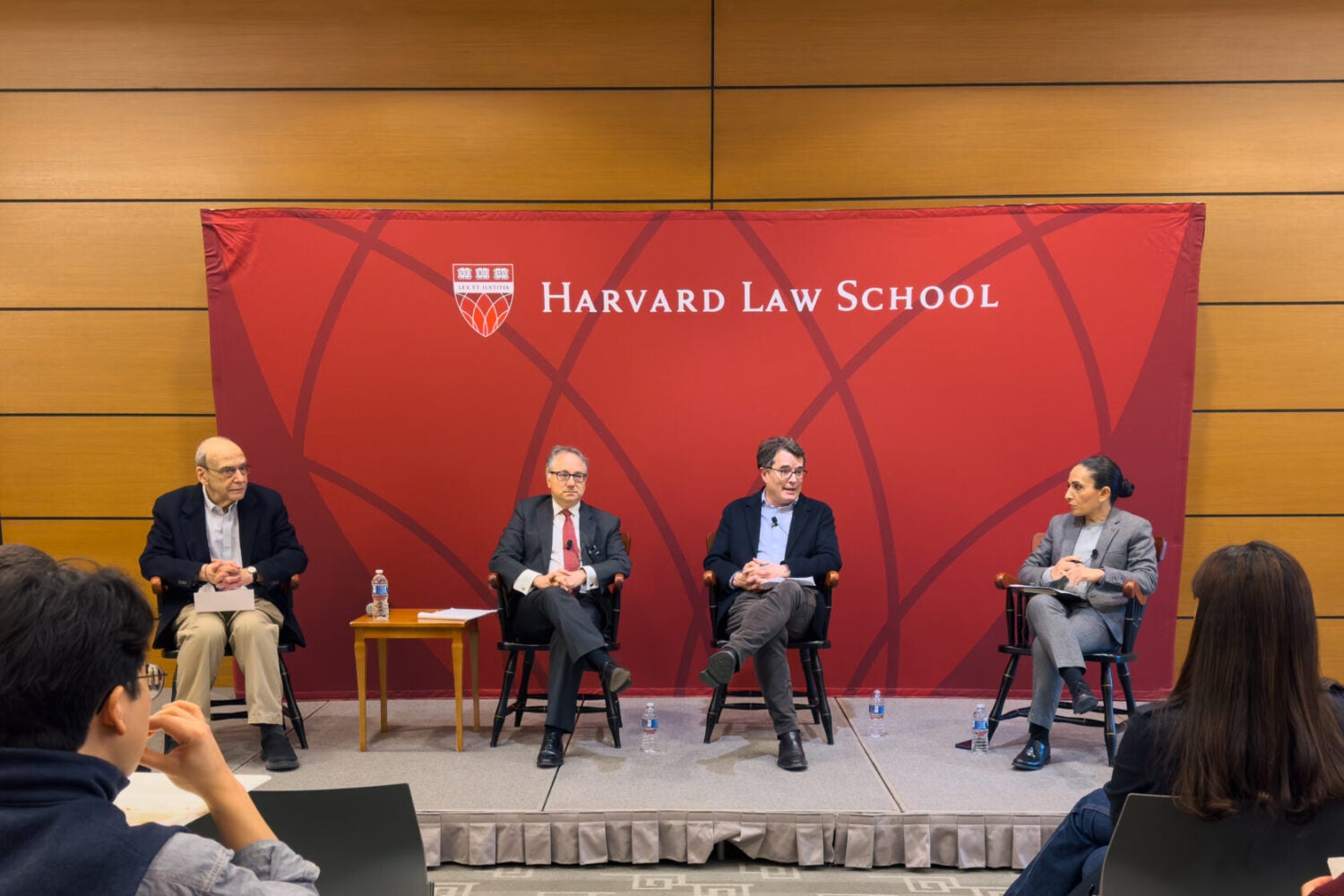
At a recent lunchtime discussion, “Targeting the Bench: U.S. Sanctions Against the International Criminal Court,” Whiting joined fellow panelists Professor of Practice Naz Modirzadeh ‘02, founding director of the Program on International Law and Armed Conflict at Harvard Law, and Foley Hoag partner Andrew Loewenstein to field questions from J. Sinclair Armstrong Professor of International, Foreign, and Comparative Law Gerald Neuman ’80 about the administration’s recent actions.
ICC jurisdiction at risk?
Whiting, the ICC’s former deputy specialist prosecutor at the Kosovo Specialist Prosecutor’s Office, began by explaining the nature of recent administrative actions against ICC personnel.
“The president issued an executive order finding that certain individuals at the court posed a national security threat to the United States on the theory that the court was exercising jurisdiction … potentially over the United States, and certainly Israel, an ally of the United States without having proper jurisdiction,” he said.
As Whiting explained, the administration contends the ICC has no jurisdiction over the U.S. because the U.S. is not a party to the Rome Statute, an international treaty with more than 100 participating countries that established the ICC. According to Whiting, though, the administration’s argument is neither novel nor compelling.
“The court doesn’t get the kind of financial, political, or diplomatic support from the world that it should and the response to the sanctions, in some ways, exemplifies that.”
Alex Whiting
“The argument that the court is unlawfully exercising jurisdiction is an argument the U.S. has been running for a long time; however, until last year, the government had had kind of abandoned that position,” explained Whiting. “There was a consensus on both sides, Democrats and Republicans, that that argument really was not a winner.”
Whiting also pointed out that support for the ICC has been waning throughout the international community as a whole.
“There is a big problem of the world moving away from international law and certainly away from supporting the court,” said Whiting. “The court doesn’t get the kind of financial, political, or diplomatic support from the world that it should and the response to the sanctions, in some ways, exemplifies that.”
Learning from constitutional victories
Loewenstein, who frequently represents sovereign states in civil litigation before the International Court of Justice, examined the limitations imposed on ICC officials by the recent executive order.
“Essentially, if you are designated for sanctions under the executive order, then U.S. persons are blocked from engaging in those types of interactions with designated persons — and that blocking is incredibly broad,” said Loewenstein.
By its terms, the executive order prohibits individuals from providing designated ICC officials “funds, goods, or services.” As a result, recent sanctions will impact court proceedings and, Loewenstein argues, violate fundamental rights.
“Providing advice or services to designated individuals includes things like evidence or submission of amicus briefs,” said Loewenstein. “So, one of the things that we’ve been very heavily involved with over the last five years, starting with the first iteration of the sanctions regime under the first Trump administration, was to challenge the application of that sanctions regime on constitutional grounds.”
During the first Trump administration, human rights organizations and international law professors who Loewenstein and others represented successfully obtained preliminary injunctions that restored their ability to interact with ICC officials. The injunction later became moot when the sanctions were revoked by the Biden administration.
According to Loewenstein, the February 2025 executive order “essentially re-instituted” the sanctions attempted under the first Trump administration. He successfully challenged the enforcement of sanctions against his clients by obtaining, this time, a permanent injunction.
“In April last year, we brought another constitutional challenge, largely on the First Amendment grounds, on behalf of two international criminal law professors,” recalled Loewenstein. “That case was brought in Southern District of New York. What we argued, and what the court ultimately agreed with, was that the application of the sanctions regime to U.S. persons violated the First Amendment.”
Although Loewenstein and others have successfully challenged the enforcement of the sanctions specifically against their clients, the sanctions overall remain in effect against the ICC officials and others.
Revisiting power dynamics in international law
Modirzadeh, who also serves on the board of trustees of the International Crisis Group, suggested that those concerned with the recent sanctions against ICC officials should consider revisiting the domestic and international legal bases said to underpin these and many other U.S. sanctions.
She explained that there is only one existing mechanism that all states recognize as a legally valid way to impose globally binding sanctions: a United Nations Security Council decision. The Council has not adopted — and, she said, is extremely unlikely to adopt — a resolution mandating sanctions on ICC officials.
Instead, according to Modirzadeh, in imposing sanctions on ICC officials as well as on many other people and entities in numerous other contexts, the U.S. relies on an extensive domestic architecture through which it asserts the power to exercise extraterritorial criminal and civil jurisdiction where U.S. national-security interests are perceived to be implicated.
“Here, you have a sanctions regime that is targeting the personal financial interests of judges and prosecutors … And if that’s not antithetical to the rule of law, I don’t know what it is.”
Andrew Loewenstein
When questioned by Neuman whether other countries have sought to claim similar unilateral sanction powers, the panelists agreed that in practice the U.S. is differently positioned than other countries in part due to the ubiquity of American currency and corresponding concerns about access to U.S. financial markets and related legal liability.
“Countries have hacked the court. They have tried to take information, they’ve intimidated witness, they’ve wiretapped the court. There’s a level of routine obstruction behavior that countries engage in with respect to the court,” said Whiting, “But I’m not familiar with any other [sanctions].”
“Here, you have a sanctions regime that is targeting the personal financial interests of judges and prosecutors as a means to try to get them to make decisions that are at odds with what they would otherwise do based on the facts and the law that’s before them,” said Loewenstein. “And if that’s not antithetical to the rule of law, I don’t know what it is.”
The event was co-hosted by several groups including the Program on Law and Society in the Muslim World, the HLS Advocates for Human Rights, the Harvard Human Rights Journal, the Harvard International Law Journal, and the Carr-Ryan Center for Human Rights at the Harvard Kennedy School.
Want to stay up to date with Harvard Law Today? Sign up for our weekly newsletter.