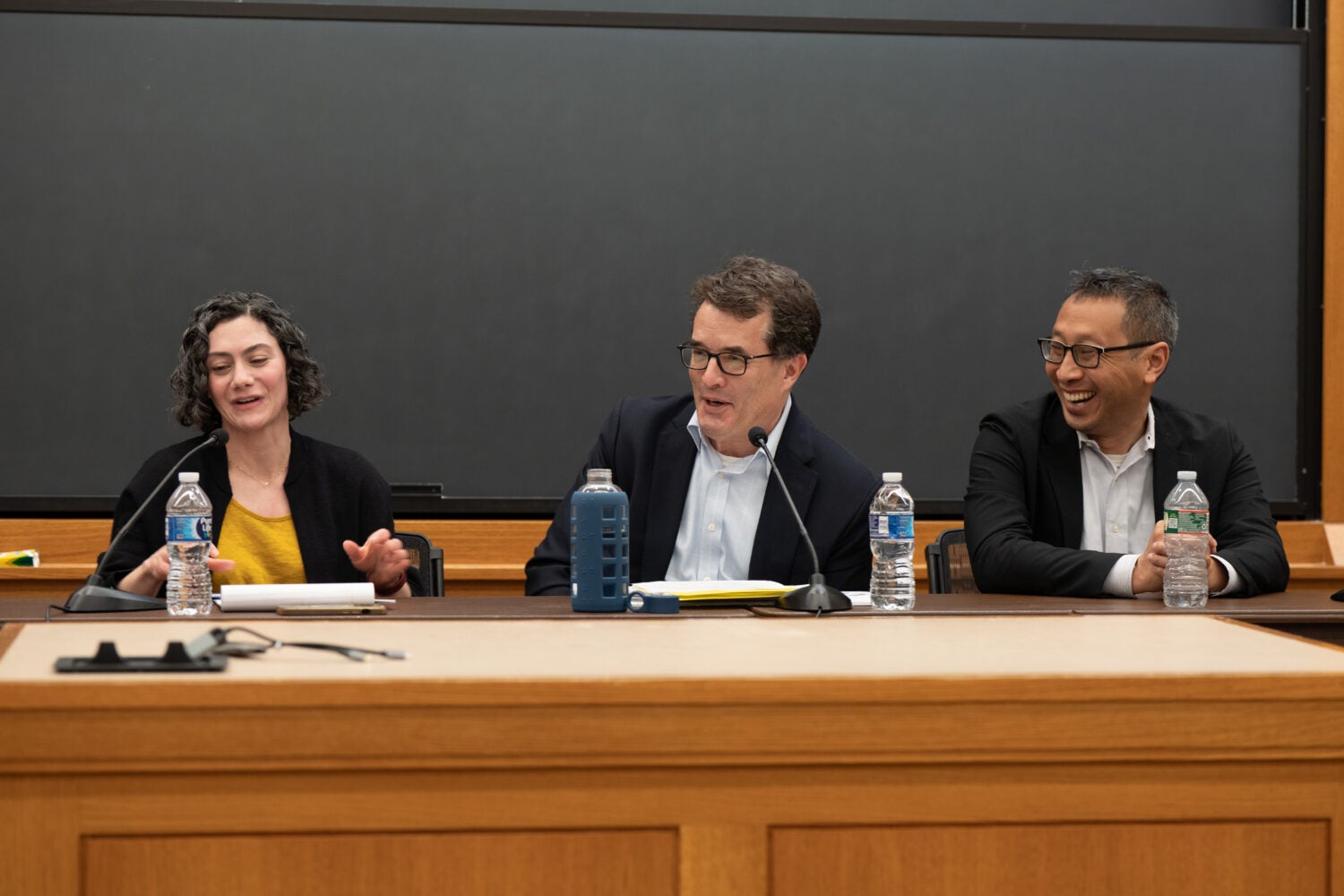
The European Union has responded in unprecedented ways to Russia’s war against Ukraine, but the organization’s impact has been constrained by its structure and founding documents, according to panelists at a recent forum at Harvard Law School.
Those were some of the takeaways from the panel discussion featuring Federico Fabbrini, author of the recent book “The EU Constitution in Time of War: Legal Responses to Russia’s Aggression Against Ukraine.” Harvard Law School Professors Susan H. Farbstein ’04, Alex Whiting, and Mark Wu appeared with Fabbrini to discuss the book’s arguments. Professor Gerald L. Neuman ’80, director of the Human Rights Program, moderated the April 16 event, which was sponsored by the Human Rights Program, the International Human Rights Clinic, the Harvard Human Rights Journal, and the Harvard European Law Association.
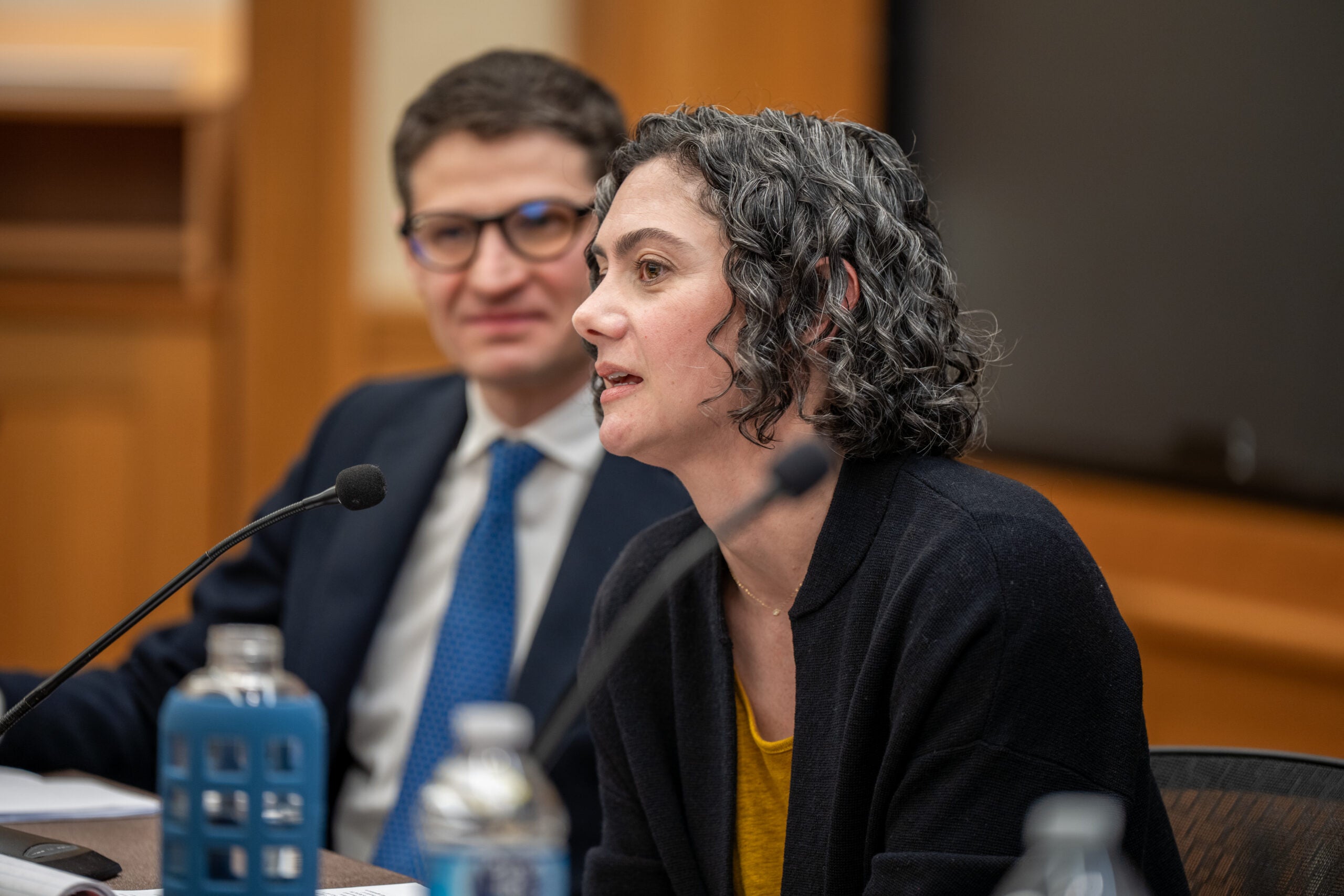
“At the end of the day, ultimately, the EU is a peacetime organization,” said Fabbrini, a professor at Dublin City University and a research fellow at the Harvard Kennedy School. “[It] was created as a project to secure peace, prevent intrastate wars … it was never conceived as an organization that had to deal with the reality of warfare, hard power, and military issues.”
Instead, the EU outsourced some of those responsibilities to other countries and entities, primarily the United States and NATO. Created in 1949, NATO has seen its centrality called into question by U.S. President Donald Trump in recent years.
“For the first time since the end of the Second World War, intrastate conflict returned on the European continent and, to put it perhaps a bit provocatively, the Kantian dream of perpetual peace … was shattered really overnight,” said Fabbrini.
Fabbrini described three central arguments in his book. First, he says the EU has interpreted its founding declaration and treaties — collectively referred to as the EU constitution — as living documents to create and launch economic and military initiatives, sometimes from scratch. Second, he argues that those actions have exposed the ways in which the EU’s governance is both too constraining — for instance, the EU’s budget cannot be used for military purposes and a single member state can block passage of an EU-level response — and not constraining enough. (He said some actions that potentially violated people’s rights sailed through the courts without much scrutiny). His third argument is that the EU will need to reform its constitutional structure to deal with ongoing uncertainty in geopolitical and geoeconomic spheres.
Farbstein, who directs the International Human Rights Clinic and is currently investigating war crimes in Ukraine, focused her remarks on the EU’s efforts in that area, including making a collective referral to the International Criminal Court, which has since issued six arrest warrants.
“The EU response has shown there is still political will to seek accountability for atrocity crimes, even in contexts where those atrocity crimes are being committed by one of the world’s major powers,” she said, adding that an arrest warrant issued against Russian President Vladimir Putin is the first against a leader of a permanent member of the UN Security Council.
The EU has supported Ukraine’s efforts to prosecute Russian soldiers in domestic courts. And, although many cases have been tried in absentia, Farbstein said the prosecutions still have power.
“Even trials in absentia do tell an important story about the kinds of violations that are being committed,” she said. “They create a public record about who’s responsible; they provide some measure of symbolic recognition and acknowledgment for the victims.”
Whiting agreed but built on her comments that those actions may not ever result in actual accountability: The International Criminal Court lacks the power to force arrests, for instance, and Ukraine’s domestic prosecutions have sometimes ended in prisoner exchanges rather than prison time.
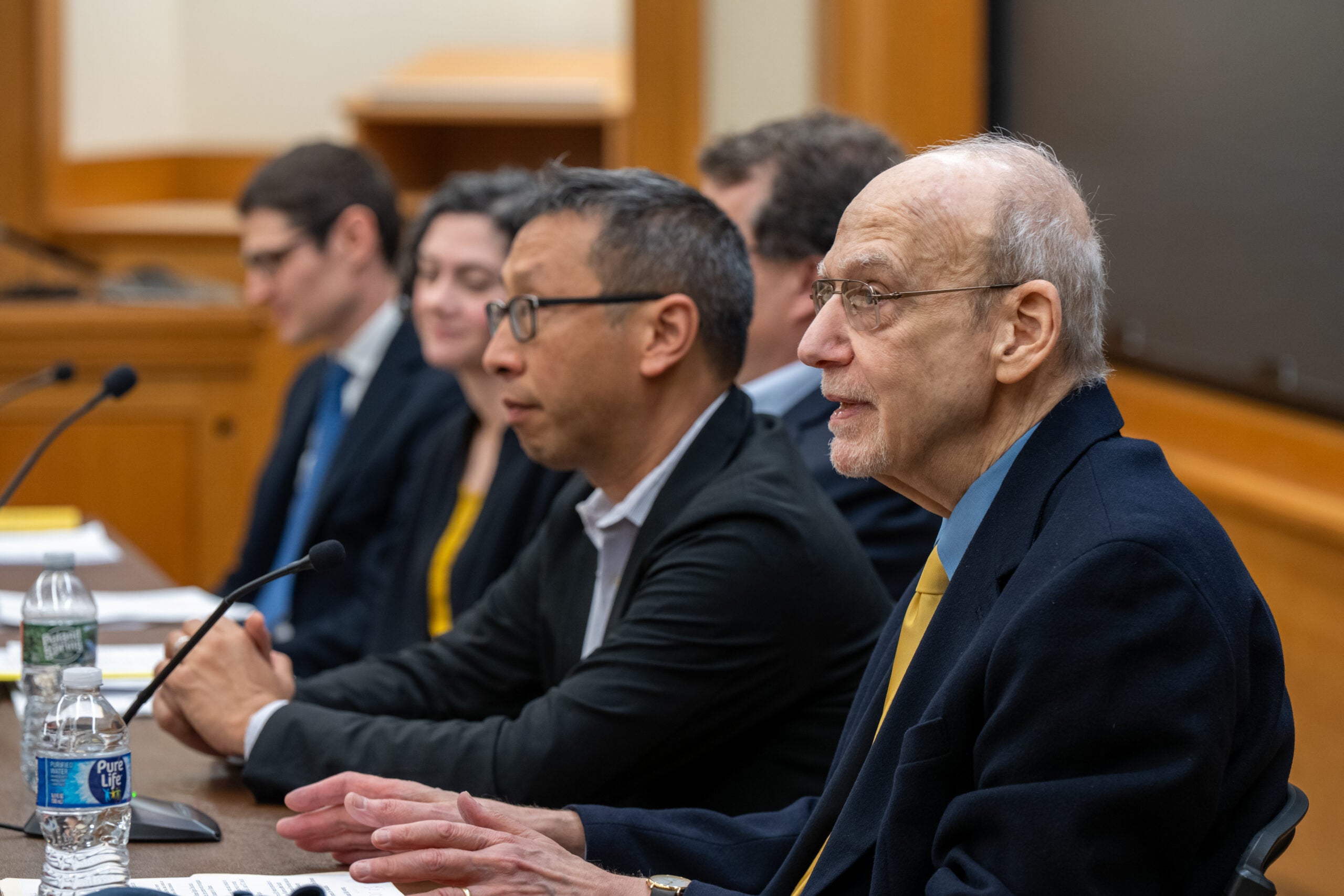
“It feels right now like incomplete justice,” said Whiting, who teaches, writes, and consults on international criminal prosecution issues. “Maybe that’s the best that can be done at the moment.”
Whiting focused his remarks on the crime of aggression. In response to past instances — in states of the former Yugoslavia, for instance — the world came together to create special tribunals to deal with such alleged crimes. Here, the response has not been global in nature, so the EU has had to work around a lack of political will, including from the United States, which Whiting said has arguably committed its own crimes of aggression in Venezuela and Iran in recent months.
After considering other options, the Council of Europe and Ukraine have agreed to create a special tribunal to deal with Russia’s war on Ukraine. Any indictments it issues against high-level leaders will not take effect unless those leaders are out of power.
Wu, the faculty co-director of the Berkman Klein Center for Internet and Society who specializes in international trade and economic law, focused his remarks on the EU’s economic statecraft and whether the organization can better prepare itself for a future in which geopolitical and economic conflict seem omnipresent. He noted that the EU’s early sanctions response was arguably “Washington-driven.”
“Do we see [the EU] as a common foreign policy project or not?” Wu asked. “Is it really an autonomous strategic actor and therefore it wants to use its economic statecraft very much independently from the U.S?”
In his current work at the Kennedy School, Fabbrini is studying what it would take for the EU to revive some of the treaties from its earliest days, including those creating a common army and greater fiscal authorities. He said the EU will need to scale up its integration to respond better to future crises of any kind.
“Moving forward, especially as this time of geopolitical and geoeconomic competition is only going to increase … there is a need to think forward how the EU can step up, but that requires reforming itself.”
Want to stay up to date with Harvard Law Today? Sign up for our weekly newsletter.