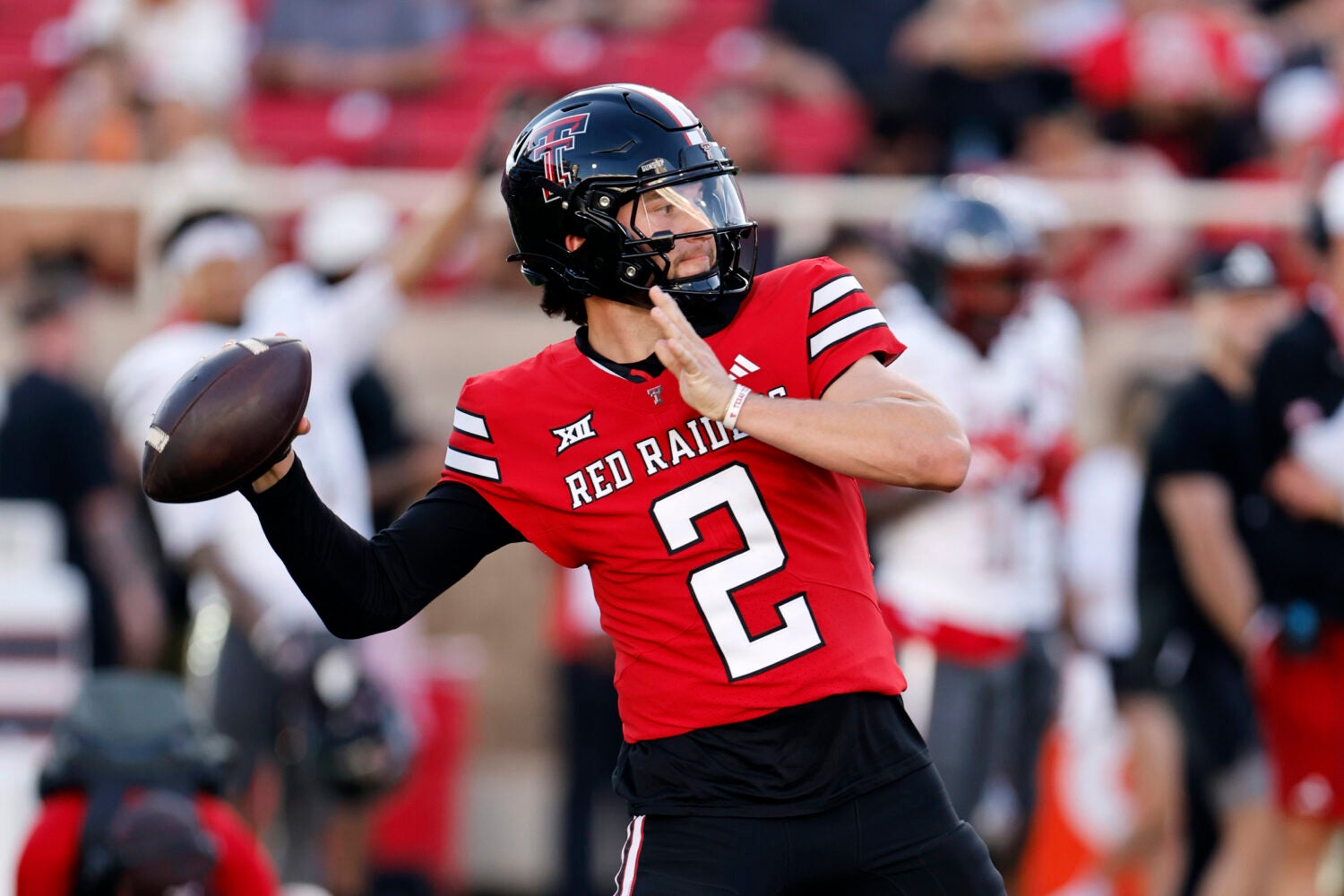
Quarterback Brendan Sorsby will not be playing football for Texas Tech this fall.
The outcome is hardly a surprise given the two-time transfer, who reportedly received a $5 million deal to join the Red Raiders as a transfer from the University of Cincinnati in January, admitted betting at least $90,000 on sports, including his own team, while still a student athlete. The road to that outcome, however, has been fraught with considerable complexity due to ongoing lawsuits involving Sorsby, the colleges he attended, the Big 12 conference, and the NCAA.
Sorsby received a permanent ban from the NCAA, but he challenged that ruling in state court and, surprisingly, won an injunction allowing him to play football this fall. “The order, in my view, lacks a cogent explanation and reached a conclusion without talking about the ‘how.’” said Visiting Professor of Law Michael McCann LL.M. ’05. “It was stunning.”
According to McCann, backlash from the court order ultimately led the Big 12 college football conference to file a lawsuit that forced Texas Tech and Sorsby to relent. McCann, a sports law expert and journalist for Sportico who has covered the Sorsby saga extensively, met with Harvard Law Today to discuss the court’s ruling against the NCAA, the University of Cincinnati’s lawsuit against Sorsby, and the evolving balance of power in college sports.

Harvard Law Today: What are the allegations against Brendan Sorsby?
Michael McCann: Betting on sports is the core problem with Brendan Sorsby. Specifically, that he bet on his own team while he was playing at the University of Indiana back in 2022. He didn’t step on the field as a freshman at Indiana, but he bet on his team and he bet on his teammates, which has long been considered a cardinal sin in sports. Betting on your own team or yourself is certainly prohibited under NCAA rules and carries the punishment of a permanent ban.
Another striking aspect of the Sorsby saga is that he has admitted to doing this — he volunteered this information in the complaint he filed in Texas earlier this year against the NCAA. He challenged the NCAA’s ineligibility ruling, arguing that the NCAA has been unfair to him given the circumstances — he wasn’t really a key member of the team, he’s dealt with anxiety, gambling addiction, etc. But betting on sports is the core problem and court documents indicate that he has bet thousands of times either by placing bets himself or using intermediaries when he either wasn’t old enough or in a state like Texas where sports betting is not legal. In fact, sports betting is a misdemeanor crime in Texas.
HLT: Can you walk us through what happened when Sorsby filed a lawsuit against the NCAA challenging the permanent ban?
McCann: After the NCAA issued a permanent ban, Sorsby filed a lawsuit in state court in Texas challenging that ruling. We know that he broke NCAA rules because he volunteered that information in his complaint. In court, he argued that the NCAA was treating him unfairly, he has anxiety issues, and he didn’t feel like he was given a fair shake in the investigatory process. To the surprise of many, including myself, the county judge in Texas gave him an injunction that would allow him to play this fall at Texas Tech after serving a two-game suspension to start the season against teams that were not in the conference.
The NCAA almost immediately filed an official appeal of that decision and an emergency motion for an expedited ruling in the Texas Court of Appeals. But if that appeal is unsuccessful, the district court trial isn’t scheduled until 2027, after the season is over. So, effectively, the temporary injunction would end the NCAA case because, unless the appeal is vacated, Sorsby would be able to play in the fall. Functionally, the case would be over with the injunction because the injunction would remain until the trial, and the trial was scheduled after the completion of the upcoming football season. At that point, Sorsby would be long gone from Texas Tech.
HLT: Did the ruling on the NCAA case reflect an adherence to precedent, a deviation from past rulings, or simply an issue of first impression before the court?
McCann: Based on the order that was issued, it did not appear to be linked to any sort of precedent. It didn’t cite some past case in which this issue came up before. The surprising part is that the player admitted to the underlying offense, betting on his own team, among other bets. There’s all sorts of case precedent on the discretion accorded to private membership organizations like the NCAA. It’s a private club, if we’re being honest about it, and clubs typically have a lot of discretion in how they administer rules as long as they’re relatively consistent.
Here, to my knowledge, there wasn’t a credible argument made that the NCAA was inconsistent in how it has approached other situations where an athlete has bet on their own team. The order issued by the judge did not have that stated reasoning. The order did note the harm that, if he doesn’t play, he doesn’t develop his skills, and he can’t earn NIL money. There’s certainly a financial injury by not being able to play, but I think what the order lacked is the, “So, what?” The order, in my view, lacked a cogent explanation and reached a conclusion without talking about “the how.” It was stunning.
HLT: As things stand, though, Sorsby will not be playing college football this fall for Texas Tech. So, what changed?
McCann: First, I should explain that in addition to being a member of the NCAA, Texas Tech football is also part of the Big 12 conference. The Big 12, like all conferences, has its own rules and bylaws that it can enforce. After the NCAA ruling, which was widely criticized, Texas Tech and the attorney general of Texas, Ken Paxton, threatened a lawsuit of over $200 million against the Big 12 conference if the conference were to attempt to impose sanctions [against Texas Tech]. Although that may have seemed frivolous, it was still from the state attorney general and had to be taken seriously. So, in June, the Big 12 conference sued Texas Tech and AG Paxton in federal court. They argued that, even if there’s a restraining order against the NCAA from banning Sorsby, the conference itself has its own anti-gambling rules that it can enforce. The conference argued Texas Tech and AG Paxton were infringing on the First Amendment rights of the conference to potentially punish the school for playing an ineligible player.
That case remains in federal district court in Texas. There hasn’t been any activity since the day after it was filed in June, but it’s still there. Sorsby, at that point, announced that he’s leaving Texas Tech to pursue the NFL. The thinking is, the lawsuit by the conference scared Texas Tech. It forced them to rethink whether they really want to play him, and they came to the conclusion that they don’t. Sorsby has claimed he voluntarily chose to leave, so we don’t know exactly what happened, but we do know that he left the school.
HLT: What is Sorsby’s next step? Can he play professionally?
McCann: Sorsby petitioned the NFL for admission into a supplemental draft. The NFL has the right to conduct a supplemental draft for a player or players upon request; it doesn’t have to under the collective bargaining agreement and hasn’t conducted one since 2023. But the NFL declined to conduct one for him. They said they’re not making fact-finding about this particular player, but he hasn’t shared enough information about the issues involved and they don’t feel like it’s appropriate. So, they rejected Sorsby’s petition and there was thinking that he might sue the NFL. I certainly wrote about that possibility. His lawyer is Jeffrey Kessler, a great lawyer who has sued all the leagues including the NCAA and has had some big wins. Sorsby declined to sue, though, and is going to sit out this year and prepare for next year’s NFL draft.
HLT: Does the outcome of the matter thus far demonstrate a system of checks and balances functioning correctly, total chaos, or somewhere in between?
McCann: That’s a good question. I think the ultimate outcome seems right, that this is a player who should not be eligible to play college sports and doesn’t have a compelling argument for the NFL to make a special exemption for him to enter the league. In that regard, that strikes me as the correct outcome. But the process there was chaotic with a county judge disrupting what seemed like the right thing in most people’s minds. Not only that, but there are all sorts of collateral effects to this including making the NCAA look good. The NCAA has long struggled with being viewed as the villain for not letting college athletes get paid, etc. Here, though, they are suddenly the party that most people think is in the right.
The NCAA is already trying to use this newfound leverage on Capitol Hill to say, “Look, this is why we need Congress to intervene.” Now, part of what they’re seeking from Congress — antitrust preemption — wouldn’t actually stop a state breach of contract claim like the one at issue here. But they’re using [the leverage] to demonstrate that they’re in the right and trying to “protect college sports,” to use the language of the bill currently before Congress. So, in a way, the Sorsby saga could end up helping the NCAA, but I don’t think it’s a good system when a county judge can issue a ruling that really defies logic and there isn’t a clear remedy to address it.
HLT: Newfound political leverage aside, is the court ruling a loss for the NCAA in terms of its authority? What does this outcome mean for the balance of power between the NCAA and power conferences like the Big 12?
McCann: In a way, it is [a loss] because the NCAA lost in court and it was the Big 12 that saved the day. Now, in fairness to the NCAA, the Big 12 had the luxury of other arguments at its disposal whereas the NCAA was a defendant in the case filed against them by Sorsby — the facts are different. But, ultimately, this was the conference coming to the rescue. Traditionally, conferences and schools don’t litigate against each other unless it involves conference dissolution or conference realignment […] This was different. This is something we haven’t seen. This was a conference stepping up to tell Texas Tech, a member school, they have agreed by their membership contract the authority of the conference to disqualify a school based on playing a player they deem ineligible for infractions like sports betting. I think Texas Tech and AG Paxton threatening the Big 12 obviously was a bad move because it got them thinking they’re now on defense and have to strike back. They were defending their discretion and the fact that Texas Tech is a member of their institution that agreed to these rules. The Big 12 suing was the game changer.
So, this is an example of a conference achieving what the NCAA could not and advancing the notion they are evolving into standalone entities less and less reliant on the NCAA. Aside from Sorsby, there’s all sorts of tension between power conferences and the NCAA over their autonomy, including federal legislation that would create revenue sharing, which power conferences like the SEC oppose. In college football, we’re seeing what I think is a migration away from the NCAA as the power-making body.
HLT: Why is the University of Cincinnati suing Sorsby?
McCann: In summer 2025, the House [v. NCAA] settlement between the NCAA and college athletes allowed, among other things, colleges to share revenue directly with athletes in the form of NIL — name, image, and likeness — related compensation. Sorsby then signed a contract with the University of Cincinnati that said he will play there for the next 18 months through December 2026 — basically, two football seasons. The contract also includes a $1 million liquidated damages provision that says if Sorsby breaches the contract, the damages would be $1 million. The contract is also said to contain language that says if he enters the transfer portal and leaves, that constitutes breach.
So, Sorsby plays the fall of 2025 at Cincinnati, has a very good year, and decides to leave despite the terms of the contract. The contract says that Cincinnati’s paying him for use of his NIL — it explicitly says they’re not paying him for his labor because his labor would be more akin to an employment contract. Colleges, even in this new world, can’t pay college athletes money for their labor — they can only pay them more or less as revenue sharing related to NIL. So, Sorsby gets recruited by Texas Tech, which offers him more money than what he would make in 2026 from Cincinnati. He breaches his contract with Cincinnati and leaves for Texas Tech. Cincinnati sues him, saying, “You’re in breach of your contract.” He argues that the contract was a farce because they were paying him to play and NIL was just a ruse.
NIL is supposed to be like an endorsement deal in pro sports for the use of an athlete’s right of publicity. The right of publicity is the right to prevent others from profiting off the use of our name, image, and likeness, but also our signature, our voice, all sorts of other things. For instance, when Tom Brady signs an endorsement deal with Tag Hauer, he’s getting paid to be a spokesperson for that particular line. Sorsby says, “That’s not what you were paying me for, you were paying me to play football — that’s it.” His point is that, basically, NIL is really just “pay for play.” So, thus, the contract should be unenforceable including that liquidated damages provision. He also says the liquidated damages provision should be unenforceable because it’s excessive in relation to what his NIL value is to the school. He argues his NIL value is de minimis and that he was only being paid to play. There’s case law in Ohio that holds a liquidated damages provision can’t be excessive and, essentially, can’t be a penalty. That case is in federal court in Ohio, and that’s still going on.
HLT: Based on the scope of the potential litigant pool, does the University of Cincinnati lawsuit have the potential to be the most impactful takeaway from the Sorsby saga?
McCann: Yes, because let’s say it gets past a motion to dismiss. Then it goes to pretrial discovery. So, as a starting point, we’re going to find out all sorts of things about what Cincinnati knew about Sorsby’s betting. Based on what the NCAA has said, he’s been betting for years and certainly while at Cincinnati, which could be eye opening. Also, it’s risky for Cincinnati because if it turns out that they were paying him to play, that’s a violation of NCAA rules. So, the school could get in trouble. For Sorsby, he’s no longer a college athlete and doesn’t care about NCAA eligibility. In a way, he could be emboldened by the fact that he’s now past that. Granted, he still has to be careful because there are NFL teams that likely have questions about his ethics, his judgment, and all sorts of things. So, the case is still somewhat risky to him too.
But this case could turn out to be an eye opener into what many think is a pattern of fake NIL deals. That athletes are being paid to play under the cloak of what’s named NIL, but in fact is not NIL, and is better understood, really, as an employment contract. There’s existing litigation about college athletes as employees, Johnson v. NCAA, which is a class action suit arguing college athletes are employees under the Fair Labor Standards Act and accompanying state laws. If they are, they’re then owed minimum wage and potentially overtime pay going back to, I think, 2016 or 2017. That’s not just football players — it’s all sorts of Division I athletes, so that is a lot of money in damages. If the Cincinnati case continues, it will be certainly relevant to other litigation about whether college athletes should be classified as employees.
HLT: As you mentioned before, there’s currently federal legislation under consideration called the Protect College Sports Act of 2026. If that bill passed, would it change how any of these cases or situations would be governed?
McCann: The Protect College Sports Act of 2026 wouldn’t extinguish state law claims; so, from that lens, a Sorsby case presumably could still happen because the exemption would be for antitrust. What the legislation would do is end lawsuits over whether college athletes can only play four or five seasons of football. They want to stick around, they want to keep making NIL money, they don’t want to leave, and there’s a market for them because schools want to pay them. So, those cases would go away. But I don’t think a Sorsby betting case or an NIL deal case go away if the bill passes. The House Settlement would continue and the legislation wouldn’t change its operative terms. The bill doesn’t address college athlete employment and that was strategic to avoid the topic. So, the economics of things would change a bit, but these particular claims would not be extinguished.
The idea is that revenue sharing would help protect women’s sports and help protect Olympic sports. The intent, I think, is good, but it’s contingent upon a certain number of schools actually electing to do that. The folks I’ve talked to in college sports seem to think administrators are more interested in it as a concept than in practice. But the biggest effect it would have is it would end eligibility lawsuits, permit revenue sharing, and create a very limited antitrust immunity. I don’t know if it’s the game changer, there are other issues at stake there like access to betting. Suddenly, every phone is a casino and that raises all sorts of real issues that I think all of sports have to grapple with.
This interview has been edited for length and clarity.
Want to stay up to date with Harvard Law Today? Sign up for our weekly newsletter.