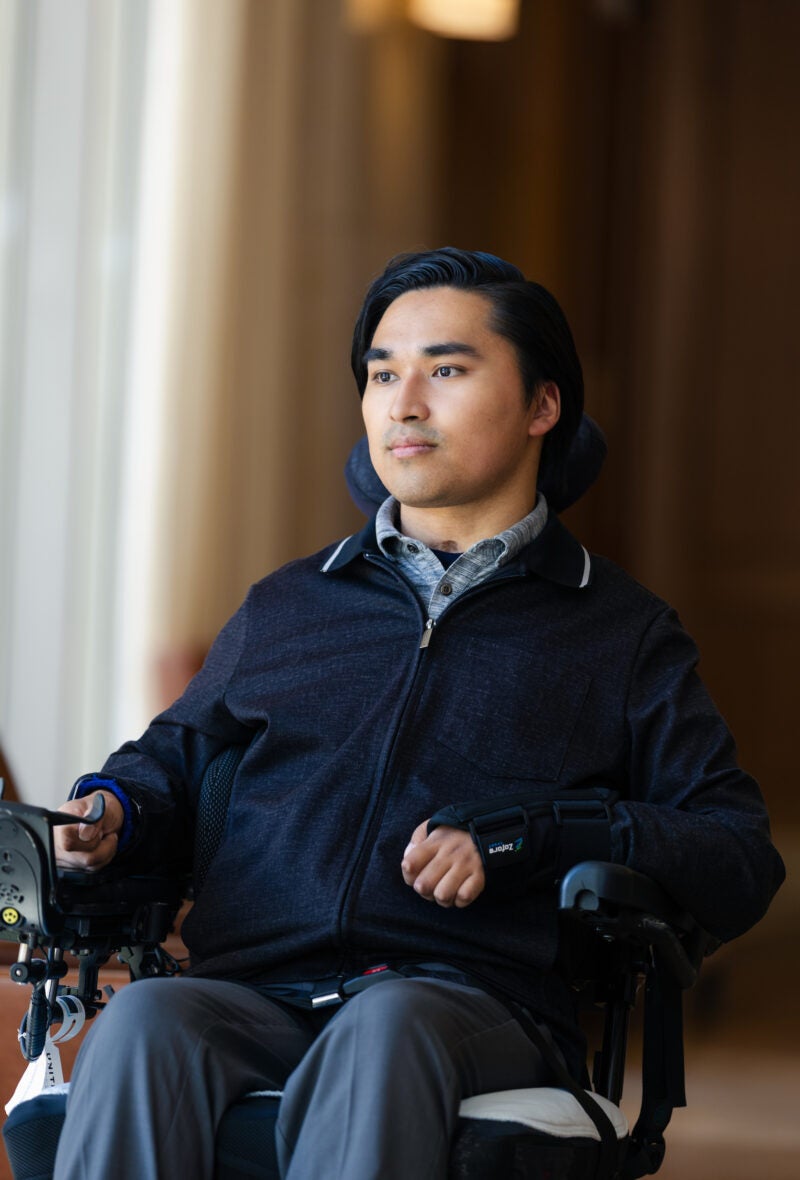
He suffered greatly, but Reo Hayashizaki ’26 considers himself lucky.
After a 2016 car crash in his home state of Oklahoma left him with a severe spinal cord injury, Hayashizaki spent months in a hospital and rehab facility recovering and learning how to live life from an electric wheelchair. He also watched as young patients around him tried to heal without the daily love and support he received from his family, and he decided to do something about that.
“I realized I’m the lucky one here,” said Hayashizaki who graduates this month with a J.D., a master’s degree from the Harvard T.H. Chan School of Public Health, and a plan for a career focused on health care reform. “I was able to go home but not everybody in my position could go home. They may have had to go to a nursing home … or they were home bound because they didn’t have the appropriate nursing help or appropriate familial support.”
“I took a forward-looking purpose to the suffering,” Hayashizaki said during an interview in Harkness Commons. “I realized everything happens for a reason, and I had to define this purpose for myself, because otherwise, the suffering would have been for nothing.”
That forward-looking approach, one focused on how to improve health care, particularly for those with disabilities, has remained for a decade. At Harvard he has studied all parts of the system, from policy to primary care reimbursements and more. He took part in the law school’s health care clinics, worked at a local hospital, and collaborated on software to help people with disabilities navigate the health care space. Quick with a laugh and a smile, Hayashizaki said his positive outlook is a result of the many challenges he has faced. “I know how bad it can get. I recognize how lucky I am, because it’s like, I’m here, you know, at Harvard Law School. Who would have imagined?”
Given his unwavering determination, many who know him likely saw it coming. As an undergraduate at the University of Oklahoma Hayashizaki pursued a dual major in finance and health care business and supplemented his studies with internships and summer jobs, learning the health care landscape from the legislative, financial, administrative, and agency perspectives.
He also learned the importance of a law degree. While doing financial modeling for Oklahoma’s largest nonprofit health care system, he began to understand the challenges hospitals face to cut costs while maintaining safety standards. During an exercise for a college class, he took on the role of the head of an outpatient clinic, offering to fund a struggling primary care physicians’ group in exchange for patient referrals. Hayashizaki was pleased with his solution until his professor told him it was “highly illegal” and a violation of the federal Anti-Kickback Statute.
Those experiences, he said, helped him to realize he needed his J.D.
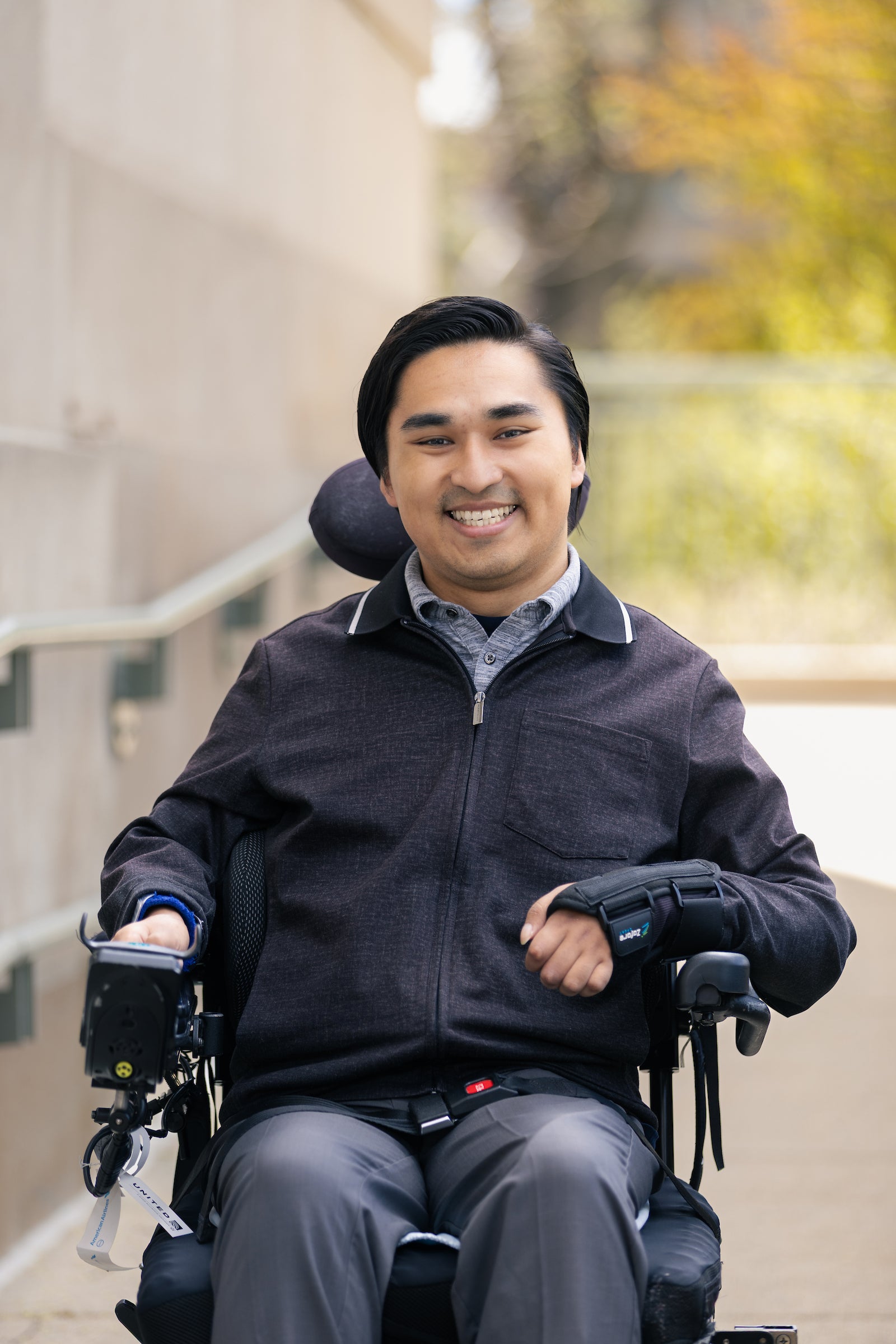
“I realized everything happens for a reason, and I had to define this purpose for myself, because otherwise, the suffering would have been for nothing.”
Hayashizaki applied to Harvard in part because he could pursue two degrees simultaneously. He decided to attend while at admitted students’ weekend. He remembers being shown around by a member of the Harvard Disabled Law Students Association, Kate Strickland ’24, a fellow wheelchair user. He also saw three other students using powered wheelchairs on campus.
“[I knew] Harvard is the place for me,” said Hayashizaki, “and that it would get me out there giving back as quickly as possible.”
Being a part of DLSA, both a source of professional and social support, was central to his Harvard time, said Hayashizaki, who was the group’s president during his 2L year and is currently its treasurer. He attended HLS Parody, dinners, and pottery-painting nights with his association friends, and took part in a range of DLSA-sponsored discussions including one with the first blind justice elected to the Michigan Supreme Court, and with lawyers working in a big law firms who explained the process of learning how, as disabled individuals, to thrive there.
On campus Hayashizaki could often be found at the Center for Health Law and Policy, studying with Assistant Clinical Professor of Law Carmel Shachar J.D./M.P.H. ’10, who became an important guide. “I took her 1L reading group, I took her class, I took her clinic. She is just so, so kind, willing to help you, willing to mentor you. I didn’t know that I was going to get that at Harvard,” said Hayashizaki.
He also took part in the Health Law and Policy Clinic with Clinical Instructor Rachel Landauer, helping deliver presentations to policymakers with “real decision-making authority.” In those conversations participants took an expansive approach to a range of topics such as food as a healthcare intervention, said Hayashizaki, addressing the idea of “food not just as a commodity but food as medicine.”
When not at the law school, he was busy collaborating with students at the Harvard Kennedy School as part of its Zuckerman Fellowship, a co-curricular leadership development program. He also enrolled in classes at Harvard Business School and the Graduate School of Education, and began working with scholars from Harvard, the University of Alabama, and Vanderbilt University on an app to improve health care access for people with disabilities.
His time at the school of public health included an internship with Boston Medical Center working in its legal department on projects such as the transfer into the system of Good Samaritan Medical Center in Brockton and St. Elizabeth’s Medical Center in Brighton following the collapse of the for-profit hospital network Steward.
It was an eye-opening experience. In mergers and acquisitions, much of the financial work is done once the contracts are signed “and the money is paid out,” said Hayashizaki. “But the integration of culture, the integration of policy, the integration of contracts, all those kinds of things take years. And being able to work alongside people who were pushing for that was just truly a pleasure.”
Hayashizaki considers himself lucky to have a wonderful family that has supported him in every way. His mother Emi has been living with him the past three years, helping with his care, and his sister is considering attending medical school inspired by the care her brother received during his recovery. He is looking forward to seeing her at graduation in Cambridge, along with his parents, and three former teachers from his home state who were instrumental in helping him complete high school and college.
“Boston’s kind of far from Oklahoma,” he said, “so I’m so thankful and honored that they’re making the time to make this trip up for me.”
Next for Hayashizaki is a job with Ropes & Gray in Boston where he plans to work with the firm’s health care law division, helping “hospitals make transformative decisions.” Long term, he hopes to help others with disabilities so they can finish their studies, and he doesn’t rule out becoming the nation’s healthcare secretary someday. But earlier he hopes to become Oklahoma’s secretary of public health, in part to give back to the community of doctors, nurses, therapists, teachers, and friends who helped change his life.
“I want to go back to Oklahoma,” said Hayashizaki. “I owe it to the people there. They have done so much for me.”
Want to stay up to date with Harvard Law Today? Sign up for our weekly newsletter.