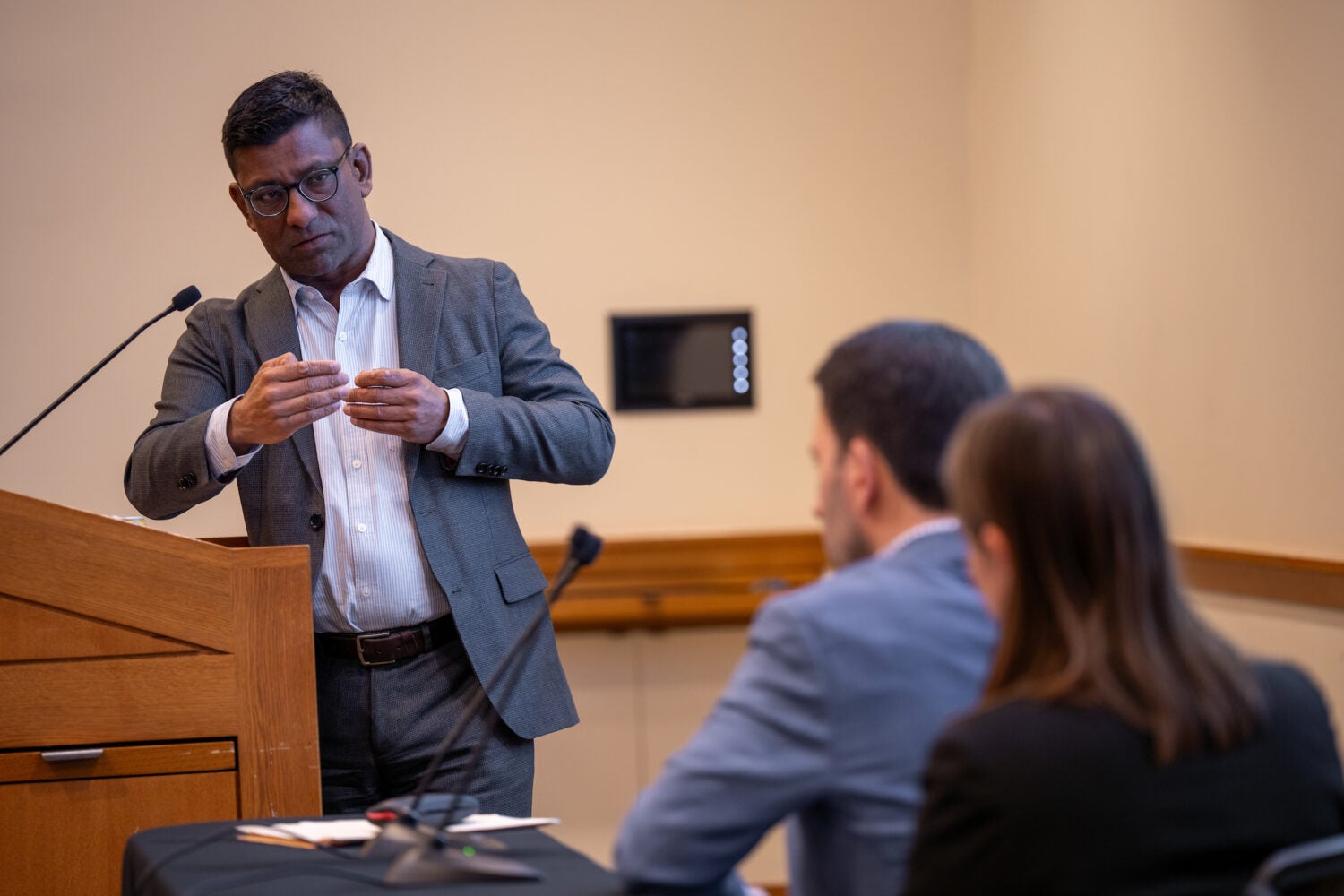
When the rule of law is eroded in a democracy, it can be difficult to restore, says Aziz Z. Huq, a scholar of U.S. and comparative constitutional law and a professor at the University of Chicago Law School.
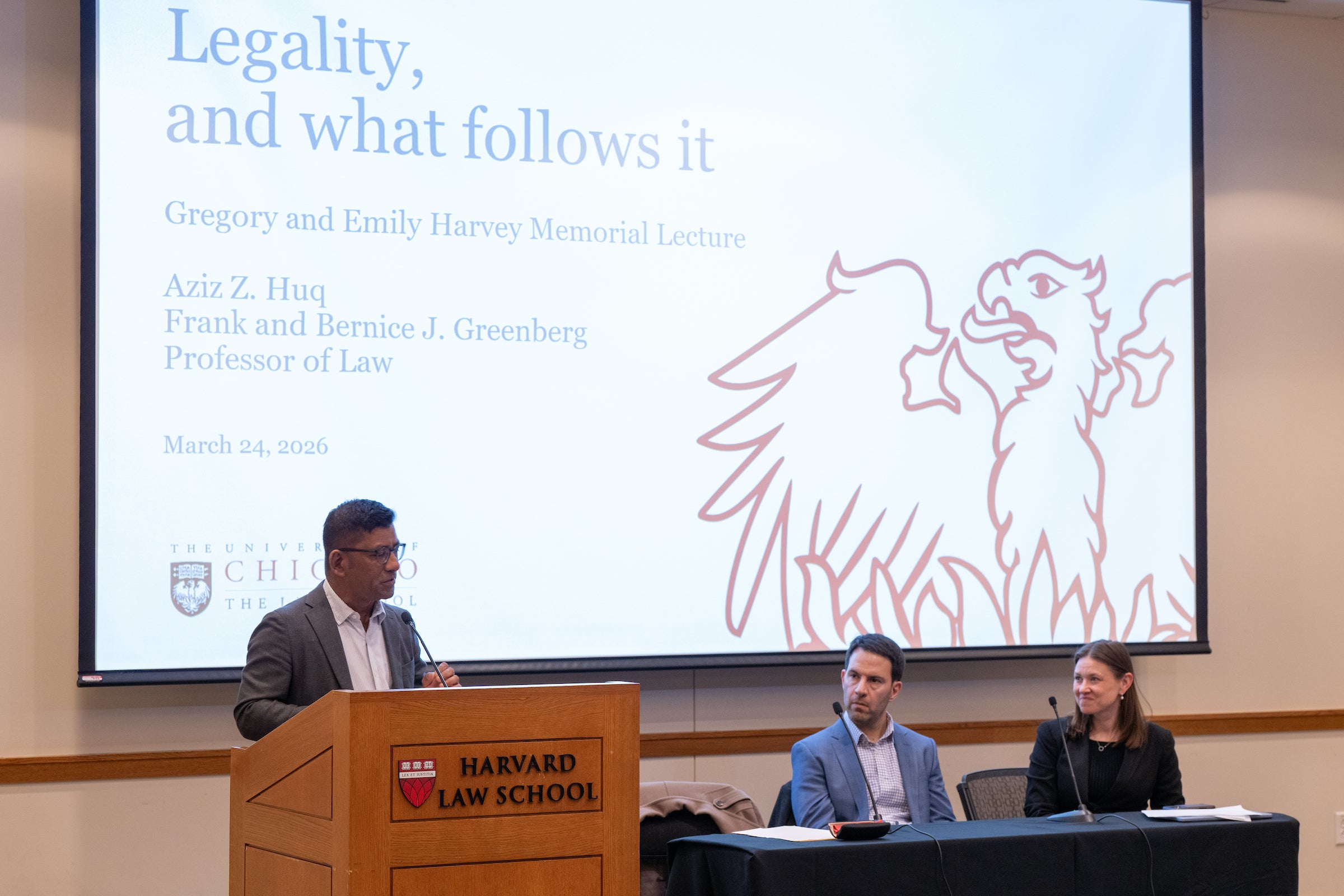
Huq spoke at the Harvard Law School Election Law Clinic’s inaugural Gregory and Emily Harvey Memorial Lecture on March 24.
Drawing on the work of two past German scholars, Ernst Fraenkel and Max Weber, and making comparisons across countries, Huq pointed to worrisome trends in the United States in which he says the ordinary meaning and practice of law have been either ignored or used to insert coercion into previously collaborative relationships. He also sees instances in which legal systems and institutions are being used to benefit members of the Trump administration or their allies.
“It is hard to imagine how one practices democracy in the absence of a stable set of legal institutions that are operationalized in predictable ways,” Huq said.
Huq offered numerous examples of these trends, which Fraenkel called the dual state and Weber called patrimonialism.
“It is not my claim that the entire federal government or the entire complex of state and federal law of the United States is characterized” by these trends, Huq said. But, he said, the ideas are useful to explain “a significant direction of travel in the nature of legality in the United States.”
Huq, a former counsel for and director of the Brennan Center’s Liberty and National Security Program, has focused his work recently on democratic backsliding. In 2018, he co-wrote the book “How to Save a Constitutional Democracy,” in which he and Tom Ginsburg examined anti-democratic movements in other countries and highlighted how weaknesses in the U.S. Constitution could damage democracy here.
Huq also has written recently on how U.S. democratic failures can lead to harm in other countries. In an op-ed published earlier this month in Le Monde, he and a co-author pointed out that Congress’ diminishing control over war powers has led to repeated conflicts abroad, including the current U.S. war in Iran.
Huq is working on a book about Fraenkel’s dual state framework.
Fraenkel was a Jewish lawyer who continued to practice in Nazi Germany until 1938 when he fled with his wife, first to the United Kingdom and later to the United States. (Despite the Nazi ban on Jewish lawyers, he had been able to work because of his service in World War I.) One thing Fraenkel noticed while practicing under the Nazi regime was that the “state was not characterized by a complete extinguishing of legality,” Huq said. Instead, “much of the familiar and ordinary legal system … continued to exist, notwithstanding the brutalities of the National Socialist regime as they consolidated their political hegemony.”
Huq described a case in which Fraenkel successfully represented members of a union who had lost their pension after the Nazis took power. His clients never received the money owed to them, however, and Fraenkel later found out that a member of the Gestapo had simply called the judge and told him not to enforce the judgment as directed.
In the United States, Huq said, a high-profile example of a similar disregard for the law was the Trump administration’s failure, despite court orders, to immediately facilitate the return of Kilmar Abrego Garcia to the United States after he was wrongfully deported and imprisoned in El Salvador.
Another form of Fraenkel’s dual statism plays out when the government uses its financial or regulatory powers to force “intolerable and unlawful concessions,” Huq said. He pointed to the Trump administration’s ultimately unsuccessful effort to force the state of Maine to ban transgender girls from female sports teams by threatening to withhold federal funding for education.
“This is an instance of a cooperative relation that is being flipped around and turned into a weapon,” Huq said.
The problem with dual state behaviors — or with using authority to benefit family members and allies — is that the damage to democratic beliefs, values, and practices can be hard to reverse. Citizens may become skeptical of any government action, wondering if it is legitimate or coercive, and people appointed to high-ranking positions by a patrimonial regime aren’t likely to give up those positions — or any accompanying power — easily. Huq pointed to the example of Poland where a liberal democratic politician, Donald Tusk, defeated an illiberal candidate in 2023 but has found it difficult to restore democratic practices after eight years of the previous party’s rule and the practices it installed.
“New constellations of both public and private power that will outlast the administration, the particular regime that has produced them … are not likely to blithely accept a change in the political climate,” Huq said. “These holdovers … that are created by the dual state and neo-patrimonial processes that I’ve described are going to fight tooth and nail to prevent a return to liberal legality, and they will have no hesitation in using the rhetorical tools of liberal legalism to achieve that end.”
The argument, he said, “paints a relatively bleak picture.” But he did offer some hope from history. He pointed out that threats to democracy are as old as the institution itself.
“Democracy moves on,” he said. “It adapts; it changes … the virtue of democracy is its capacity for endless reinvention, its possibility of being swept away, as it was even in Athenian times, but then being rebuilt, reimagined, and built better against the relentless tide of events and countervailing forces.”
The Gregory and Emily Harvey Memorial Lecture was endowed by the late Gregory M. Harvey ’62, an election law lawyer in Philadelphia, in memory of his late wife, Emily Mitchell Wallace Harvey.
Huq was introduced at the lecture by Election Law Clinic Director and Assistant Clinical Professor Ruth Greenwood. Clinic Director of Strategy and Kirkland & Ellis Professor of Law Nicholas Stephanopoulos led a Q&A with Huq after his remarks. (Huq and Stephanopoulos are former colleagues at the University of Chicago Law School.)
Created in 2021, the Election Law Clinic is the first such clinic in the country. It focuses on building power for voters, operating from the premise that the struggle for voting rights is a struggle for racial justice. Ongoing or recent cases include challenges to the redistricting process in DeSoto County, Mississippi, and racially gerrymandered districts in Jefferson County, Alabama, and a lawsuit to protect votes cast overseas and by members of the military in a North Carolina election.
Want to stay up to date with Harvard Law Today? Sign up for our weekly newsletter.