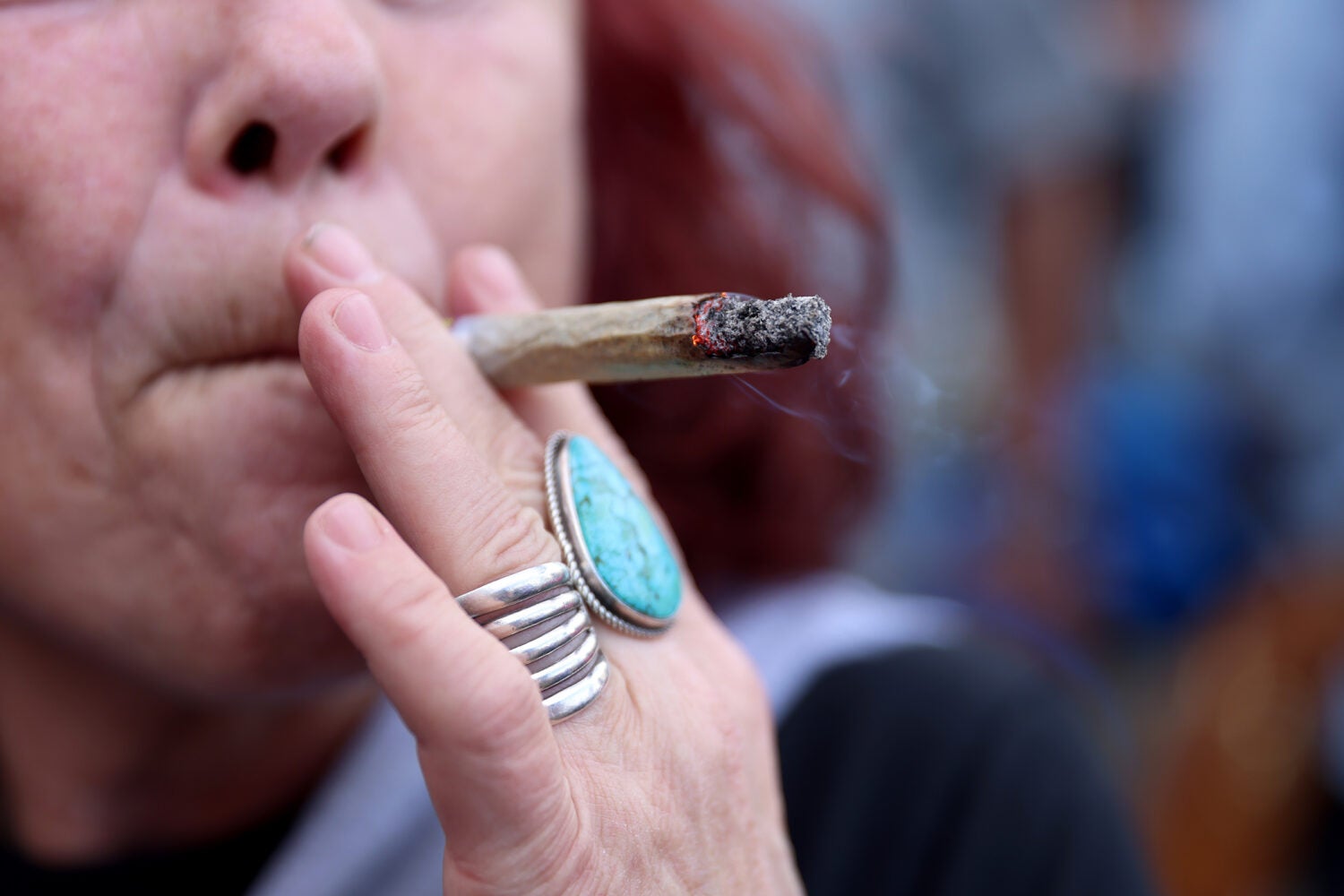
Let’s be blunt — these days, it can feel like getting Americans to agree on anything is a struggle. Between chronic polarization and information silos, opinions often seem baked in. But on at least one topic, there is joint approval: marijuana. In 2023, a Gallup poll found that a record 70% of Americans believed that the psychotropic drug should be legal.
Now, owing to a recent executive order by President Donald Trump, national decriminalization — if not outright legalization — may be one step closer. The president’s directive, issued in mid-December, instructs federal agencies to begin reclassifying cannabis from Schedule I, the most restricted group under the Controlled Substances Act, to Schedule III, which would allow the drug to be prescribed by a doctor.
But perhaps one of the most important results of the executive order would be to open the door to more medical research on marijuana and related products, explains Carmel Shachar J.D./M.P.H. ’10, an assistant clinical professor at Harvard Law School.
Under the drug’s current classification, it can take a long time to win federal approval for studies, and the plant must be procured by researchers from specific sources, says Shachar, who is also the faculty director of Harvard’s Health Law and Policy Clinic.
A change would mean that marijuana and other cannabinoid products can be better studied for their impact on users’ health, and for their utility in treating conditions like depression or post-traumatic stress disorder. While an effort to reclassify the drug began during President Joe Biden’s administration, Shachar says, it became mired in administrative problems, making this latest effort an important nudge to rulemaking agencies.
In an interview with Harvard Law Today, Shachar explained what the executive order ultimately means — and how it could lead to more knowledge about marijuana and its impacts.

Harvard Law Today: What does this executive order actually do?
Carmel Shachar: I think it’s important to note that in and of itself, this executive order doesn’t do a lot. Executive orders work by telling the administrative agencies what they would like to see and signaling to the public where the administration is going. This executive order is pushing to have marijuana removed as a Schedule I drug, which is the most restrictive schedule under the Controlled Substances Act, to Schedule III. That is not zero restrictions, but it is an acknowledgment that we do think that there are some reasonable medical applications and that research should be done.
Again, it doesn’t automatically change the scheduling. If you were hoping to launch your marijuana trial next Wednesday, that’s not going to work. But the Attorney General and the rest of the administrative apparatus that covers the Controlled Substances Act will be likely acting on this.
HLT: What does the rulemaking process look like?
Shachar: Rescheduling is a very long and formal process, which means that the Department of Justice needs to act, the administrator of the Drug Enforcement Administration needs to sign off, and there might need to be a hearing in front of the administrative law judge. All of this started happening during the Biden administration in 2024; it eventually got stuck in the administrative sausage-making process and fell apart.
The value of this new executive order is signaling to all of the many parties involved, especially the DEA administrator, that this is a priority for the White House and that the DEA administrator should act to achieve this goal.
HLT: What would reclassifying marijuana as a Schedule III drug mean?
Shachar: The first thing to appreciate is that the rationale behind a Schedule I drug is that there is no good reason for you to have it, and so that means that all of the legal apparatus is set up with expectation that there should be minimal research on it because there’s no real good use for it.
By contrast, Schedule III has limitations, and recognizes that a drug can be unsafe or addictive, but it does allow that there may be good reasons for access to these medications. I think what you will see with a move to Schedule III, which I think is likely given this executive order, is a lot more research being done on marijuana.
The EO really focuses on the need for research on cannabis, and it specifically directs Health and Human Services, and its subagencies, to develop research methods and models around these products. That’s largely a good thing, because already, the medical evidence suggests that there are some great uses of marijuana for managing pain or nausea, and so I would expect to see a lot of research studies with different applications to better understand when it is appropriate to prescribe cannabis and cannabis-derived products. We might also see some FDA submissions for products that make financial sense to go through the FDA regulatory approval process, which can be quite expensive.
HLT: The executive order also is careful to be inclusive of what it calls “hemp-derived cannabinoid products.” What are those, and why might the administration have wanted to be sure they were included in this?
Shachar: Hemp is a category that contains less than .3% THC, or at least that’s how it was defined in 2018, when Congress, in the Agricultural Improvements Act, split apart the legal category of marijuana and hemp. When Congress did that, hemp fell out of the Schedule I controlled substances, meaning it was no longer subject to the DA, although it was still regulated by the FDA. Then, back in November 2025, the Agricultural Appropriations Act amended the definition of hemp to bring some hemp products back under DA control. Now, it depends on exactly what percentage of THC you have.
But ultimately what that all means is that some hemp products that could be on the market under the 2018 Act would again be unlawful under the Controlled Substances Act. And so, what the EO tells the Trump administration to do is work with Congress to revise the hemp definition, to make these products more available. But we have to remember that an executive order is not binding on Congress, because Congress is not part of the executive branch. That said, I think an executive order is a good signaling message, if I’m a senator or a member of the House, and I’m aligned with the Trump administration, I might read this executive order as something the administration wants me to do. But again, they don’t have to do it.
HLT: Could this executive order have any impact on law enforcement related to marijuana?
Shachar: It’s interesting — right now, we’re in an era in which the federal government has turned a somewhat blind eye in terms of enforcement to marijuana, because there are a lot of states now that allow for either medical use or for what is sometimes called recreational use or adult use. We’re not seeing a ton of enforcement federally, but I think moving it to Schedule III will further relax that, but again with the caveat that Schedule III doesn’t necessarily allow for recreational use dispensaries. As a result, some of that industry will remain in a legal gray area.
HLT: It wasn’t so long ago that presidents from both sides of the aisle were against loosening federal marijuana restrictions. But in recent years, both the Biden and Trump administrations have looked more favorably on the idea. What changed?
Shachar: I think there’s been a real social shift in the last decade or so when it comes to cannabis. States decriminalized or legalized access to it and the sky didn’t fall. People now view it as somewhat similar to alcohol: something that can be responsibly enjoyed, even if there are some serious counterarguments to why you shouldn’t have that whisky sour or edible. It’s such a broad social shift, across generational lines, that it isn’t surprising that both parties are embracing this change.
Want to stay up to date with Harvard Law Today? Sign up for our weekly newsletter.