Kudos!
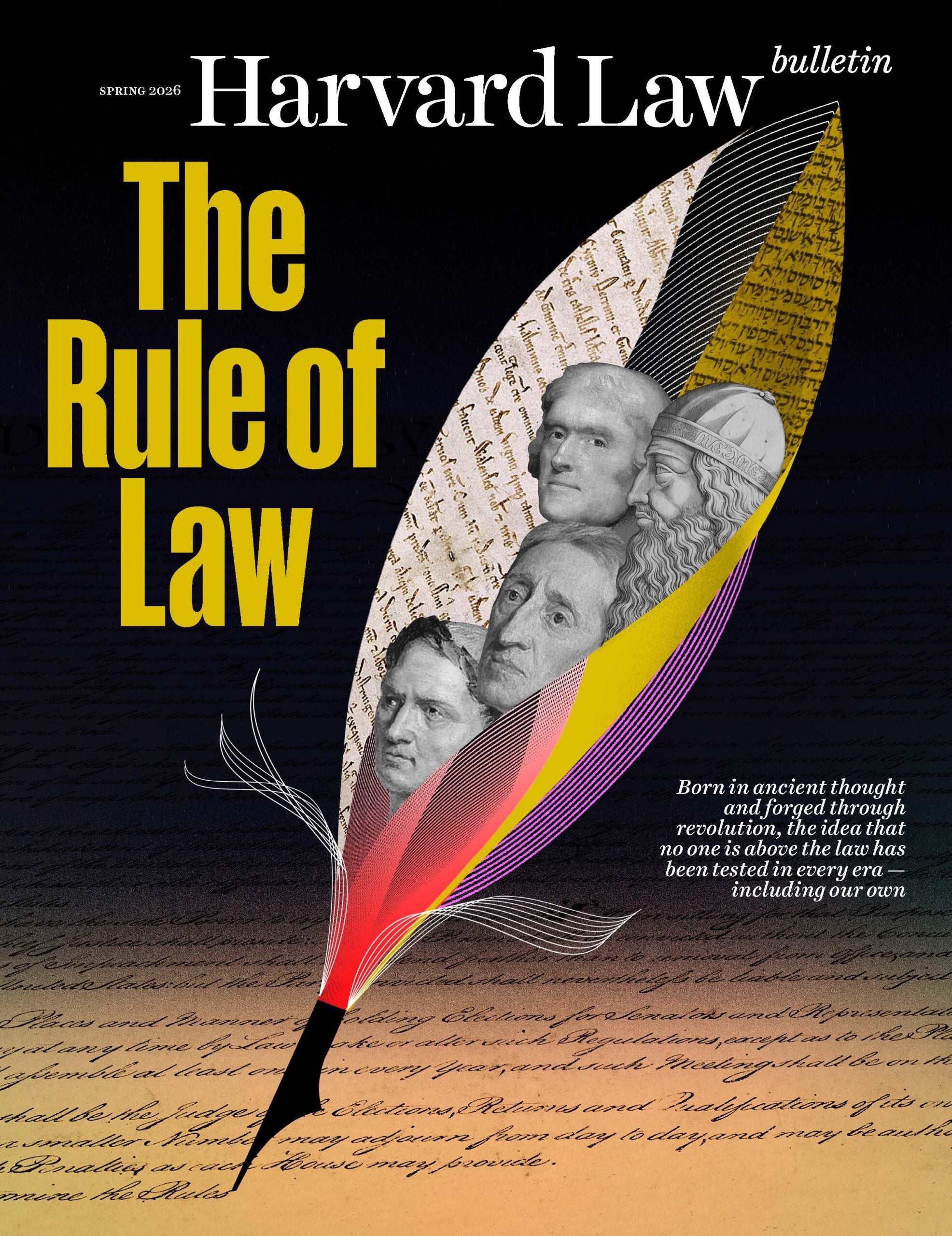
For years, I have been receiving the Harvard Law Bulletin at whatever address I was living at. I’ve always just glanced through it to see if there was somebody I knew in there, but for the first time I actually sat down and read most of the Spring 2026 Bulletin. Wow, I’ve been missing out. Great job. I really enjoyed it.
Carey Worrell ’03
Setting Precedent
The article pointing out that Shakespeare’s Richard II was deposed by an Act of Parliament forgot to mention that once Bolingbroke, now Henry IV, took over the throne, he had Richard II murdered.
Another fact of interest: When the play was performed during Elizabeth I’s reign, in an act of censorship, she had the scene giving Parliament authority to depose the king removed. She thought it a bad precedent and one that could be used against her.
Geoffrey M. Connor ’73
Maintaining Balance
Being on the conservative side of the political spectrum, I have suffered (and sometimes criticized) the Bulletin’s (and the school’s) painfully endless liberal bias over the past decade. But today I am happy to acknowledge that your most recent issue [Spring 2026] has taken a major step away from liberal bias and toward (gasp!) balanced reporting.
The new issue includes no fewer than three articles featuring students or speakers with conservative (or likely conservative) political views. Your feature on 2009 graduate Jennie Bradley Lichter emphasizes her commitment to the pro-life movement, with neither criticism nor disdain. Your “Inside HLS” feature on a debate between conservative law professor Jonathan H. Adler and presumably not-conservative scholar Kate Shaw displayed no favoritism. Finally, your “Student Snapshot” on former Air Force and Space Force intelligence officer Kent Romney ’28 emphasized his love of country and devotion to the U.S. Constitution—values that are not expressly political but are rarely announced publicly in and around the Harvard campus.
Good work, Harvard Law Bulletin! But don’t get cocky: I guarantee that many of your alumni will be looking closely to assure your continued emphasis on balanced reporting.
Mark Rutzick ’73
Internet, Not Web
The article “We don’t know what the risks are” [“Inside HLS,” Spring 2026] opens with a reference to the release of the Morris worm on ARPANET in November 1988 and goes on to remark that it “infected thousands of computers on the fledgling World Wide Web.”
To be precise, the World Wide Web did not exist at the time that the Morris worm was released. It was a year later, in 1989, that Tim Berners-Lee first wrote a proposal at CERN to build a protocol (HTML) to represent hypertext documents and another protocol (HTTP) to exchange documents between internet nodes. An implementation of these protocols and ancillary software was made available to the public in August 1991. The web browser created to display and edit these documents was called WorldWideWeb; the name caught on.
Tomas Arango ’24
Editor’s Note: We did misuse the term World Wide Web and should have instead called it the “fledgling internet.” Thanks for the catch!
Double Distinction
The Bulletin’s article “Degree of Distinction” [Spring 2026] was interesting but, I think, mistaken as to President Rutherford B. Hayes’ Harvard law degree. He was born a few miles from where I now live and got his LL.B. the way most of us did—by actually attending the law school! Prior to Civil War military service that launched him onto a political career, he was a successful lawyer practicing in Ohio.
Alan J. Davidson ’63
Editor’s Note: President Hayes did indeed receive a traditional law degree from Harvard, but he also received an honorary one—a double degree of distinction, one might say.
10/10 Would Recommend
I’m not sure what you’ve done, or maybe it is just me, but I found this [Spring 2026] edition to be rock solid and impossible to put down. Thanks.
Henry Klaiman ’64
A Life-changing Clerkship

I read with great interest the article about judicial clerkships [“A Legal Training Ground,” Spring 2026]. The article resonated with my own experience as a judicial clerk, and I thought I would share some of the reasons that experience was a life-changing period for me.
In 1983–84, I had the privilege to clerk for Hon. Zita L. Weinshienk (HLS ’58), of the U.S. District Court for the District of Colorado, in Denver. Following a lengthy and distinguished tenure as a Colorado state court trial judge, Judge Weinshienk was appointed to the federal bench in 1979 by President Jimmy Carter, becoming the first woman to serve as a U.S. District Court judge in the state’s history.
During my 2L year, I applied for a few judicial clerkships. All of the positions were located in western states, because I wanted to live “out west.” After I finished with my classes and exams, I drove cross-country to take a summer associate position with a law firm in Los Angeles. I stopped off in Denver so I could interview with the judge, her law clerks, and her courtroom staff.
While I genuinely and thoroughly liked the judge and everyone else I met, little did I know that my one-year clerkship with the judge would result in her becoming a lifelong mentor, great friend, adviser, and confidante. In short, the judge became one of the most influential women in my entire life.
Judge Weinshienk took a risk in offering me the clerkship, because I was East Coast-born, -bred, and -educated. I had no direct connection to the state. But she must have sensed something, because by the time my clerkship ended, I had become a Colorado citizen and accepted an offer to join a major Denver law firm.
I came to view the judge and her staff as my second family, some of whom I have remained in contact with ever since. In fact, Judge Weinshienk’s law clerks were collectively so fond of the judge and her staff that a clerk-alumni group known as the “Z-Team” was founded. For many years, the Z-Team held annual reunions, usually at the judge’s house.
There was another, unfortunate, reason the judge and I became lifelong close friends. I had only been a clerk for a few months when the judge’s husband passed away from a cancer that had remained undetected until it was terminal.
Less than one month later, my youngest sister died in a horseback riding accident in the Chicago area. Even though Judge Weinshienk was still grieving herself, she did not hesitate to provide me with the sympathy, comfort, and support I needed while my sister lingered in a coma that lasted three weeks before she passed.
My clerkship caused me to move to Colorado. But Judge Weinshienk caused me to fall in love with the state and its people. To this day I still think of Colorado as my second home state, where I developed and still cherish some of the best friends of my life.
For these and many other reasons, I am eternally grateful to Judge Weinshienk for hiring me as a clerk. She passed away in the fall of 2022, and I will always miss her.
Curt Krechevsky ’82
We want to hear from you
Online: Submit your letter
Email: bulletin@law.harvard.edu
Mail: Harvard Law Bulletin, 1563 Mass. Ave., Cambridge, MA 02138
Letters may be edited for length and clarity.