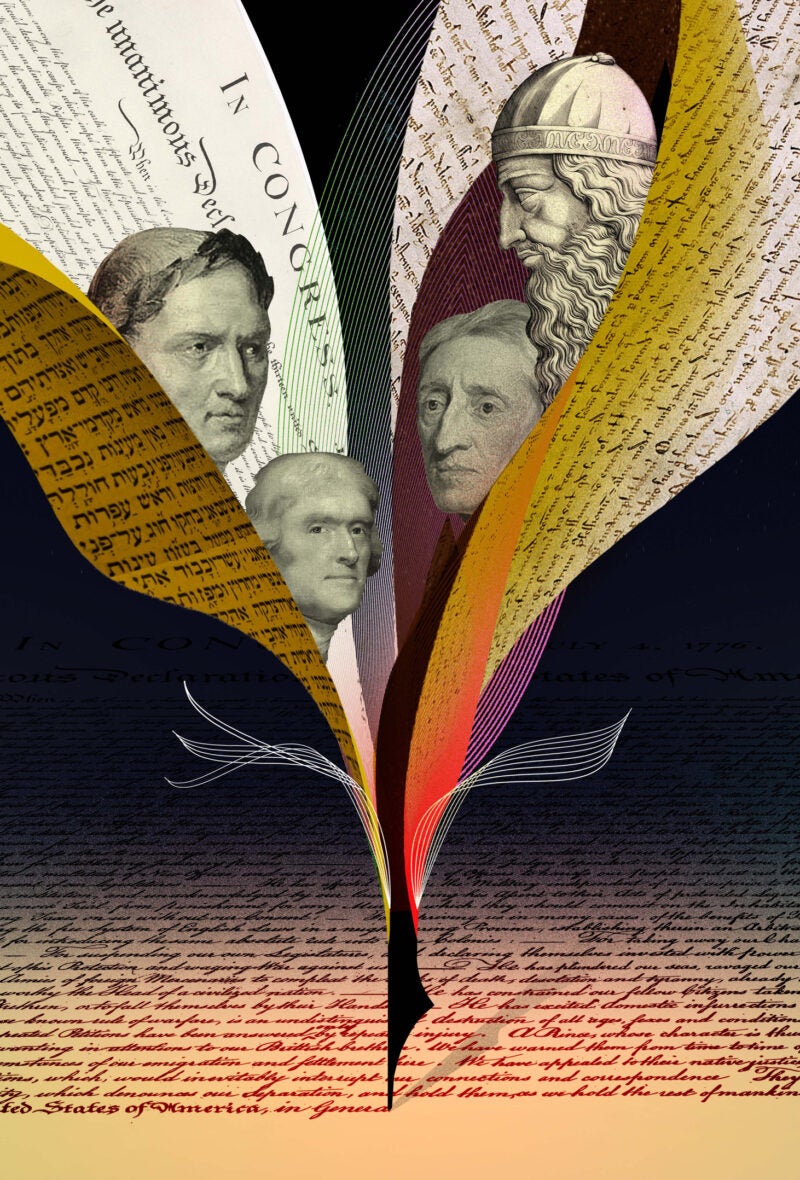
In 1399, King Richard II of England was stripped of his crown by his cousin, Henry Bolingbroke, with the support of Parliament. The outgoing king, it was argued, had become increasingly autocratic, taking revenge on enemies, alienating nobles, and governing tyrannically.
After Richard’s abdication, Parliament formally recorded the charges against him, both to justify the succession of Bolingbroke (now known as Henry IV) to the throne, and to frame his predecessor’s deposition as a lawful act. Among the document’s chief complaints was that Richard “expressly said, with an austere and determined countenance, that his laws were in his own mouth or, occasionally, in his own breast.”
Nearly 600 years later, another Richard, this one former American President Nixon, spoke to journalist David Frost about decisions he had made in office. Despite insisting that he understood the chief executive to be bound by the law, Nixon argued that some actions taken by the president, such as those done in service of national security, are lawful. Full stop.
“When the president does it,” Nixon famously said, “that means that it is not illegal.”
Both Richards had, in effect, challenged a key principle of what has become known as the “rule of law” — the idea that no one, neither citizen nor city clerk nor king, is above the law.
The idea continues to underpin the American legal tradition, as it does that of many other nations. Today, the concept has taken on renewed prominence in disputes over presidential criminal immunity — most recently in Trump v. United States — with supporters and critics alike claiming the rule of law as a central principle.
But where does the concept come from, and what does it encompass? Harvard Law scholars are examining these and other questions, drawing on legal history, legal theory, and contemporary legal practice to illuminate how the rule of law has been understood — and contested — over time.
‘A Government of Laws and Not of Men’
Harvard Law School Professor Noah Feldman points to a basic formulation found in the Massachusetts Constitution, which was authored by Harvard lawyer and patriot John Adams, and ratified in 1780.
“[The rule of law] provides that we be a government of laws and not of men,” says Feldman, the Harvard Law School Arthur Kingsley Porter University Professor.
At minimum, Feldman says, the rule of law requires that crucial decisions made by government actors are “shaped, governed, and controlled to some degree by the legal rules that are established for them.”
In the Anglo-American tradition, the rule of law has long been understood to require that rulers, along with the ruled, be subject to laws. It necessitates also that legal rules be publicly accessible and implemented through fair procedures, and that rule violations ordinarily give rise to meaningful forms of accountability. And while the rule of law does not preclude discretion in enforcing the law, Feldman says that where such leeway exists, it must be “because the legal system authorizes that discretion, rather than because someone just decides to extend it.”
That means that the law, in principle, applies to everyone, with no categorical exceptions for the wealthy, powerful, or connected, Feldman says. In other words, no one is supposed to be above the law. “That’s the aspirational part of the rule of law — that the system will follow the rules always, and not have deviations based on factors that aren’t considered legitimate within the law.”
In 1399, King Richard II of England was stripped of his crown by his cousin, Henry Bolingbroke, with the support of Parliament. The outgoing king, it was argued, had become increasingly autocratic, taking revenge on enemies, alienating nobles, and governing tyrannically.
An Evolving Norm
Although the phrase “rule of law” was popularized only as long ago as the 19th century, many of the ideas underpinning the concept are hundreds, perhaps thousands, of years old, and in the Western tradition have roots in sources such as the Hebrew Bible and the writings of ancient Roman and Greek thinkers like Cicero and Aristotle.
According to Elizabeth Papp Kamali ’07, the Austin Wakeman Scott Professor of Law at Harvard, inklings of these ideas can be found in English legal thought by the 12th century. But Kamali says one of the first clear articulations of the concept that no person is above the law is found in the early-13th-century treatise “De Legibus Et Consuetudinibus Angliæ,” also known as “Bracton’s On the Laws and Customs of England” and commonly referred to as “Bracton.”
Long attributed to Henry of Bratton, a 13th-century judge and cleric, but likely written at least in part by royal justices William of Raleigh and Martin of Pattishall, the work describes the English legal system as it existed at that time, including statutes, court decisions, and legal customs — and borrows extensively from Roman and canon law sources as well. Among the most famous of its maxims is “Non sub homine sed sub Deo et lege” — “Not under man but under God and law” — which is inscribed above the entrance to Harvard Law’s Langdell Hall. The treatise further declares, “There is no rex [king] where will rules rather than lex [law].”
“In what may be a later addition to the treatise, Bracton indicates that, because the king is below the law, he ought to be bridled by his earls and barons if he is perceived to be acting lawlessly,” Kamali says.
This notion came to the fore when King John was compelled by English barons angry at his highhanded ruling style to affix his seal to Magna Carta in 1215. Although John quickly revoked the charter — which promised key protections for barons and the church — the document was an important step in conceding some limitations on the monarch, Kamali argues.
She says that the famous charter, which was reissued by subsequent kings, also contains provisions fundamental to conceptions of due process. “A king can’t simply declare, for example, ‘I’m going to seize the properties of this person,’” she says. “Instead, Magna Carta insists there has to be some process that precedes a judgment of that kind.”
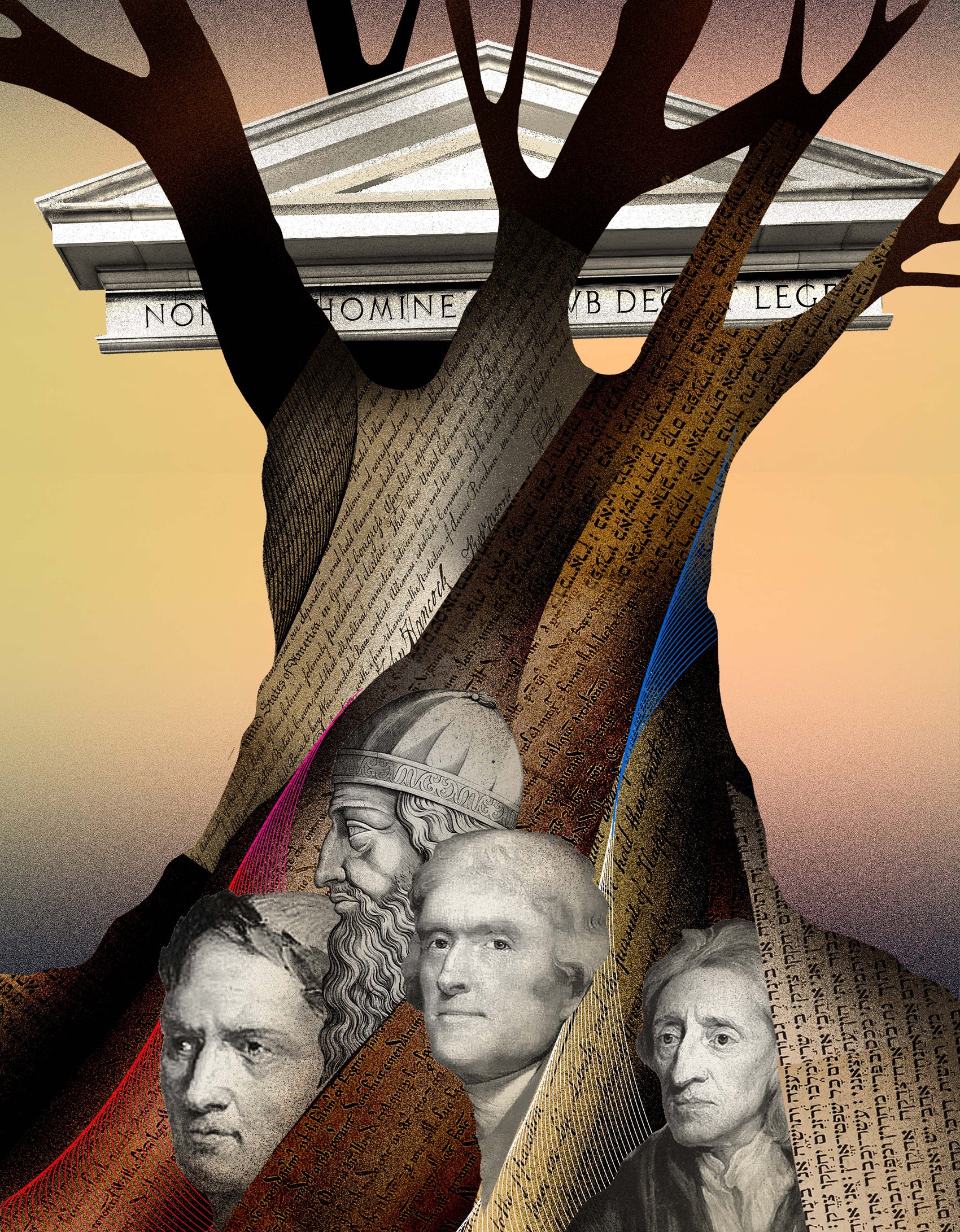
But there are tensions within Bracton and the reissuances of Magna Carta, Kamali adds. “There is no direct recourse to deal with violations by the king,” she says. “Instead, you have to trust the fact that he will moderate his behavior because he is a vicar of Christ on earth, and also because God will eventually judge him.” As the 13th century turned into the 14th, England’s Parliament, which had primarily served as an ad hoc councilor to the king, gradually developed into a body capable of holding monarchs accountable, and occasionally deposing them. “Over the course of time the idea developed that Parliament could stand in judgment of a king, determining whether he has exceeded the bounds of his authority,” Kamali says.
To this day, Parliament’s stated purpose is “to check and challenge the work of Government, make and shape effective laws, and debate/make decisions on the big issues of the day.” In other words, to create the law and hold everyone, including the nation’s leaders, accountable to it.
The 17th and 18th centuries saw the dawn of the Enlightenment and an increased emphasis on natural rights, reason, and progress, which fostered new ideas about political authority. In her book “These Truths,” Harvard Law School Professor Jill Lepore credits English barrister Sir Edward Coke with “resurrecting” Magna Carta in the 1600s as a political weapon against royal sovereignty. Coke helped cast the historic charter as a symbol of a long tradition of leaders constrained by law, she says. This resurrection of Magna Carta, Lepore writes, “explains a great deal about how it is that English colonists would one day come to believe that their king had no right to rule them.”
Further conflicts followed. A believer in the divine right of kings, Charles I fought with Parliament over rulership, government finance, and religion, with the end results being the English Civil War (1642-1651) and his execution. After the Glorious Revolution of 1688, Parliament passed the English Bill of Rights, formally establishing Britain as a constitutional monarchy where the king could not rule without Parliament’s consent. The king, it declared, was not above the law after all.
And in 1689, English philosopher John Locke argued that power flows not from the divine but from the governed themselves, who give their consent to secure fundamental rights such as life, liberty, and property. “Wherever law ends, tyranny begins,” he wrote in “Two Treatises of Government” — words that would soon inspire the founders of the United States.
A Revolutionary Idea
As the British colonists began establishing permanent communities in North America in the early 1600s, they brought with them English ideas about law and governance. But it’s important to note that legal influences on early America also came from many other sources, says Bruce H. Mann, the Carl F. Schipper, Jr. Professor of Law at Harvard.
“The American colonists were not a homogeneous group,” he says, pointing to significant influxes of English religious minorities, as well as Dutch, Germans, Scots-Irish, Swedish, and enslaved people from Africa, not to mention the Indigenous Americans these groups quickly displaced.
By the 1700s, expanded ties with England through immigration and commerce, along with British control of nearly all 13 colonies, meant that Americans had come to see themselves as more fully British than the earliest settlers had — a sentiment that was decidedly not shared by the British, Mann says.
People have long worked to build better systems of law and government, shaped by evolving ideas about liberty, fairness, representation, and equality.
As Great Britain began imposing trade restrictions and new taxes in the 1760s to alleviate debt it had accumulated defending the American colonies during the French and Indian War, Americans’ perception of their situation changed. “The Americans were outraged,” Mann says. “They saw themselves as loyal subjects, but here they were being taxed, even though they were not represented in Parliament. All of this made the colonists start looking at Great Britain through a very different lens.”
In the period leading up to the American Revolution, the colonists framed their various complaints against the British in legal terms, arguing that Parliament and the king had exceeded their authority in the law, Mann says. In doing so, he adds, “many British North Americans saw themselves as upholding the highest traditions of the common law,” which included rule-of-law principles.
But when these arguments ultimately failed, America’s founders looked to the ideas of the Anglo-Saxons, Magna Carta, and John Locke, as well as the common law, to justify declaring independence from Great Britain, Mann says. “The arguments for the Revolution were not just political ones, but legal ones as well.”
Feldman agrees. “The Revolution itself was revolutionary in the literal sense, because they were British laws, and the people who declared independence were claiming the right from natural law to break the British legal system,” he argues.
Independence didn’t mean a complete break from inherited principles, however. In fact, the founders embraced the ideal of the rule-of-law concept and elevated it in the U.S. Constitution. Unlike in the English system, where the monarch and later Parliament claimed sovereignty, Feldman says, the new American republic vested sovereignty in the people themselves, who then delegated authority to specific institutions. As Thomas Paine put it in 1776: “In America the law is king.”
Above the Law?
While everyone in the fledgling nation was supposed to be subject to the law, as with many ideals, this one was often flouted. In early America, Mann notes, this was most notably the case with enslavers, whose authority over the men, women, and children they enslaved was, in theory, subject to various legal limitations. “But in practice,” he says, “it was unlimited.”
Likewise, although the Constitution sets limits on federal officials’ exercise of power, and provides mechanisms, such as impeachment, to hold some of them to these limits, American presidents have also long faced accusations that they were acting “above the law,” most often in response to official policies and acts, other times for personal misconduct, or a tangled combination of the two. Legal and constitutional challenges related to the former — official presidential actions — have typically been resolved over time through the courts or political mechanisms, such as elections or congressional impeachment. But a constitutional crisis can arise when these processes fail to generate consensus, Feldman says.
“In a constitutional crisis, neither side will acknowledge that the other is a legitimate actor under the Constitution to do what they want to do, and no one knows what’s going to happen next,” he explains.
As a prominent example, Feldman points to President Abraham Lincoln’s suspension of habeas corpus during the Civil War, a move which was deeply controversial even among fellow Republicans. Taken as a war measure, the decision allowed the administration to hold people suspected of disloyalty in prison without trial. Lincoln’s policy may or may not have violated constitutional strictures, though U.S. Chief Justice Roger Taney, writing in a federal court case called Ex parte Merryman (1861), certainly thought it had. But Congress stepped in to authorize suspension in 1863, and Lincoln was never prosecuted for his actions.
While few argue that presidents are or should be above the law, profound disagreements exist about the scope of executive power.
That is the other way in which a chief executive may theoretically be subject to the law: in a personal criminal or civil case, an idea tested in the 20th century during Nixon’s administration.
In 1972, during the Watergate scandal, Nixon participated in covering up a break-in at the Democratic National Committee headquarters by those working for his reelection campaign. A grand jury drafted an indictment against Nixon for obstruction of justice and other offenses, but prosecutors questioned whether they could charge the sitting president.
Ultimately, a 1973 Department of Justice memorandum concluded that indicting a president while in office would impermissibly interfere with the functioning of the executive branch. Instead, the impeachment process would have to suffice while Nixon was still president — a process that would surely have happened had Nixon not voluntarily relinquished his office in 1974, Feldman says.
“When Nixon resigned, that crisis was resolved,” he says. President Gerald Ford’s controversial decision to grant his predecessor “a full, free and absolute pardon” ended the possibility that Nixon might have been indicted and the question of presidential immunity tested in the courts.
In the late 1990s, President Bill Clinton, too, battled accusations of impropriety. In Clinton v. Jones, the Supreme Court made it clear that the president was not immune from civil litigation for conduct that occurred before taking office. Then, in 1998, Clinton faced threats of prosecution for obstruction of justice and perjury for lying about his relationship with White House intern Monica Lewinsky. The independent counsel investigating the allegations again deferred to the impeachment process rather than pursuing criminal charges.
In 2000, the Department of Justice issued a memo reaffirming its policy against criminally prosecuting a sitting president, while expressing the view that the chief executive might still be prosecuted after leaving office. But this would not be the final word on presidential immunity.
Presidential Power in Flux
Debates about the scope of presidential power and the capacity of legal institutions to hold modern presidents subject to the law during and after their time in office have recently flared with renewed urgency.
John C.P. Goldberg, the Morgan and Helen Chu Dean of Harvard Law School, points out that there is a difference between official actions that may exceed the powers of the presidency and administration officials’ refusal to comply with specific court orders, at least when it comes to rule-of-law concerns.
“The former — when presidents and other officials push the boundaries of their authority — have been commonplace throughout U.S. history, and don’t threaten the rule of law if courts can be relied on to determine the lawfulness or illegality of these actions,” Goldberg says.
It’s when chief executives try to thwart the judiciary that problems arise. “The failure to heed properly issued court orders is a more direct threat to the rule of law,” Goldberg says. “It at least suggests that the executive branch will decide for itself what the law permits, which is closer to having no controlling law at all.”
Today, the administration of President Donald Trump, who survived two impeachments during his first term, has reportedly faced more than 700 lawsuits targeting his administration’s policies on issues ranging from immigration and the environment to trade, federal agencies, and more.
“There is this perception that Trump is really pushing the envelope of what is legally permitted,” Feldman says.
So far, these controversies are being hashed out in the usual way — through the courts, which ruled against the administration 75% of the time in 2025, according to a New York Times analysis.
But while “the administration has not yet admitted to directly violating a court order,” Feldman says, “there is a perception that the rule of law is in jeopardy, because of their overt attacks on judges, overt attacks on the legal procedure, and hints that if push came to shove, they might be willing to violate the law if it were absolutely necessary.”
This concern was sharpened by the Supreme Court’s 2024 decision in Trump v. United States, which arose from an indictment of then-former President Trump for allegedly conspiring to overturn the 2020 election results. In its decision, six of the Court’s nine justices held that a former president is completely protected from criminal prosecution for conduct that was within the authority exclusively delegated to the office by the Constitution, and presumptively immune from prosecution for the exercise of powers shared with Congress.
The Court ultimately returned the case to the lower courts to consider the extent to which some of the president’s actions were within his constitutional authority. The case was then dismissed after Trump won a second term in 2024, and experts disagree about the impact of the decision.
A Variety of Perspectives
Harvard Law scholars have expressed various perspectives about the Court’s presidential immunity ruling and what it portends for the rule of law.
Feldman says that some degree of immunity for the chief executive is not inherently incompatible with the rule of law: Government officials are routinely shielded from civil suits for conduct consistent with established legal rules. But he worries about the implications if the Court’s reasoning is pushed to its limits.
“If a government official, including the president, could overtly break all the laws and avoid all consequences of that, at some point, the law would no longer constrain that person, and then you wouldn’t be in a rule-of-law system,” Feldman says.
Goldberg and Fordham Law Professor Benjamin Zipursky share that concern. In “The Roberts Court Paradox,” a 2025 article in Fordham Law Review, they argue that the Court, out of an exaggerated concern to provide very clear, bright-line rules, adopted an unduly broad rule of immunity when a more nuanced, standards-based approach would have allowed for some legal accountability for presidential crimes without interfering with the ability of presidents to perform their official duties.
Adrian Vermeule ’93, the Ralph S. Tyler, Jr. Professor of Constitutional Law at Harvard, views the decision differently. He draws a distinction between the law’s directive and coercive elements — that is, the president’s obligations under the law versus the consequences for failing to follow it. Even if presidents are immune from criminal prosecution, Vermeule argues, they remain “subject to substantive legal obligations” and are therefore still bound by the law in an important sense. “His authority, even in an official capacity, is always subject to and indeed constituted by the law in its directive sense,” he writes in a post on his Substack, “The New Digest.”
Jack Goldsmith, the Learned Hand Professor of Law at Harvard, has argued that the immunity holding may be less consequential than critics fear. The decision’s more significant impact lies in its related rulings on the president’s exclusive removal power and exclusive power over investigation and prosecution, he writes in “The Presidency after Trump v. United States,” published in the University of Chicago Law School’s Supreme Court Review.
On the immunity question specifically, Goldsmith contends that norms of proper executive branch behavior — paired with the fact that lower-level officials remain subject to criminal prosecution — “are the main determinants of executive branch compliance with criminal law,” as he said in a 2024 speech.
In his Supreme Court Review article, Goldsmith points out that many factors inform a president’s compliance with criminal law. “One can certainly imagine a bad-man president engaging in widespread lawless criminal behavior,” he writes. “But, unfor tu- nately, the bad-man president had many tools to skirt the law before Trump [v. U.S.], to which its uncertain immunity ruling added relatively little.”
The Path Forward
For now, the full implications of the Court’s decision remain to be seen. While few argue that presidents are or should be above the law, profound disagreements exist about the scope of executive power — and the extent to which they may be personally subject to criminal or other court processes for violating the law.
Still, many experts are likely to concur with at least one of Feldman’s takeaways: Legal rules alone, he says, aren’t sufficient to sustain a rule-of-law system. “You need practices, norms — you need moral values,” he explains. “And if those are undermined, or they start to break down, then it’s very difficult to sustain any form of government in a regularized way.”
It is a lesson that echoes across the centuries, from Bracton to Nixon, from Magna Carta to the American Revolution to today. People have long worked to build better systems of law and government, shaped by evolving ideas about liberty, fairness, representation, and equality — in short, a commitment to the rule of law, including the idea that the law applies to even the most powerful among us.
As former U.S. Supreme Court Justice Anthony Kennedy ’61 said in a 2019 speech, “The rule of law … is the only secure foundation for the freedom to which we must always aspire.”