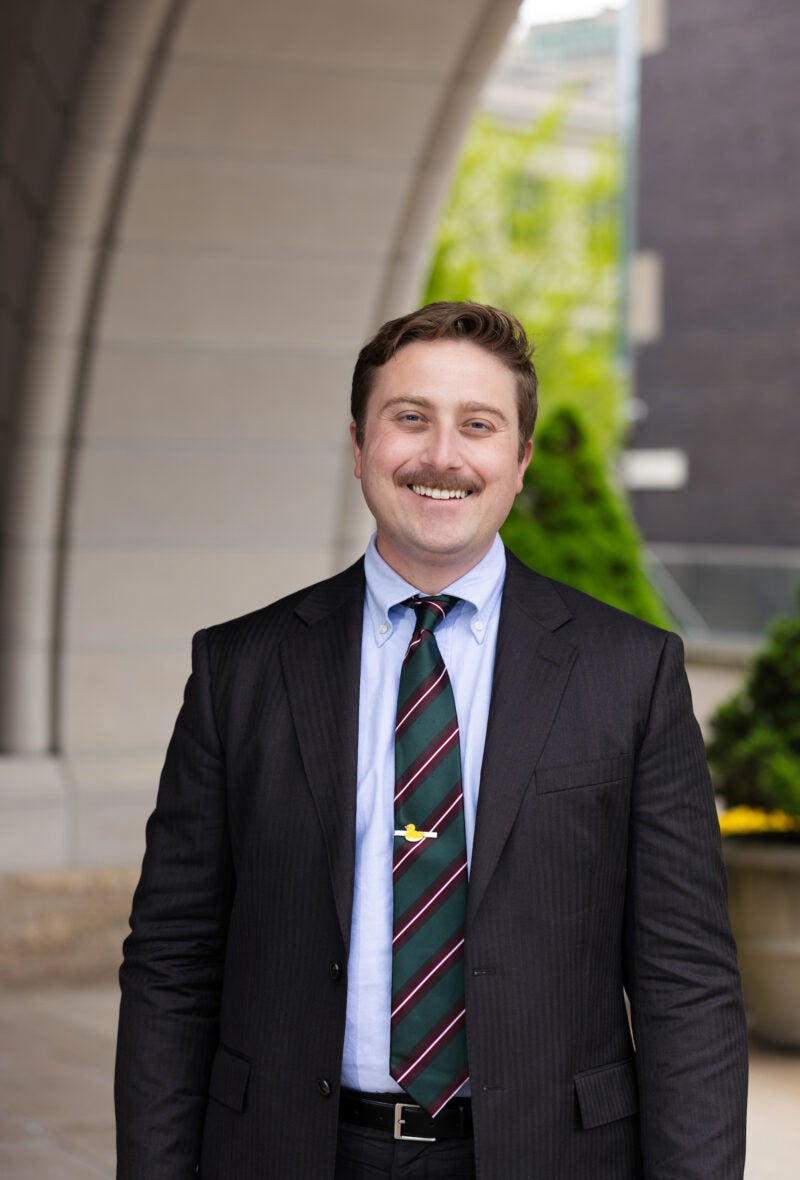
Jett Watson ’26 is the recipient of the 2026 David A. Grossman Exemplary Clinical Student Award. The award is given each year in honor of David Grossman ’88, who was faculty director of the Harvard Legal Aid Bureau, was a longtime director of the Housing Law Clinic of Harvard Law’s WilmerHale Legal Services Center, and was a champion of Harvard Law’s clinical programs who devoted his life to the pursuit of justice.
Across four semesters in the Veterans Law and Disability Benefits Clinic at LSC, Watson has embodied Grossman’s spirit of compassionate, client-centered representation as he served veteran clients on individual and system levels. Watson’s work in the clinic not only helped secure a class action settlement for hundreds of post-9/11 veterans from Massachusetts, but provided a sense of safety, security, and care to clients he worked with on estate planning, benefits, and discharge status reviews.
Receiving this award, Watson said, is “nerve-wracking, exciting, gratitude-inducing — it’s deeply moving, just like all the experiences I have been lucky enough to have in the clinic. I wasn’t lucky enough to know David Grossman, but his fingerprints are everywhere at the Legal Services Center. He helped make Harvard Law’s clinical program what it is today, and it is humbling that anyone would think of me in similar terms.”
Coming to Harvard Law after serving in the U.S. Navy, Watson felt called to join the veterans clinic during his second year of law school. The clinic is composed of three distinct areas serving veterans in various capacities: veterans justice, estate planning and safety net. While most clinic students decide to focus on just one area, Watson was the first student in the clinic to work across all three, requiring him to get up to speed quickly on a wide array of legal matters serving all manner of clients.
In the Veterans Justice Project, Watson spent four semesters on the Welcome Home Bonus case, a class-action challenge brought by the clinic against the Massachusetts Office of the State Treasurer, charging unlawful denial of benefit payments to post-9/11 veterans who served repeated enlistments but whose final discharge status was less-than-honorable due to challenges after deployments, discrimination, or similar experiences.
The case had a dense and lengthy history after years of clinic students ushering it through many stages of litigation. That didn’t give Watson any pause. He jumped in, second-chairing a class-certification motion hearing within a month of joining the clinic and then devoting the next semester to drafting a renewed motion for class certification, which entailed painstaking legal research and drafting a highly technical 20-page brief for the court with student co-counsel.
When the superior court scheduled arguments on the renewed motion for the middle of the summer, Watson stepped in to prepare and deliver a stellar oral argument, which led the court to grant class certification. He accomplished that while working as a summer associate at a law firm.
This year, Watson was the lead student engaging opposing counsel in negotiations over class relief and potential settlement, ultimately reaching a resolution that received preliminary approval from the court. The case now awaits its final fairness hearing. In large part due to Watson’s skill and dedication, the clinic could secure $500 cash bonuses for each of the nearly 1,000 represented Massachusetts veterans through the settlement.
The Welcome Home Bonus case, which encompassed an incredibly broad portfolio of work, was only one part of Watson’s myriad contributions.
In the Estate Planning Project, Watson carefully guided clients facing health and family challenges through the process of drafting their estate plans. Watson cultivated a deep sense of trust with his clients, creating plans that addressed their wishes and secured their legacies. Not only did this work require issue-spotting skills and attention to detail while drafting the plans, it also showcased Watson’s strengths in client counseling and trauma-informed lawyering as he worked to make sure each client was left with a sense of confidence about his or her estate plan.
“When I was in the Navy, I was taught that the best ship handlers never have to show how good they are,” Watson said. “My experiences with clients are the same. In an ideal world, I would never meet my clients in a situation where I am helping them with legal issues. In this world, I want to do my absolute best to make sure that their experience with me is pleasant, quick, and forgettable.”
In the Safety Net Project, Watson employed those strengths to ensure his clients were receiving the benefits they deserve after serving in the nation’s armed forces. His work has encompassed many types of challenges, including a notoriously difficult Department of Transitional Assistance appeal involving a client who had been accused of fraud in her receipt of SNAP benefits, while simultaneously working with another client on a Social Security disability appeal over a period of months. In each case, Watson brought a calming guidance to the client and confident performance to the bench.
His confident presence as an advocate never came at the cost of critical self-reflection; Watson’s instructors note his eagerness to zoom out, peel back the layers of what happened in client counseling sessions and court appearances, and ask himself what he might have done differently and better. After any event, Watson prepared “after action reports,” borrowing a term from military service, to unpack the choices made and how his performance could have been improved.
He credits his clinical instructors for teaching real-life lawyering lessons he could not learn anywhere else: “My clinical instructors Daniel Nagin, Destini Agüero, Dana Montalto, and Julie McCormack were the first people in the legal field I met that made me feel like, ‘Oh, I can do this.’ That feeling never really left me and drove me to pursue a career continuing this work.”
Watson also participated in the Harvard Mediation Program, serving on the student board as a training director. “HMP was my first brush with direct client services work, and it was truly inspiring for me,” he said. “When I began to see the real disputes and problems that people came to the legal system with, looking for a solution, it felt like I found a place to be helpful, where I truly fit.”
After graduation, Watson will work in Legal Aid Chicago’s Public Benefits Practice Group as a Skadden Fellow, increasing the reach of Legal Aid Chicago’s medical-legal partnership with Department of Veterans Affairs hospitals in Illinois.
“I would not be going down this path without the clinical work experiences I have had, and I am tremendously grateful for all the folks who changed my life in my clinical experiences.”
Want to stay up to date with Harvard Law Today? Sign up for our weekly newsletter.