
William D. Zabel ’61, whose career combined extraordinary success in private practice with a lifelong commitment to human rights, and whose work on Loving v. Virginia helped persuade the U.S. Supreme Court to strike down laws banning interracial marriage, died July 7, at his home in Bedford, New York. He was 89.
“Bill’s commitment to human rights and passion for justice was a throughline in his life,” said John Goldberg, the Morgan and Helen Chu Dean and Professor of Law at Harvard Law School. “He will be remembered for his wisdom, leadership, and a career devoted to making a difference for society and his clients.”
Describing Zabel as an “outstanding lawyer and friend beloved by so many,” Martha Minow, the 300th Anniversary University Professor and former dean of Harvard Law School, said: “Bill Zabel’s leadership and vision powerfully and memorably advanced civil rights and human rights in this country; I will always remember our warm conversations, the twinkle in his eye, and his many decades advancing justice.”
One of the nation’s leading trusts, estates, and family law attorneys, Zabel co-founded Schulte Roth & Zabel in 1969. A trusted advisor for many high-profile clients, he represented many of the country’s most prominent business leaders and philanthropists, including George Soros, Rupert Murdoch, Jacqueline Kennedy Onassis, and Jack Welch of General Electric.
In one of his most notable cases, he negotiated a settlement of $7.2 billion from the estate of his client, Jeffry Picower, an investor with Bernie Madoff, which returned money to the victims of Madoff’s Ponzi scheme in what Zabel called the largest civil judgment against an individual in the history of American jurisprudence.
His consequential career included an enduring commitment to civil rights. He often said that he considered his greatest legacy to be his role in Loving v. Virginia, the case in which the U.S. Supreme Court overturned the conviction of Mildred and Richard Loving, ruling that laws prohibiting interracial marriage were unconstitutional. The decision became one of the Court’s defining civil rights rulings and later served as an important precedent in the constitutional recognition of same-sex marriage.
His longtime advocacy to end anti-miscegenation laws sprung from his time at Harvard Law School when he argued a moot court case challenging those laws. In an interview in the Harvard Law Bulletin, he said he was appalled when he learned that people of different races were barred at the time from marrying each other in 16 states. “It struck me that how the hell in America could a man not marry a woman just because one was white and one was Black.”
After graduating law school, Zabel spent the summer of 1964 in Mississippi as a volunteer civil rights lawyer with the Lawyers’ Constitutional Defense Committee to help with efforts to expand voting rights for Black citizens.
By 1965, he had published an article in The Atlantic, “Interracial Marriage and the Law,” arguing against the constitutionality of U.S. miscegenation laws. He went on to write a pivotal amicus brief for the ACLU in the Loving v. Virginia case, arguing that Virginia’s anti-miscegenation statute violated the Equal Protection Clause by making race an element of a criminal offense. In 1967, the Supreme Court unanimously agreed, holding that the freedom to marry could not be restricted on the basis of race.
For more than seven decades, Zabel championed human rights and social justice at home and abroad, serving as the chairman of Human Rights First, a nonprofit group he helped establish, and Immigrant Justice Corps, a training organization for lawyers.
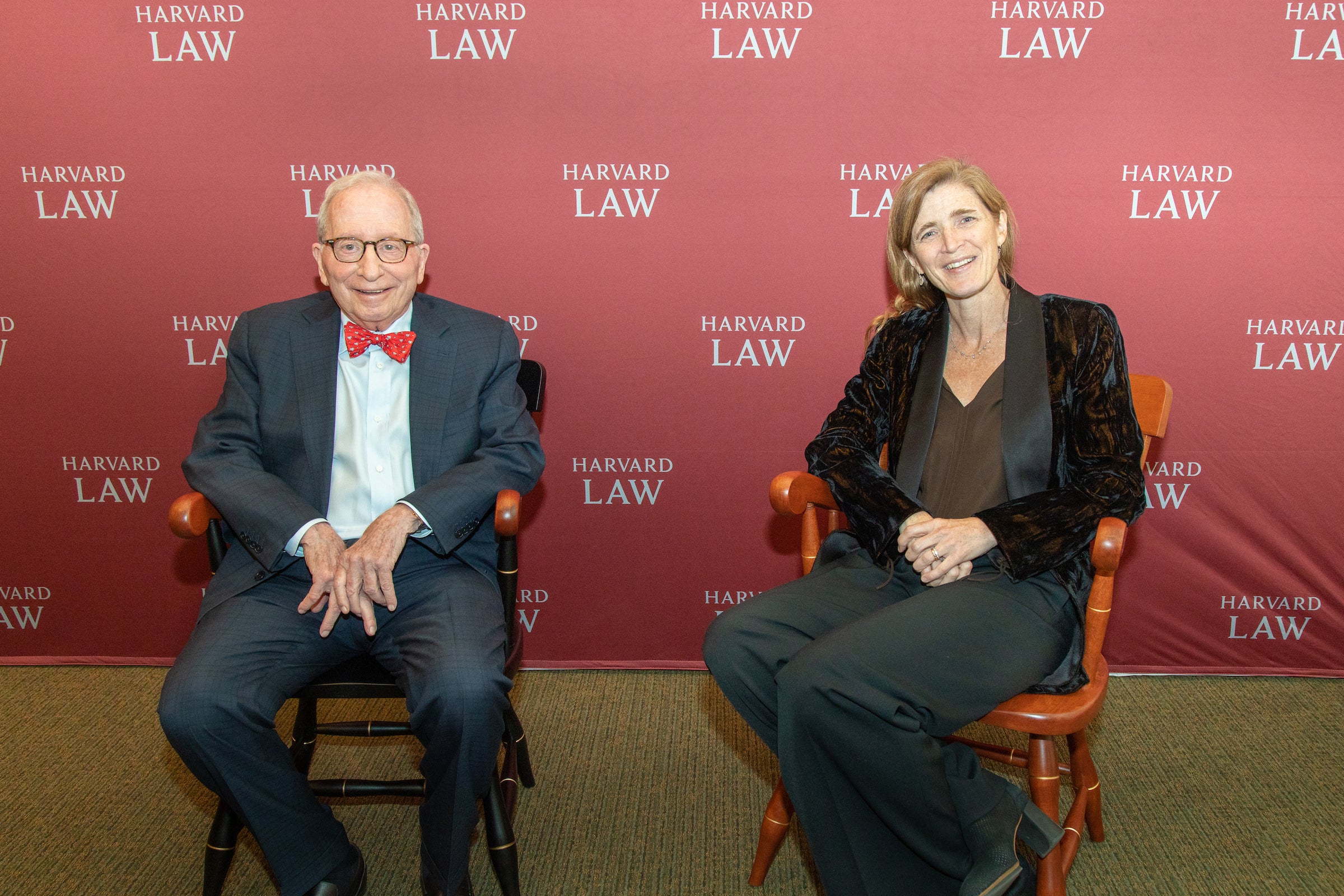
In 2016, he endowed the William D. Zabel ’61 Professorship in Human Rights at Harvard Law School, affirming his belief that legal education should prepare lawyers to advance justice as well as excel professionally.
Diplomat and human rights advocate Ambassador Samantha Power ’99, who was first appointed the William D. Zabel ’61 Professor of Practice in Human Rights at Harvard Law School in 2019, said: “Bill was a relentless advocate for immigrants and for people at home and abroad who often felt they had no one else in their corner. Throughout his life, Bill’s litigation, advocacy, and philanthropy were rooted in the grand American idea that all people should receive equal protection under the law. In endowing the Zabel chair at Harvard Law School, he put in place a mechanism to ensure that future generations of lawyers would be exposed to scholarship and teaching about individuals, like Bill himself, who used the power of law to advance the cause of human rights.”
In later decades, he investigated the disappearances and killings of government critics during Chile’s Pinochet dictatorship, and pursued reparations claims for the last living survivors of the 1921 Tulsa Race Massacre.