Technology and good governance are no longer separate domains — if indeed they ever were — and it is time for experts in both fields to come together to protect civil liberties and democracy, argued speakers at an event at Harvard Law School last month.
“The internet has become more important to everything, including, increasingly, to questions about democracy and the rule of law and how we’re going to govern ourselves — and are we still going to govern ourselves,” said Cindy Cohn, the executive director of the Electronic Frontier Foundation.
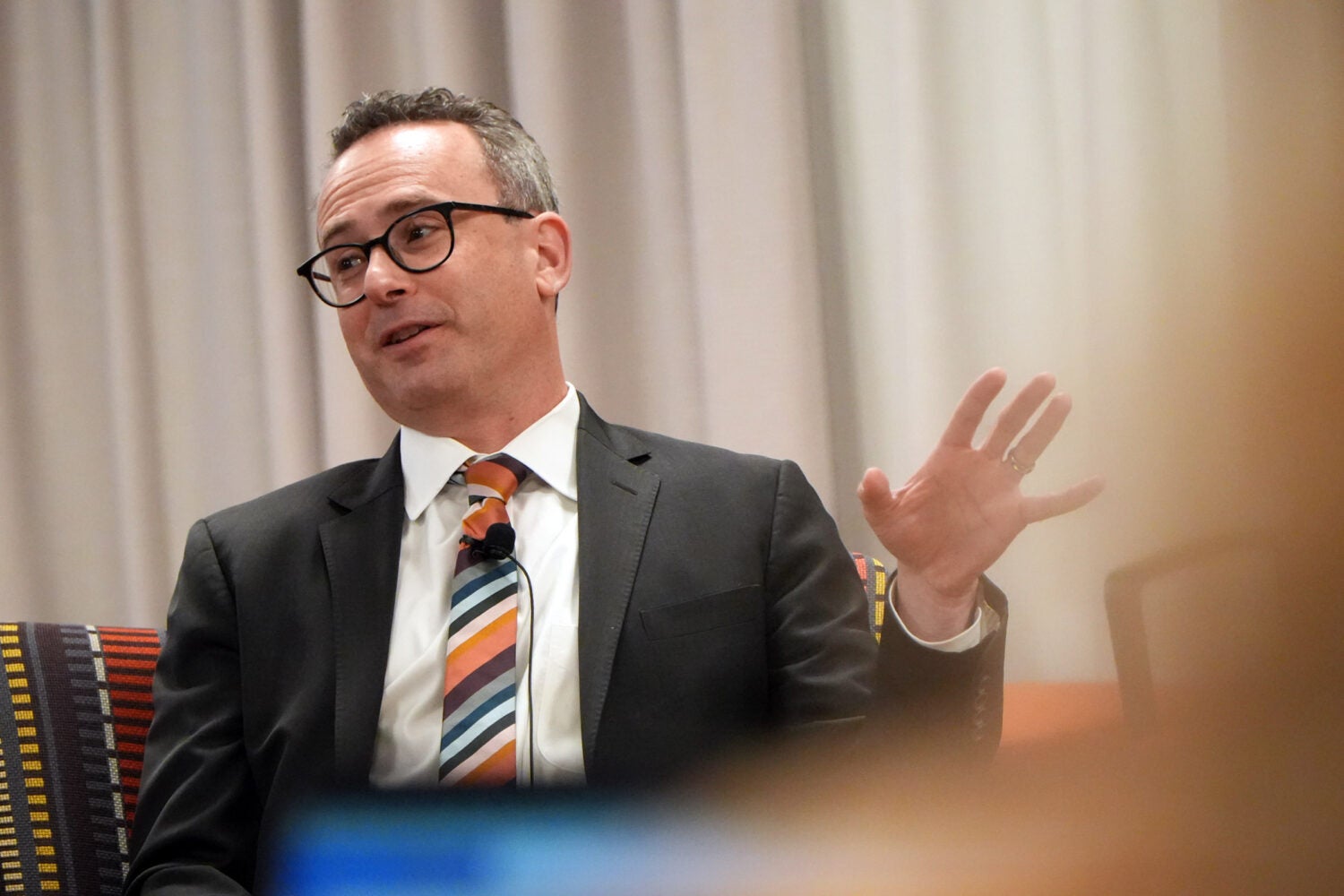
The event, hosted by metaLAB and the Berkman Klein Center for Internet & Society, featured Cohn in conversation with Larry Schwartztol, faculty director of the Democracy and the Rule of Law Clinic and a professor of practice at Harvard Law School.
Joined by moderator Sarah Newman, director of Art & Education at metaLAB at Harvard, the pair discussed the intersection of tech and democracy, and the power — and limitations — of the law to tackle important problems.
Cohn began by describing her organization’s ongoing lawsuit against the Department of Government Efficiency, also known as DOGE, for accessing sensitive personnel records for thousands of government employees, and another suit involving U.S. Immigration and Customs Enforcement’s use of IRS data in support of its immigration enforcement activities.
Both cases hinge on claims that the U.S. government violated the Privacy Act, which outlines how federal agencies can collect and share information about Americans, Cohn said. Yet the Privacy Act, which was signed in 1974, is not enough to protect individuals from inappropriate uses of their data in the digital age, especially by private entities, Cohn warned.
“It could have been an act for everybody,” she said of the law. “Instead, the Privacy Act is about information the government collects about you, and generally just requires the government to do a bunch of processes before they use it.”

Cohn added that there can be additional issues when data is mishandled, including “security risks and problems from a technical angle that come in when you give willy-nilly access to massive databases.”
Schwartztol noted that he, too, is part of a lawsuit against DOGE — this one on behalf of unions and government employees who are suing the Office of Personnel Management, the Department of Treasury, and the Department of Education.
He also is worried about the ways in which the current administration is managing data. “Our lawsuit focuses on not only procedural violations of the statute, but the risks that the very loose handling of very sensitive information has for individuals, individual privacy, and governance.”
While Schwartztol said he was grateful that the Privacy Act “spoke directly” to an important element of his organization’s lawsuit, he agreed that the law as written is too narrow to be fully effective.
“There was a much broader harm taking place … focused on the ability of the executive branch to govern effectively and with legitimacy, and there were not a lot of legal tools that were well suited to take on every one of those harms,” he said.
Schwartztol also detailed his involvement with another lawsuit filed by former Federal Trade Commission commissioner Rebecca Slaughter contesting her termination by the Trump administration as unlawful, which the Supreme Court will consider on December 8. Among the important implications of that decision, he said, is the extent to which the president can control so-called “independent agencies” such as the FTC, which plays a major role in regulating the tech industry.
“It’s about the ability of Congress, among other things, to set up institutions in the executive branch with sufficient independence to regulate sectors of the economy and sectors of American life that have profound consequences on all of these topics,” he said.
Cohn argued that some degree of separation between the president and agencies like the FTC is ideal to enable expertise to develop without political influence. “There are supposed to be three branches of government,” she noted.
In Cohn’s view, it is unsurprising that Slaughter and another fired commissioner were among those at the FTC “who were starting to get tough about privacy and privacy protection for consumers in tech and beyond.”
Newman asked the two panelists what a better, more robust privacy law for the modern era would include.
“First of all, I think at this point in time, a comprehensive privacy law has to be comprehensive, which means it has to include the cops. It has to include police and surveillance and official surveillance, not just consumer surveillance,” Cohn said. “And you need a private right of action [which would allow people to sue to enforce it].”
And Schwartztol agreed with Cohn that regulations restricting behavioral or surveillance advertising — which tracks users across the web and over time to customize marketing based on personalized data — would be an important component of such a law.

‘I think we should be in charge’
Despite largely concurring with Schwartztol, Cohn said that she doesn’t always see eye to eye with everyone in the “democracy sphere,” particularly people who “really want a government that’s active and robust and can take strong positions.”
“Sometimes I end up in weird places vis-à-vis other progressives, because I’m always thinking about the counter-thing,” she explained. “I tend to have a little bit of a civil liberties perspective, which is, I’m always thinking about how that power can be used against you.”
The pair also diverged on platform accountability. Schwartztol cheered what he viewed as a growing bipartisan interest in reforming Section 230, a law that shields social media companies from liability for what its users post. There is, he argued, a “broad sense that a lot of people don’t like the consolidation of power over their lives that the platforms are accumulating.”
But Cohn was skeptical of attempts to reduce those protections. “I think that the Republicans call it platform accountability, but what they really want is the ability to have the platform censor in the way that they want to,” she said. “And frankly, the Democrats are a little bit on the same side.”
Schwartztol turned to the debate about the use of body-worn cameras as a tool to ensure that police and government actors are complying with the law. Where does a civil libertarian draw the line when surveillance might, in fact, be helpful to individuals?
“I’m conflicted about the balance between being able to ensure a pretty robust body of evidence that the court can continue to return to as it’s supervising [an order, for example], with the normalization of constant surveillance,” he said.
“Surveillance doesn’t actually lead to safety nearly as much as people would like it to. … We’re under constant surveillance by each other, all the time. So, the question is, who’s in charge? I think we should be in charge.”
Cindy Cohn
But Cohn was skeptical that such tools are effective. After all, she noted, there have been situations in which police-worn cameras were turned off at critical times, or footage was allegedly lost.
“Surveillance doesn’t actually lead to safety nearly as much as people would like it to,” she argued. “We’re under constant surveillance by each other, all the time. So, the question is, who’s in charge? I think we should be in charge.”
Finally, Newman asked Schwartztol his view about the impact on democracy of online public discourse being controlled by a few large, private entities, such as Google or Meta.
“It narrows what democracy looks like,” he said. “It’s a thing that I worry about, and I think it’s central to how we diagnose threats to democracy and think about what advocacy should look like.”
As to solutions, Schwartztol and Cohn alike felt that Congress isn’t likely to pass legislation addressing these issues anytime soon.
But Schwartztol expressed optimism that it might, someday. “The questions around tech accountability and platform accountability have, at various moments, achieved at least a higher level of bipartisan rhetorical buy-in than other areas of democracy reform.”
Until then, Cohn proposed that one answer is for people to “vote with their feet” — to move off mega platforms onto smaller, more organic ones, and to demand more from big tech companies.
The other solution, the pair both agreed, is for people in tech and democracy to come together around a common goal — to promote the rule of law.
“The democracy world is kind of in one silo, and we tech people are in another silo,” Cohn said. “If we don’t start talking to each other soon, bad things are going to continue to happen, at least for those of us who care about democracy and justice.”
Want to stay up to date with Harvard Law Today? Sign up for our weekly newsletter.