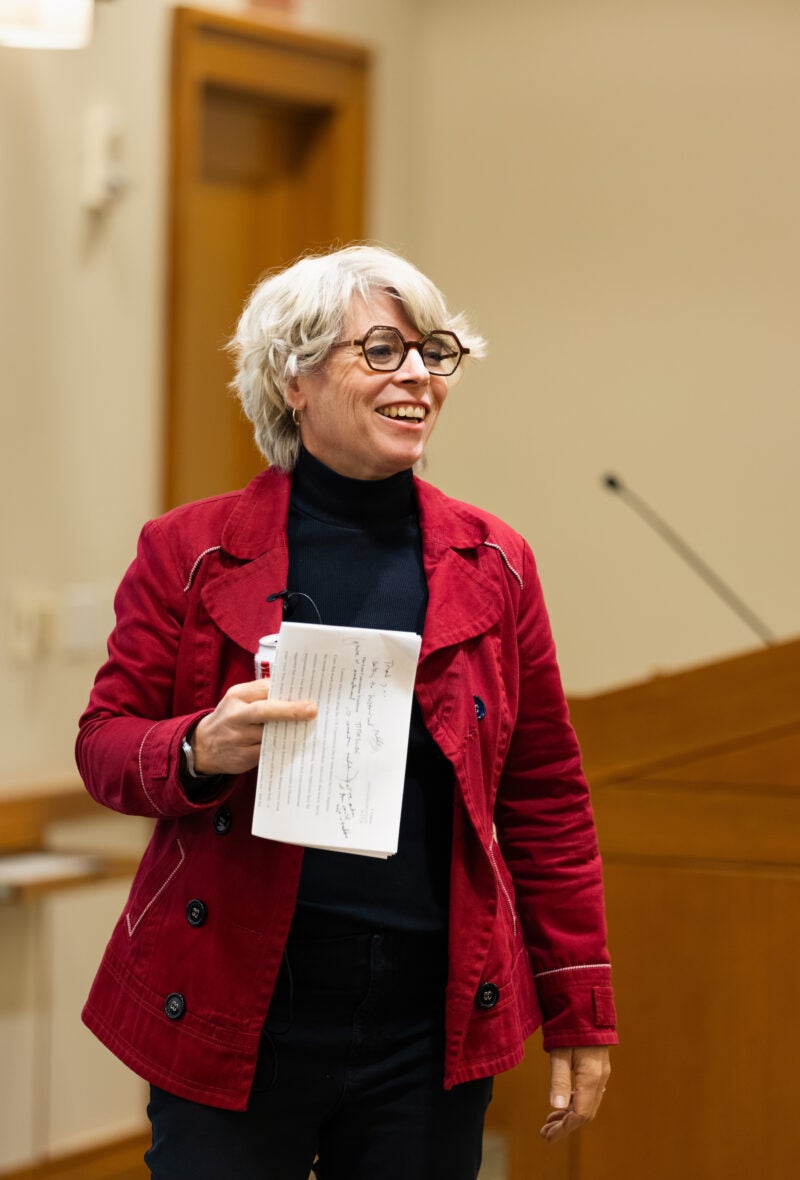
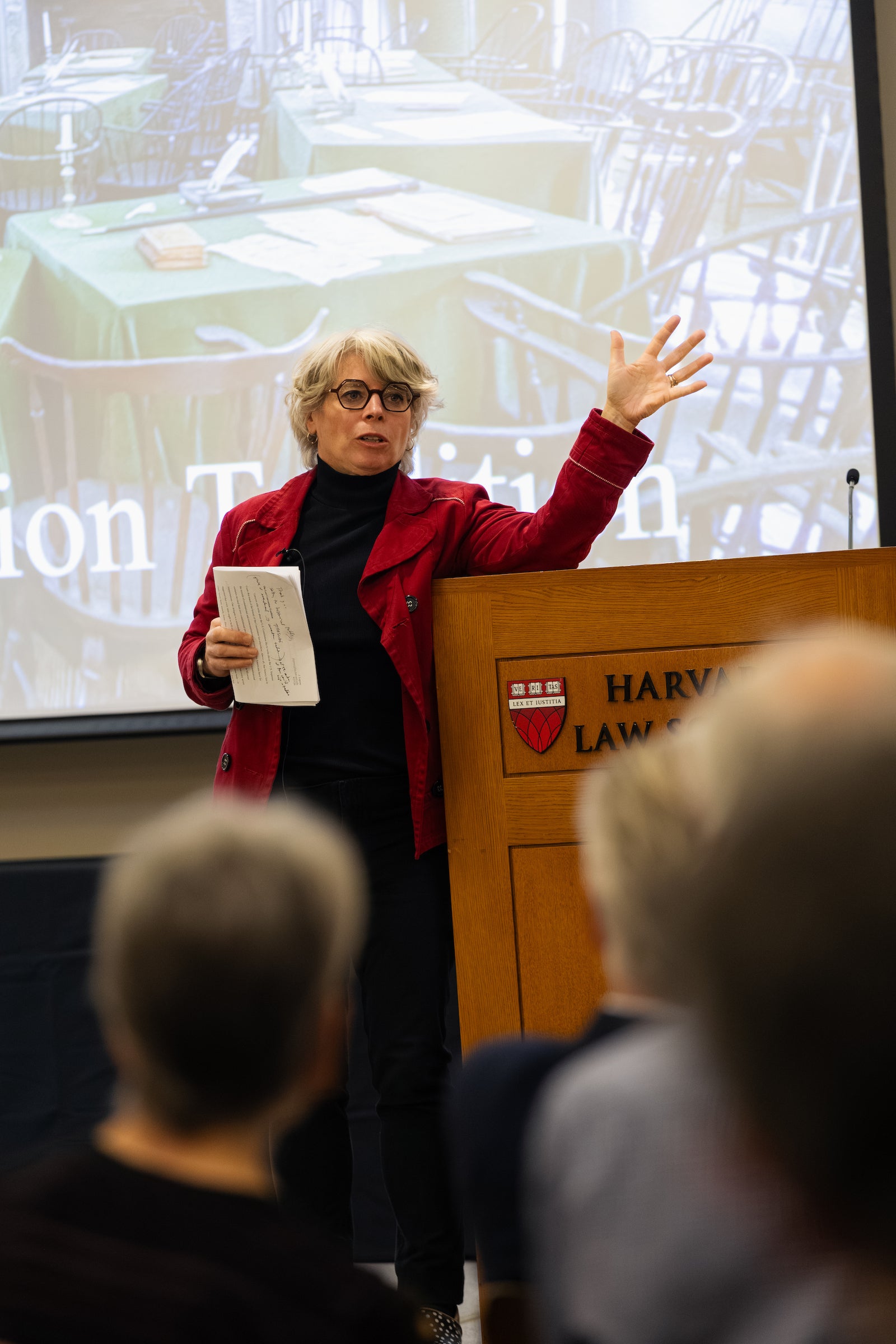
To understand how important constitutional conventions used to be to the fabric of civic life in the United States, look no further than the purposely “gigantic heads” of the men in a portrait of the Virginia Convention of 1830, suggests Professor Jill Lepore of Harvard Law School.
That the artist sought to render the delegates’ noggins in such glorious detail reflects the stature convention service once conferred, said Lepore, who is also the David Woods Kemper ’41 Professor of American History at Harvard.
“You could look at this painting, and you could tell who every single one of these guys was. That’s the … pride of having served in this convention,” she said. “The constitutional convention is both an ingenious American invention and an essential element of the history and tradition of constitutionalism in America.”
But that rich history has largely faded, and it would take work to recover the collective skills needed for a successful convention of that kind today, implied Lepore, who delivered her remarks at the VthePeople conference held at Harvard Law School on Oct. 2-3.
The gathering, organized by Professor Lawrence Lessig, the Roy L. Furman Professor of Law and Leadership, brought together a diverse array of scholars, legislators, advocates, and skeptics to explore the possibility of calling an Article V convention, which Congress must call if two-thirds of state legislatures apply for one. No such convention has ever been held, but it could propose amendments to the U.S. Constitution that would then require ratification by three-fourths of the states.
In her keynote address, Lepore recalled how, in the early years of the republic, American states held conventions and amended their constitutions or ratified new ones with what might today seem like shocking fervor — and that a wide swath of people paid attention to and engaged with these efforts.
“Conventions were more than news stories,” she said. “They were also celebrated in many other ways across the culture.”
Lepore added that, since 1776, states have held “nearly 250 constitutional conventions and have adopted 144 constitutions, about three per state.”
During the 11 years between the American Revolution and 1787 alone, 13 states wrote and ratified 20 constitutions, she noted.
“Conventions were more than news stories. They were also celebrated in many other ways across the culture.”
Credit: Lorin Granger
“The ubiquity of constitutional conventions in this era deepened Americans’ commitment to the tradition,” she said. “Some 300,000 men did the actual drafting and revising, serving as delegates in constitutional conventions or special congresses. But political participation in the processes was far broader.”
To illustrate how important this participation was to the body politic, Lepore pointed to the creation of Massachusetts’s first constitution. An early effort by the state’s legislature to draft one on its own failed by a large margin, as cities and towns demanded a more inclusive process. A constitutional convention was therefore called, with delegates including John Adams meeting in Cambridge to deliberate and craft a new version.
In fact, Lepore added, “if we had windows in this room, we could see the site at which they first assembled.”
The resulting document, which was ratified in 1780, was an important influence for the delegates to the Philadelphia Convention several years later, who were tasked with writing a new federal charter, she said. Afterward, as their newly drafted U.S. Constitution sought legitimacy, nearly 2,000 Americans served in state ratifying conventions, the last of which was in 1790.
“These conventions were hard-fought. Ratification was a very, very close call,” Lepore said. “It turned on actually a lot of political chicanery and the overrepresentation of federalists in the ratifying conventions.”
But despite — or perhaps because — of the immense work of drafting and approving the U.S. Constitution, the convention as a tradition had been firmly established by this time, Lepore said. “In 1787, no one could have predicted — no one would have predicted — that another federal constitutional convention would have become unthinkable, but that in the states, conventions would be as regular as rain.”
The 1800s saw much of the same energy, as states continued to regularly hold conventions and draft new constitutions, even as efforts to amend the federal constitution were few and far between.
“A commitment to the convention tradition in the 19th century — the age of the railroad and the telegraph and the power loom — was very much attached to the idea of progress and later in the century to the idea of evolution,” Lepore argued.
Beyond the ballot box, conventions were also a key means of political participation and social reform during this period, Lepore said. African Americans, Native Americans, women, and groups such as utopian communities and religious organizations all held conventions of their own to influence public life and policy, she said.
Race, in particular, became a central point of debate as many state constitutions eliminated property requirements for voting — expanding suffrage for white men while imposing or retaining separate restrictions on Black voters and others, making these movement conventions particularly meaningful, Lepore said.
“Courts and lawyers tend to forget these conventions of Black men, of white women, of native nations. They’re very seldom cited in legal opinions,” she said. “And yet, they are as essential a constitutional convention tradition as any of the state constitutional conventions.”
A ‘growing skittishness’
Despite a flurry of constitutional activity in the states, it was not until the Progressive Era that serious efforts to organize an Article V convention gained momentum, as advocates hoped to bypass Congress to institute a series of democratic reforms. But by this time, conservatives began to worry that a federal constitutional convention could open the door to a broader array of changes — an uncertainty that made lawmakers balk.
“If the choice were between an amendment or a convention, conservatives who had blocked calls for a convention decided to agree to a series of amendments. The result was four progressive constitutional amendments in eight years,” she said, referring to the 16th through 19th amendments (which collectively instituted a federal income tax, required the direct election of U.S. senators, temporarily banned the sale of alcohol, and gave women the right to vote).
Decades later, the Civil Rights Movement helped spur calls for state constitutional revision — for reasons both in support of and opposed to desegregation. Following the Supreme Court’s decision in Brown v. Board of Education in 1954, Lepore said, some in the South called for an Article V convention to limit federal power. An effort to convene the states under Article V to limit the effect of the Court’s decisions establishing “one person, one vote” in apportionment also came within one state of success, she added.
The era also saw renewed interest in “extra-constitutional conventions” — gatherings and collective advocacy by Black Americans, women, and other groups — even as this period marked “the beginning of the end of the convention tradition,” according to Lepore.
“Deliberating is a muscle that can easily atrophy. … The abandonment of the convention tradition is part of a broader decline in other forms of democratic participation.”
That’s because by 1979, although there remained popular support for a national constitutional convention, Lepore said, Democratic and Republican politicians alike worried about the possibility that such a convention could become “runaway” — delving into issues supposedly beyond its purview.
“The growing skittishness about a federal constitutional convention had a knock-on effect,” Lepore said. Although states continued to have their own constitutional conventions into the early 1980s, they, too, “grew more nervous about holding conventions.”
The last full-scale state constitutional convention was held in Rhode Island in 1986. Since then, a “convention phobia” has prevailed, Lepore argued, which, along with other factors such as the alienating effect of social media, has eroded the conditions necessary for a productive and successful Article V convention today.
“Deliberating is a muscle that can easily atrophy. The less frequently people meet and debate, the less they are able to do so,” she said. “The abandonment of the convention tradition is part of a broader decline in other forms of democratic participation.”
But in a question-and-answer session following her talk, Lepore offered her view on how Americans could reclaim their knowledge and ability to engage in thoughtful debate, compromise, and coalition-building of this kind: by participating in government at the local level and working their way up.
“Given that people haven’t exercised those muscles,” she said, “we would need to build those skills back. And the way to build those skills is by meeting to do smaller things.”
Want to stay up to date with Harvard Law Today? Sign up for our weekly newsletter.