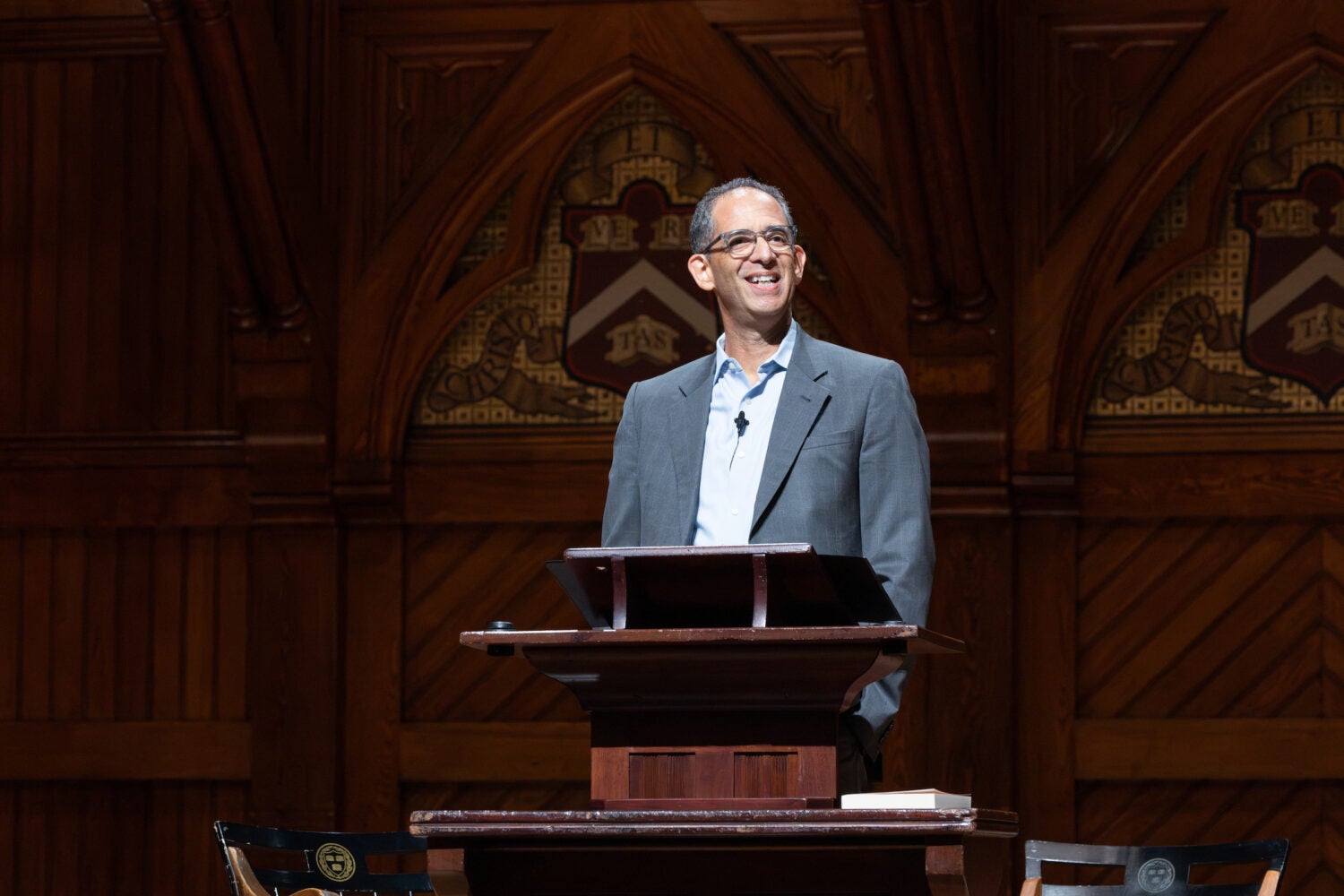
At Sanders Theatre on August 26, Dean John Goldberg welcomed Harvard Law School’s newest students, urging them to approach their legal education with intellectual openness, compassion, and a commitment to engaging seriously with different views and the people who hold them.
The incoming class includes eight S.J.D. students, 184 LL.M. students, 561 first-year J.D. students, 24 transfer J.D. students, and seven international exchange students. After offering his remarks, Goldberg led a conversation with Professors Alexandra Natapoff and Guy-Uriel Charles about their new book, “America Unfinished: 250 Years of Law and Governance.”
All three speakers emphasized that learning the law also means understanding how to navigate disagreement — and accepting the responsibilities that come with the power to shape institutions and resolve disputes.
Goldberg noted the accomplishments and varied paths of the incoming class, which includes prosecutors, judges, and diplomats; Phi Beta Kappa inductees and Fulbright scholars; teachers and opera singers as well as an Olympic weightlifter, a watchmaker, and a cheesemonger. The new class also includes students from nearly every U.S. state and from dozens of countries around the world.
“Beginning today and for the rest of your lives, this is your Harvard Law School,” said Goldberg, the Morgan and Helen Chu Dean and Professor of Law.
Goldberg also praised the academic community the new students are entering as one of “honest intellectual inquiry, careful research and writing, and the fearless pursuit of knowledge,” encouraging them to embrace the opportunities that come with joining it.
Noting that the study and practice of law can involve delving into difficult subjects, including laws that sometimes foster injustice, he encouraged his audience not to fall into cynicism.
“When you study law, you have to deal with difficult topics … it is easy to lose sight of the good in law — its potential to help us achieve the things we hope to achieve. Laws that protect core human rights, laws that support technological and business innovation, laws that promote accountable government — these are all part of our traditions, too,” he said. “Be alive to the bad in law, of course, but don’t dismiss its potential.”
He encouraged students to embrace this special “academic community of scholars, practitioners, and learners working together to advance understanding and articulate truths,” and to take advantage of the opportunity to engage with people whose ideas are different from their own.
“You will encounter people from all over the world, people with distinctive perspectives, extraordinary experiences, and real wisdom … Engage seriously. Lead with kindness and compassion. Get to know the people behind perspectives different from your own, and the reasons they think the way they do,” he said.
He continued, “We make each other better when we develop and refine our own thoughts through sincere, open-minded, and serious engagement with those who think differently. And by the way, we become better lawyers by doing so.”

“You will encounter people from all over the world, people with distinctive perspectives, extraordinary experiences, and real wisdom … Engage seriously. Lead with kindness and compassion. Get to know the people behind perspectives different from your own, and the reasons they think the way they do.”
Dean John Goldberg
Goldberg then invited Natapoff, the Lee S. Kreindler Professor of Law, and Charles, the Charles Ogletree, Jr. Professor of Law, and faculty director of the Charles Hamilton Houston Institute for Race and Justice, to the stage to discuss their recently published book, “America Unfinished: 250 Years of Law and Governance.”
The collection includes essays by more than 60 Harvard Law School faculty members examining the challenges, risks, and opportunities of this historic moment in American law and governance — 250 years after the country’s founding.
Charles, who also serves as a deputy dean, explained that the “unfinished” in the title refers to the iterative nature of the rule of law. He pointed to the famous phrase in the Declaration of Independence that, in his words, “all persons are created equal” and the 14th Amendment’s Equal Protection and Due Process clauses as examples of lofty foundational ideals of which we sometimes fall short.
“We are always working to live up to [those principles]. … But the American political and constitutional enterprise is one that requires continual renewal, and so it is unfinished, while inspiring us with the principles, ideals, concepts, and a foundational set of commitments,” Charles said.
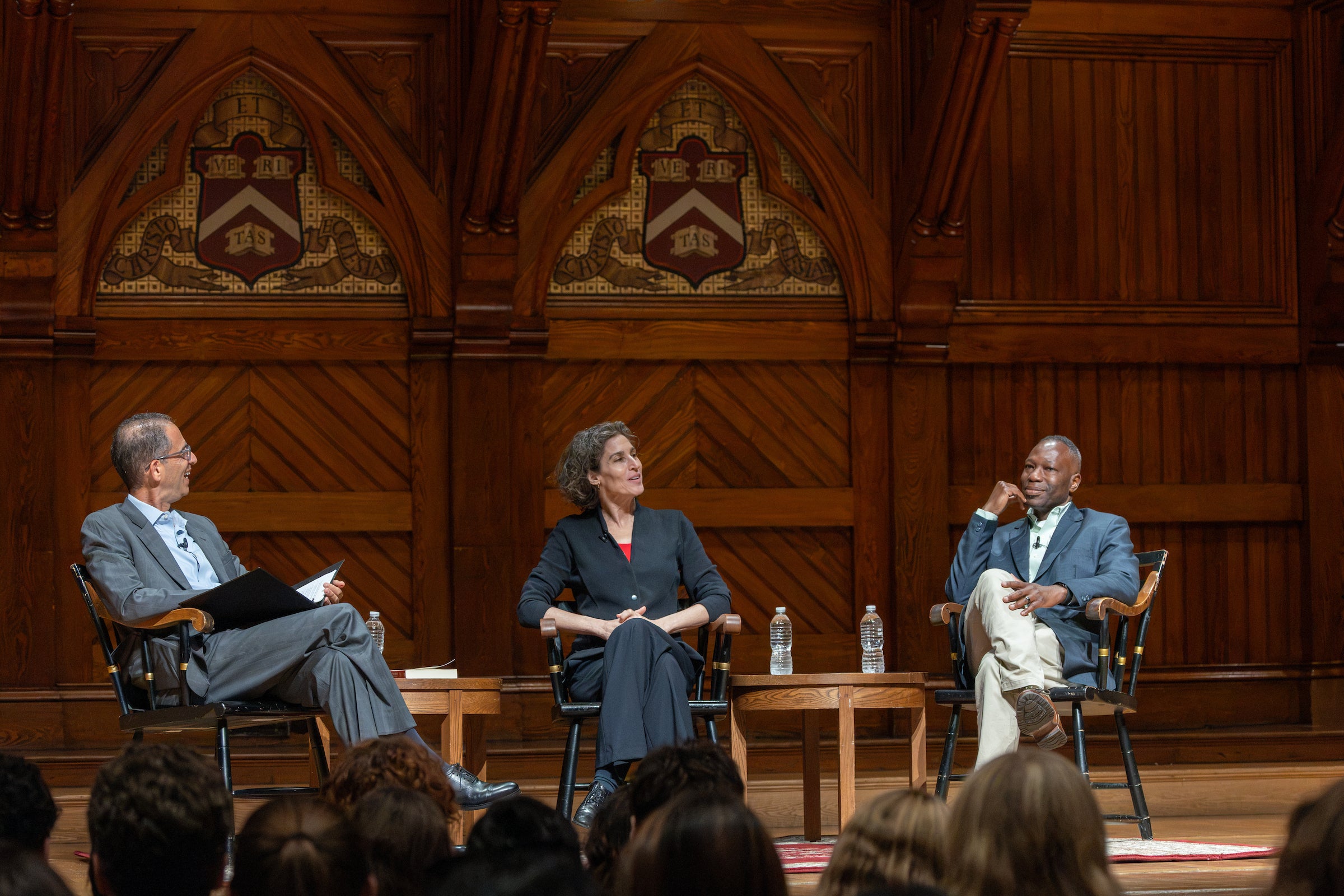
Echoing Goldberg’s emphasis on engaging across differences, Charles and Natapoff reflected on what it means to live together under the rule of law and how a pluralistic society can build common institutions amid disagreement.
Natapoff described law as both old and new, static and changing, while emphasizing that the rule of law is “how we come together” — a vehicle for resolving conflict constructively and peaceably, rather than through violence.
“You cut a deal when you become a lawyer,” she said, adding that: “You will be able to get people out of jail with your words. No crowbar required.” In exchange for this special power, she suggested, becoming a lawyer also means accepting both the constraints of law and the responsibilities that come with resolving conflict through words and institutions rather than violence.
Charles added that, for lawyers, “the sense of engagement that produces knowledge that enables us to do the things that are necessary to have an impact in the world is foundational to who we are.”
Goldberg concluded the conversation by inviting Charles and Natapoff to share advice for the students beginning their time at Harvard Law School. Natapoff returned to the importance of community.
“It’s the people,” she said. “And you’ll forget that, because we’re going to tell you it’s about the law and the book and the rule and the institutions and the power and the money and the things. But at the end of the day, we build law through people.”
Charles offered a simpler hope: that the students enjoy law school. “It is transformative — to your mind, your approach, the way that you see the world,” he said.
Want to stay up to date with Harvard Law Today? Sign up for our weekly newsletter.