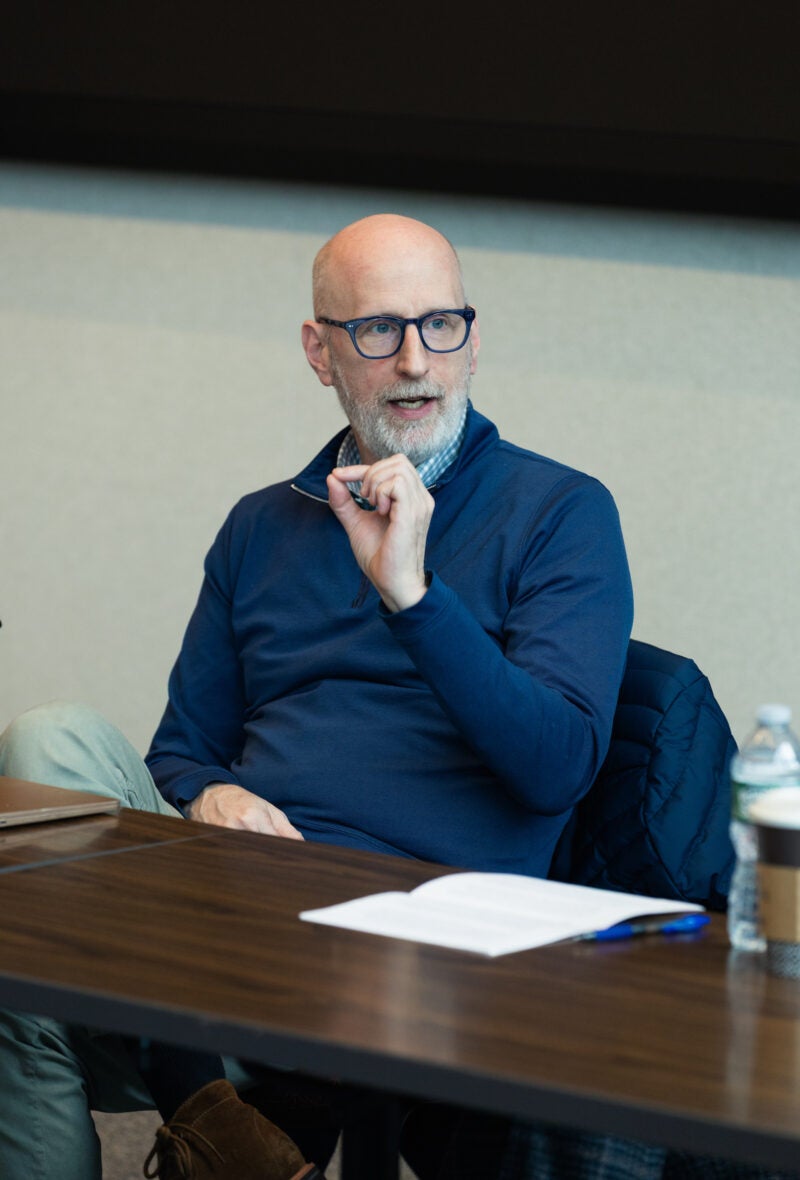
David French ’94 never wanted to be a writer or a lawyer. He wanted to be a fighter pilot.
The author and New York Times columnist was a teen when the blockbuster movie “Top Gun,” about the U.S. Navy’s elite flight training school, hit theaters. Like countless viewers, French was hooked and thought “I wanted to do that.”
But his eyesight wasn’t good, and it was a time when “glasses and an F-15 were incompatible,” French recalled during a conversation with Harvard Law School writer-in-residence Amy Davidson Sorkin, a longtime staff writer for The New Yorker.
French’s talk last month was the last of a four-part spring speaker series that’s part of the Jane Lakes Harman Writer-in-Residence program, a new initiative helping law students ponder the power of narrative and storytelling in their legal writing. The program was made possible by a donation from Harman ’69, a former U.S. representative from California and former president of the Woodrow Wilson Center for International Scholars.
Getting law students thinking about narrative matters, Sorkin told the crowd gathered in Lewis Hall. The goal is “talk to you about writing for the public and also the many different roles you might have in that writing. You might be the source, you might be the subject, you might be the journalist yourself.”

French was the perfect guest to address myriad writing roles, walking his listeners through his winding path from college to Harvard Law and ultimately to journalism during the conversation that also touched on politics, the judiciary, and U.S. Supreme Court cases. Writing was central to his career even before becoming a journalist, said French, but his professional path wasn’t always clear. He studied political science at a small Christian college in Nashville and landed in Cambridge unaware of what a law firm really was.
“I took the LSAT, did well enough that I applied here,” said French, “and couldn’t believe it when I got in.”
A conservative raised in the Church of Christ tradition, French founded a pro-religious liberty group on campus during his 2L year, dug into issues of free speech, and left Harvard with “a lot of contacts in the First Amendment world.” After graduation, he worked in commercial litigation and took on a robust pro bono caseload. Then, increasingly frustrated with the way his free speech cases were being covered in the press, he started penning op-eds.
“[It wasn’t] because I felt like the media was biased against me and my clients,” said French, “but I just didn’t feel like they were grasping the issues.”
Eventually, French jumped to public interest litigation. At the Foundation for Individual Rights and Expression, he devoted even more hours to writing, regularly explaining cases for the organization’s blog. That work led to outside requests for French to write about issues including free speech, due process, the U.S. Constitution, and later, since he also served with the military in Iraq, the war on terror. In 2015, French joined the National Review as a full-time senior writer.
During the two-hour conversation, French discussed some of the writing lessons he has learned during his career. One early critical piece of advice came from a retired federal judge who encouraged French to “write with regret and not outrage.”
“He told me, ‘everybody’s outraged all the time,’” recalled French. “‘Your clients are outraged. Attorneys are outraged on behalf of their clients. If you’re a judge, you’re just getting a nonstop avalanche of outrage. If you come in with sober regret, you cut through the noise.’” Then when you do get outraged, the judge added, “‘people will really pay attention.’”
French relies on the “show, don’t tell” technique that underpins strong narrative journalism. “In other words, accurately and vividly describ[ing] what is happening is enough in most circumstances,” said the author, “without me also characterizing what I just accurately and vividly described.” That mindset “gets you into the craft of storytelling,” added French, who urged his listeners to avoid using adverbs “to engineer an emotional response” and instead let facts and straightforward prose do the work.
“If you tell the story well enough,” said French, “it will do that.”

Of his time in Iraq, French said he had been an early supporter of the war and felt compelled to enlist. He joined the U.S. Army Reserve at 36 and was a military lawyer in the Judge Advocate General’s Corps. He was stationed in the Diyala Province in 2007 during “the surge,” the increase in U.S. military forces intended to help stabilize the nation. At the time there was a sense that “the media had failed in the choice to go into Iraq,” said Sorkin, who wondered if French’s experience on the ground informed how he “felt about the role of lawyers, about the role of journalists, about all the decision makers and influencers.”
His tour helped him truly to understand the phrase “the fog of war,” said French, and how difficult it is to grasp the facts in real time in a war zone, as well as the consequences. “[People] want to know the complete picture, and they want to know it now, and they especially want to know it if it’s going to conform with their pre-existing expectations. So there’s an enormous demand for immediate, definitive analysis, and the more that you can push back on that without losing your audience, the better off we are.”
Over time, French said he has tried to develop a “thick skin and a soft heart” when it comes to his writing, something that helps to protect him from “bad faith insults” and keep him open to “good faith criticism.” He often uses his own life to connect with his readers. “By kind of describing my experiences, I’m telling my audience not just where I stand, but where I have sat, which helps them understand it,” said French, “and it’s a great way of bridging divides ideologically.”
In addition, you should write what you know, advised French, whose output is often tied to the news cycle and his knowledge of the law, free speech, and the military. But French also keeps a running list of other story ideas, many of them related to issues he cares deeply about, such as polarization, friendship, and social connection.
“One of the fastest ways to lose your credibility is to stray from your lanes and try to write with some degree of authority on something that you do not have authoritative knowledge about,” said French, adding, “If I’m going to walk into something new, it has to be only new to the reader, not new to me.”
“Not maybe don’t stray,” expanded Sorkin, “but be looking at areas that weren’t obviously part of your purview but where it can be brought to bear.”
“Exactly,” agreed French.
Looking back, the columnist said the worst of his writing came when he “got kind of high on my own supply of enjoying the accolades,” and that his best work is when he tries to “connect with the persuadable person with whom I have disagreements and build from what I know of their value set.”
He said his work has a “civic education” function and he wants “people who disagree with me to still have learned something” from his writing. “As much as possible, I want the curious, skeptical reader to feel that we have a common value set, and that my position growing out of that common value set is worth considering.”
French strives to appeal to both experts and an educated lay audience and always rereads his stories after they publish to constantly “be better,” noting how a paragraph he thought “was so clear at 1 a.m.” can seem less so hours later. He also emphasized the importance of clear prose. Clarity, said French, “can be like a superpower.”
In addition, reading his pieces aloud before they go to press helps him with quality control, French said. “If this sounds compelling, then I feel like I’ve done my job. If I’m bogging down as I speak it, then I’m very self-critical.”
Want to stay up to date with Harvard Law Today? Sign up for our weekly newsletter.