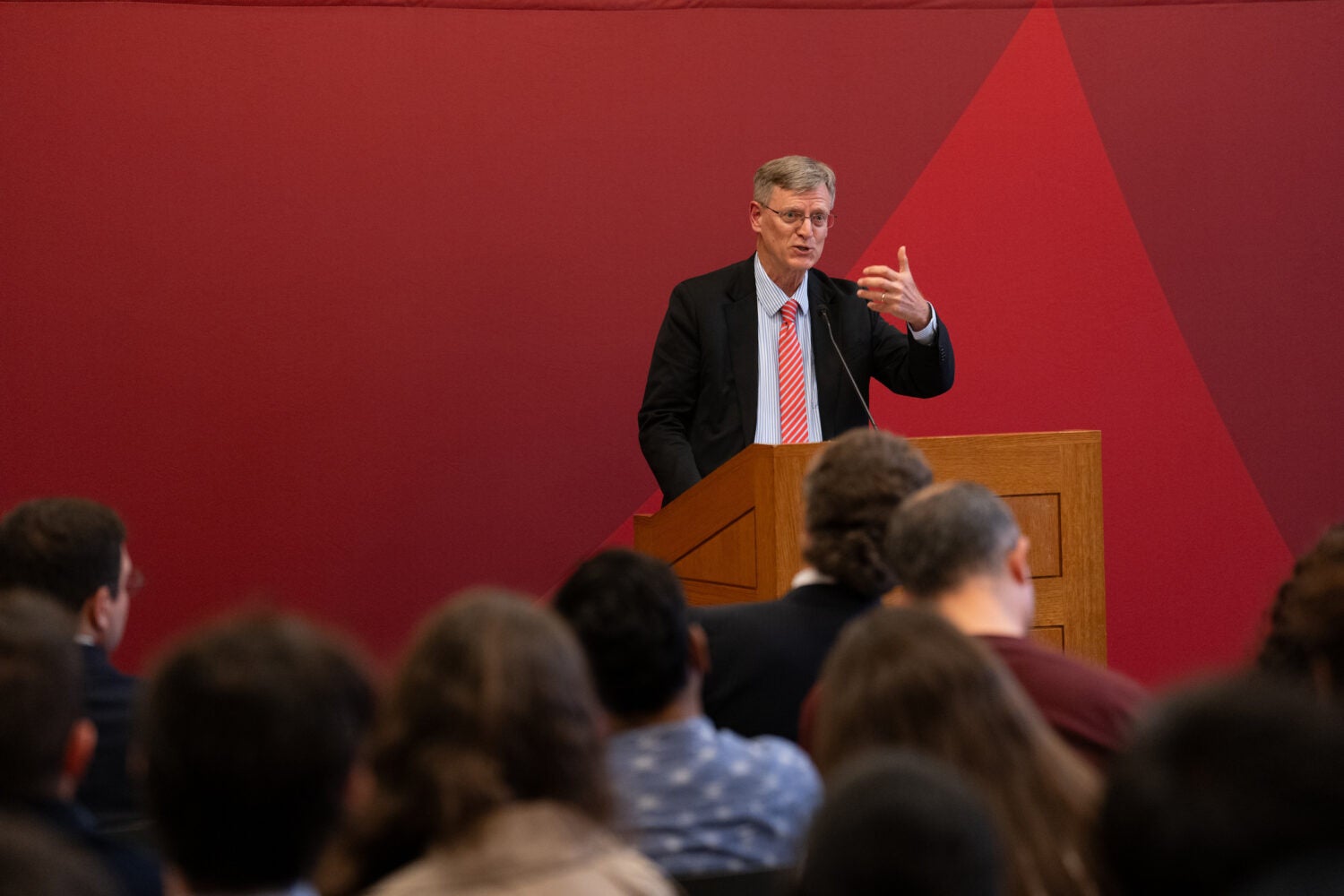
Although there have been prominent criticisms in the investment arbitration field about the difficulty in determining whether an arbitration panel has temporal jurisdiction over a dispute between states and parties to a bilateral investment treaty — such as figuring out if a treaty’s dispute resolution process applies retroactively — the United Nations’ 2001 articles governing the responsibility of states for wrongful acts, and subsequent case law, can help provide answers, says Sean D. Murphy, a leading practitioner and scholar in the field.
“There are reasons to regard these temporal articles as having successfully laid out the framework for the law in this area,” said Murphy, the Manatt/Ahn Professor of International Law at the George Washington University Law School, who delivered the fifth annual Gaillard Lecture at Harvard Law School on Sept. 24. “Any inconsistencies in the jurisprudence of investor-state arbitrations are not necessarily a product of inadequate law” but of “difficult facts.”
The Gaillard Lecture, hosted at a different institution each year, honors Emmanuel Gaillard, a founding partner of Gaillard Banifatemi Shelbaya Disputes, a firm focused on international arbitration. Gaillard, a leading authority in the field who first came to Harvard Law School as a visiting professor of law, died in 2021.
Murphy was a member of the U.N. International Law Commission from 2012 to 2022. He has presided over investor-state and inter-state arbitrations, and has represented several countries in international courts and tribunals.
Before the lecture, which hewed closely to a 2022 article he wrote on the topic, Murphy described Gaillard as a “remarkable individual.” Murphy then offered several propositions that he said govern questions of temporal jurisdictions in investment treaty arbitrations, including the rule of non-retroactivity, which says legal strictures and penalties shouldn’t apply to actions that took place before a governing law took effect.
Most important, he said, is the proposition that tribunals generally default to that rule when a treaty neither explicitly addresses whether its dispute resolution process is reserved only for violations of a treaty nor whether the tribunal can hear disputes based on acts that occurred before the treaty took effect.
“Based on the case law to date, a [treaty] that is silent in both of those ways is usually interpreted by investor-state tribunals as not providing temporal jurisdiction,” Murphy said.
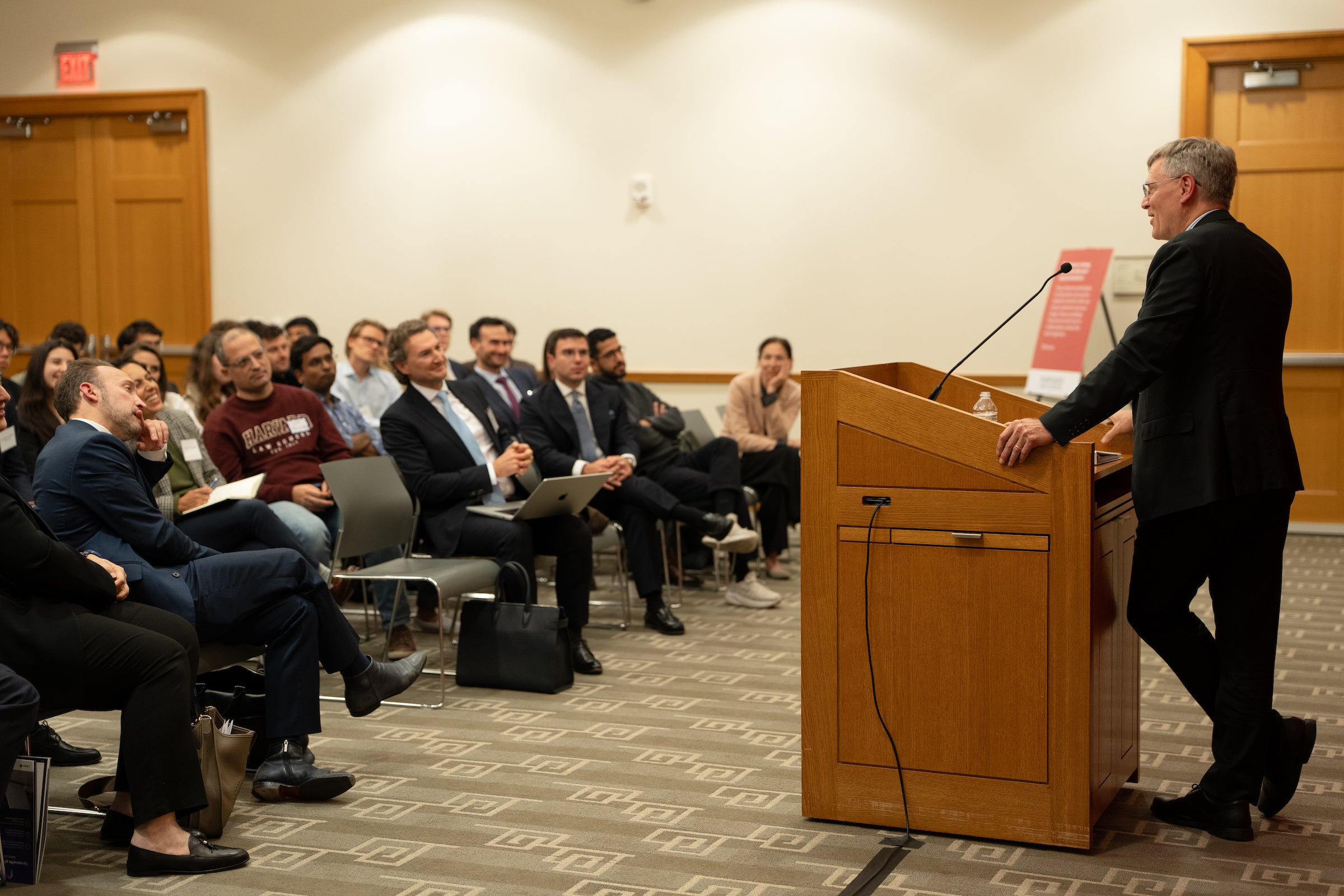
One way claimants try to escape the non-retroactivity rule is to claim that a breach has a “continuing character.” In other words, the breach wasn’t a one-off occurrence but something that happened repeatedly over time, including within the time frame that a treaty did apply. As an example, Murphy pointed to the high-profile case of Chevron v. Ecuador, a long-running dispute between the oil giant and the country over pollution from drilling.
Murphy cautioned against attempts to delineate temporal jurisdiction more clearly in the form of secondary rules, arguing that the case law emanating from investment treaty arbitration panels is providing clear enough guidance for practitioners.
“Overly detailed codification can inhibit the development of law over time, which can instead be shaped through the experience — the crucible of experience — rather than through logic,” he said, before ending on a humorous note, endorsing common law over codification.
“The wide range of arbitral decisions that I’ve noted reveal a repeated effort by tribunals to clarify the law through application to concrete situations, no doubt shaping the law as it moves along,” he said. “At least for lawyers from a common law system, that’s a perfectly sensible way to run things.”
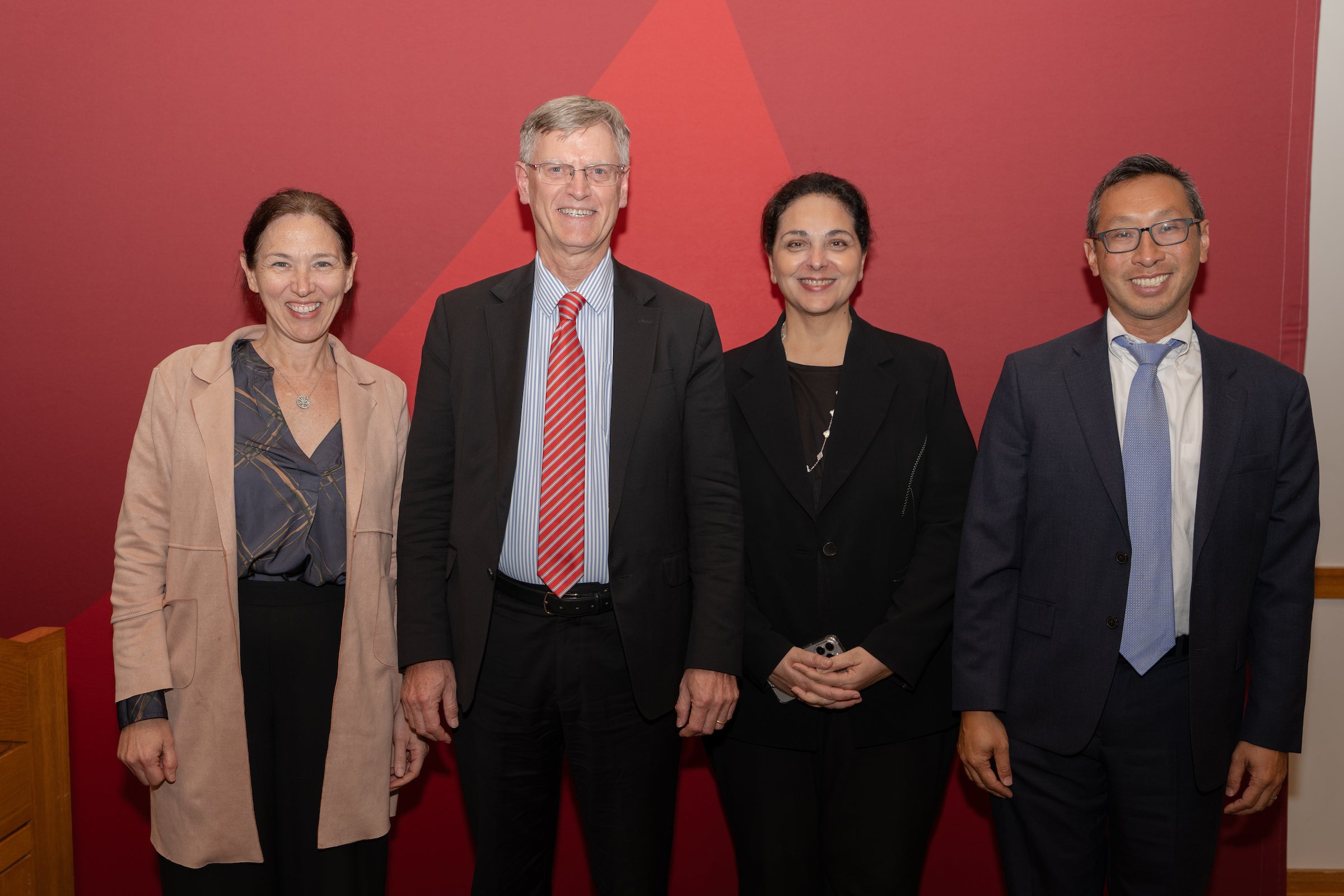
The lecture was cohosted by Gaillard Banifatemi Shelbaya Disputes and by Harvard Law School’s International Legal Studies program. Murphy was introduced by the program’s vice dean, the Rita E. Hauser Professor of Human Rights and Humanitarian Law Gabriella Blum LL.M. ’01 S.J.D. ’03; by Gaillard founding partner Yas Banifatemi LL.M. ’97, who is a visiting professor at the law school; and by Henry L. Stimson Professor of Law Mark Wu, who helped facilitate Gaillard’s return as a lecturer in 2018.
“[Gaillard] put out a lot of different theories about international arbitration. Some of those are very much still in use,” said Wu. “But he was very much open to being challenged, to hearing other perspectives, and to expanding his world view. … We’re delighted to have a chance to remember Professor Gaillard through the Gaillard Lecture.”
Want to stay up to date with Harvard Law Today? Sign up for our weekly newsletter.