PON Live! Negotiating from a Distance: The Impact of Communication Media and Negotiator Characteristics
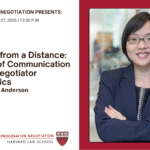
How does the communication medium shape negotiation outcomes? As negotiations increasingly take place by video, audio, or text, the choice of medium has become an essential negotiation skill. Drawing on her experimental study of 400 participants, Dorcas Quek Anderson examines how four communication modes influence both economic and relational outcomes. The effectiveness of a communication […]
From the World Court to the Shop Floor: The ICJ Ruling and the Future of the Right to Strike

Despite its status as a foundational tenet of collective labor law, the right to strike currently faces a historic crisis of domestic compliance and backlash. Today, this fundamental protection is actively violated in 87% of countries worldwide. As international crackdowns on organized labor intensify, workers are facing escalating threats of arrest, detention, and even physical […]
Judging on State and Federal Courts: A Tale of Two Systems — Judge Britt Grant and Professor Jack Goldsmith
What distinguishes judging on a federal court from judging on a state court? Join the Federalist Society for a conversation between Judge Britt Grant of the U.S. Court of Appeals for the Eleventh Circuit and Professor Jack Goldsmith about the differences between state and federal judicial systems. Drawing on Judge Grant’s experience serving on both […]
What Remains: AI, Death, and Loss
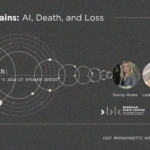
Our online lives increasingly outlast us, leaving our likeness with loved ones grappling with challenging but eternal questions of legacy, loss, and law. How does this digital afterlife change the ways we grieve, remember, and honor the wishes of those who have died? Join Stacey Wales, whose family created the world’s first courtroom AI-generated victim […]
Originalism and Textualism: Past and Present — Judge Steven Menashi and Professor Stephen Sachs
What does it mean to interpret the Constitution and statutes according to their original meaning, and how have originalism and textualism evolved over time? Join the Federalist Society for a lunchtime conversation between Judge Steven Menashi of the U.S. Court of Appeals for the Second Circuit and Professor Stephen Sachs of Harvard Law School. Drawing […]
Joe Rez: Lawyering and Marketing That Make You “Call Joe!”
See Joe’s ads on Instagram at @joerezlaw.
Networked State Capital in China’s AI Ecosystem
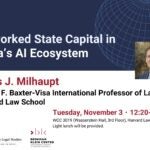
East Asian Legal Studies Talk: Curtis J. Milhaupt William F. Baxter-Visa International Professor of Law Stanford Law School Senior Fellow, by courtesy, Freeman Spogli Institute for International Studies Professor Milhaupt will discuss “Networked State Capital in China’s AI Ecosystem,” his current joint project with Liwen Lin, Associate Professor at the University of British Columbia, Allard […]
ACLU Immigrants’ Rights Project – Conversation with Founder, Prof. Lucas Guttentag
Professor Lucas Guttentag (HLS ’78) will be giving a lunch talk about his experience founding and leading the ACLU’s Immigrants Rights Project for 25 years and will engage students in a conversation about the current state of immigration law. Please note that you are required to RSVP using the following link in order to […]
Choosing Law Teaching as a Career
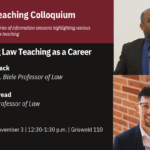
Are you considering a career as a law professor? Whether you are committed to this career choice or considering it for the first time, this inaugural session of this year’s colloquium is designed to give you an insight into the life of a law professor. Professors Mack and Allread will discuss their own journeys to becoming […]
How to Tell an AI What to Do: Rules, Cases, and Interpretation

What can the law teach us about where AI systems should exercise judgment when their instructions leave room for interpretation? AI developers now govern their most capable models through written “constitutions.” These documents set out a model’s values, priorities and character, and they’re used directly in training. Anthropic’s constitution for Claude is the most prominent […]
The Platform State: How China Governs Innovation to Achieve Tech Supremacy
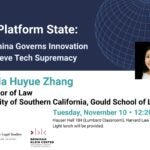
East Asian Legal Studies Talk: Angela Huyue Zhang Professor of Law University of Southern California, Gould School of Law Professor Zhang will discuss “The Platform State: How China Governs Innovation to Achieve Tech Supremacy,” her current joint project with S. Alex Yang, Professor of Management Science and Operations at London Business School. China’s innovation economy […]
Crutch or Catalyst? How AI Is Changing the Ways We Relate

As AI becomes increasingly embedded in our lives, it has taken on roles as a therapist, a friend, even a lover. When we allow AI systems into our communities and our closest circles, what happens to our agency, our inner lives, and our ability to form relationships with other people? Join MIT professor and author […]