
When I first began selecting and purchasing Chinese legal materials for the Harvard Law School Library in the early 1990s, the landscape of Chinese legal publishing looked very different from what it is today. At that time, most publications fell into two main categories: basic textbooks for classroom instruction, and general legal awareness materials aimed at introducing the public to the rule of law. Scholarly monographs and specialized research were relatively rare.
Over the past three decades, however, Chinese legal scholarship and publishing have undergone a profound transformation. For law students and professors interested in comparative, international, or China-focused work, this evolution has opened an unprecedented range of resources and research opportunities.
From Translations to Original Scholarship
The first major shift I observed came in the form of a surge of translated works. Influential legal scholars from the United States, Japan, and other Western jurisdictions began to be translated into Chinese and made widely available. These works helped introduce new concepts, analytical frameworks, and comparative perspectives into Chinese legal academia.
Translations played a crucial role in shaping early debates on topics such as constitutionalism, judicial reform, administrative law, and economic regulation. For many Chinese scholars and students, these texts offered an initial window into foreign legal systems and methodologies, and they helped lay the groundwork for more sophisticated comparative and theoretical work.
The Rise of Independent and Methodologically Diverse Research
During the 2000s and 2010s, I began to see something new on our acquisition lists: independent, scholarly Chinese-authored legal monographs and collected essays that went beyond basic doctrinal analysis. These works reflected a growing confidence and maturity in Chinese legal scholarship. At the same time, new research methodologies gained traction:
- Empirical legal studies, incorporating data analysis, surveys, fieldwork, and case studies of legal institutions in action.
- Clinical legal education, linking scholarship with practice and legal reform.
- Interdisciplinary research, drawing on economics, sociology, political science, public health, and technology studies.
These developments signaled that Chinese legal scholarship was no longer simply borrowing from foreign models, it was beginning to develop its own questions, methods, and voices.
A Turn Toward Localization and Nationalism
In recent years, Chinese legal scholarship has increasingly emphasized localization and nationalism, drawing explicitly on 中国本土文化和经验 (China’s indigenous culture and experience) and a heightened sense of national pride. This trend reflects a more conservative orientation: foreign legal models are approached with caution, selectively adapted only when they are seen as compatible with China’s existing institutions, values, and governance priorities. Legal reforms and theories are frequently framed as vehicles for safeguarding social stability, reinforcing the socialist legal system, and affirming a distinctly Chinese path to modernization.

Expanding Topics: Law Meets Technology, Health, and Data
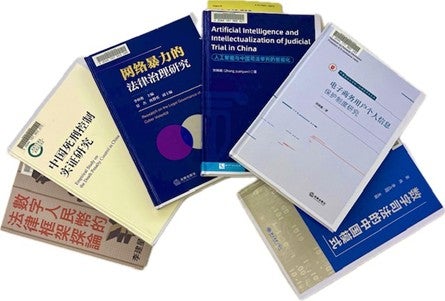
One of the most striking changes is the sheer diversity of subjects now covered in Chinese legal publishing. Our recent acquisition lists include works on legal issues in areas that, three decades ago, were either marginal or did not yet exist as fields of inquiry. For example:
Health and biotechnology:
- The right to health and access to healthcare
- The regulatory framework for gene-editing technologies
- Long-distance and telehealth services
Data and surveillance:
- Cross-border data transmission and data localization
- The installation of cameras and the collection and use of images in public spaces
Technology and innovation:
- Legal regimes for integrated circuits and chips
- Digital forms of Chinese currency
- Artificial intelligence governance and liability
- The regulation and use of drones
These topics reflect the intersections between law, technology, public policy, and everyday life in contemporary China. They also mirror broader political, economic, and technological shifts within the country, including rapid digitalization, growing attention to data governance, and major public health challenges.
An Especially Opportune Moment
Looking back to the early 1990s through today, the evolution of Chinese legal scholarship and publishing has been remarkable. What began as a field dominated by basic textbooks and general legal education materials has grown into a sophisticated and diverse academic ecosystem, engaging with major issues in technology, health, data, finance, and governance. For students and professors interested in Chinese law, this is an especially opportune moment to dive in. The combination of richer subject matter, more varied methodologies, and increasingly accessible sources—enhanced by the growing capabilities of translation technologies—makes it possible to study Chinese law in greater depth and breadth than ever before.
In short, if you are considering incorporating Chinese legal materials into your research or teaching, there has never been a better time to start.

Filed in: New In the Collections
Contact Us
phone: 617-495-3455
email: asklib@law.harvard.edu
library website: hls.harvard.edu/library
Stay Connected
Library Innovation Lab (LIL) Blog
Instagram @hlslibrary
Facebook @hlslibrary
Et Seq blog (archived)