Writing is messy, recursive, and frustrating. If you don’t self-identify as a “writer,” it’s helpful to know that there’s a linear sequence that simplifies the writing process. Each step sets you up to take the next.
When something isn’t clicking in a paper, it’s because you skipped over one of the steps. Go back and figure out which step you didn’t take.
Half of the writing process is about coming up with a good idea to write about; the other half is writing that idea out in an effective paper.
There are four main stages to the writing process: (1) Interpretation, (2) Research, (3) Drafting, and (4) Revision. Good writing goes through these broad stages in order but regularly returns to earlier steps, making adjustments.
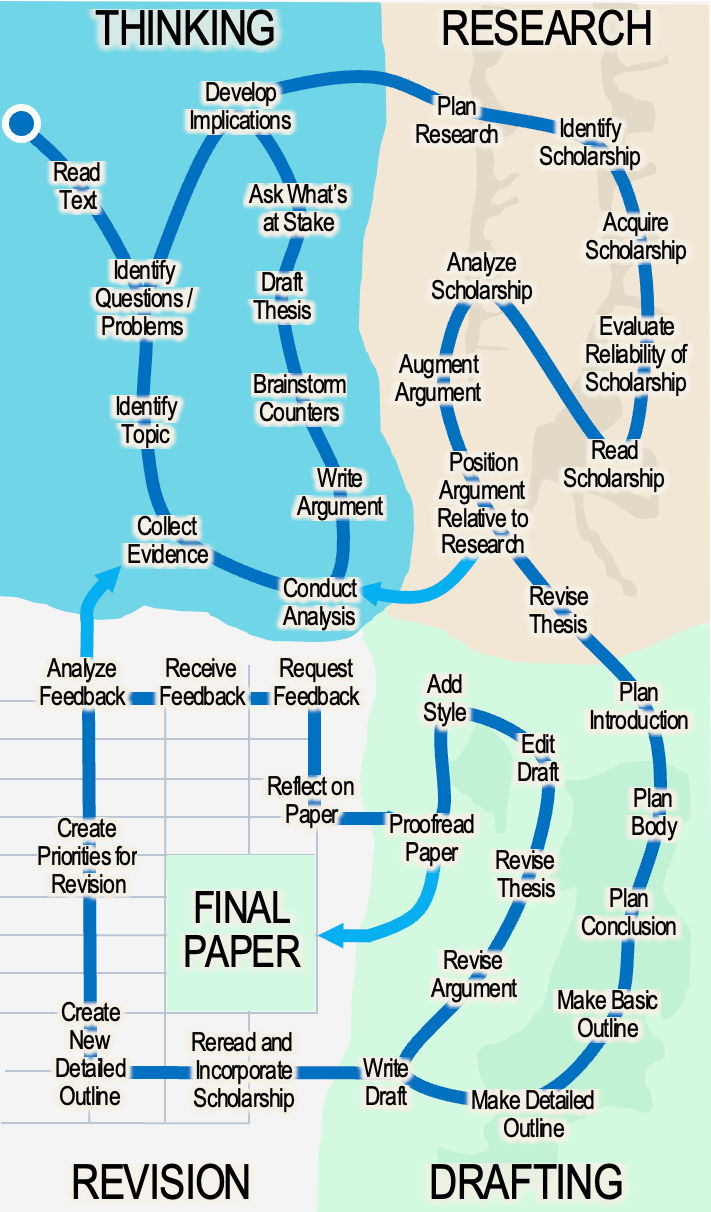
The Thinking Stage
You’ll develop ideas by defining a topic, identifying questions that need to be asked, collecting evidence, conducting analysis, synthesizing an argument, and articulating why it matters.
Read text
And then read it again. It is important to start with a thing that you want to interpret, not a point that you want to make.
Identify questions / problems
Brainstorm some quirks, quandaries, contradictions, gray areas, and moments that run counter to expectation in your text—problems that demands interpretation. Begin with a question that you can’t answer, not an argument that you want to make.
Collect evidence
Pinpoint the places in your text(s) that you will need to look to answer your question. You don’t need an interpretation yet—just a clear understanding of the information that needs interpretation.
Conduct analysis
Start with key passages. Make as many observations about them as possible. How might an observation about your key evidence unlock and elucidate the rest of the text? Map out how your ideas relate.
Write argument
Synthesize your ideas into a main point that you want to make in, say, 300-600 words. This is an “argument statement,” which is different from a “thesis statement.”
Brainstorm counters
Ask how someone might see things differently from a different perspective; stress-test your argument for gaps and fallacies.
Draft thesis
Write the one- or two-sentence main claim about your text that you want your reader to accept because it is true.
Ask what’s at stake
Brainstorm possible answers to the “so what?” questions: why does your argument matter? and to whom? what can we do with the knowledge conveyed in your thesis?
Develop implications
Select one direction from your stakes, and articulate the pay-off of your argument, which should illustrate its value.
NOTE
As you move through the thinking stage, you frequently cycle back to earlier steps in the process, adjusting previous ideas based on later discoveries and decisions.
The Research Stage
You’ll put your ideas in conversation with others by finding, reading, evaluating, incorporating, and properly citing the ideas of other thinkers and writers.
Plan research
Identify the areas that you need research on—create a list of keywords to use in search engines.
Identify scholarship
Search for scholarship that has addressed your topic or similar topics.
Acquire scholarship
Access the scholarship that you want to read. Save copies of sources so that you always have access to them.
Evaluate reliability of scholarship
Ensure that your potential sources are high-quality, whether that’s peer-reviewed books and articles or reputable public writing.
Read scholarship
Read through the books and articles you have collected, keeping notes that summarize sources and key passages.
Analyze scholarship
Consider the relationship between your argument and the scholarship, not to change your ideas, but to mark out where you might make an original contribution to the academic conversation.
Augment argument
Based on your work with the scholarship, revisit the argument you created to make it as complete and accurate as possible.
Position argument relative to research
Articulate the critical conversation related to your topic and how your argument makes a contribution to it.
Plan research
Identify the areas that you need research on—create a list of keywords to use in search engines.
NOTE
As you complete the research stage, you should return to the thinking stage; your thinking will evolve as you research.
Revise thesis
Based on your updated argument, revisit your thesis, revising it so that it is as complete and accurate an account of your thinking as possible.
ALSO NOTE
Everything up to this point has been about how to develop a good idea to write about; everything that follows is about how to present that argument effectively in a paper.
The Drafting Stage
You’ll outline a paper that is easy for a reader to follow while writing clear, powerful sentences and paragraphs that are free of grammar and punctuation errors and snap with style.
Plan introduction
Identify the key elements to cover in your introduction, which should be built around your thesis.
Plan body
Decide which evidence and analysis to include, what sections you need in the body of the paper, and what paragraphs in those sections.
Plan conclusion
Figure out how to wrap up the paper by delivering the implications of your argument.
Make basic outline
Draft an outline with (1) an introduction that describes a problem and responds with a thesis; (2) a body that supports your thesis with evidence and analysis that illustrate your argument; and (3) a conclusion that discusses the implications of your argument.
Make detailed outline
Develop your basic outline by writing out your introduction, conclusion, and the assertion of each body paragraph—keeping it in outline form so that you can adjust structure as you go.
Write draft
Turn your outline into paragraphs. Writing is the easy part of writing: putting words in sentences goes smoothly when you have done the thinking that generates an argument worth writing.
NOTE
Next comes the “cycle of revision.” Revision doesn’t happen just once; you revise over and over to make the paper better. You’ve been revising throughout the whole writing process.
Revise argument
While writing your draft, your argument may change. You may land upon new insights or a completely different argument. Write a new “argument statement” to update your central point.
Revise thesis
If you revised your argument statement, you also need to revise your thesis statement.
Edit draft
Work through your paper to tighten it up, trimming unneeded words and sentences.
Add style
Add in some creative flourishes to make your writing pop.
Proofread paper
Do a final read-through of your draft to correct any typos, fix grammar and punctuation errors, and make the formatting perfect.
The Revision Stage
You’ll approach writing as an extended development and improvement of ideas, using a series of brainstorming activities, drafts, and revisions while inviting and incorporating feedback from others.
Reflect on paper
Step away from the paper and write about what’s working well and what’s not yet working. (You can use writing from your reflection when revising the paper in the next stage.)
Request feedback
Ask for comments from peers, teachers, random people on the street, anyone who will give it.
Receive feedback
Organize the comments you receive by themes.
Analyze feedback
For every point of feedback, write a sentence describing what you would do if you were to incorporate that note.
Create priorities for revision
Decide which feedback you’re going to act upon. List the three main improvements you’re planning to make, along with smaller changes.
Create a new detailed outline
Revision is not about fixing your earlier draft; it’s about writing a new paper. Based on the comments you’ve received, and your continuing thoughts on your project, create a new outline—not a revision of your previous outline, but a new outline based on what the completely new paper you would write today would look like.
Reread and incorporate scholarship
Revisit the key scholarship read earlier; your enhanced understanding of the issue will allow you to judge more effectively which critics get things right and which get it wrong. Incorporate new insights on the scholarship into your detailed outline. Cite scholars aligned with your argument; critique those who aren’t.
NOTE
Repeat the cycle of revision as needed. Go back to the first step in the cycle of revision—writing a draft—and repeat the cycle as needed until you arrive at a paper you’re happy with. Eventually, you’ll get a final paper. It’s done—time to celebrate!