There are millions of academic books and articles out there. No one could read them all. There are, however, only 23 kinds of information that appear in academic books and articles.
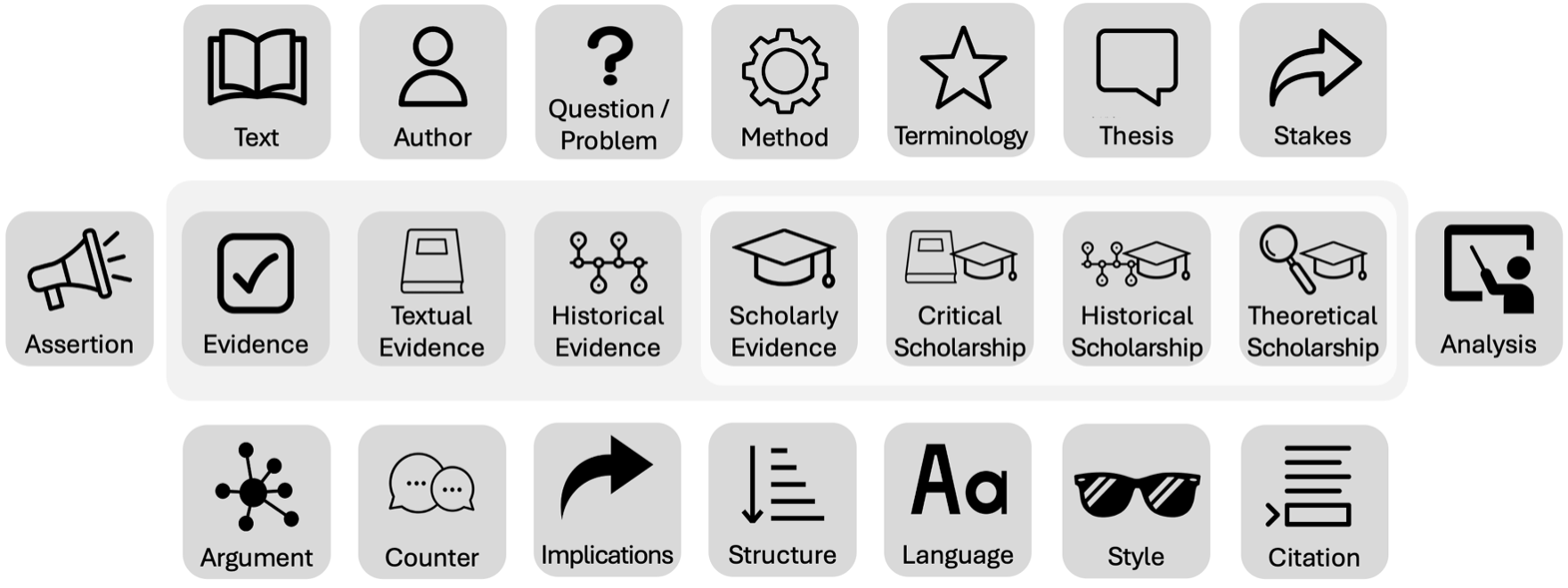

Text
The thing being interpreted—the object, event, topic, or phenomenon being discussed, even if it’s not a book.

Author
The person interpreting the text.

Question/Problem
Why the text needs interpretation.

Terminology
Key concepts in the argument.

Thesis
The central claim about the text and main takeaway from the argument.

Stakes
Why the argument matters, pointing to the implications.

Assertion
A sub-claim made in support of the argument that is substantiated with evidence.

Evidence
The information—facts, examples, quotations, details, experiments, data, statistics—presented in support of an assertion. There are three kinds of evidence—textual, historical, and scholarly—and evidence always receives analysis.

Textual Evidence
Facts, examples, details, quotes, etc. drawn from the text; sometimes called “primary source(s).”

Historical Evidence
Facts, examples, details, quotes, etc. from outside the text; context that influenced the text or helps explain the argument; a form of “secondary source(s).”

Scholarly Evidence
Scholars cited to help deliver an argument; another form of “secondary source(s).” There are three kinds of scholarly evidence:

Critical Scholarship
A scholar who has interpreted the same text or textual evidence as the author, often marshaled to support analysis or argument, or used as a counter that the author responds to.

Historical Scholarship
A scholar who has interpreted the historical evidence relevant to a text, usually cited for context.

Theoretical Scholarship
A scholar whose ideas (often abstract or philosophical) help deliver an argument, even though that scholar doesn’t directly discuss the text or context in question.

Analysis
The interpretation of evidence—whether textual, historical, or scholarly; how a writer makes facts and information speak in support of assertions and arguments.

Argument
The network of ideas, claims, and reasoning that explain and support a thesis and thereby interpret a text.

Counter/Response
Alternate evidence, analysis, or argument (real or imagined) that an author must account for to be fully persuasive.

Implications
The significance of an argument beyond the specific text(s) under consideration, answering questions such as: so what? who cares? what does this change? what can we do with the knowledge in the thesis?

Structure
The sequence in which a piece of writing moves through all the other elements—from sentence to sentence within paragraphs, from paragraph to paragraph, and from section to section.

Language
The effectiveness of words and sentences, including grammar, punctuation, concision, and clarity.

Style
Creative language that makes writing lively, impactful, and memorable, including a writer’s perspective—including the worldview or personality an author brings to a topic.

Citation
References to the sources of evidence.