
One of Patrick Radden Keefe’s preferred writing tools isn’t a favorite pen, or a special lined notebook, or a classic typewriter. It’s an envelope.
The nonfiction author, New Yorker staff writer, and law school graduate uses it to create a “notional outline” early in his research, he told a crowd of Harvard Law School students during a talk last week. The outline is where he lists his main characters and any “big hinge moments” in a handful of bullet points. That’s his way into a story.
Why an envelope, wondered his interlocutor and Harvard Law School Writer-in-Residence Amy Davidson Sorkin, a longtime staff writer for The New Yorker who has covered the Supreme Court. It’s because the shape helps him hone his vision, Keefe replied, and constrain his research. Using an envelope means he avoids going off on tangents and can focus instead on turning his rough outline into a larger document. In time, it becomes a flexible path forward.
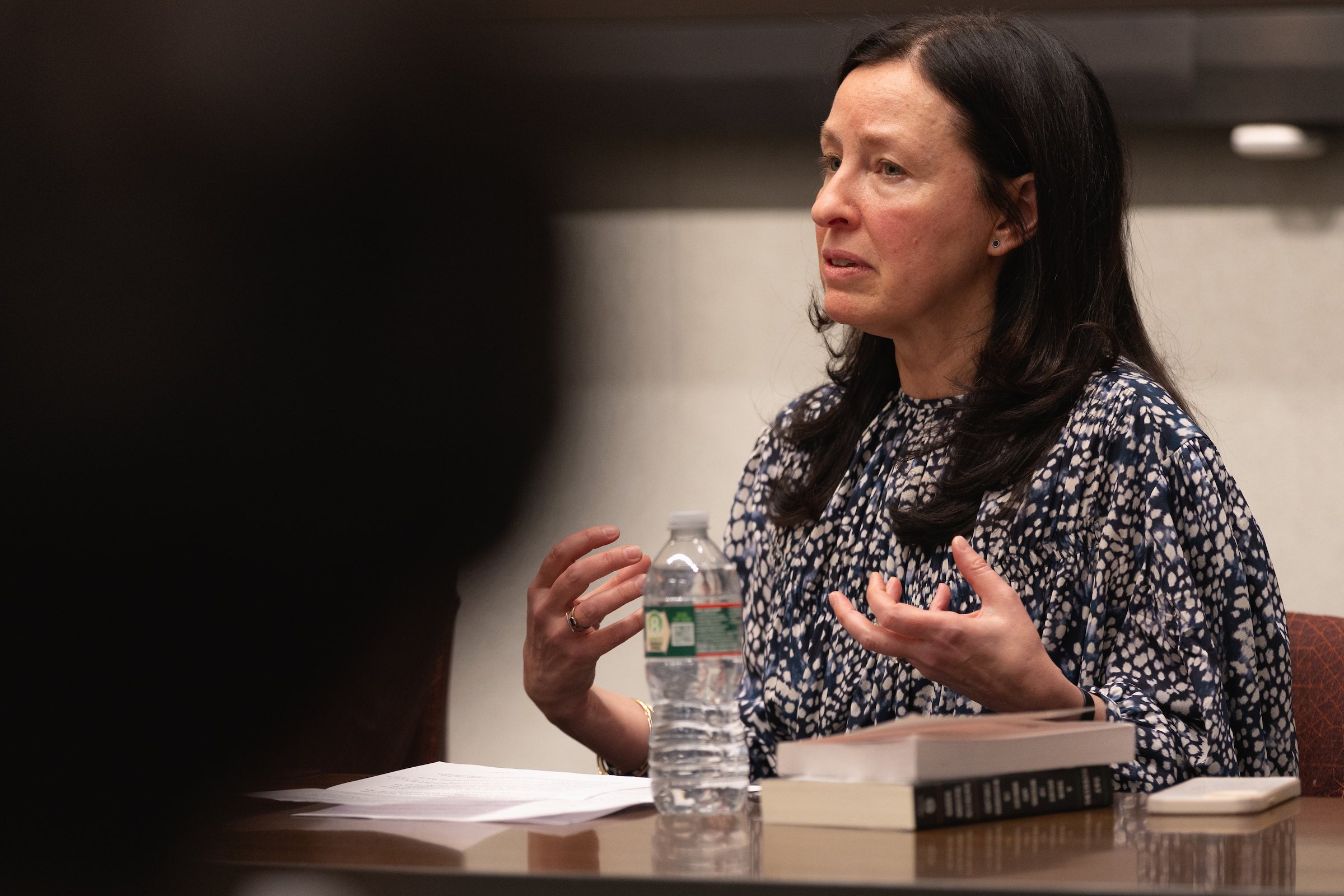
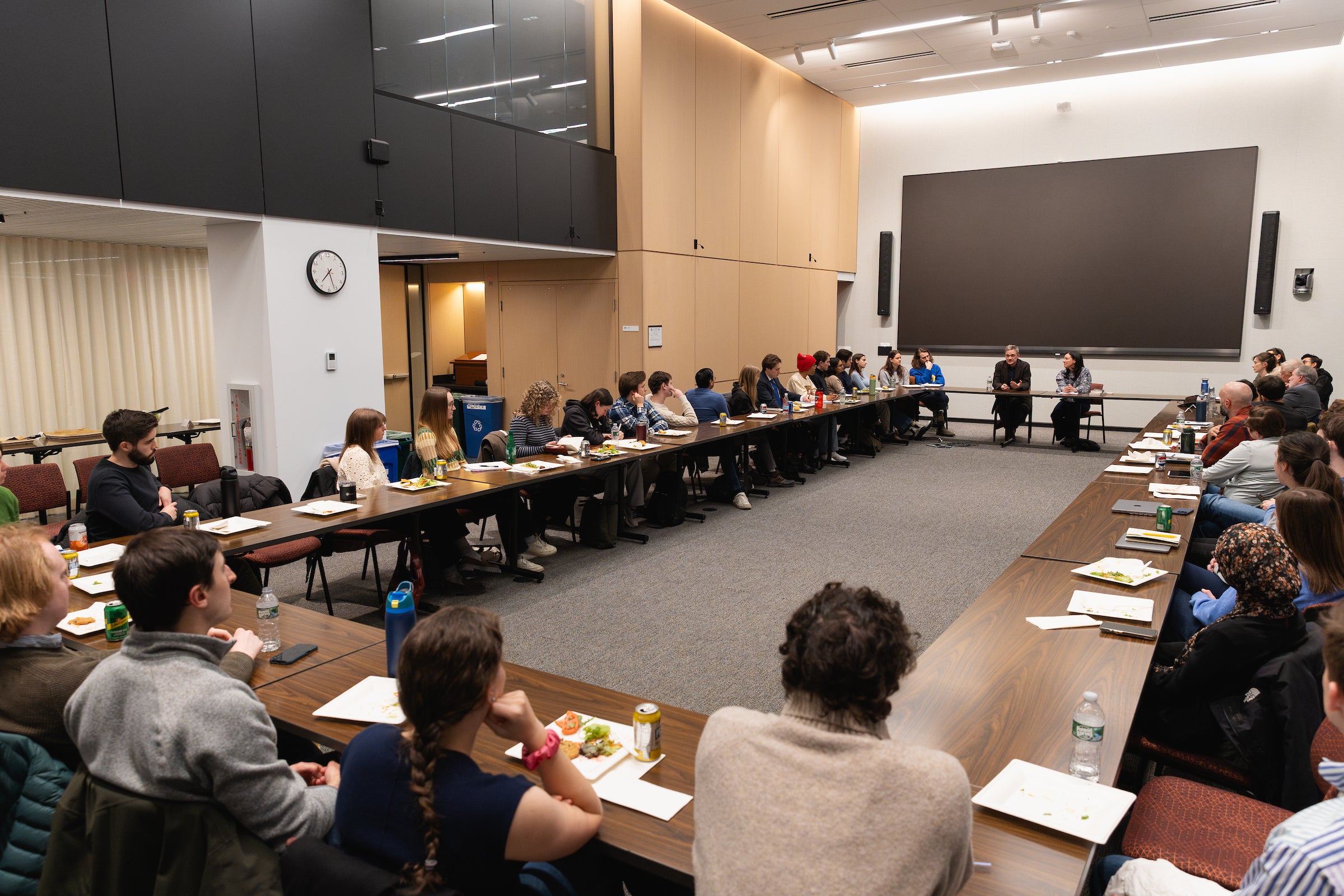
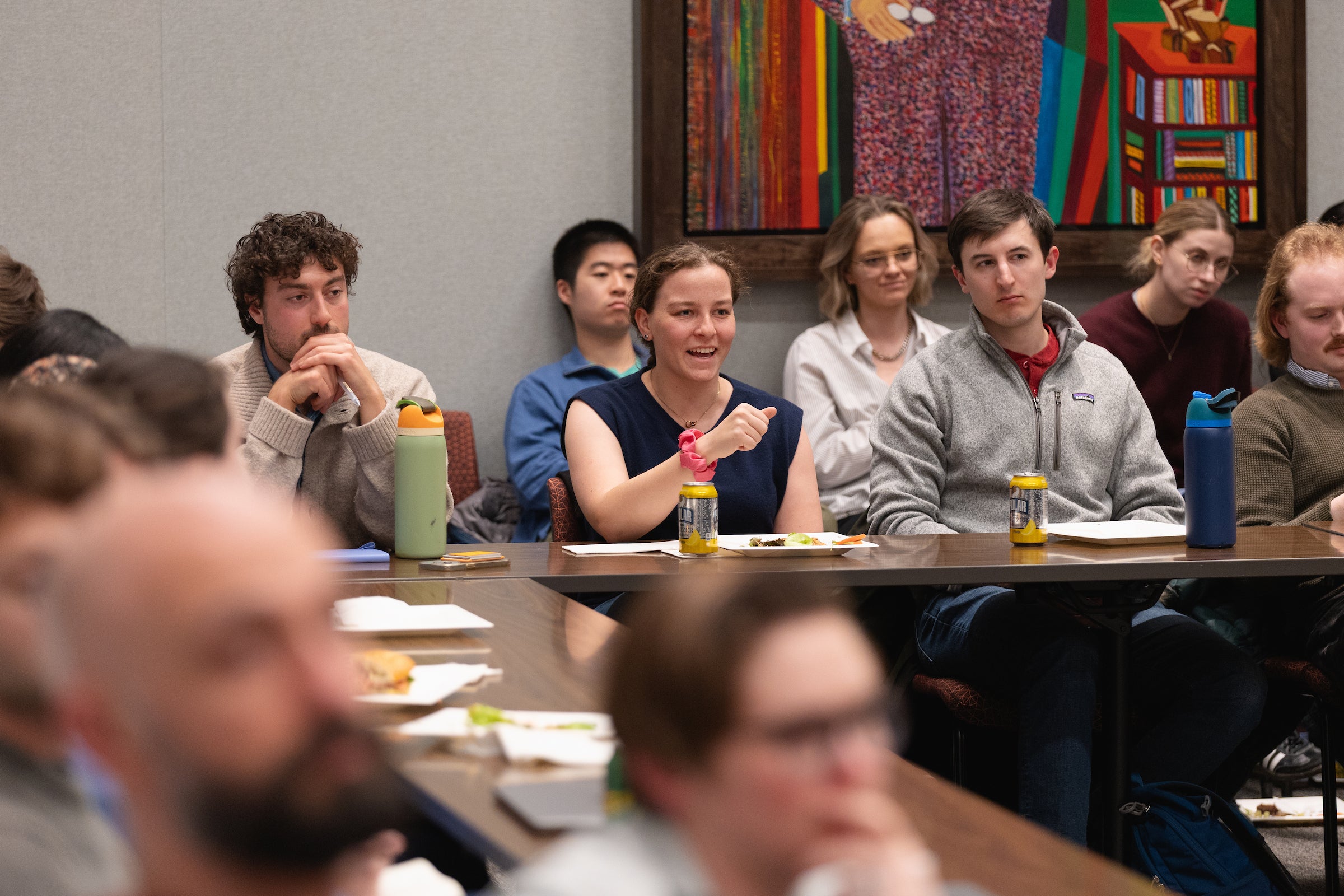
“Everybody’s different. This works for me; it may not for you,” said Keefe. “When I sit down to write, I’m never looking at a blank page … I have this highly fleshed out outline. I’ve done all the rough work, and so that then gives me a kind of situation where I can be sort of limber enough that I can be creative.”
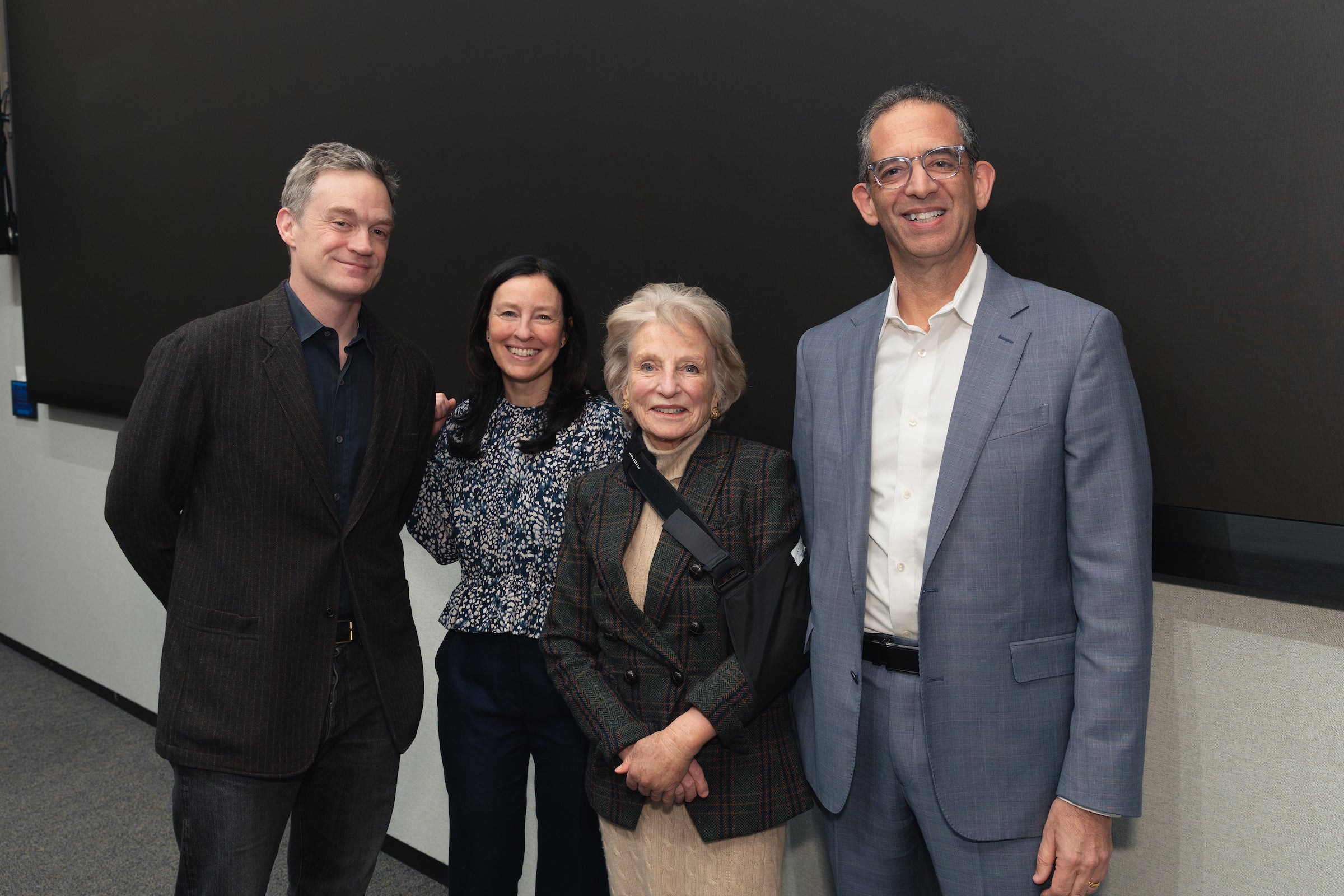
Keefe offered myriad details and tips during the two-hour discussion on writing. The talk was part of the Jane Lakes Harman Writer-in-Residence program, a new initiative helping law students ponder the power of narrative and storytelling in their legal writing. The program was made possible by a donation from Harman ’69, a U.S. representative from California from 1993 to 1999 and again from 2001 to 2011 and a former president of the Woodrow Wilson Center for International Scholars.
John Goldberg, the Morgan and Helen Chu Dean and Professor of Law, introduced Harman, calling her “a pioneer for women in public service and a committed mentor and a vital member of this community for nearly six decades.”
In brief remarks, Harman lamented not having had access to a similar course while at Harvard. “When I was at this law school … there were no writing courses,” she said, noting that early in her political career she “didn’t have a clue about how to do public-facing writing,” and taught herself by “looking at what other people did.”
“I hope this goes on and on and on and it’s a tool,” she added.
The new program includes office hours with Sorkin and a series of events hosted by Sorkin featuring a number of distinguished writers. The next talk will be on March 10 with Jennifer Gonnerman, a staff writer at The New Yorker and author of “Before the Law,” a finalist for the 2015 Pulitzer Prize for Feature Writing. A fourth event in March will be announced in the coming weeks.
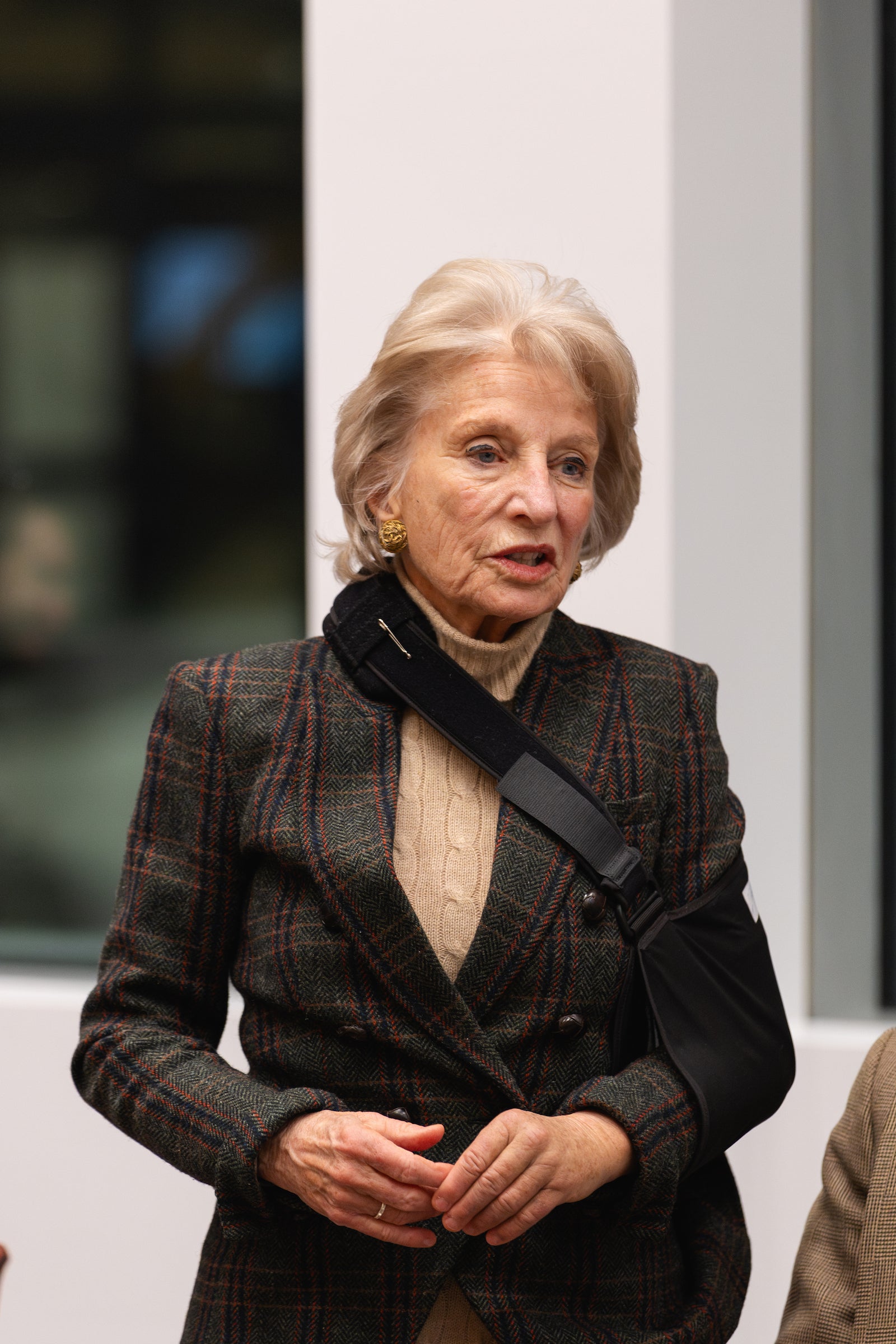
The idea behind the new program, said Sorkin, is to help students “talk and think and work on writing about the law, not court papers, not for other lawyers, not for your professors, not even strictly speaking for your clients, but for people in the public, for the general public, for people who aren’t lawyers.
“And I think that some of you may end up doing this sort of writing. Some of you may find yourself responding to it, or find that your clients are being written about, or that you may be written about in some ways. And so it’s also thinking about the stories that you’re helping to tell as writers and to be part of as writers.”
Sorkin called Keefe, her New Yorker colleague and author of several nonfiction books covering a range of topics, from global eavesdropping to human smuggling, an ideal guest. “His magazine articles and his books are really wonderful models of the kind of writing that we’re talking about,” she said, “but they’re also full of lawyers. … And I think it’s fair to say that not all of the lawyers who appear in his pages are what he calls ‘heroes.’”
For Keefe, a Yale Law School graduate, writing was the dream. Just months after passing the bar, he received his first New Yorker assignment and never looked back. His passion for telling stories developed early, inspired by parents who read to him and told him stories, and by gatherings with his extended Irish family in the Dorchester neighborhood of Boston, where storytelling became “kind of a competitive sport.”
“I just think there’s something about us as humans, where I think we are hardwired to process information, especially complex information, if it is relayed to us within some kind of narrative framework.”
Keefe discussed the importance in his work of staying attuned to “the stories people tell about themselves,” and remaining “objective.”
In writing his acclaimed book “Say Nothing: A True Story of Murder and Memory in Northern Ireland,” he described the challenge of depicting the plight of a handful of young people who joined the Irish Republican Army during the sectarian violence between Catholics and Protestants known as the Troubles.
“They had a real kind of moral clarity, but also, it was fun, and they were young, and it felt glamorous, it felt incredibly romantic,” said Keefe. “And in capturing their experience … I think it’s important to capture that romance without romanticizing it yourself.”
As a magazine writer and author of half a dozen books, Keefe said he is always transparent with his subjects, and, whether they agree to talk with him or not, he always hopes they “feel a little shiver of discomfort” when they read his work.
“I have told people, even in situations where it’s a fairly friendly profile and they’re cooperating with me, ‘If you read this and you feel as though I’ve perfectly captured you the way you see yourself in your mind’s eye, that’s like malpractice on my part, because I’m not in PR. I’m not here to be your ventriloquist.’”
They should view his work like an oil painting, not a photograph, he added, something that’s “been filtered through somebody else’s perception.”
When it comes to the law, good storytelling also can be essential, said Keefe, be it in brief or opinion writing or in the courtroom. He said you could make the case that most trials “are not really on the merits so much as the ability of the different litigants to tell the best story, to kind of take the facts, take the law, and then come up with the most compelling narrative.”

Fact checking, working with lawyers and editors, and learning how to not “write for the experts,” were topics Keefe touched on during the discussion, as was screenwriting, something he tried and calls “incredibly painful” because he’s “paralyzed by choice.”
“[With] screenwriting you’re God … it’s like this person could be that person, the sky could fall, aliens could land in the front yard,” said Keefe. “You know, all bets are off, right? And I strangely find that very inhibiting.”
He found “the intellectual rigor of law school incredibly stimulating.” He credits his time there with helping him learn how to think and “to express myself in a certain register,” while giving him a “little superpower as a writer.”
“I think there are a lot of writers who, if they see a stack of 1,000 pages of court filings, it’s hard for them to imagine that there might be enough gold in there to turn it into an incredibly compelling yarn,” said Keefe. “Whereas for me, I’m on Pacer every day, looking for the filings with the most exhibits.”
William Yee ’27, who has attended office hours with Sorkin to talk about writing, said he enjoyed hearing Keefe’s thoughts on the importance of facts and narrative.
“I think in law school we focus a lot on the doctrine. I think a lot of our cold calls are going to be, ‘Tell me what the majority opinion says.’ And I think sometimes we breeze through or overlook the facts,” said Yee. “But as we discussed in this kind of seminar, I think it’s really important for lawyers to be masters of the facts, very grounded in the facts. And I think this was [also] a very helpful reminder that law, at the end of the day, it’s stories of people. It’s not just … bright-line rules, three-part tests. It’s people.”
Want to stay up to date with Harvard Law Today? Sign up for our weekly newsletter.