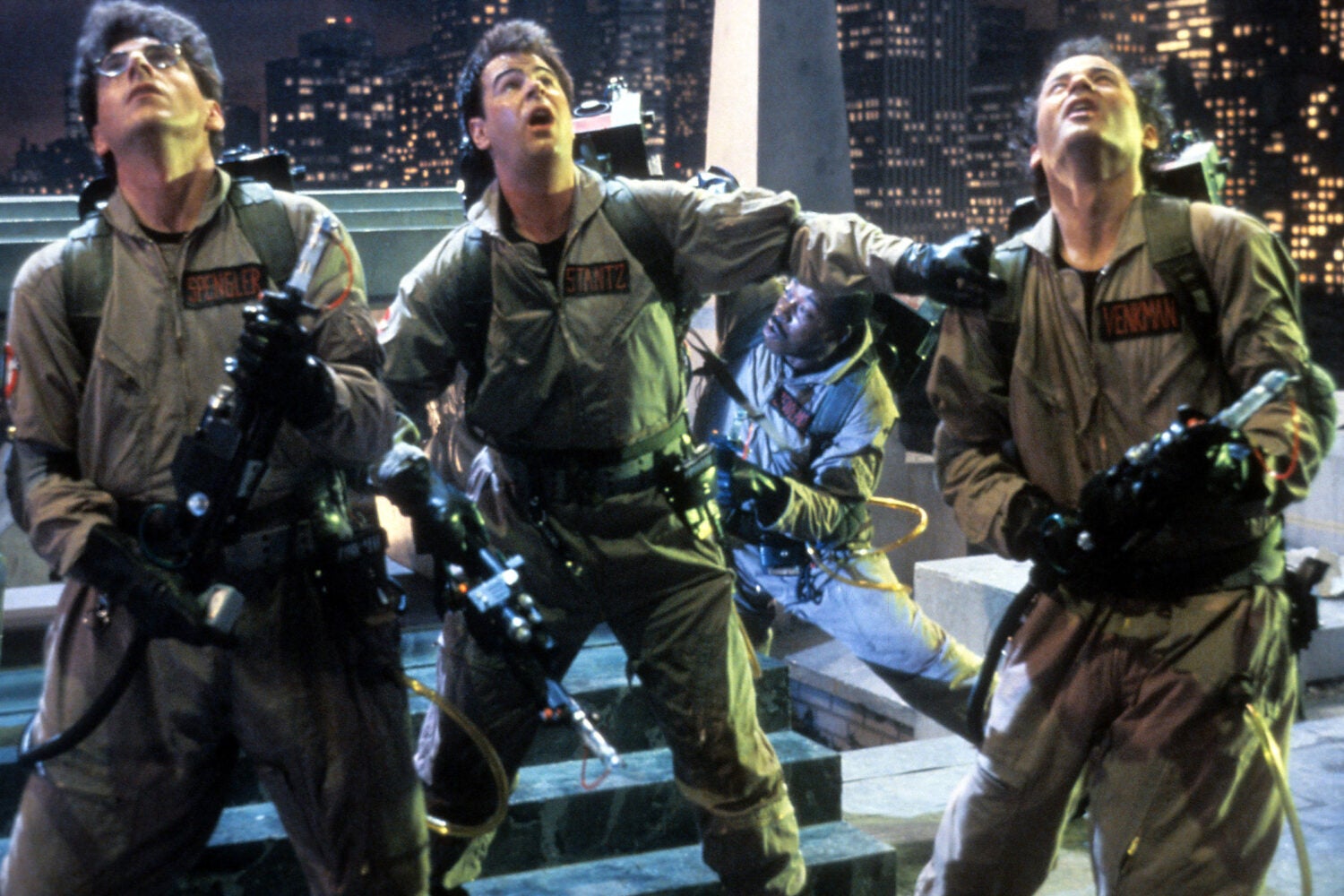
If there’s something strange in your neighborhood, who you gonna call? And if the people you call store your problematic poltergeist in an underground containment unit in the middle of your city — who’s gonna regulate it?
The original 1984 “Ghostbusters” follows a motley crew of academic rejects who develop a technology to capture and store ghosts. In the course of their work, they encounter a slew of ancient, shape-shifting ghouls from another dimension, but also a decidedly more mundane adversary: Walter Peck, an official from the Environmental Protection Agency. Peck, who is suspicious of the crew and their gadgets, ultimately issues an order forcing the Ghostbusters to turn off the power to their containment unit, unleashing an army of phantoms on New York City. And you thought Zohran Mamdani had challenges.
It’s a disaster that might have been avoided with a little more cooperation between the private sector and its regulator — or, as the film suggests, a little less government interference.
The movie “captures a broader skepticism toward government and institutions that was especially pronounced during the Reagan era,” argues Andrew Mergen, the Emmett Assistant Clinical Professor of Environmental Law at Harvard Law School. It was President Ronald Reagan, after all, who famously quipped that the nine most terrifying words in the English language are: “I’m from the government, and I’m here to help.”
In honor of Halloween, Harvard Law Today spoke with Mergen about how the EPA would actually regulate a business like Ghostbusters Inc., which laws might apply, and what the movie can tell us about contemporary environmental questions.
He also referred us to Benjamin Rolsma ’24, a Harvard Law graduate whose paper on a once-obscure provision of the Federal Power Act was cited in a recent opinion by the U.S. Court of Appeals for the D.C. Circuit. The provision has become an increasingly important tool for administrations seeking to help energy providers bypass certain environmental requirements in an emergency, Rolsma says. But could it also come in handy during an attack by an all-powerful god of destruction?
Fair warning: while our questions may be ridiculous, the legal issues they raise are anything but.

Harvard Law Today: In a broad sense, what does the 1984 film reveal about the era’s attitude toward environmental regulation and government bureaucracy?
Mergen: The movie reflects a sensibility that government cannot do its job and that government officials are mostly annoying. Walter Peck is arrogant and irritating, but the movie also treats the Ghostbusters as people whose practical expertise should prevail over government process. The film is hard on academia, too. The Ghostbusters are fired from the parapsychology department at Columbia, and one character is told that he has never been outside the college and does not understand that results are expected in the private sector. It captures a broader skepticism toward government and institutions that was especially pronounced during the Reagan era.
HLT: Do you have any other big takeaways from the film, after watching it again?
Mergen: “Ghostbusters” is a very techno-optimistic movie. The Ghostbusters confront a wicked problem: something difficult or impossible to solve because the facts and requirements are incomplete, contradictory, and constantly changing. The Ghostbusters’ answer is to build a machine and figure out how to use it. They are warned not to cross the beams, but in the end crossing the flows is what allows them to defeat Gozer [the film’s primary antagonist]. That resembles current debates over climate change and artificial intelligence. One side emphasizes cultural and behavioral change; another says that if we develop the right technology quickly enough, we can solve the problem without changing the way we live. “Ghostbusters” is firmly in the second camp.
HLT: Let’s get more specific. If Ghostbusters Inc. opened today, what legal regime would most likely govern it?
Mergen: There are probably two main regulatory schemes. The movie tells us early on that the Ghostbusters have an unlicensed nuclear accelerator, which would be regulated by the Nuclear Regulatory Commission rather than the Environmental Protection Agency. But assuming they are also storing and disposing of hazardous materials, the most obvious EPA statute would be the Resource Conservation and Recovery Act, or RCRA. RCRA is essentially a cradle-to-grave statute for hazardous waste: It regulates materials from the moment they are generated or arrive at a facility through their treatment, storage, disposal, or reuse.
HLT: How would RCRA govern what the Ghostbusters do with their wall full of poltergeists?
Mergen: They would need to identify to the government what materials were on the premises, maintain records that would allow the EPA to know what was there, and demonstrate that they were handling and disposing of those materials properly. RCRA applies to hazardous-waste treatment, storage, and disposal facilities, so the Ghostbusters’ containment unit could create serious problems if it were being used to store hazardous material without the required controls. The law also has both civil and criminal provisions. If it felt like the law was being broken, the EPA could refer a criminal case to the Department of Justice, which would prosecute it.
HLT: In the movie, Walter Peck claims that the Ghostbusters are violating something called the “Environmental Protection Act.” Is there really such a law?
Mergen: No. That is a made-up statute. We do not have one overarching Environmental Protection Act that regulates every environmental problem. We generally regulate by medium: water, air, hazardous waste, and so on. The closest thing to an overarching statute is the National Environmental Policy Act, or NEPA, but NEPA is primarily procedural. It asks the government to assess and disclose the environmental consequences of a proposed action before proceeding. It is not the statute that would directly regulate the Ghostbusters’ containment unit. This looks much more like a RCRA problem.
Suspending regulations in an emergency
HLT: Could the EPA simply suspend regulations if, say, the Ghostbusters’ containment unit were leaking and an army of ghouls were taking over Manhattan?
Mergen: There are emergency provisions that allow the EPA to take action when there is an imminent threat to human health, but that is not the same as having a general power to suspend every environmental regulation. The legal authority would depend on the particular statute and the particular emergency. In a genuine crisis, the agency might be able to authorize or direct immediate action, use a narrow exemption, or postpone some procedural requirements. But there would still be limits on what could be waived and how the response could be carried out.
HLT: In your opinion, what did lawmakers have in mind when they created emergency exceptions to environmental laws?
Mergen: They likely anticipated situations in which the government had to act immediately to address a serious threat. National security may qualify in some circumstances, because the statutes say that it can. But there is a meaningful difference between an actual emergency and an ordinary activity that the government characterizes as an emergency. If aliens were coming and the government had to act in endangered species habitat to prevent the country from being taken over, that would look different from simply pumping oil and calling it a national security emergency. The question is whether emergency authority is being used to respond to an immediate danger or to avoid environmental law more generally.
HLT: How have administrations used those environmental emergency exceptions in contemporary contexts?
Mergen: The Trump administration has been unusually willing to use emergency or national security arguments to move certain actions outside ordinary environmental review. One example involves a decision by the Endangered Species Act’s so-called “God Squad” — an interagency panel with the authority to exempt federal actions from the ESA — to exempt oil and gas operations from the law based on national security concerns, including the argument that compliance could interfere with energy needed in case of war.
Another example is the current administration’s extensive use of emergency waivers for industrial facilities. As the New York Times documented this weekend, the Clean Air Act allows polluters to obtain exemptions from complying with new rules under the law if doing so threatens national security and if the necessary technology is not readily available. Since taking office for the second time, President Trump has exempted 202 facilities from this provision, even though the technology is available and the national security claims appear to be unsubstantiated.
HLT: Let’s talk about what happens in the wake of an accident. Pretend Peck isn’t involved — if the Ghostbusters’ incompetence leads to a city covered in slime, who is responsible for cleaning up the mess?
Mergen: The first responsibility would generally fall on the company that caused the release — in this case, the Ghostbusters. That was true in disasters such as the Exxon Valdez spill and the Deepwater Horizon explosion: The company was responsible for containing and cleaning up what it had released. Local fire and police departments and other emergency responders would also respond, even if they did not have specialized knowledge of the particular material. The EPA would not necessarily be the first agency on the scene. Under statutes such as the Oil Pollution Act, an on-scene coordinator from the Coast Guard or EPA might be appointed, but the responsible company is often the first responder in the legal sense.
Emergency electricity powers under the Federal Power Act

HLT: The film’s containment unit shutdown raises a separate question about emergency electricity powers. That includes the Department of Energy’s authority to enable electric utilities and electric grid operators to bypass some environmental regulations in an emergency.
Ben, could you tell us about Section 202(c) of that law and what it does? What kinds of emergencies did Congress have in mind when it created the provision?
Benjamin Rolsma: The provision allows the agency to direct temporary electricity generation, delivery, and transmission measures during emergencies. This is a tool that Congress has provided the federal government with since the 1930s to step in to make sure that the electricity grid is stable, so we can turn the lights on when we need them.
When it passed this law, Congress was not just thinking about wartime, but it also didn’t mean simply your average brownout or blackout. In 1935, when Congress passes the Federal Power Act, which includes 202(c), one of the conditions that allows it to be invoked is “during the continuance of any war.” But in the legislative history, Congress also references these droughts that occurred in California in the early 20th century that caused big electricity shortages.
Those references and the fact that the statute’s text goes beyond just the continuance of any war, make it clear that Congress had something bigger in mind for what would count as an emergency. But the reference to these extreme circumstances also signals that legislators probably weren’t thinking about just kind of run-of-the-mill grid problems.
HLT: How has Section 202(c) been used over time, and how is it being used today?
Rolsma: There are a few different eras in how it has been used. At first, it was only invoked during wartime and right afterward, in the context of the Second World War. Between 1945 and 1977, it’s only invoked a few times and usually in extreme circumstances. In 2000, the Department of Energy used it to support California during its energy market crisis.
After that, however, we start to see its use ramp up, particularly over the last decade. In my article, I argue that a 2015 amendment to the law really transformed 202(c) into an environmental “super waiver.” Increasingly today, grid participants will ask the Department of Energy for waivers from Clean Air Act or Clean Water Act provisions, usually during heat waves or cold waves or hurricanes.
During the second Trump administration, we continue to see that use and another new thing, which is using 202(c) to require coal-fired power plants that were going to retire to stay open. The coal plant orders sometimes cite relatively short-term concerns about electricity shortages, but they’re also pointing at medium- and long-term reliability risks. We’re no longer talking exclusively about an immediate emergency.
In September, the D.C. Circuit issued a new decision in litigation about one of those coal plant orders. The D.C. Circuit’s decision endorses, I believe, a relatively narrow understanding of what could count as an emergency. I think it’s an open question about whether a lot of the orders issued — even going back to the post-World War II era — would hold up against the court’s definition.
HLT: So, would an attack by ghouls qualify as an emergency in that context?
Rolsma: There are two possible ways it could qualify as an emergency.
You would ask: As a result of the invasion of ghouls, is there a war in which the United States is engaged? That’s an interpretive question that no court has ever examined. If you’ve decided we’re not technically at war, you would then ask: is the ghoul invasion causing some kind of dramatic and unexpected effect on the electrical grid? For example, are the ghouls attacking the power plants, and we need to use 202(c) to bring in electric energy from outside of New York City? If that was happening, I think that would be a relatively straightforward application of 202(c).
On the other hand, if the ghouls are leaving the electrical system alone, there would be a lot of problems, but an electric emergency might not be one of them.
These interviews have been edited for length and clarity.

Want to stay up to date with Harvard Law Today? Sign up for our weekly newsletter.