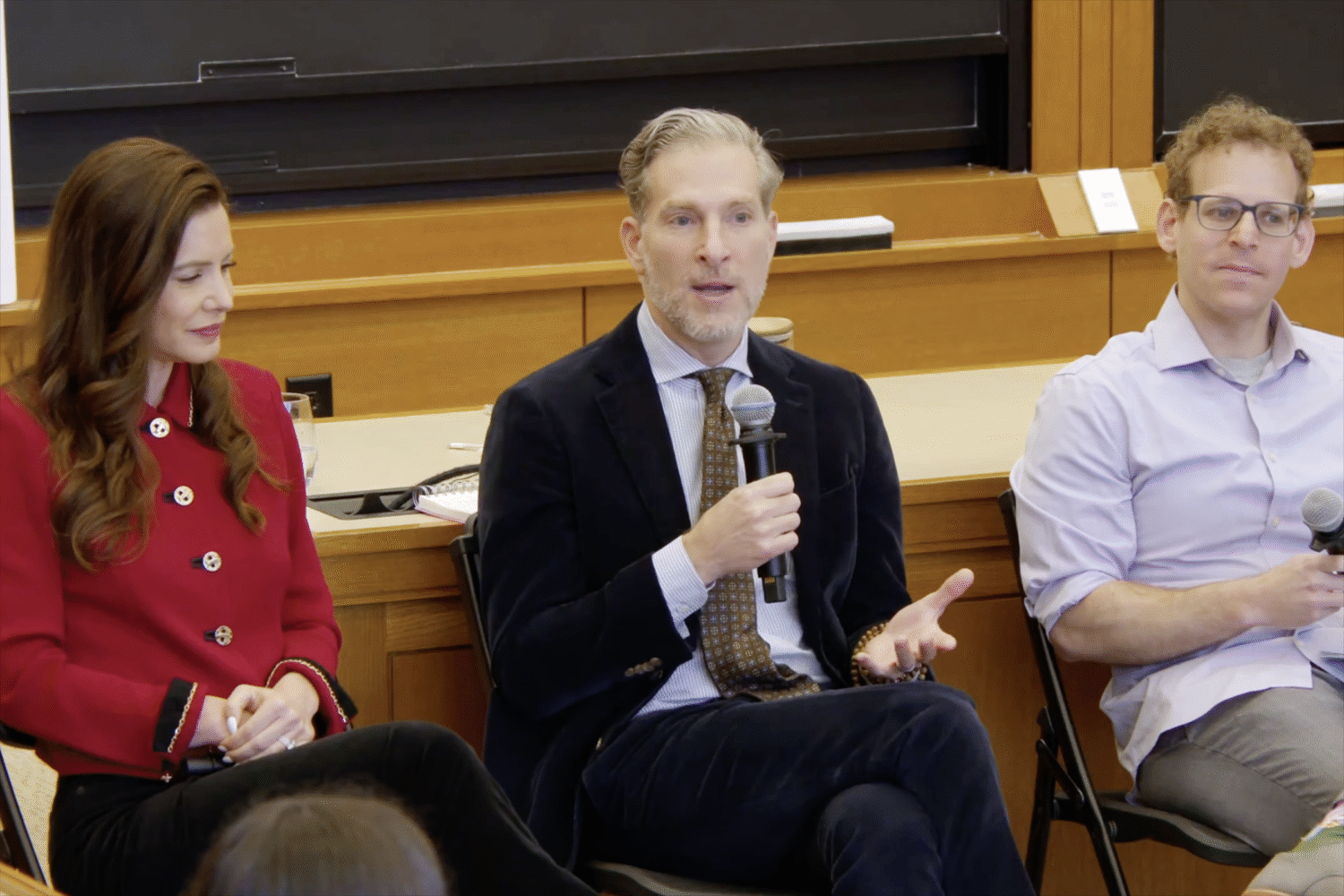
When it comes to identifying public officials, transparency in decision-making should be required, but the law should also do more to protect government representatives and employees from online harassment, says Harvard Law School Professor Noah Feldman.
Feldman, the Arthur Kingsley Porter University Professor, spoke as part of a panel discussing the idea of anonymity on animal research committees. He was joined at the April 3 event by Asher Smith, general counsel in charge of litigation for the People for the Ethical Treatment of Animals (PETA) Foundation, and Julia Allison, a Shorenstein Fellow at the Harvard Kennedy School who specializes in the intersection of media and politics. The talk was sponsored by the Harvard Animal Law Society, the Animal Law & Policy Clinic, and the Brooks McCormick Jr. Animal Law & Policy Program.
Shira Fischer ’26, who is an Animal Law & Policy Program board member, moderated the discussion, which focused on a long-running case that Smith won last year in which the University of Washington’s Institutional Animal Care and Use Committee had sought to prevent the release of its personal information to PETA.
Such committees, known as IACUCs, are required at institutions that receive federal funding for animal research. The University of Washington IACUC argued that the release of its members’ names would violate their First Amendment right to anonymity and could subject them to harassment by animal rights activists. PETA argued that the information is vital to ensuring that the committee’s membership has the required balance — with representatives in both scientific and nonscientific roles.
After PETA’s victory, the organization filed a complaint with the federal government requesting an investigation into the University of Washington’s IACUC.
PETA is “pushing the federal government to take action, perhaps in the form of clawing back grant money or other penalties,” Smith said. “That would be revolutionary if that happened.”
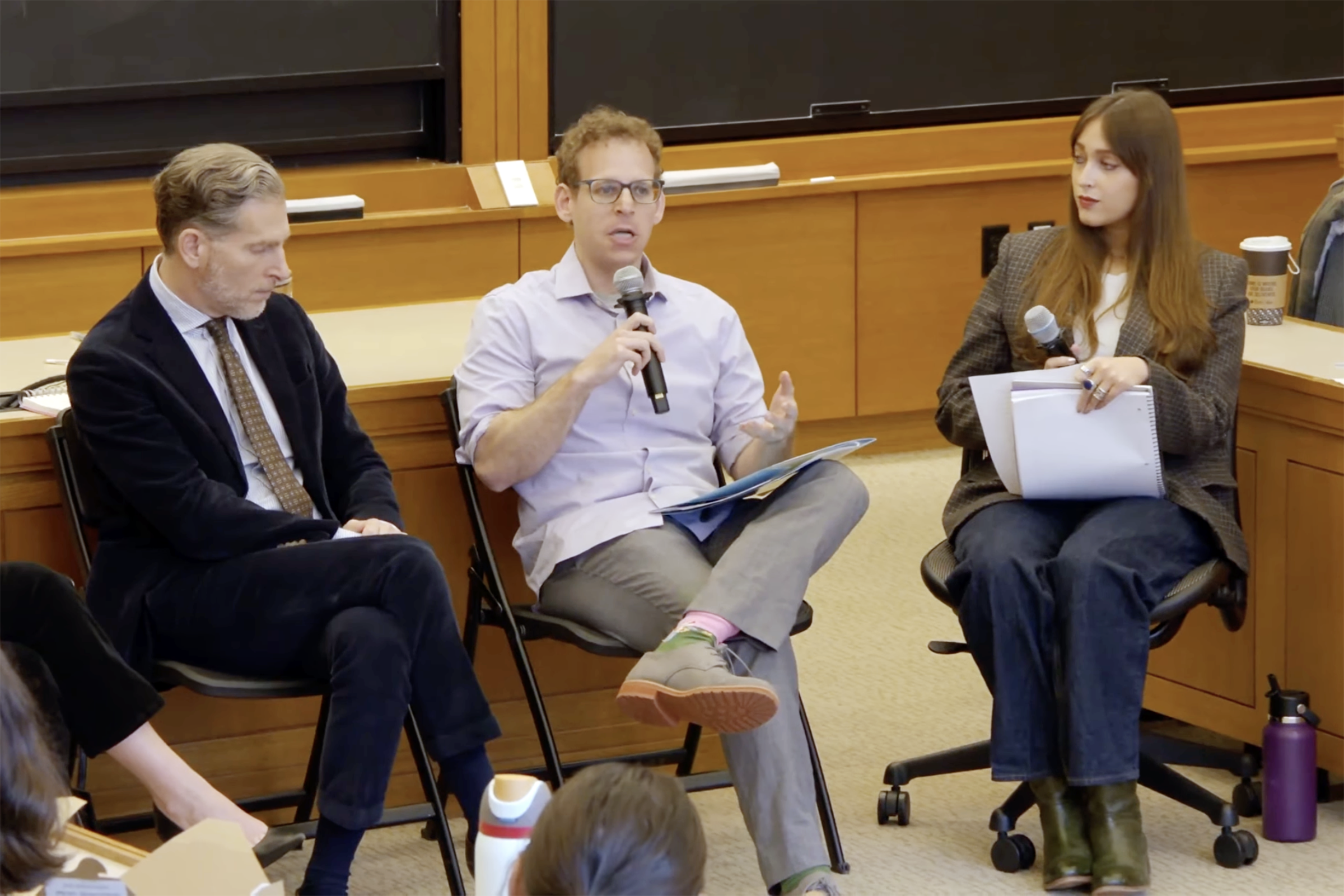
Feldman pointed out that the circumstances of the case were unique. Because the University of Washington is a public institution, it and its employees are subject to First Amendment standards and to any applicable state public records laws. A private university and its employees might not be required to turn over the information.
“Employees [at a private university] could have made an argument that, as private citizens, they were entitled to speak anonymously,” Feldman said. “The case would have looked really different.”
Feldman offered his views as a constitutional law expert. Allison, on the other hand, described herself as an animal rights advocate who regularly lectures Feldman on the issues at the dinner table. (The pair are married). She also spoke from her own experiences of being harassed online as a media personality and journalist.
“I am not unbiased here,” she said. “I think it’s important for us to have transparency when we have actors that have decision-making power, especially over groups that cannot consent … [and] I myself have been a public person who has experienced online harassment.”
Harassment should be dealt with, Allison said, but “it doesn’t mean that we need to allow for anonymity where there ought not to be anonymity.”
Although Smith’s case came in the context of animal research and oversight, the experts agreed that it has broader implications, especially during a time when federal law enforcement officers have used masks to conceal their identities while on duty and when school board decisions about what should be taught and athletics organization decisions about who can participate have been politicized.
“We should actively require transparency, but we should also have laws that actively protect public employees from public harassment. We should do better at the latter in order to make sure that we keep transparency.”
Noah Feldman
Asher pointed to a recent ruling in a case involving former Department of Government Efficiency employees in which a federal judge ruled that the employees’ video depositions could remain online despite the employees’ claims of harassment.
“I’ll just plant my flag,” Asher said. “If you’re doing public work as a public official, full stop, you just can’t have a right to anonymity.”
Feldman said he didn’t think the distinctions could be so neatly drawn.
“Certainly, elected officials and public officials who are engaged in activity that’s a matter of legitimate public concern should not have a First Amendment right to be exempt from public records laws,” he said. “But I do think that there are plenty of people who work in the government who shouldn’t automatically be subject to having their identities disclosed just because they work for the government.”
Ultimately, Feldman said, “We should actively require transparency, but we should also have laws that actively protect public employees from public harassment. We should do better at the latter in order to make sure that we keep transparency.”
The panel was the final in a series held during Harvard Law School’s Animal Law Week. The program also included conversations about industrial animal agriculture, so-called greenwashing in food law, animal law enforcement, and energy development and wildlife in the Arctic.
Want to stay up to date with Harvard Law Today? Sign up for our weekly newsletter.