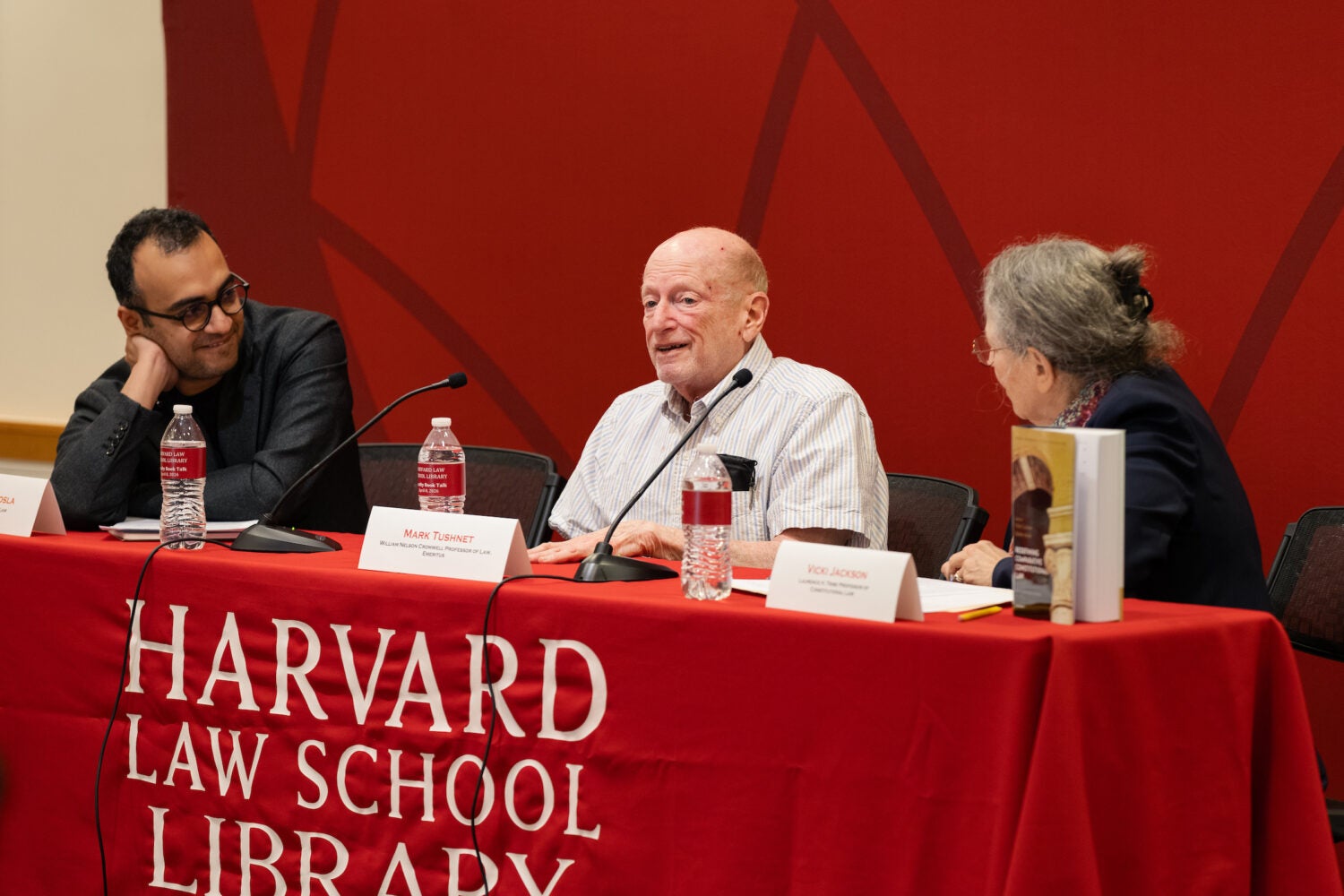
An organized political opposition and an active civil society are both important keys to recovering democratic practices and values in countries where authoritarianism has taken hold, said retired Harvard Law School Professor Mark Tushnet.
Tushnet gleaned those takeaways from his own and others’ work in the field of comparative constitutional law, which has been dominated in recent years by concerns about democratic backsliding around the world.
Tushnet, the William Nelson Cromwell Professor of Law Emeritus, spoke at an April 8 talk on a book published in his honor last year, “Redefining Comparative Constitutional Law: Essays for Mark Tushnet.” He was joined on the panel by the book’s editors, Vicki C. Jackson, the Laurence H. Tribe Professor of Constitutional Law, and Visiting Professor Madhav Khosla, the Dr. B.R. Ambedkar Professor of Indian Constitutional Law at Columbia Law School. The three scholars, along with Rosalind Dixon L.L.M. ’04 S.J.D. ’08, are also coauthors of “Comparative Constitutional Law,” the leading casebook in the field.
Tushnet answered questions from Jackson, Khosla, and members of the audience in the hour-long talk, which covered everything from populism and the role of courts in preventing authoritarianism to recent “No Kings” protests in the United States.
“Here in the United States, for a while, we thought we were immune from” democratic backsliding, Tushnet said. “We were seeing what was happening elsewhere and learning about decline and resilience and possibilities of recovery and now we actually have to think about it for ourselves. Comparative work is very valuable in seeing how other nations have responded to democratic decline.”
In addition to a united opposition and strong civil society organizations — including media and educational institutions, both of which are under attack in the United States — Tushnet said the courts can prevent authoritarian tactics, but only temporarily.
They can give “the political opposition and civil society a chance to get its act together, to do what’s actually effective,” he said.
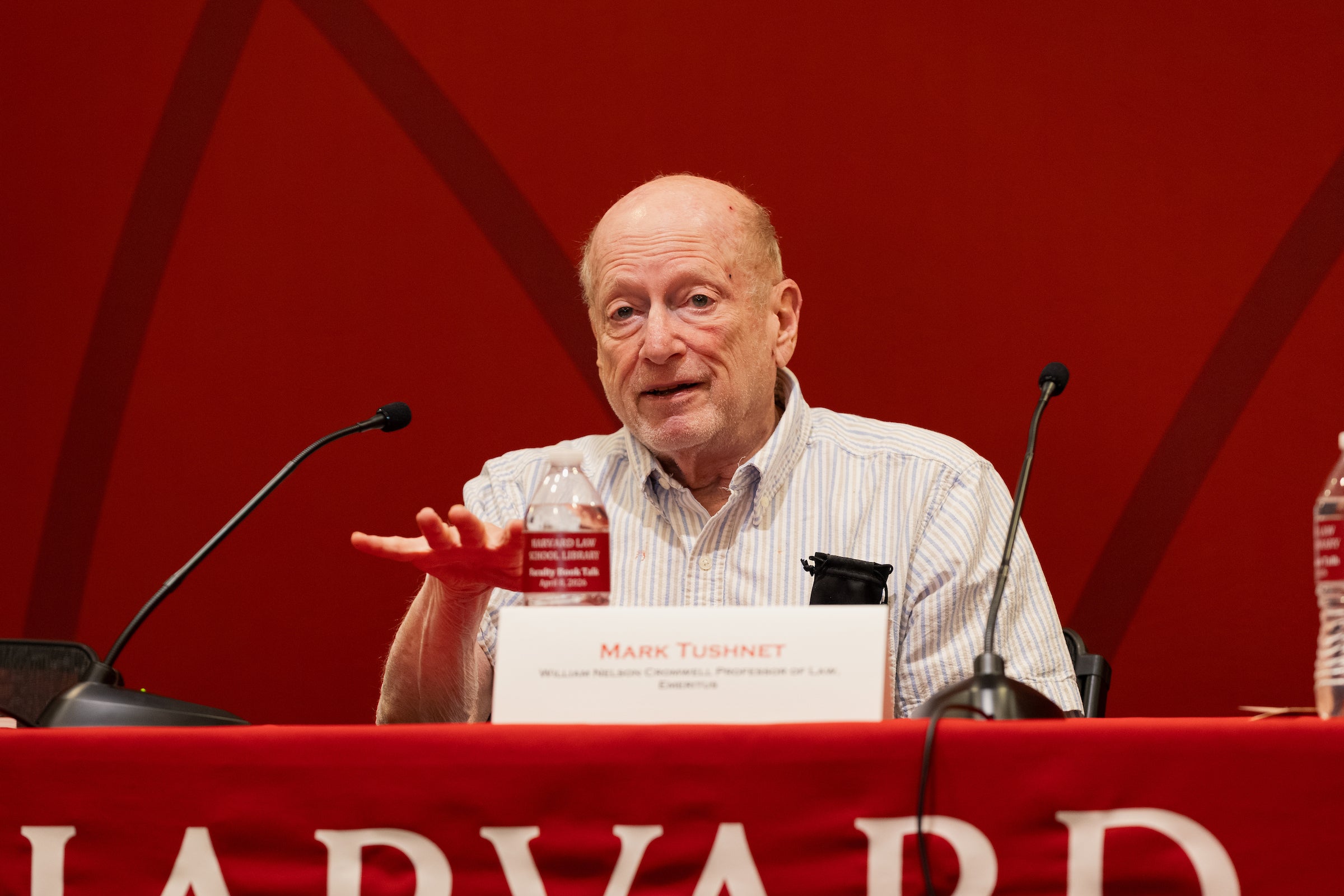
When Khosla pressed Tushnet to reflect on examples of countries that had successfully restored democratic practices after the rise of authoritarian governments, Tushnet was cautious. Pointing to varying levels of success in Poland, Brazil, and Hungary — where voters just ousted longtime leader Viktor Orbán, who describes himself as “illiberal” — Tushnet said there weren’t “systematic” lessons to point to.
“The stories are going to be nationally specific,” he said.
Tushnet also discussed his forthcoming book, “Constitutionalism and its Discontents,” in which he and Bojan Bugarič argue that political mobilization may be a better bulwark against democratic backsliding than constitutionalism. The book is a follow-on to the pair’s prior work, “Power to the People: Constitutionalism in the Age of Populism.”
During the Q&A portion of the event, an audience member asked how the recent “No Kings” protests could be converted into a meaningful opposition movement.
Tushnet mentioned an upcoming episode about popular constitutionalism on a podcast he cohosts called “Supreme Betrayal: How the Supreme Court and Constitutional Law Have Failed America.”
“I think [popular constitutionalism is] a real phenomenon, and I think ‘No Kings’ is a good example,” he said. “‘No Kings’ is a constitutional claim made by ordinary people in the streets about the kind of government we want to have … it shows that … liberal constitutionalism can be defended by ordinary people mobilizing in the name of a constitutional vision.”
One audience member asked Tushnet to comment on the legitimacy of right-wing populist movements that gained power without manipulating electoral processes.
“Right-wing political programs short of fascism are as fair game in politics as left-wing political programs short of Soviet totalitarianism,” Tushnet answered. “In terms of political theory, fine. If you offer a bad program and somebody says, ‘It’s bad; we’ll do better,’ that’s the way politics works.”
But he gave an important caveat: a willingness to accept the outcome of an election.
Want to stay up to date with Harvard Law Today? Sign up for our weekly newsletter.