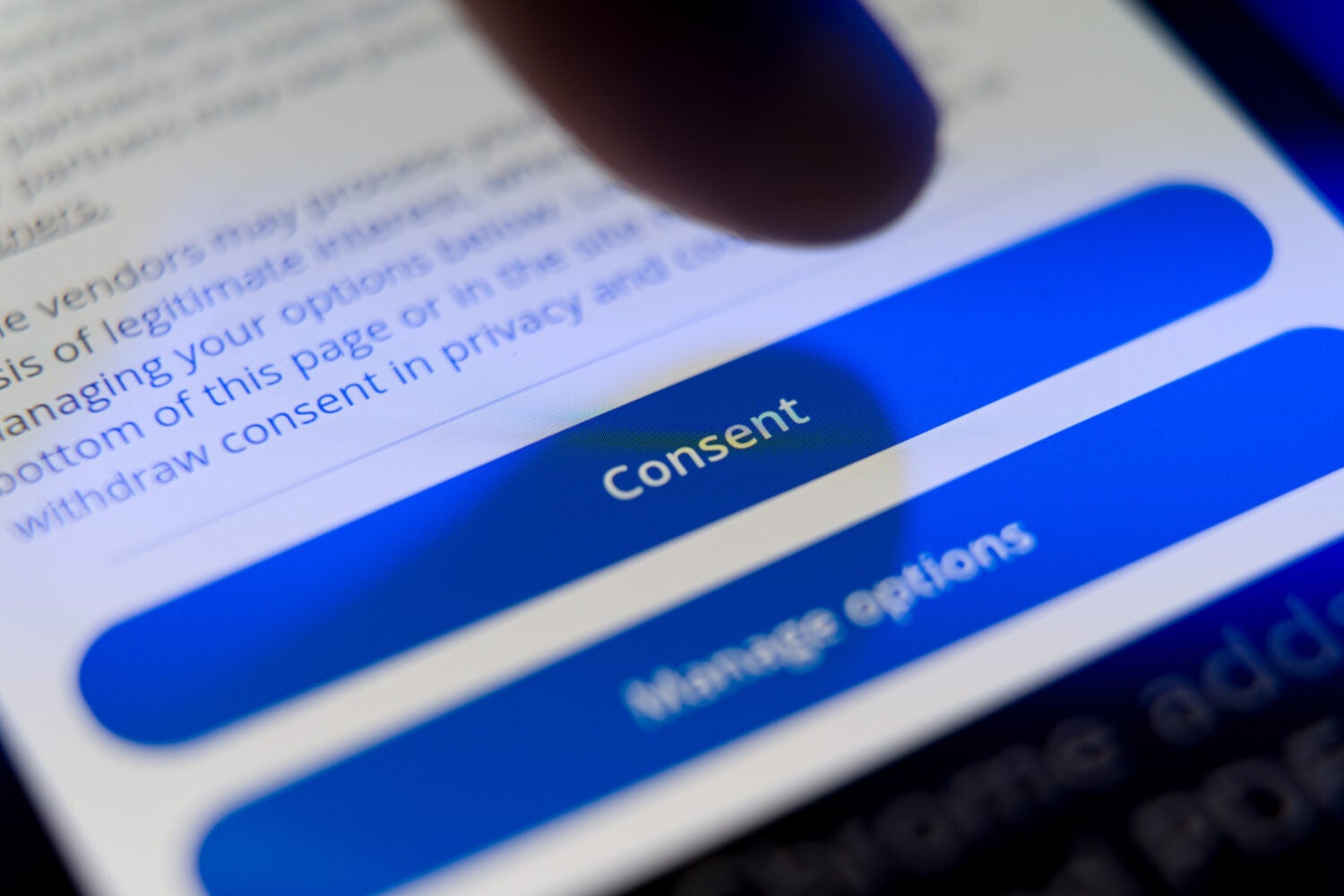
We’ve all done it — downloaded a new social media app, glanced at a privacy policy longer than “War and Peace,” and quickly clicked “accept” without reading it.
But those text-heavy pop-ups are legal agreements, and they contain important information about how the platform collects and handles your messages, photos, videos, and even personal information, as well as your rights and responsibilities as a user.
Spoiler alert: Many companies give themselves broad leeway to use your data — and prevent you from suing them in court if things go awry, according to the team behind the Transparency Hub, an open-access resource by the Applied Social Media Lab at Harvard University’s Berkman Klein Center for Internet & Society. (The Applied Social Media Lab is also supported by a gift from Frank H. McCourt, Jr. and the nonprofit Project Liberty Institute.)
“When you click ‘I agree,’ you’re agreeing to a legal contract. Most people have no idea what’s in it, and platforms are really counting on that,” said Kevin Wrenn, a student researcher at Boston University who got an early look at the Transparency Hub’s data.
Now, finding — and understanding — these policies and how they are responding to legal and social incentives is simple, thanks to the tool, which provides access to more than 20,000 policy documents from 300 social media platforms, including industry titans like TikTok and Instagram and smaller, niche apps such as Raya and Christian Mingle.
“This project is designed to make it easier [for users] to understand what sites are doing with their data, and how out of sync their practices might be with other sites.”
Jonathan Zittrain
“It’s understandable that people don’t read the fine print as they flit from site to site and app to app. Especially when the fine print too often appears to be written to be as dense and off-putting as possible,” says Jonathan L. Zittrain ’95, the George Bemis Professor of International Law and faculty director of the Berkman Klein Center. “This project is designed to make it easier to understand what sites are doing with their data, and how out of sync their practices might be with other sites, either for individual users or for those in the public interest who take one for the team to look out for everyone else.”
Teagan D’Addeo, one of the Transparency Hub’s lead engineers, says the project’s goal was to help people easily find and view social media privacy policies, terms of service, community standards, and other platform policy documents that are scattered around the internet.
These documents offer a rare glimpse into the inner workings of social media platforms — operations many of the companies would prefer to keep opaque, D’Addeo says. In some cases, his team found policies hosted not on public websites but in Google Docs or other cloud storage platforms; in at least one instance, documents disappeared from the internet after his team began accessing them.
“By building a project around these policies, specifically a publicly accessible dataset, there is a hope to help make these online spaces more transparent,” he says.
Aimed at individual users, researchers, journalists, and others, the Transparency Hub is unique in that it contains past versions of many of these policies — some, like Facebook’s dataset — go back decades. D’Addeo says the online platform includes a custom-built widget to enable users to see precisely how the documents have changed over time.
“When we were building this dataset, we knew we wanted to have a way for the everyday user of these social media tools to actually interact with these documents in both an interesting and constructive way,” he says.
D’Addeo says that law and policy scholars are among those who might stand to benefit from access to this trove of policy documents.
Already, researchers from the project team have uncovered several interesting trends, he says, including that social media policy documents have gotten markedly longer and more complex in recent years. His team found that 86% of policies require college-level reading proficiency.
“Even as legislation is passed that seeks to serve the user by providing restrictions on platform data and privacy handling, it seems there is often a hidden cost in making those policies longer or harder to understand,” D’Addeo says.
“Most major platforms have quietly removed your right to sue them in court.”
Kevin Wrenn
There’s another alarming development, according to Wrenn, a researcher with BUSpark!, which gained access to the early data through a collaboration with the Transparency Hub. At the launch event, Wrenn described how most apps now require users to resolve disputes against their platform exclusively through arbitration — and often, through a mediator hand-picked by the company itself.
“Most major platforms have quietly removed your right to sue them in court,” Wrenn said, adding that platforms also often prohibit class action lawsuits and jury trials.
D’Addeo says he and his team hope that the Transparency Hub aids scholars interested in discovering more about how social media companies are updating their user policies, and what rights users are retaining — or giving up.
“We hope it enables journalists to shed light on policy changes that might have real meaningful impacts that would otherwise be swept under the rug,” he says. “We hope it streamlines researcher overhead, allowing teams without extensive technologist backing to access all this otherwise difficult to obtain data. And beyond that, we hope these building blocks give policymakers the tools they need to enact positive public change on these social spaces.” Whether it’s individuals interested in knowing more about their rights and responsibilities with respect to the social media apps they use, or others hoping to make sense of our digital commons, the Transparency Hub is an important resource, D’Addeo argues. “We think there are many ways this data can be used for good.”
Want to stay up to date with Harvard Law Today? Sign up for our weekly newsletter.