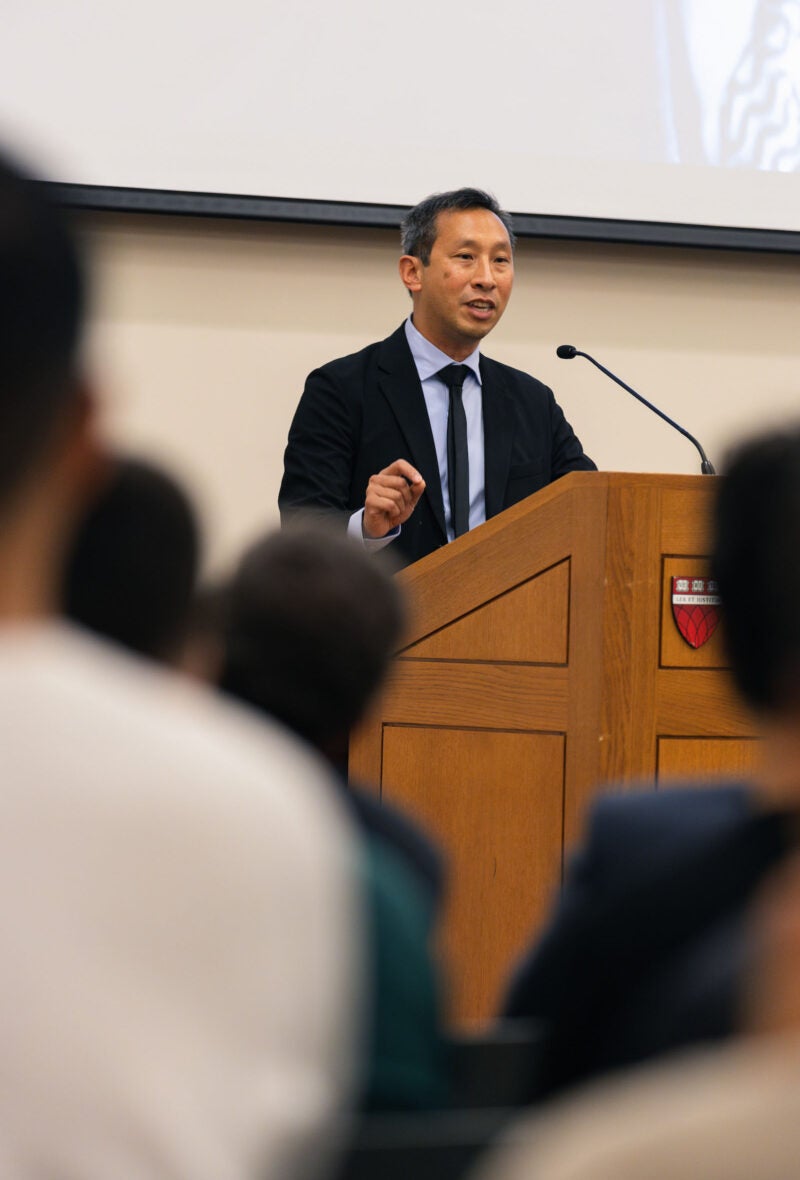
In a rapidly changing world, the United States should consider flexible, cooperative agreements with global actors whose values align with it, in order to ensure mutual security and prosperity, contends Mark Wu, the Henry L. Stimson Professor of Law at Harvard.
“International law does have a role to play in making us more secure,” said Wu, an expert in international trade and international economic law.
At an event last month celebrating his appointment to the named faculty chair, Wu argued that the U.S. should consider the lessons of a public servant from another turbulent time in world history — that of Henry L. Stimson LL.B. 1890.
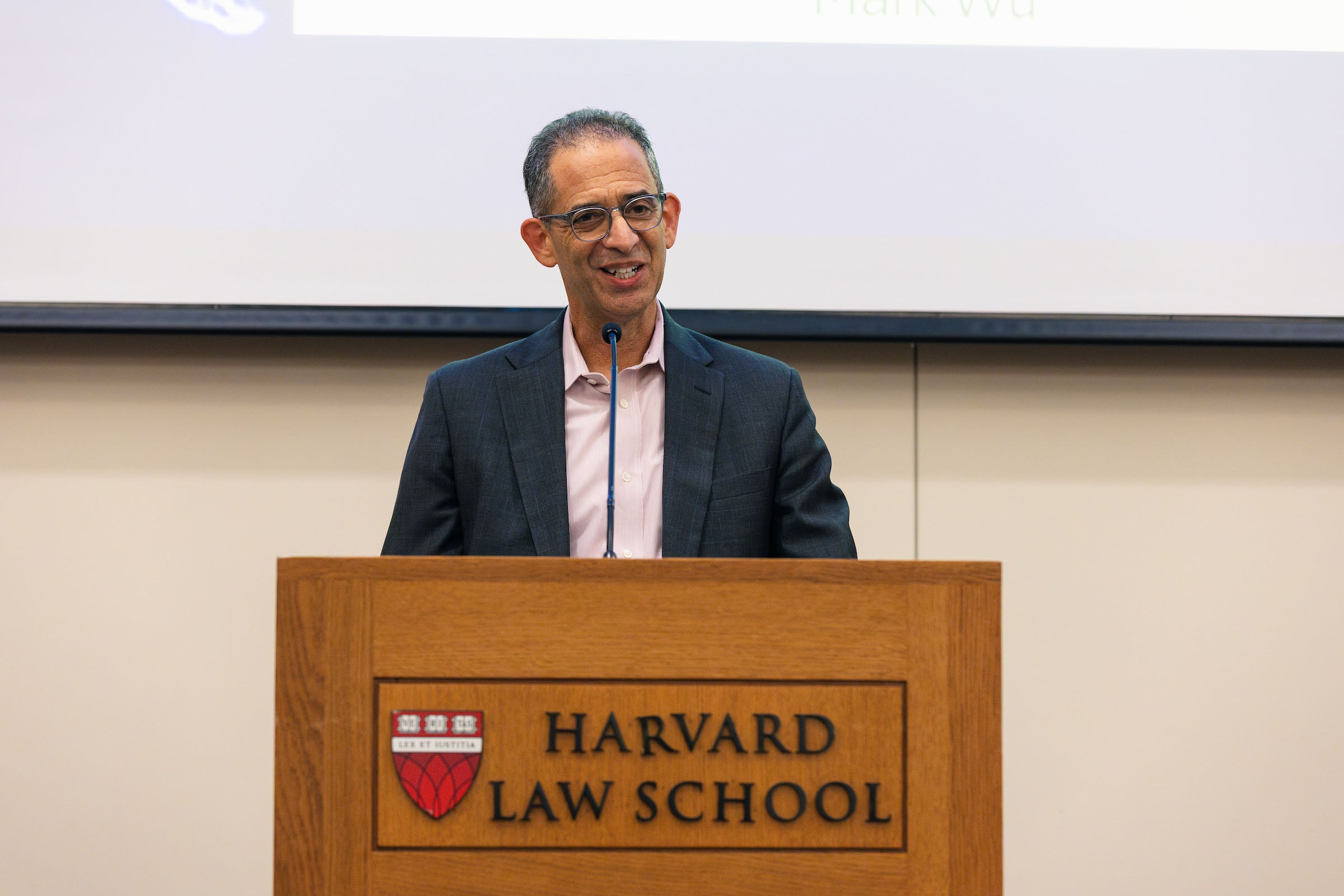
In opening remarks, John Goldberg, the Morgan and Helen Chu Dean, praised Wu’s teaching, mentorship, and scholarship, which focuses on economic security, trade, technology, and statecraft, including Wu’s “unparalleled expertise on U.S.-China relations.”
Wu, the faculty director of the Fairbank Center for Chinese Studies at Harvard University and faculty codirector of the Berkman Klein Center for Internet & Society, also served as a senior advisor to the U.S. Trade Representative and as a member of the agency review team for President Biden’s transition team.
“Professor Wu could not be a more deserving candidate, nor a more fitting occupant, to a chair that was established to help ensure that Harvard Law School is well positioned to address vital questions of international trade, international law, and international relations,” Goldberg said.
After thanking the colleagues, family members, friends, and students who had supported him throughout his career, Wu began by noting the similarities between the contemporary era and that of his namesake chair.
“We live in a turbulent time,” Wu said. “We live in a time of uncertainty, of geopolitical change, of vast socioeconomic dislocation, and that’s very similar to the world in which Henry Stimson inhabited when he was here at this law school in the late 1880s.”
Stimson served in Republican and Democratic administrations, was involved with both World Wars, and was part of the team that established “the liberal international order, which has held the peace now for three-quarters of a century and counting,” Wu said.
But while Stimson may be best known and revered for these achievements, Wu contended that Stimson’s illustrious career offered other valuable lessons for our times.
The statesman’s first stint as secretary of war, from 1911 to 1913, Wu highlighted, “was also an era with much geopolitical rivalry.” Much like today, “there were warning signs of possible conflict on the horizon.”
But while Stimson personally pushed the U.S. to be more prepared for global conflict, Wu explained that he served in an administration where “the overall theory of the case” proved, in hindsight, to be wrong. Believing that America need not entangle itself in foreign affairs, the Taft Administration primarily focused on domestic issues. Accordingly, when pulled into World War I a few years later, the United States “found itself woefully underprepared.”
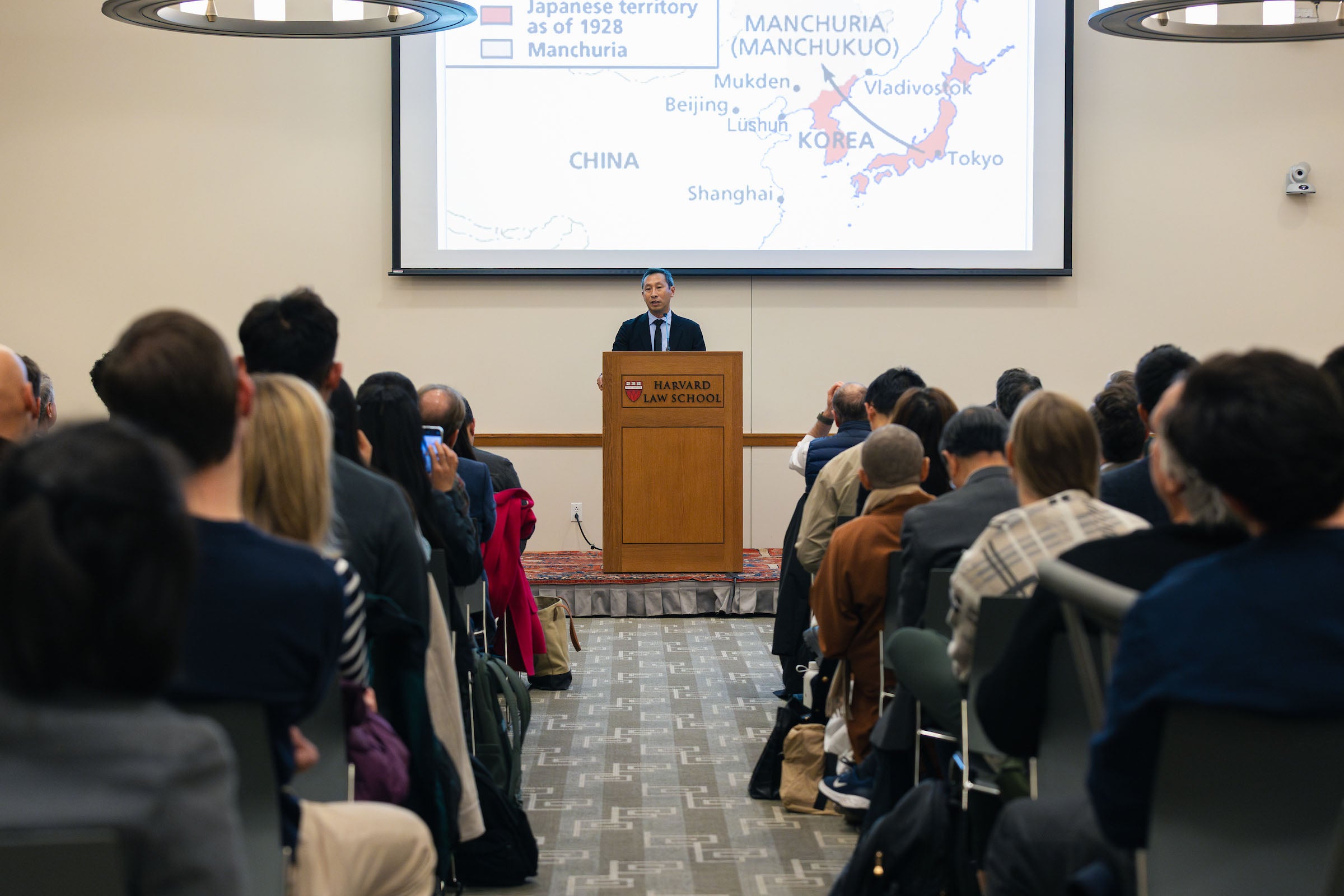
In 1929, Stimson again served in government, this time as secretary of state under President Herbert Hoover. During this stint, Wu noted, Stimson embraced the power of diplomacy, including chairing the U.S. delegation to the London Naval Conference, seeking to curtail the use of new technologies for war. But when Japan invaded Manchuria in northeast China in 1931 and Italy invaded Ethiopia in 1935, it soon became clear that the League of Nations and existing treaty arrangements were not adequate.
“Again, we can see parallels with our own time,” Wu emphasized, “where we have international law, but we have countries [acting unilaterally] to change borders because of resources, or because … they view territory as being historically part of their sphere of influence.”
Stimson helped develop a doctrine that the U.S. “would not recognize territorial change brought about by force alone,” Wu said. But the Stimson Doctrine had little effect initially at reversing the invasions, coming at a time “when sovereign actors … felt that they had the ability to use force to take the world’s geopolitics into their own hands — and could do so without consequence.”
“We can see parallels with our own time … where we have international law, but we have countries [acting unilaterally] to change borders because of resources, or because … they view territory as being historically part of their sphere of influence.”
According to Wu, the lessons from challenges in his first two stints in government informed Stimson’s later successes as secretary of war under President Franklin D. Roosevelt and the post-World War II period that he helped usher. America’s security is intertwined with the world, but relying on principles-based international law to ensure security is insufficient.
The arc of Stimson’s career, Wu argued, reveals a more complicated truth about international law. What held true in the statesman’s time, Wu suggested, may ring true once more today.
“At the heart [of the post-World War II era] was a geopolitical rivalry,” Wu noted. “There were major powers with different political and economic systems that were not necessarily compatible with one another … challenging each other in different parts of the world.”
To address this complicated but interconnected new world, Stimson and his contemporaries developed an approach to global affairs that Wu described as “security internationalism.” Rather than create a universal set of rules and invite all countries to join, the post-war architects of the new international order focused on devising flexible arrangements among countries whose values aligned with one another in order to enhance their mutual security.
An example cited by Wu was the 1947 General Agreement on Tariffs and Trade, which reduced trade barriers between a diverse array of signatory countries. Initially, at the 1944 Bretton Woods conference, Wu pointed out that the Soviet Union participated actively, as did Yugoslavia. But the final 1947 agreement did not include countries then in the Soviet bloc and provided flexible arrangements for countries to change their commitments to one another when political conditions later shifted in any signatory. This type of flexible, values-aligned internationalism, Wu argued, laid the groundwork for post-war economic recovery and further security cooperation.
The challenge that international law faces today, Wu suggested, is that Stimson’s security internationalism approach had been eclipsed by what he called the emphasis on “values harmonization” of the last several decades.
“In the aftermath of the Cold War, and in the triumphalist moment of the 1990s, there was a belief that international law could be used as a building block to help cajole, change, and move the world towards a set of harmonized, aligned economic systems,” he said.
But while evolving technology has meant that “we are more similar across countries” in some ways, Wu continued, “we are seeing the limits of that” kind of thinking.
“Many of these great powers and also former colonial states don’t want to be told by more powerful countries that they should become just like us,” he said.
It is once again time to return to the prior approach, Wu suggested. “The lessons that at least I infer from the experience of Secretary Stimson — and I think you’re moving into a world that looks similar to his — is that we need to be focused on recreating … arrangements of security internationalism.”
“The lessons that I infer from the experience of Secretary Stimson is that we need to be focused on recreating … arrangements of security internationalism.”
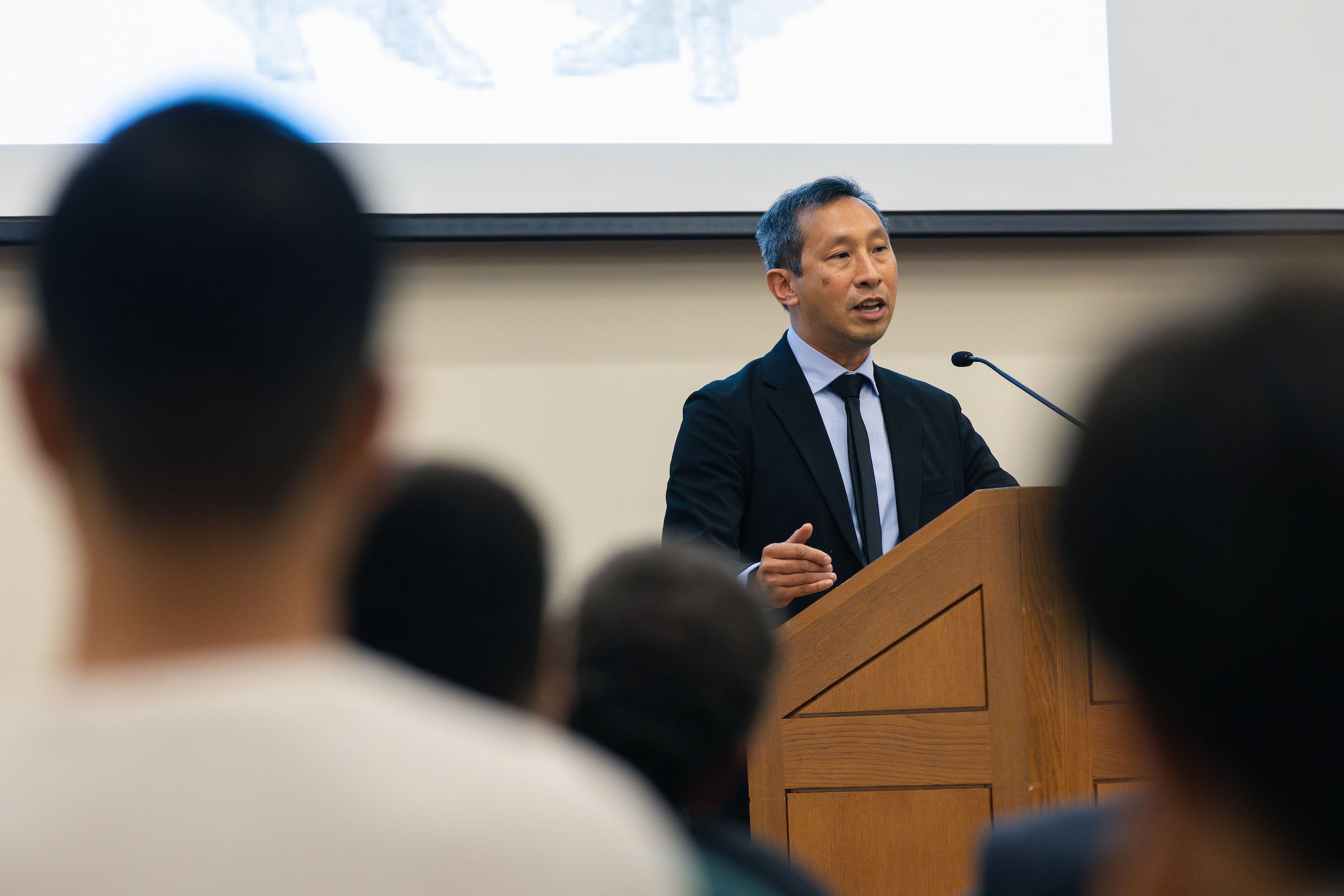

Wu acknowledged that this task will be even more difficult today than in Stimson’s time, because modern countries do not neatly align into distinct geopolitical blocs.
The challenge today is that “many countries, big and small, want to serve as necessarily bridging states,” he said. “They want a security arrangement with the United States, but they also want to be able to import oil from Russia, for example.”
Another challenge, Wu contended, is that technological change and rivalry “leads to a sense of uncertainty and fluctuating interest preferences” in the polity itself. In a democratic country, he said, “you’re shaping international law where there’s fluctuation in your own interest preferences.” Furthermore, he added, “a country that you think of as an ally today may not necessarily be an ally tomorrow, may become non-aligned, may [then] become a bridging state with a new regime, only to flip back with the next parliamentary election or the next presidential election.”
One way for international law to address this shifting and uncertain landscape, Wu suggested, is to focus on those problems that are truly existential — such as nuclear technology or perhaps issues arising from certain forms of artificial intelligence — and “on these narrow values-aligned bases, we need to look for security arrangements that are flexible but yet align in a very concrete set of issues to deal with the challenge at hand.”
As for trade, Wu contended that there is a need for greater differentiation among countries, “recognizing the interplay between economic integration and security.” Furthermore, new ways of thinking are needed on the rules defining a product’s origin, to ensure trade does not undermine security and resiliency.
Finally, Wu suggested that greater use of liability rules may prove helpful. “What is the danger we wish to contain?” he said. “How do we put liability in place [to] induce actors . . . to behave in a way that enhances our security upfront, as opposed to having to try to anticipate every single set of rules” needed to address possible scenarios.
Ultimately, Wu said, it may be impossible to completely identify a set of shared values with some nations — but that doesn’t mean that nothing can be done to prevent conflict.
“What we need to create is a more set of flexible arrangements that allow people to address the security concerns that are going to come out from these new dynamic arrangements,” he said.
Want to stay up to date with Harvard Law Today? Sign up for our weekly newsletter.