The U.S. Constitution is clear: The president controls the executive branch of the government. But does that mean that he or she can fire anyone who works for the federal bureaucracy at any time — for any reason?
At a Harvard Law School event last week, constitutional law experts squared off on what scholars call the unitary executive theory — the idea that the president, as head of the executive branch, has nearly unlimited power to direct or remove all executive officials.
The debate has taken on a renewed urgency following efforts by President Donald Trump to dismiss members of the Federal Trade Commission, National Labor Relations Board, Federal Reserve Board, and other so-called independent agencies. Through emergency orders, the United States Supreme Court has largely allowed the firings to proceed while litigation moves forward in the lower courts, but it has suggested there may be a possible exception for officials at the Federal Reserve.
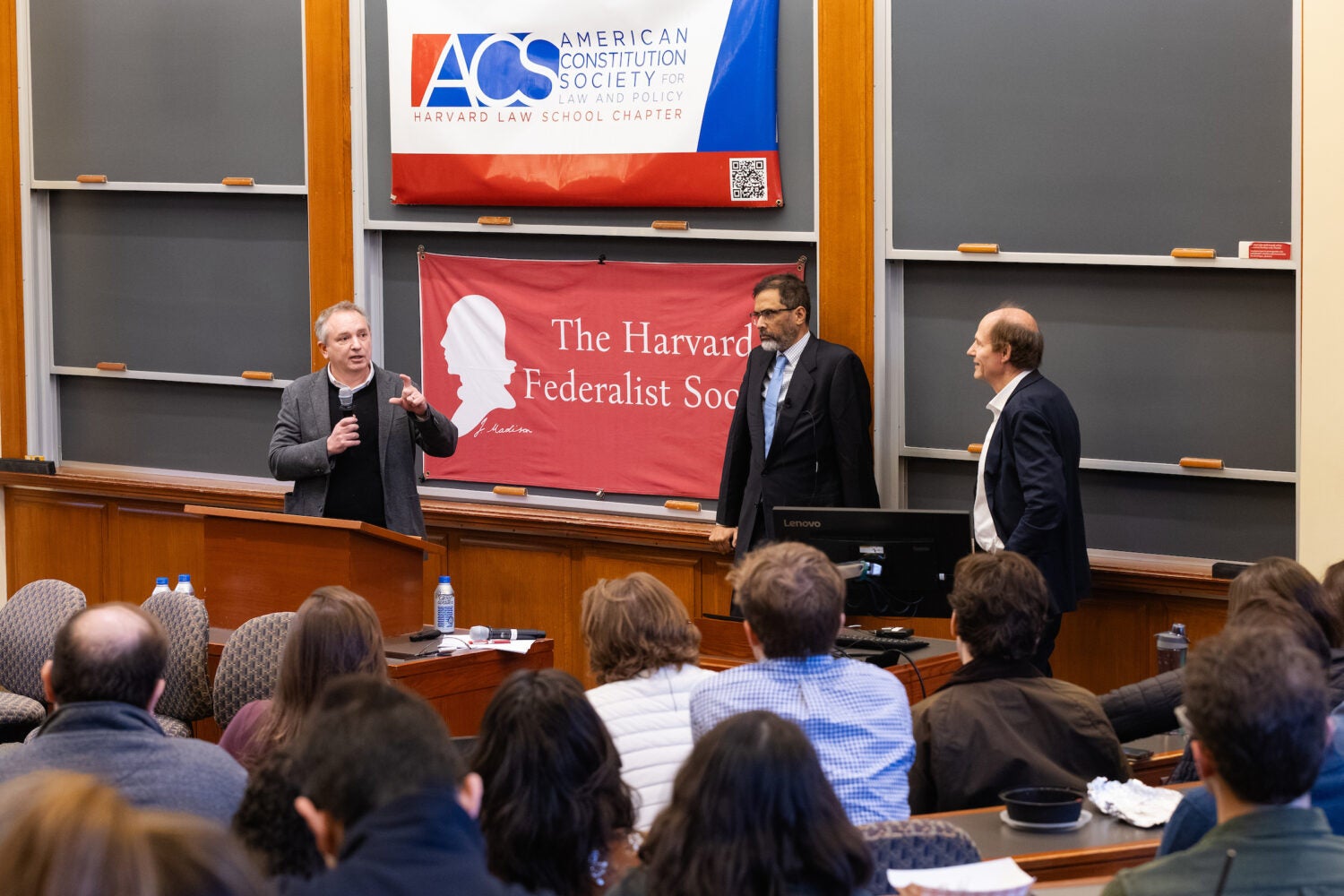
The March 12 discussion was cosponsored by two Harvard Law student groups — the American Constitution Society and the Federalist Society — and featured Cass R. Sunstein ’78, the Robert Walmsley University Professor at Harvard Law School in conversation with Saikrishna Prakash of the University of Virginia School of Law.
With moderator David J. Barron ’94, the Louis D. Brandeis Visiting Professor of Law at Harvard and Chief Judge of the United States Court of Appeals for the First Circuit, Sunstein and Prakash discussed the Supreme Court’s consequential 1935 decision in Humphrey’s Executor v. United States, which held that Congress may shield some executive branch officials from complete presidential control.
Recently, several justices on the Court’s majority have signaled their interest in revisiting — or perhaps even overturning — the nearly century-old precedent, which protects some officials from removal by the president in the absence of specific cause, such as wrongdoing or neglect of duty.
Sunstein started by identifying what he saw as four categories for thinking about the extent of the president’s power — “all honorable,” he argued — showing that they do not always neatly align with modern political ideology.
There are originalists — that is, those who prioritize what can be divined about the intentions of the country’s founders in constitutional interpretation — who believe that the president should have extensive authority over the executive branch, Sunstein said, counting Chief Justice John Roberts ’79, among this group.
But there are also originalists who think that founding era leaders went “the other way, and Congress lacked the votes for a strongly unitary conception of the presidency,” Sunstein added. According to Sunstein, this group contends that while the president should have exclusive control over bureaucrats engaged in “constitutionally specified functions” of the presidency, Congress can provide some layer of insulation for executive branch officials with quasi-legislative or judicial roles, such as Federal Trade Commission officers.
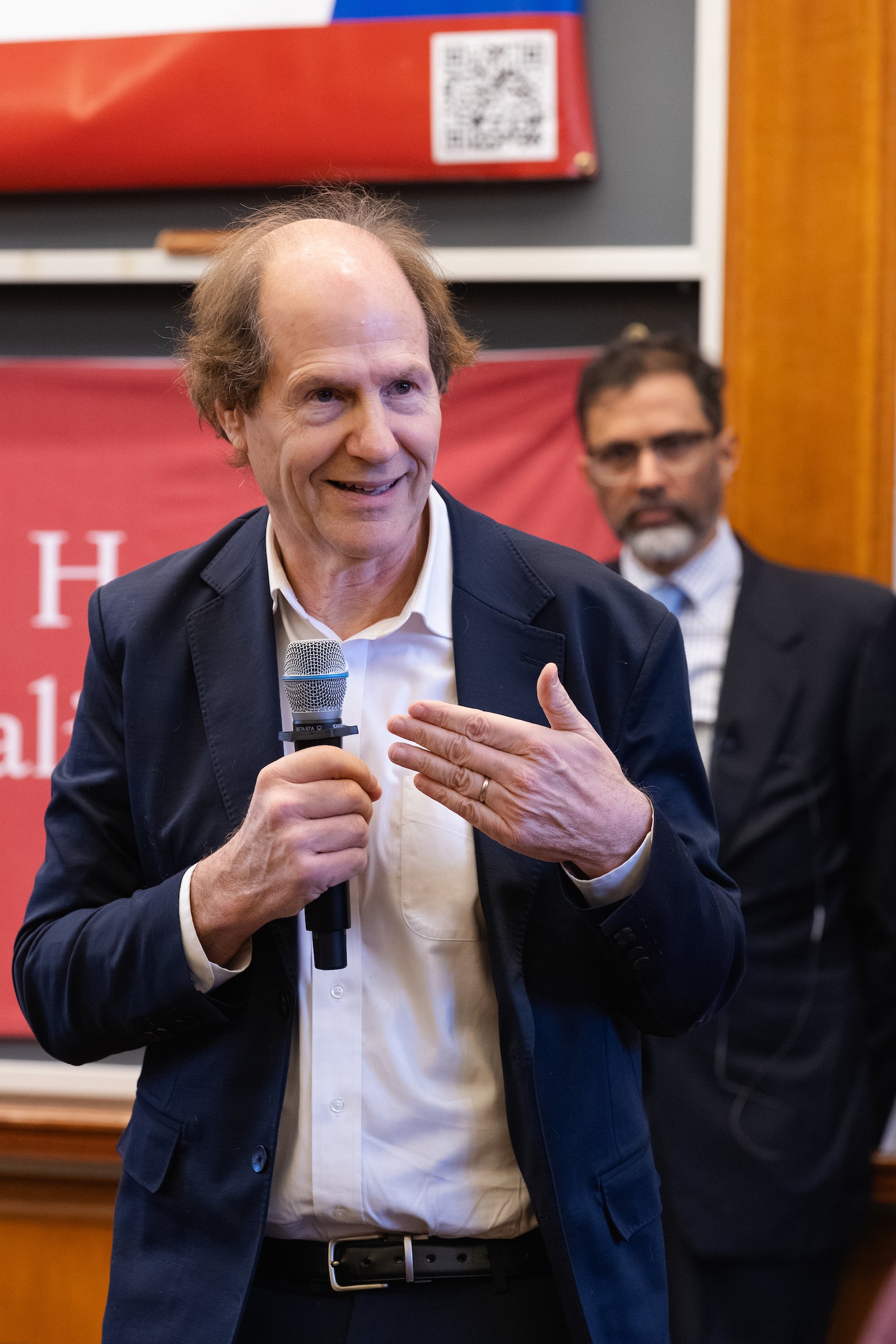
Similarly, Sunstein said, there are non-originalists — sometimes called “structuralists,” for their emphasis on how the Constitution works as a whole document — who argue for a strong unitary executive because they believe it is better for “centralization and accountability and managerial control.”
Some of the Court’s recent cases reflect this line of reasoning, too, Sunstein argued.
“It may be the text of the recent decisions is originalist, but the music is structural,” he said, “where the opinions that the Chief Justice has written, which are leaning toward a strongly unitary view, are not, in the last instance, insistent on historical account, on which they’re relatively thin, but are ultimately attempting to make purposive or structural sense of the constitutional order.”
Finally, Sunstein said there are non-originalists scholars who believe that, for reasons having to do with the Constitution’s diffusion of power and checks and balances, that Congress, under Article I’s “necessary and proper” clause, can create independent agencies.
Sunstein acknowledged that there is support for each of the four views, but he contended that historical evidence favors a weaker unitary executive, while rightful concerns about centralization and accountability would press the other way, toward a strongly unitary president.
Given this impasse, Sunstein argued for upholding the Court’s longstanding precedent in Humphrey’s Executor. To do otherwise, he said, “would be a little like a French Revolution in Washington, DC.”
Instead, Sunstein suggested an incrementalist approach. “What we ought to do is move in the direction of the stronger unitary view by construing relevant statutes in a way that preserves a degree of presidential policy control and bracket the most fundamental questions on which reasonable people differ.”
‘I think the Court made a mistake’
Prakash, the UVA professor, agreed with Sunstein that “all these positions are honorable.”
Nonetheless, his view was clear: “I think the president has a power to remove. I don’t think Congress has the power to limit it.”
The founders, Prakash argued, had come to a consensus: “There was a decision that the president had power to remove,” he said.
In the early days of the new republic, “the president asserted authority to remove over all executive offices” and even to direct their actions — and he did so publicly, without pushback from Congress, Prakash noted.
Prakash also argued that the U.S. Constitution is distinct from state constitutions, which generally allow legislatures to modify a governor’s powers.
“There’s no generic power that Congress has to modify presidential power.”
Saikrishna Prakash
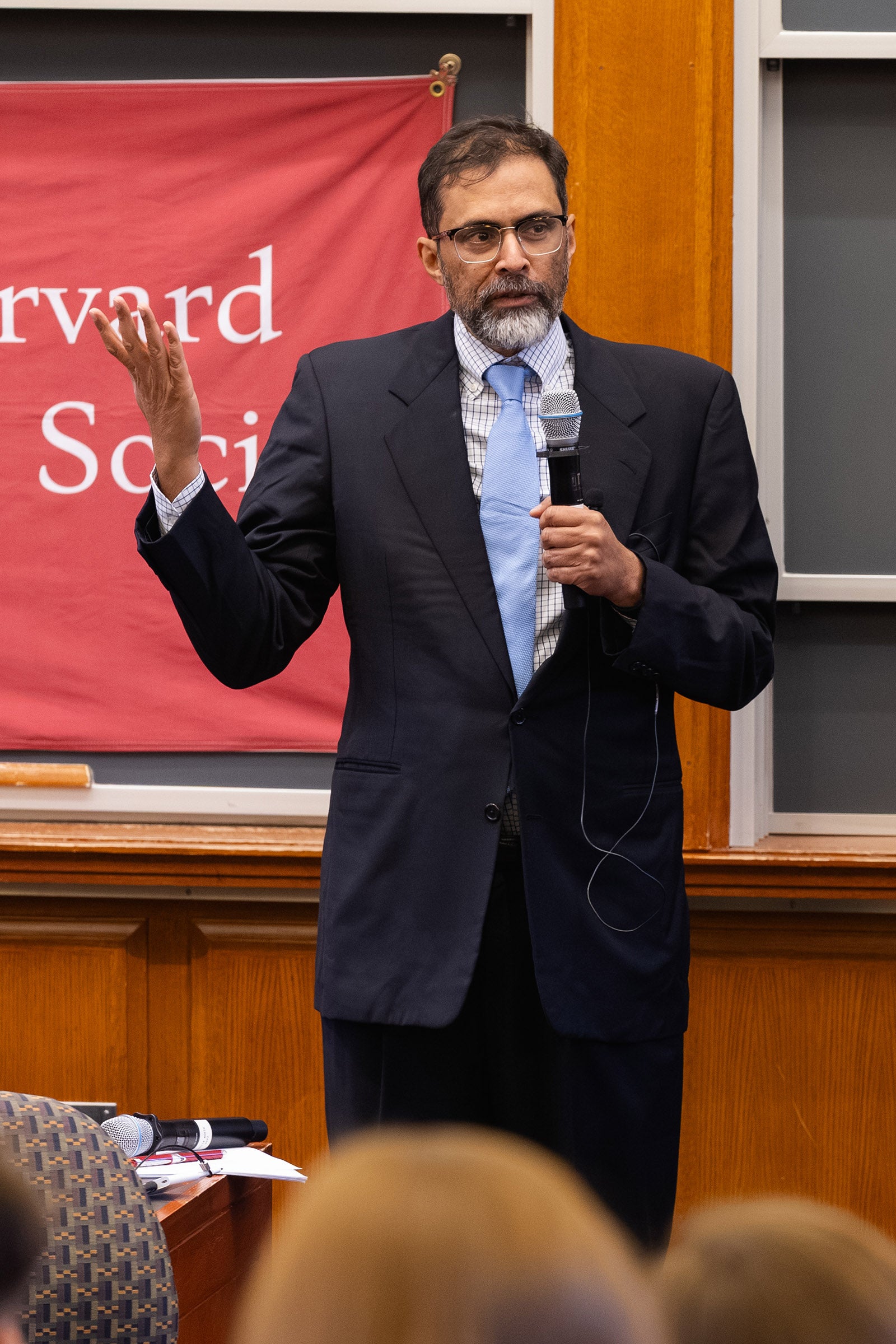
“There’s no generic power that Congress has to modify presidential power,” he said. “Congress cannot say by statute, ‘You’re not going to be able to veto these sorts of bills unless you have cause. You’re not going to be able to appoint these people unless you have cause, or that you can’t pardon people unless you have a good reason for doing so.’”
“I think the Court made a mistake in the 1930s,” he said, adding that Humphrey’s Executor was “shocking” to President Franklin D. Roosevelt and other Democrats at the time, particularly because it clashed with precedent favoring an extensive view of the president’s authority.
Prakash argued that overruling Humphrey’s Executor would be wise — but not revolutionary, as Sunstein believed.
“It turns out that the president effectively controls most so-called independent agencies one or two years into his administration, because most commissioners that serve in independent commissions don’t serve their full term,” Prakash said.
That is, even if President Trump had not tried to fire independent agency commissioners, Prakash said — if he had been more of a “status quo president” — he “would have effectively controlled them anyway over a period of time.”
The stakes
Barron, the moderator, wondered about the stakes of overturning Humphrey’s Executor — what would it mean for the president to be able to fire any executive branch official at any time? “Will that cash out as a real change in how we understand the bureaucracy?”
Sunstein reminded the audience that the power to fire is effectively the power to control. And that, he argued, would be the “transformative” part of overruling the case.
“If the independent agencies are treated as if they were executive agencies, the rule-making decisions of the Federal Communications Commission, the Federal Trade Commission, the Nuclear Regulatory Commission, are subject to the ongoing control of the White House. That’s a really big deal,” he said.
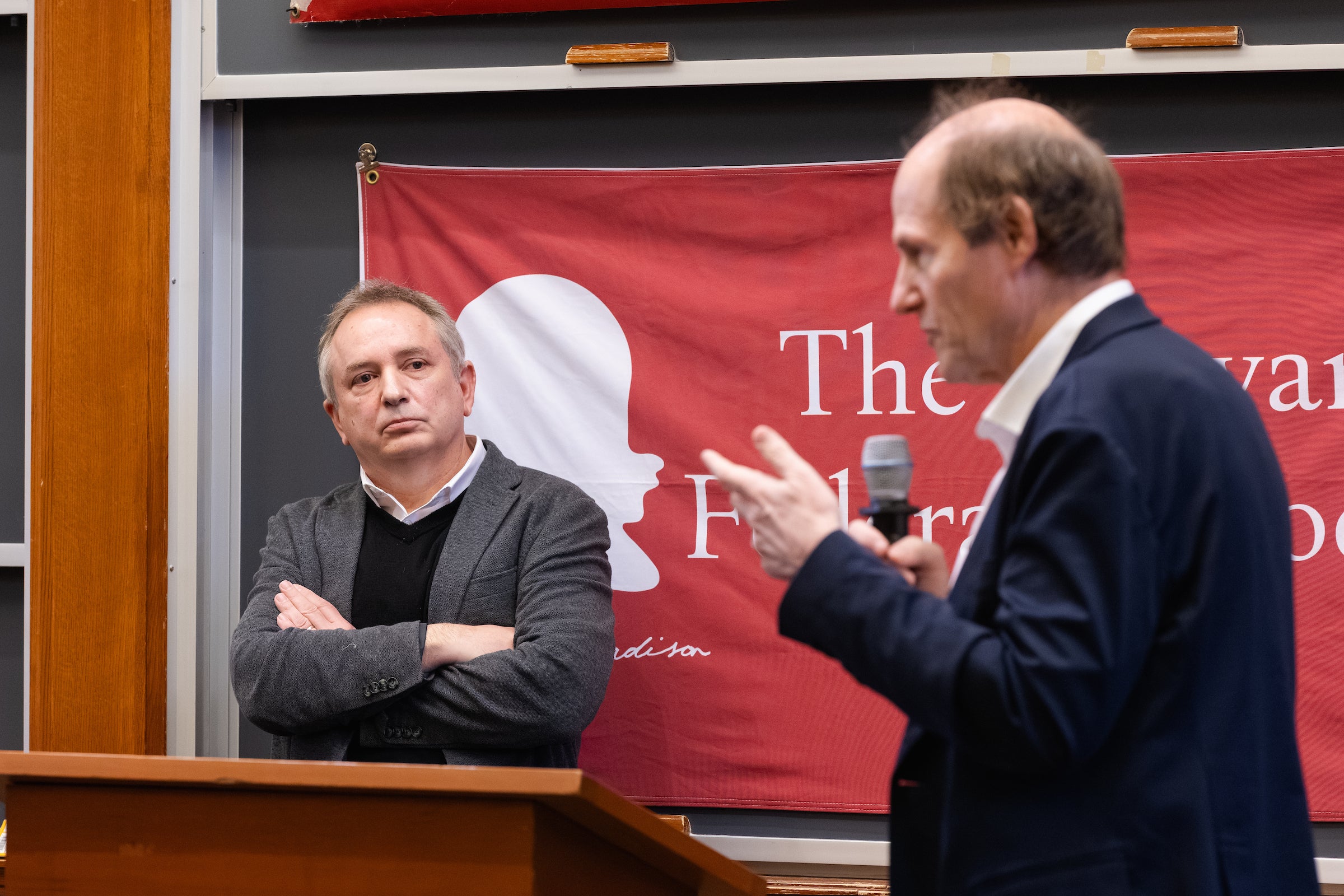
Barron asked Prakash whether independent agencies could or would remain independent if his view prevailed.
“I think [Sunstein] is right that there would be consequences to what presidents might do in these realms,” Prakash acknowledged.
“But I don’t really know how independent-minded some of these agencies are,” he added. “Certainly, in this administration, even if the Court says, ‘we’re not overturning Humphrey’s Executor,’ no one should be under the illusion that the heads of these agencies aren’t working hand-in-glove with the White House. And one has to wonder whether that norm is now going to be the norm going forward.”
To Sunstein, though, overruling Humphrey’s Executor would be, at minimum, “disruptive” to the functioning of the federal government. And the Court, he argued, seems to understand that, pointing to language in its 2025 emergency order, Trump v. Wilcox. In that case, the Court allowed the removal of a National Labor Relations Board member while her case is litigated in the lower courts — but indicated that it likely would have treated a Federal Reserve Board member differently.
“They’re terrified of it with respect to the Federal Reserve, which is why the Court wrote those two amazing sentences basically preserving, without briefing or argument, the legitimacy of the Federal Reserve Board by reference to ‘historical’ precedence,” Sunstein said.
But perhaps the debate over Humphrey’s Executor is effectively moot. After all, Prakash noted, the Court has “radically undermined and disparaged” the case repeatedly in recent years.
“One is left to wonder what is left of Humphrey’s Executive, other than the holding” as applied to a long-ago, less powerful Federal Trade Commission, Prakash said. The Court would only have to limit the 91-year-old case to its facts to make it virtually meaningless when applied to any agency today, he concluded.
Want to stay up to date with Harvard Law Today? Sign up for our weekly newsletter.