With colleges no longer permitted to consider race as one of many factors when deciding which students to admit, might universities instead offer an admissions preference for American descendants of slavery? Or focus on students from low-opportunity areas?
In its 2023 decision in Students for Fair Admissions v. Harvard, the United States Supreme Court effectively banned the consideration of race in and of itself as one factor among many in selecting students.
But Yale Law School Professor Justin Driver ’04 argues that the Court’s majority opinion still leaves room for admissions choices that could comply with the law while continuing to foster racial diversity in the nation’s colleges.
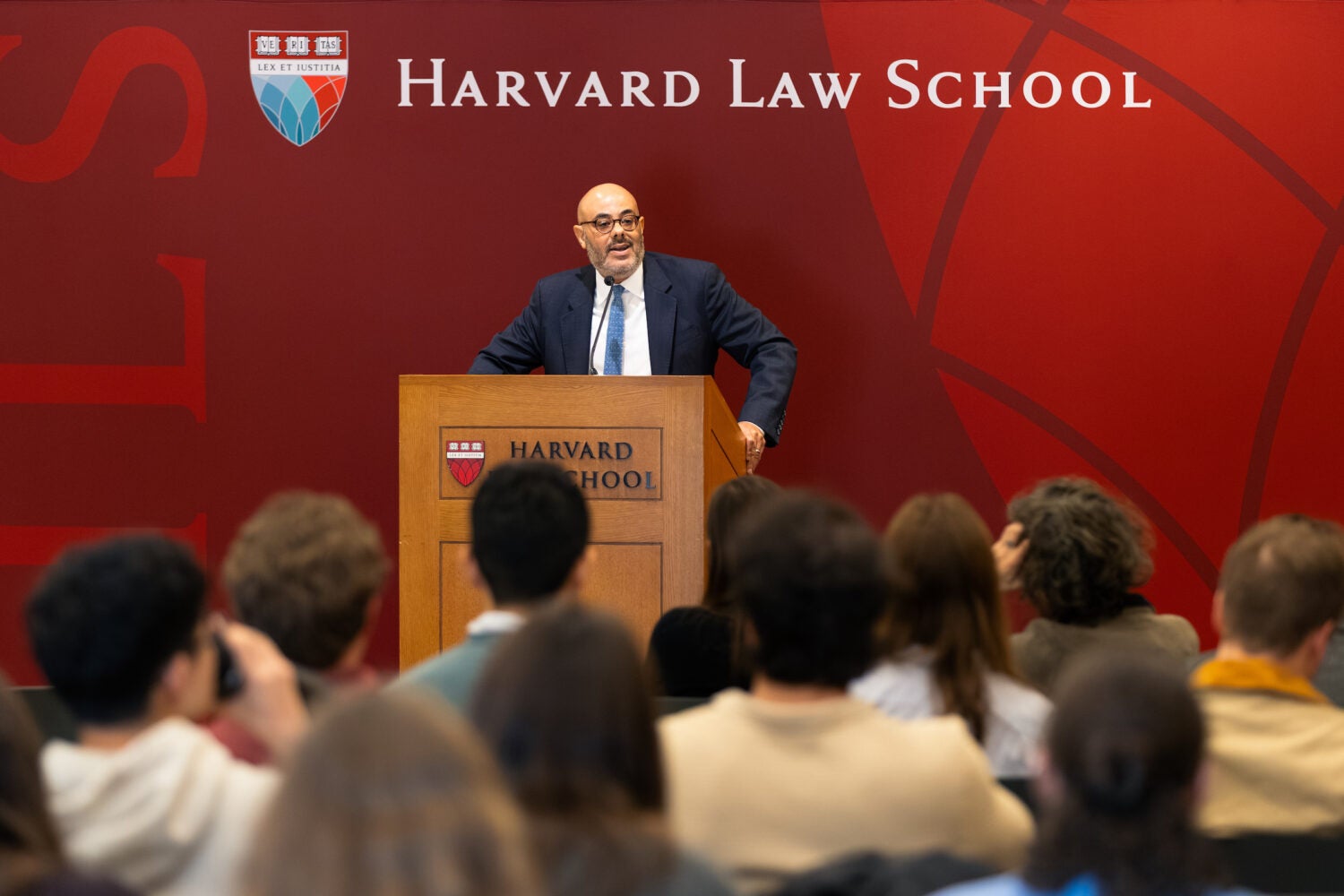
“It’s tempting to view Supreme Court cases as ending disputes, but often they mark not just the end of one era, but also the beginning of another era, and that’s exactly where we are right now,” said Driver, who delivered Harvard Law School’s annual Francis Biddle Memorial Lecture on Oct. 21.
The decision marks a “critical moment with respect to the Equal Protection Clause,” Driver argued, referring to the 14th Amendment’s guarantee of equal protection under the law.
Driver said he considered the SFFA case to be “the most significant judicial opinion involving race and education since Brown v. Board of Education invalidated racial segregation seven decades earlier.”
But before diving into the SFFA decision and its repercussions, Driver highlighted the impact that decades of race-conscious admissions have had on the nation and its institutions. As just one example, between 1960 and 1970, the total Black student populations at Harvard, Yale, and Princeton expanded 20-fold, owing to new race-conscious admissions policies emerging from the Civil Rights Movement.
“This is a transformation that, of course, did not end on college campuses,” he added. “It went on to change the professions, including the legal profession, the medical profession, engineering, academia, and beyond. We should salute affirmative action for these really valuable contributions and get over the ambivalence that has clouded the area for too long.”
Driver argued that the demise of race-conscious admissions policies has halted some of that progress: “SFFA has had, in many instances, catastrophic effects on the enrollment of Black students in elite higher education.”
What colleges might be able to consider
But while Driver lamented the Court’s decision in SFFA for its impact on university enrollment, Driver also suggested that the opinion may encourage the very mindset some critics of affirmative action oppose.
Some skeptics of race-conscious policies argue that they encourage people of color to view themselves as “victims,” Driver said — “a dangerous posture if you’re trying to make contributions in American life.”
Yet admissions policies adopted since SFFA — including those that permit applicants to describe racial bias or trauma in essays or interviews — may give students more reason to frame their experiences that way, he argued.
To understand why universities interested in fostering diversity have developed these new policies, Driver unpacked the reasoning underlying Chief Justice John Roberts’ ‘78 majority opinion in SFFA.
While the Court banned colleges from considering “race qua race” — that is, race in and of itself — it expressly allowed them to weigh what an applicant’s experiences, including those involving race, reveal about their potential contributions or personal qualities.
“Nothing in this opinion should be construed as prohibiting universities from considering an applicant’s discussion of how race affected his or her life, be it through discrimination, inspiration, or otherwise,” Roberts wrote.
Driver suggested that Roberts’ opinion in SFFA, when read alongside other recent Supreme Court decisions, such as Louisiana v. Callais (2026) — which held that Louisiana’s congressional map unconstitutionally prioritized race — opens the door to ideas that might increase racial diversity without the direct use of race as a factor.
“Callais says, in effect, that we should not presume that governmental actions that are correlated with race are racially motivated,” Driver said. “It suggests that there are other safe harbors – governmental bases for decision-making — that would not, taking the logic of Callais seriously, be invalid, [such as] elements of class or even geography.”
Driver also found support for this reasoning in a 1979 essay by Antonin Scalia ’60, in which the late associate justice indicated that while he opposed racial affirmative action, he nonetheless supported various kinds of help for disadvantaged people — many of whom, he recognized, would be people of color. In fact, wrote Scalia, “I would not care if all of them were [members of minority races]. The unacceptable vice is simply selecting or rejecting them on the basis of their race.”
Driver said that he hoped that those “including Supreme Court justices who have referred to [Scalia] as a hero … take this insight very seriously.”
New paths to campus diversity
Driver emphasized that his own ideas for increasing racial diversity in higher education were intended to fit within the Court’s SFFA framework — not circumvent it. Nonetheless, he acknowledged that their legality has not yet been tested. “It’s possible that some of the proposals [that I talk about] that are perfectly constitutional today will be deemed patently unconstitutional down the line.”
The Trump administration, for instance, has opposed the use of ostensibly race-neutral criteria when it believes they serve as substitutes for race-conscious admissions. In an August 2025 memorandum, President Donald Trump criticized what he described as hidden proxies for race. Earlier that year, the U.S. Department of Education argued that using nonracial factors to achieve racial diversity could violate federal law. A federal judge subsequently ruled that the department’s guidance was unlawful and set it aside in August 2025.
Perhaps most provocatively, Driver proposed that schools hoping to ensure diversity in their student bodies give preference to descendants of slavery. This might even be grounded in originalism, he suggested, likening such a measure to support for freed enslaved people under the Reconstruction-era Freedmen’s Bureau.
While being the descendant of an enslaved person is highly correlated with race, these categories do not perfectly overlap, Driver argued. “Yes, there are many Black people today in the United States who could check a box saying that they are descended from the enslaved, but there are also many Black people in the United States today who are not able to check that box.”
Driver suggested that colleges could also offer consideration to members of Tribal Nations without reference to race. They might also treat favorably — or even have a quota to enroll — students from low-opportunity areas around the country.
“Racial quotas are prohibited, but quotas for people from low-opportunity areas are completely constitutionally permissible,” he argued.
Universities could also guarantee admission based on class rank, regardless of their high school, Driver suggested. Texas adopted this approach in 1997, after a federal appeals court barred race-conscious admissions, guaranteeing eligible Texas students in the top 10 percent of their high school class admission to the state’s public universities.
In any case, Driver admitted that his proposals were not yet mainstream. “I do not suffer the delusion that any universities are tomorrow going to [announce] preferences for the descendants of the enslaved.”
But while Driver said he ultimately views SFFA as “abyss,” he expressed hope that the decision can nonetheless accommodate ideas like his, some of which might eventually “come to seem sort of essential and inescapable.”
“If Justice [Thurgood] Marshall managed to summon some enthusiasm and optimism that a brighter day is coming in the ’30s and ’40s when Jim Crow is at its height,” he said, “it seems to me that it is incumbent upon us to muster a sense of enthusiasm and optimism that a better day is coming.”
Want to stay up to date with Harvard Law Today? Sign up for our weekly newsletter.