
In 1761, a lawyer named James Otis strode into a Massachusetts courtroom and laid out a fiery case in defense of his clients, a group of Boston merchants. His speech — witnessed by an admiring John Adams — took aim at writs of assistance, documents issued by colonial courts that enabled customs officials to search homes and ships without individual search warrants. Both Otis and Adams were Harvard graduates.
Calling the writs “instruments of slavery on the one hand, and villainy on the other,” Otis clearly believed these measures were an affront to principles of freedom. But his arguments were also articulated in the language of the law. The writs, he said, were “the worst instrument of arbitrary power, the most destructive of English liberty and the fundamental principles of law, that ever was found in an English law-book.”
Otis was not the only early American who wielded English law to argue first for a more favorable relationship between the colonies and Mother England, and then later to justify the establishment of a new republic.
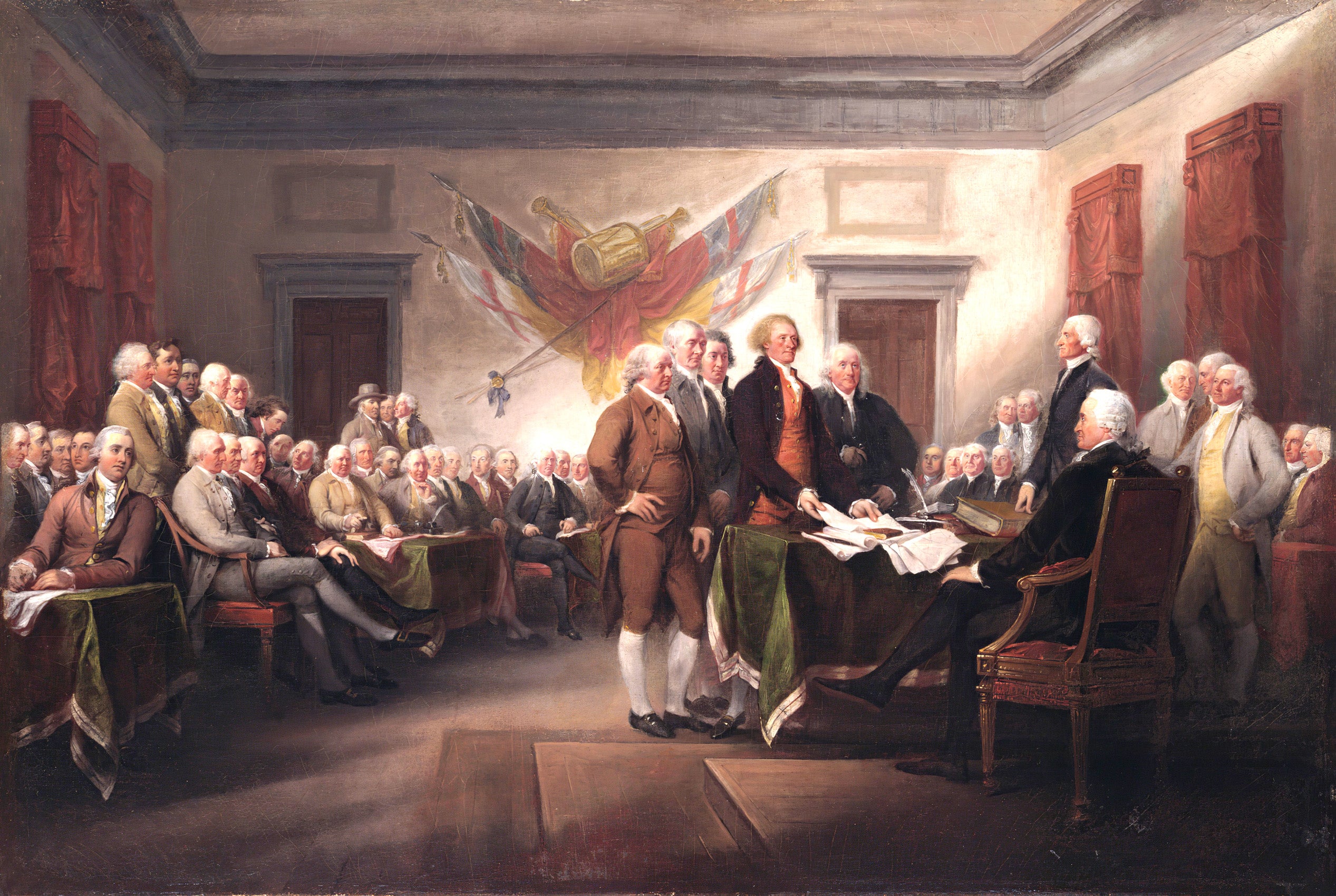
In fact, in the decades preceding the Declaration of Independence — signed 250 years ago this year — many of the complaints made by American colonists were framed in terms of the law, not just politics, says Bruce H. Mann, the Carl F. Schipper, Jr. Professor of Law at Harvard. As the U.S. commemorates the semiquincentennial of its birth, the Harvard Law Bulletin spoke with Mann about how colonists regarded the law, where American law diverged from English common law, and an early rule-of-law lesson that still resonates today.
When colonial and early Americans thought about “the law,” what were they referring to?
First, you have to remember the American colonists were not a homogeneous group.
That said, colonists in New England, in particular, thought of themselves as English. They had grown up in the English common law tradition, and they had absorbed notions of English common law. For them, the law comprised things from vague notions from the English common law tradition, to more formal common law precepts, to statutes enacted by Parliament or the colonial assemblies. It was all operating within an English legal framework.
Were there differences between English law and law in the American colonies before the Revolution?
New Englanders in the 17th century recognized Old Testament notions of divine law, but that was not thought of as superseding common law. From the 17th into the early 18th century, people often tried to resolve conflicts through church disciplinary processes first. If that failed, they would turn to law. But it’s not as though they thought there were two jurisdictions, so much as they considered these to be two sources of authority.
Also in New England, Scripture exercised particular influence in the area of criminal law, and more specifically, felonies. By the time of the 17th century, English law recognized about 50 different capital offenses, which rose to 200 by the beginning of the 18th century, although the people who were convicted of these offenses were not necessarily executed. But in early-17th-century Massachusetts, the only felony offenses punishable by death were those for which judges could find authority in Scripture, of which there were just 12.
There was also a very different set of punishments for general offenses in New England. Since there were no jails or prisons, people were more often subject to physical punishments, such as standing in the stocks, being whipped, occasionally even being branded. You didn’t start to see prison sentences until after the Revolution.
On the other hand, all of this was still operating within the common law framework of due process. In other words, people were very picky about adhering to procedural regularity, and you can see that in some early cases.
Could you give us an example of what you mean by that desire for procedural regularity?
In 17th-century Massachusetts, there was a case involving a man who had repeatedly raped a young girl. People were outraged, and there were calls for him to be executed. But the judges refused to do so, because rape was not recognized in the Bible as a capital offense, and therefore it was not a capital offense in the statutes of the colony. That’s a very early example of the power of adhering to basic principles of due process, even when the perpetrator committed a particularly heinous act.
How did disputes with Great Britain in the 1760s and 1770s reshape colonial views about what made law legitimate?
By that time, the American colonists had come to see themselves as even more British, in part because of the patterns of immigration, and also because of the significant expansion of commercial relations between British North America and Great Britain. You had merchants who operated on both sides of the Atlantic. In a sense, the two worlds were closer together — certainly culturally. But there was a difference in perspective: While the American colonists saw themselves as British, the British regarded them as simply colonists; they didn’t really identify with them at all.
In the 1760s, Great Britain began more strictly enforcing its regulations on commercial trade in the colonies, in part to raise money. Great Britain was coming out of the Seven Years’ War, called the French and Indian War in the colonies. During that war, Great Britain, with significant assistance from colonial militia, mostly removed France from North America. That had the effect of removing a foreign threat from the American frontier, but it was very costly. They reasoned that North Americans should help pay for the war, so they began levying taxes, starting with the Sugar Act and the Stamp Act.
The Americans were outraged. They saw themselves as loyal subjects, but here they were being taxed, even though they were not represented in Parliament. That’s where the idea of “no taxation without representation” comes from. All this made the colonists start looking at Great Britain through a very different lens.
“The colonists looked to the common law tradition, to Magna Carta, and even to Anglo-Saxon times for authority.”
In the years leading up to the American Revolution, were the colonists’ complaints against Great Britain framed purely in political terms, or did they try to deploy the law as well?
Before the Revolution, you had 15 years of intense debate and political pamphleteering about the proper structure of the British Empire, where sovereignty resided, and the power Parliament should have over the colonies. These were not simply political arguments; they were legal ones as well. Many of the participants were lawyers, such as John Adams. By engaging in this debate, many British North Americans saw themselves as upholding the highest traditions of the common law. The British were also using legal arguments in making their own case. Later, leading up to the Revolution, the colonists looked to the common law tradition, to Magna Carta, and even to Anglo-Saxon times for authority. For example, when the colonists said, “No taxation without representation,” they were referring to ideas in Magna Carta and the English Bill of Rights.
So, you’re saying that American colonists weren’t looking to overthrow the law, but rather, wanted it to apply to them fairly?
One of the hallmarks of expanding settlement in mid-18th-century America, as the population spread from the coast into the backcountry, was that as the population moved, they wanted the law to follow. They wanted local courts. They didn’t want to shuttle back to the coast to hear cases or record a deed or collect a debt. These were people who, as they expanded westward, saw themselves not as escaping law, but as bringing it with them. It was really only debtors who were running away from their creditors that were perhaps trying to move beyond legal process.
In general, though, there had always been something about the common law that sunk its influence into generations on both sides of the Atlantic. It represented something that people associated with due process, fairness, rights. And the political arguments in the lead-up to the Revolution reflect that as well.
Are there lessons about the rule of law from this period in American history that resonate today as we mark the United States’ 250th anniversary?
In my view, it’s that people have rights that are protected. People expect a legal system that will observe elemental due process, so that, in principle, everyone receives a fair resolution of their disputes. But it’s important to recognize that too often in American history, you observe those principles more in the breach. For example, this was the case for Black Americans under Jim Crow, who, at least at the federal level, were supposed to have constitutional protection of their rights, and yet the federal government refused to intervene when the states were actively trying to oppress them.
But the ideal survived, and that’s what so much of the Civil Rights Movement was fighting for: a principle of legal equality. Leaders of the movement were determined to claim this principle for themselves against overwhelming opposition. Ultimately, if those ideals of legal equality had not existed in the first place, that struggle would have looked very different. It would have been impossible to frame it as a struggle for rights that were guaranteed to everyone.