For international arbitration practitioners, the annual Willem C. Vis International Commercial Arbitration Moot, a world-renowned competition in which university teams wrestle with a complex contract dispute to see who can best handle the pressure and nuance, is a rite of passage.
For some, it’s an entryway to the field. Many universities outside of the United States, especially in Europe, have built up longstanding traditions and deep wells of expertise with it.
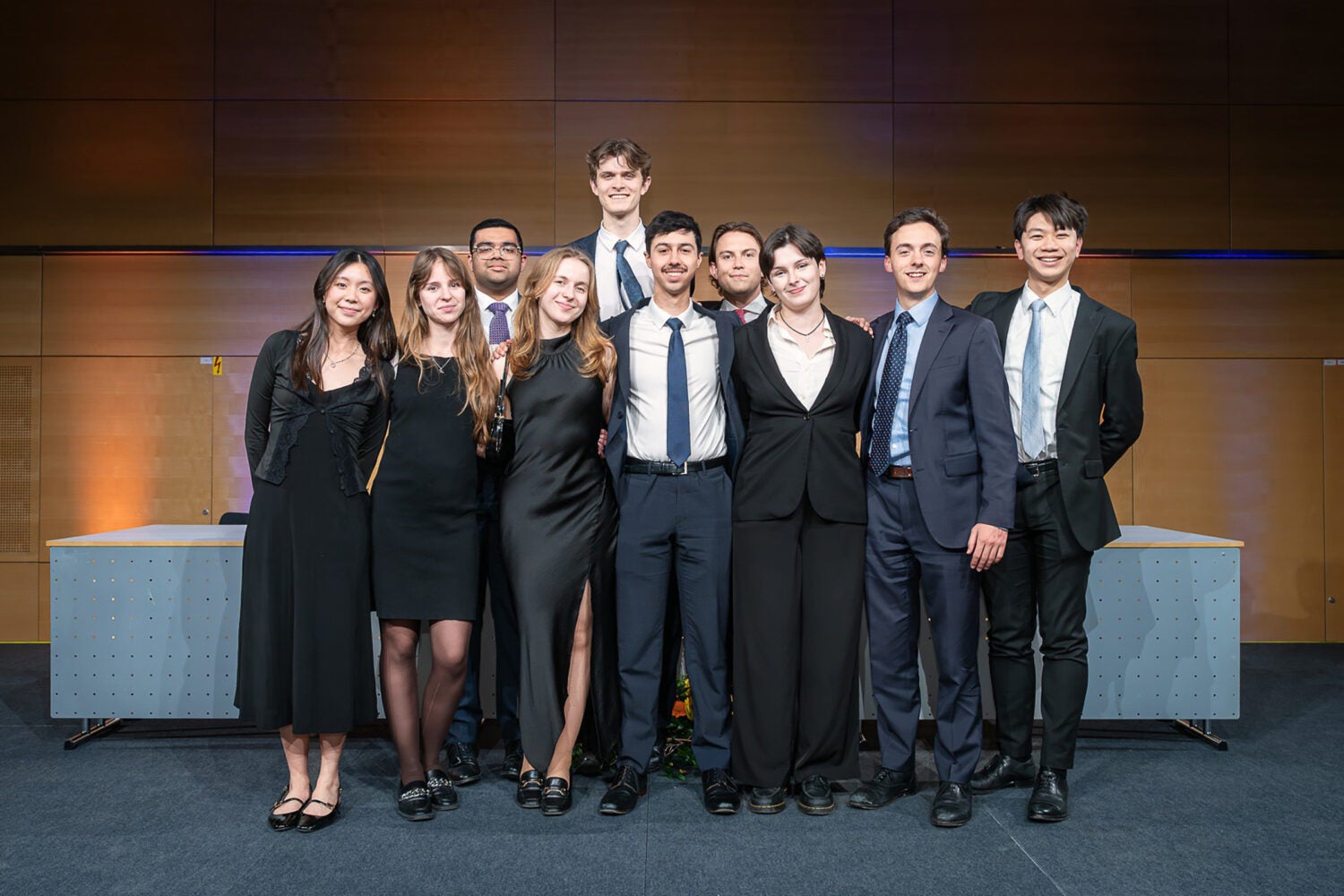
In March, for the first time since 2021, Harvard Law School students travelled to Vienna to participate in the 33rd annual moot.
Over five days, the 11-member Harvard team, a mix of J.D. and LL.M. students, saw its intense year of preparation and sacrifice rewarded. The group made it into the elimination round of 64 teams and secured a number of awards, ultimately becoming the best performing American team this year.
The Vis moot brings around 400 university teams from 90 jurisdictions to Vienna to arbitrate a fictional case involving a contractual issue concerning the United Nations Convention on Contracts for the International Sale of Goods. The complex problems tackle both procedural and substantive issues. This year’s problem involved a contract concerning an orchid sale and took place under the Singapore International Arbitration Center rules.
Building the team
When Jens Hvolbøl arrived at Harvard to start his LL.M. degree last August, he was not entirely surprised to discover the school had little Vis tradition. A Danish-trained lawyer, Hvolbøl had competed in the Vis moot in 2020 while completing his master’s at the University of Aarhus. The event, albeit remote because of COVID, was formative.
“I knew nothing about arbitration before then,” he said. “And I think that’s actually a very common experience for law students, because the fact that there’s a private alternative to the courts is not something I think we talk that much about during training.”
At other universities, students receive substantial course credit for participating in the competition. Some students even take a year off from school to focus solely on preparation. Programs may be faculty-led, and coaches — there can be dozens — are paid. “I think if you ask many people at Harvard what the Vis moot is, they might not know,” said Ben Mays, an LL.M. student on the Harvard team who competed in 2024 for the University of Cambridge.
“We had to raise the funding ourselves,” Hvolbøl said. “Whenever there was anything we needed assistance with from the school, we had to figure it out ourselves.” Mays called it a “grassroots campaign.” The team agrees that made their success all the sweeter.
Over time, Hvolbøl made it his mission not only to put together a formidable team, but to jump start a new legacy. He had to be creative.
Harvard Law School has a longstanding tradition of taking part in the Philip C. Jessup International Law Moot Court Competition, the world’s largest moot court. Far more students apply to Jessup than the team can accommodate, so Hvolbøl emailed its leaders to say: “When you turn folks away, send them our way.”
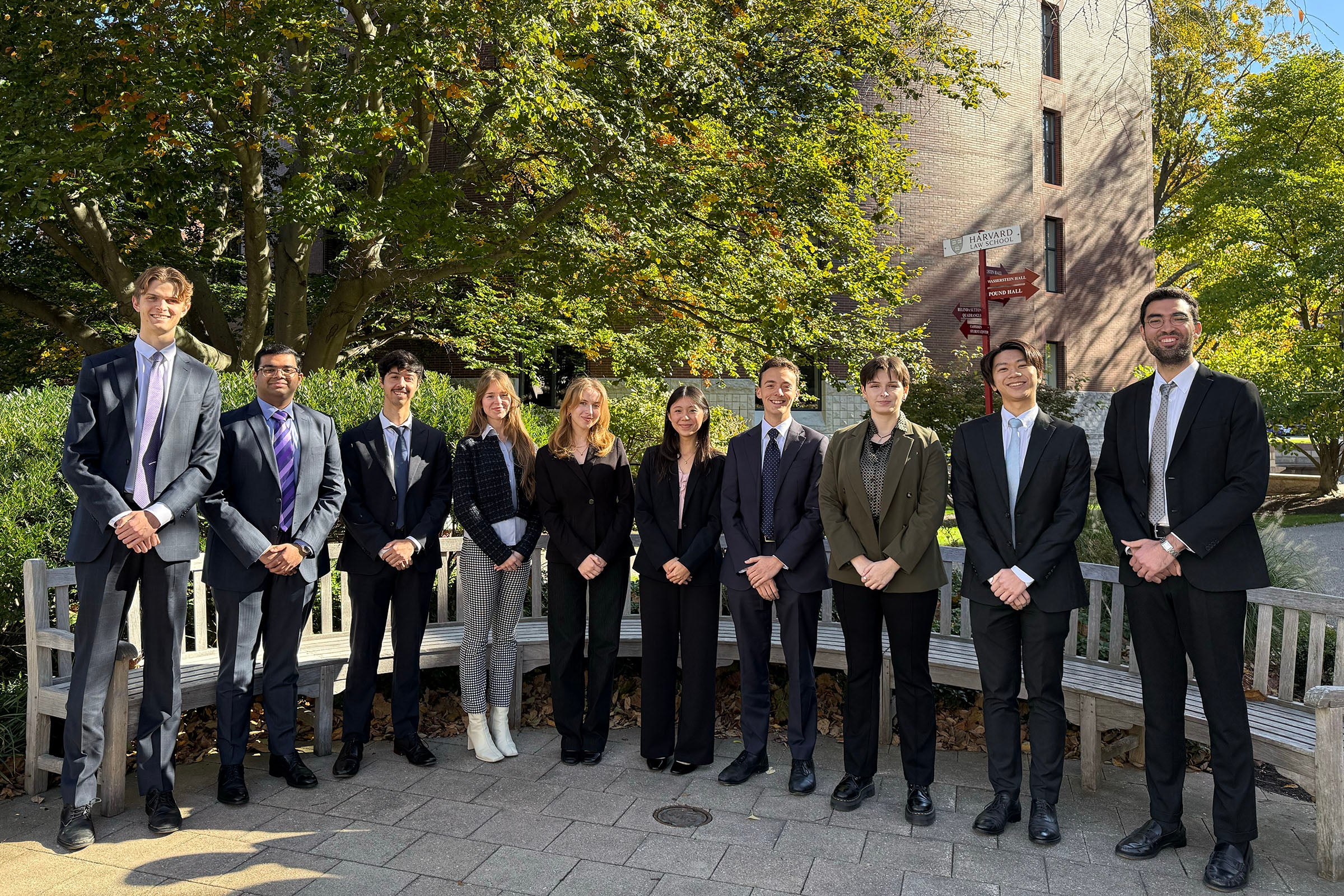
This year’s Vis moot problem was released in October. Hvolbøl finalized the team less than a week before, with three J.D. and four LL.M. students. He also recruited Harvard LL.M. students with Vis experience to act as coaches: David Wong LL.M. ’26 from Hong Kong, Zofia Halbersztat LL.M. ’26 from Poland, and Can Özcan LL.M. ’26 from Turkey. Having fellow students as coaches helped contribute to a relatively “flat hierarchy,” the team members said.
Team members were drawn to the competition for different reasons. Joyce Mau, an LL.M. student from Singapore who completed an undergraduate degree in law at the University of Cambridge last year, found that Vis moot allowed her to explore “the weeds of legal arguments,” delving into “the very fine distinctions of fact and law.”
Because Mays made it into the round of 64 in 2024, he was barred from competing in the oral arguments this year. Still, he wanted to be part of a team and have another “shot at the memoranda,” he said, which offers legal depth.
Vaishnav Rajkumar, a J.D. student with Indian origins from the United Arab Emirates who did his undergraduate studies in London sees Vis as an opportunity to become more well-rounded in international law. Rounding out the team were Isobel Houlihan, an LL.M. student from Ireland; Mark Milian, a J.D. student from New York City; Célia Aïssou, an LL.M. student from France; and Jackson Kelley, a J.D. student from Washington.
Arguing the case
Once the problem was assigned, the Vis moot team had roughly two months to submit a memorandum for the claimant. The group then received another team’s memo and had a month and a half to submit a memorandum for the respondent.
The Vis organizers “are very, very good at making the legal issues very complicated,” Mays said. “And there’s usually a lot of ways you can approach it.”
Strategy is key. “Law students are used to having to explain everything and making sure they don’t leave out any relevant arguments,” said Hvolbøl. “Here, I very often have to tell them, ‘I don’t think the opposing party is going to dispute this at all.’ And we only have so many pages or so much time, so we really have to just cut straight to the case. What will the other party actually dispute, and what will they agree with us on?”
After the team argued both sides in writing, it turned to the oral phase.
In the oral arguments, the team condensed two 35-page memoranda into two 14-minute opening statements, one on procedure, and one on substance. Opening statements can run much longer, since the three-member tribunal of arbitrators interrupts with questions.
“Where the game is won is in terms of the questions that the arbitrators ask in the heat of the moment,” Rajkumar said. “Anyone can write a script, commit it to heart, and then go and speak. But when you’re thrown off with the questions — it could be good questions, it could be bad questions — it doesn’t matter. It’s how you deal with those questions that really helps you come out on top at the end of the day.”
Presentation can be more important than the substance of your arguments, Hvolbøl admitted. In what could turn into five-hour team meetings, Vis moot members practiced their opening statements and responses to questions. Coaches acted as arbitrators and gave feedback along the way.
All 400 teams spend the year delving into the same issues. They know each side backward and forward and can anticipate many arguments by the other side. Some teams show up with a “question bank” — set responses to draw from. The Harvard team went without.
Pre-moot competitions hosted by local institutions and other schools also provide opportunities for teams to test out their arguments. In addition to a pre-moot at Harvard (where the Harvard team was a runner-up), the team attended pre-moot competitions in Washington, D.C. (where it was runner-up), at Fordham University and the International Chamber of Commerce Court of Arbitration, in New York, (both of which it won), and at Southern Methodist University in Dallas (which it also won).
During each pre-moot and during the competition itself, the students learned how to argue both sides of the issue. “Law students are used to showing that they understand all the nuances of one side, whereas here they actually have to be able to switch how they think about the issue very quickly,” Hvolbøl said. “I think in many ways that’s also what it feels like to be a real lawyer. Sometimes you represent clients where you have to view things entirely differently from how it was in another case you just had.”
The Vis moot has been intense and an incredibly taxing time commitment on top of the normal courseload most students take, as well as the LL.M. theses papers that many of the students had to complete. Still, Hvolbøl hopes the moot experience also has been fun, or at least “fun enough that someone wants to carry it on next year.”
In addition to making it into the elimination rounds, the team garnered several awards, including the Pieter Sanders Award for Best Memorandum for Claimant (honorable mention); the Werner Melis Award for Best Memorandum for Respondent (honorable mention); and the Eric E. Bergsten Award for Best Team Orals (honorable mention).
Out of almost 400 teams, Harvard was one of only two American universities to make it into the elimination rounds.
During the competition, the team also found a tremendous sense of community — both with each other and the wider arbitration world. “We met teams we might not ever have met had it not been for the Vis,” said Rajkumar, including competing against universities from Turkey, Japan, and Italy. “At some point, we all effectively speak the same language because we have been spending the last six months working on this very specific, discrete problem.”
Milan said, “Our achievements show that the hard work paid off.” He hopes that the next Vis team will find the experience similarly rewarding.
“We’re confident that the team’s performance in the 33rd Vis moot has built a strong foundation for Harvard to reach even greater heights later,” Wong said. “The best is yet to come.”
This article is adapted from “An Unlikely Underdog on the World Moot Stage,” which came out in March prior to the Vis Moot as part of The Practice, the HLS Center on the Legal Profession’s digital magazine, focused on international arbitration. Read the full issue here.
Want to stay up to date with Harvard Law Today? Sign up for our weekly newsletter.