The U.S. Supreme Court is increasingly leaning on its emergency — or shadow — docket to issue orders on hot button topics such as student financial aid relief, immigration, foreign aid, and firings of independent agency heads.
But is the Court playing politics — or simply reacting to Washington’s dysfunction? Are the justices responding to urgent needs by issuing temporary decisions while cases wind their way through the lower courts pending more permanent disposition, or are narrow majorities fundamentally tinkering with people’s rights under the law with little briefing or consideration?
To Jonathan H. Adler of the William & Mary School of Law, Congress’ decades-long failure to make laws on many important matters has created a power vacuum, one that presidents have readily stepped in to fill. And because lower courts have increasingly responded by blocking these policies across the United States, the Supreme Court has had to intervene more and more often, Adler argued during a discussion at Harvard Law School on February 25.
“It just can’t be right that one district judge can stop a nationwide policy in its tracks and leave it stopped for the years that it takes to go through the process,” he said.
Adler’s remarks came at Harvard Law School’s latest Rappaport Forum, a discussion series that, since 2021, has worked to promote and model full, vigorous, and civil discourse on critical and complicated issues.
The panel focused on the Supreme Court’s emergency docket — applications decided on an accelerated basis, often while cases are still pending in the lower courts. Unlike the traditional “merits” cases, these matters typically proceed without oral argument and with abbreviated written briefings. The Court’s orders are usually short and often unsigned, with little of the detailed reasoning found in standard opinions. And although these emergency orders are supposed to function as temporary relief in extraordinary circumstances, critics have argued that in practice, they may effectively be the last word in some important disputes.
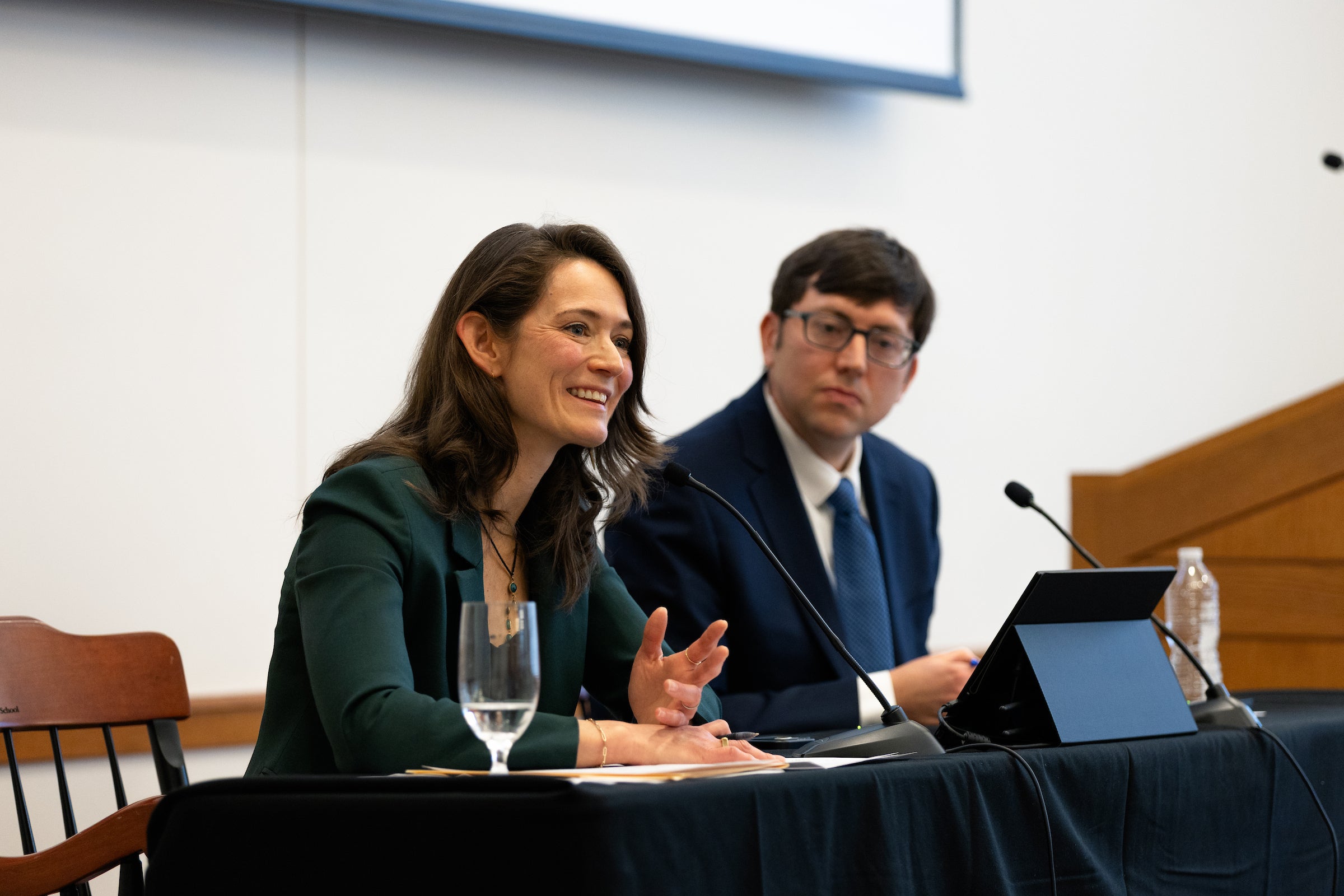
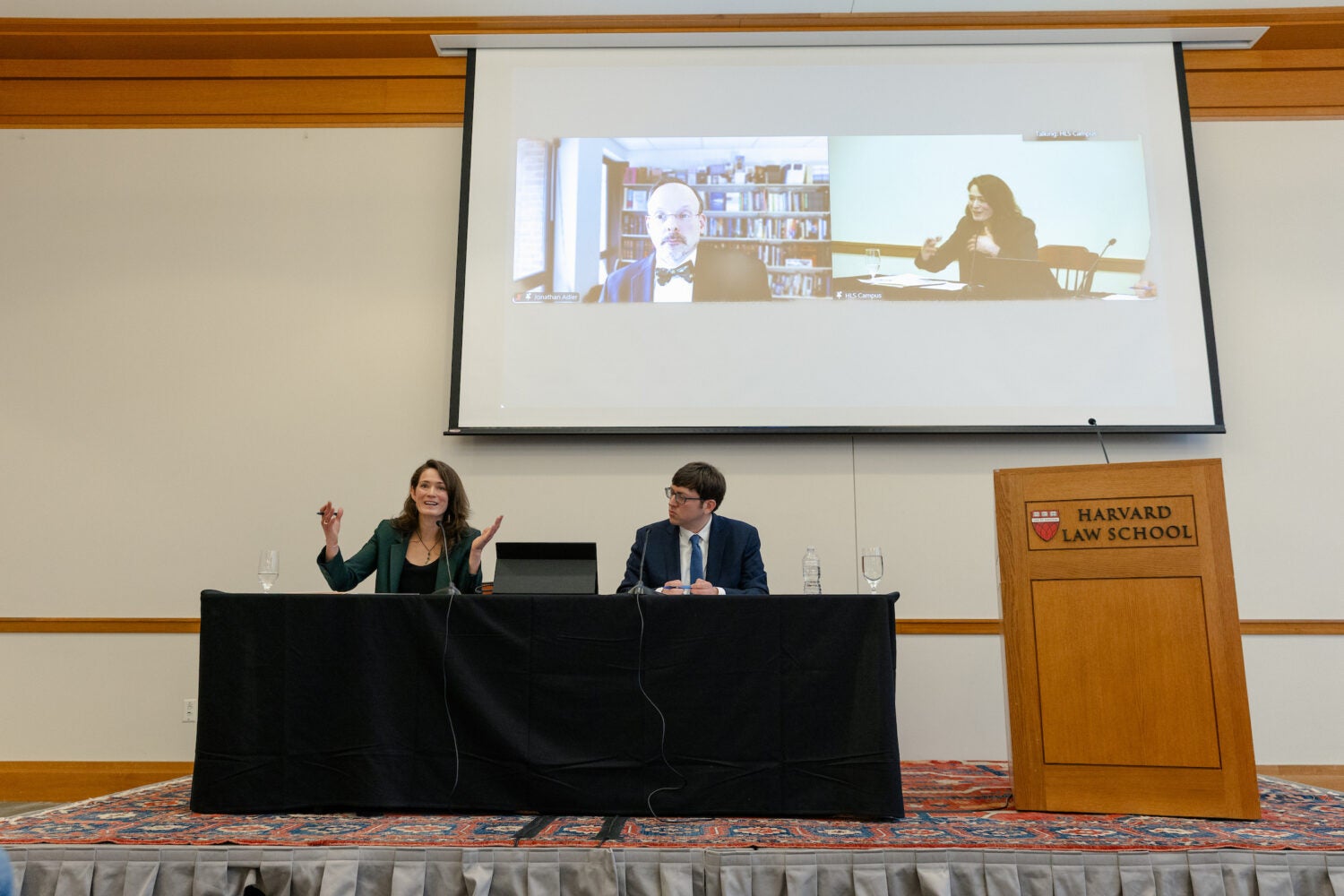
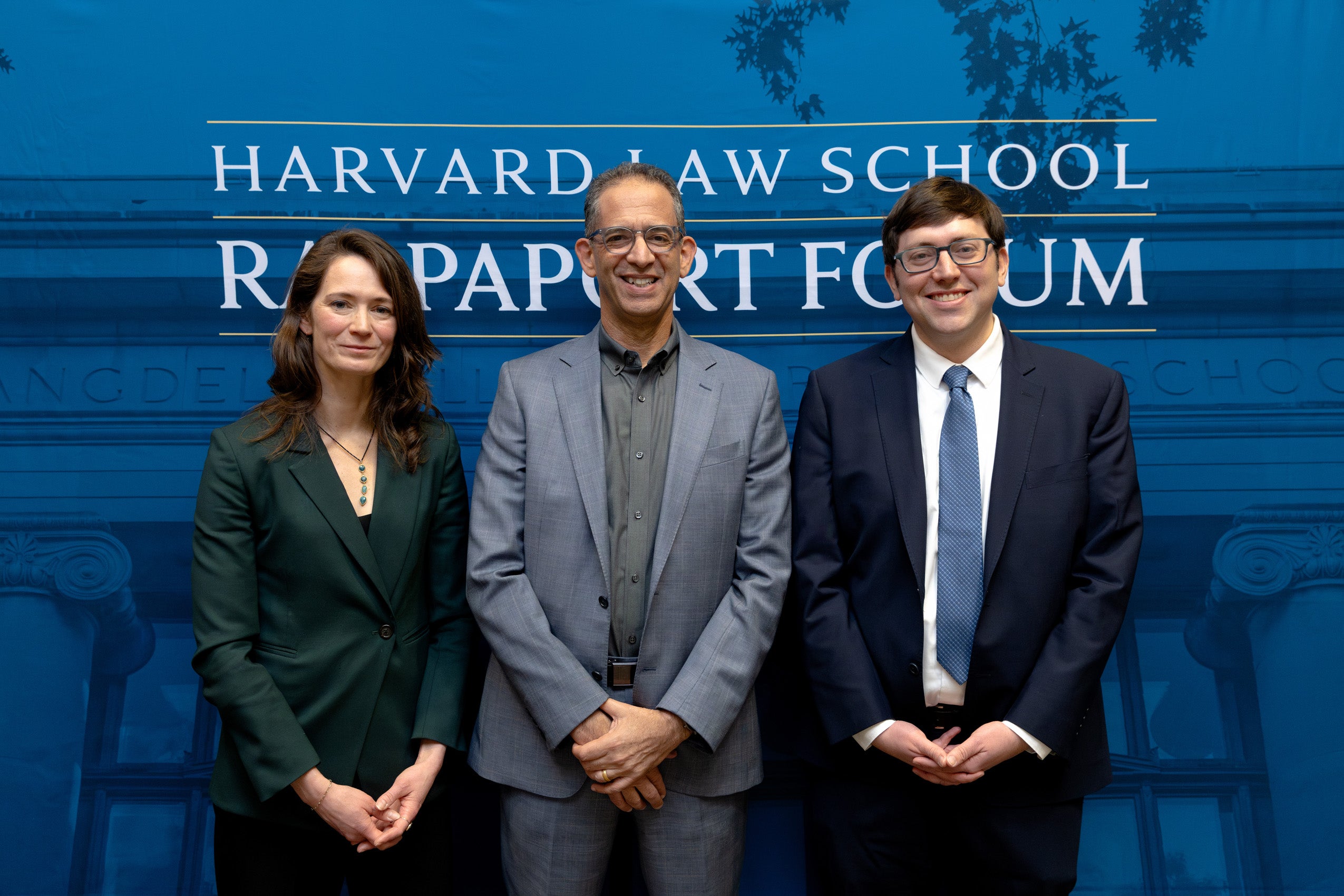
The Rappaport panel featured Adler in conversation with Kate Shaw, a professor at Penn Carey Law at the University of Pennsylvania, with Harvard Law Professor Richard Re as moderator. Together, they discussed the evolution of the emergency docket and how it might continue to shape the law and litigation in the future.
Shaw saw danger in the Court’s expanded use of emergency orders, particularly in light of the current administration’s actions.
“Since Donald Trump took office for the second time, the Supreme Court’s work on the shadow docket has virtually eclipsed its work on the merits docket, if not yet in volume, then arguably in impact,” she said.
Shaw cited statistics showing an acceleration in the number of applications for emergency relief over the past decade. During the preceding administrations of presidents George W. Bush and Barack Obama ’91, the solicitor general had asked for emergency relief just eight times in total. But during President Donald Trump’s first term alone, his administration asked for such relief 41 times, followed by 19 times by President Joe Biden.
And today, as Trump serves his second term, there has been an “astronomical” increase yet again, Shaw said. She suggested that neither scholars nor the media have paid proper attention to these orders, despite her view that “many shadow docket rulings were far more consequential in terms of on the ground impact.”
“I think we still pay far more attention the Court’s merits docket,” Shaw said. “Law professors don’t typically teach shadow docket orders, even where those orders appear to have significantly changed existing law, and even though the Court has recently suggested that these orders are precedential.”
This is so, Shaw argued, even though the Court’s emergency docket rulings have touched on matters important to many Americans.
“Shadow docket grants have included orders permitting the administration to remove individuals to third countries without complying with the Convention Against Torture, to expel transgender service members from the military, to permit roving ICE raids to stop citizens and non-citizens alike,” she said. “The Court did not offer one word of reasoning in any of those cases.”
Shaw outlined several problems she saw with these kinds of orders, the first of which, in her view, is their disregard for the “carefully reasoned decisions of lower courts replete with factual findings to which appellate courts are supposed to defer.”
While the emergency docket is not new, Shaw acknowledged, what she called the Court’s “manifest disrespect shading into contempt” for lower courts lacks precedent, she said. “It is only in the last year that [the Court] has also lashed out at district courts for failing to properly implement the rules emanating from its shadow docket orders, or for not anticipating the Supreme Court’s future moves.”
As one example, Shaw pointed to cases involving the president’s firing of heads of independent agencies. Following the Supreme Court’s own precedent set in the 1935 decision Humphrey’s Executor v. United States, lower courts blocked the removals, but the courts ultimately “found their order stayed and sometimes derided, and the president given the power to fire immediately.”
“I think it is profoundly destructive to the rule of law and to basic precepts of our legal system for the Court to send the message that it will utterly disregard the factual findings of lower courts if those findings are an obstacle to the result the Court wants to reach,” she said.
Shaw also argued that a conversation about the emergency docket is not complete without considering the larger political context. “The aggregate effect of the Supreme Court shadow docket in the last year is to affirmatively facilitate the actions and to shore up the authority of a president who is waging an assault on the separation of powers and whose actions, I think, reveal outright contempt for the Constitution,” she said.
‘A dramatic increase in presidentialism’
But Adler blamed wider structural problems within the federal government for the Court’s expanded use of emergency orders.
“The Court is fundamentally a reactive institution,” he said. “What we’re seeing from the Court is it responding to dynamics that are occurring in other institutions and through our legal system.”
He began by reminding the audience that the term “shadow docket,” coined in 2015 by the University of Chicago Professor William Baude, was meant to refer to all non-merits decisions by the Court, including certiorari, or the usual requests for Supreme Court review; rehearings; time extensions — and, yes, requests for relief before the case has received a final judgment. More than a decade later, Adler argued, “much less of this is actually occurring in the shadows.”
In Adler’s view, the Court’s ability to provide “extraordinary interim relief in pending cases” is essential to its role as superintendent of the lower courts. And as such, he argued, it must be able to “consider requests to provide relief to what are outlying or overbroad or unwarranted relief offered by the lower courts.”
“It just can’t be right that one district judge can stop a nationwide policy in its tracks and leave it stopped for the years that it takes to go through the process.”
Jonathan H. Adler
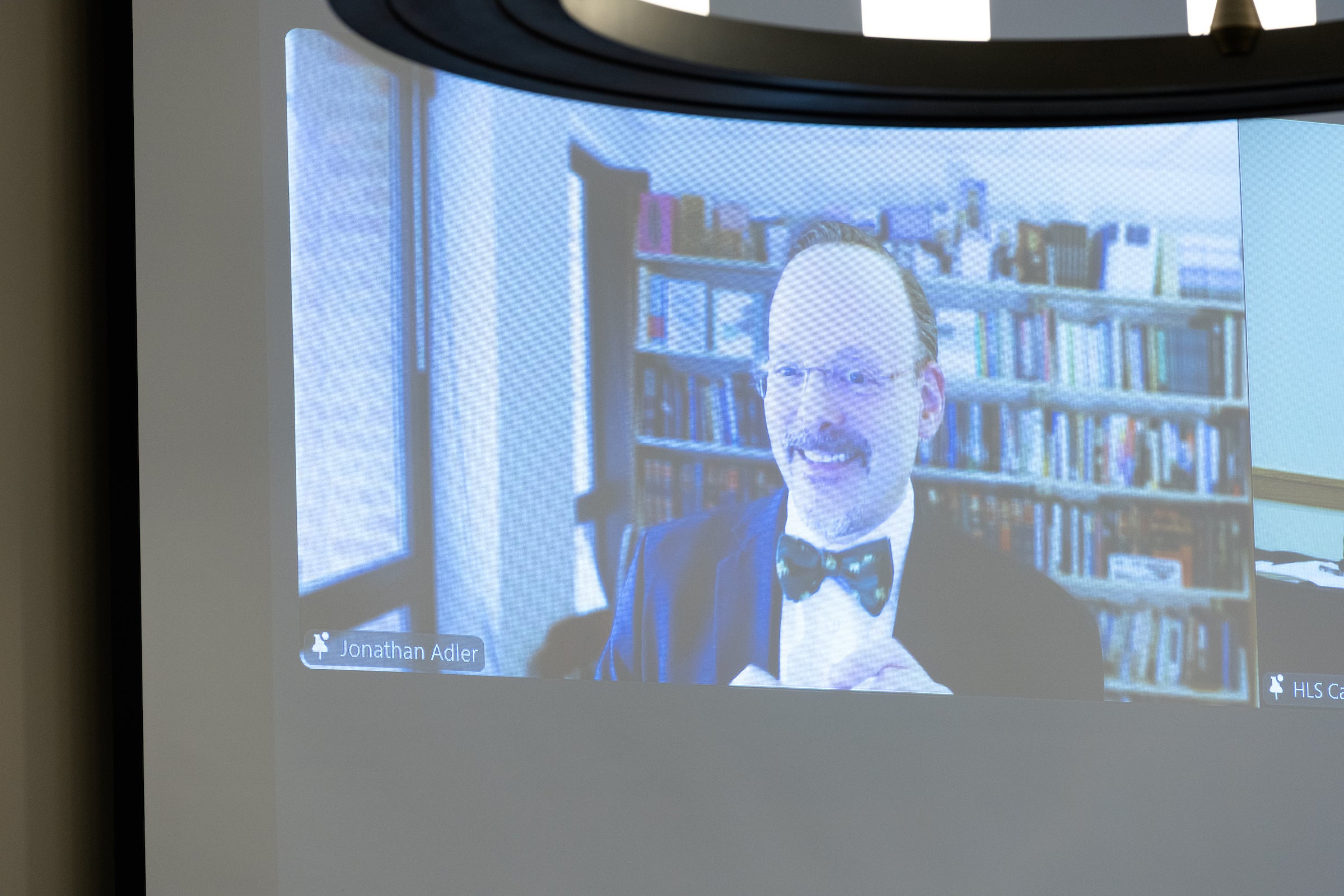
There has been a “dramatic increase in presidentialism,” Adler argued. That is, an increase in unilateral action taken by recent chief executives — “efforts by the executive branch to take policy initiative that used to be a done by Congress,” he said.
Individuals, activist groups, and state attorneys general often sue over these actions, shopping around for favorable jurisdictions, and in some cases, obtaining a nationwide injunction, which halts the policy across the country. And this is where the Court has felt it must intervene, Adler said.
“The Court believes, across the board, that injunctions against the executive branch necessarily impose irreparable harm,” he argued. “And I think that is informed in part by the idea that the executive branch only has a particular amount of time to advance its priorities, and if litigants or others can run out the clock and prevent things from happening, then the executive branch doesn’t get to do what the executive branch should be allowed to do as a result of elections.”
These broader dynamics have accelerated in the current administration, Adler acknowledged, which has led to more requests for intervention at the Court. “The dramatic increase in requests has meant there are more cases that the Supreme Court intervention is warranted, and the Supreme Court has responded.”
But while the Trump administration has faced many such injunctions, Adler argued that it has not, in fact, pushed back against all, or even most, of them.
“Of the 150 orders against it, fewer than 25% of those [are] brought to the Supreme Court,” he said. In fact, the current administration, Adler argued, is only appealing adverse lower court rulings it thinks it can win. “It’s bringing the strongest cases. It’s not picking the cases where its legal arguments are nonsense.”
Ideas for reform
Re, the moderator, wondered what reforms might address the problems identified by Shaw and Adler.
For one, Shaw suggested, the Court could require that emergency orders receive support from more than a simple majority of justices. Or it could move these cases to its regular merits calendar, which would mean “more argument, more written decisions, even if I disagree with the bottom-line outcomes and reasons.”
But in the absence of more careful consideration, Shaw suggested that the Court not intervene at all.
“If the Court it is not in a position to offer reasons to support its decisions, then, except in the most extraordinary circumstances, it should do nothing and allow the carefully reasoned orders of lower courts to stand,” she said.
“If the Court it is not in a position to offer reasons to support its decisions, then … it should do nothing and allow the carefully reasoned orders of lower courts to stand.”
Kate Shaw
While Adler agreed that the Court should take on more merits cases, he was reluctant to endorse the conversion of all emergency docket disputes into such cases.
“I think we would regret doing that across the board for every high profile, monumental question related to some executive branch initiative that a district court has decided is problematic,” he said. “I think we would lose a lot of what I think we generally value in appellate review, especially at the Supreme Court level, which is percolation, which is the ability of the justices to be able to take their time and really think through the cases.”
Instead, Adler suggested that the Court could make it more difficult for certain parties — such as state attorneys general — to sue. “I do think the Court could try and have litigation more driven by people that have actual complaints, rather than by political entities that have their other agendas.”
But ultimately, Alder argued that Congress could take action — and legislate. “Not that any of us knows how to make Congress do anything, but I do think that’s where the biggest solutions lie.”
Want to stay up to date with Harvard Law Today? Sign up for our weekly newsletter.