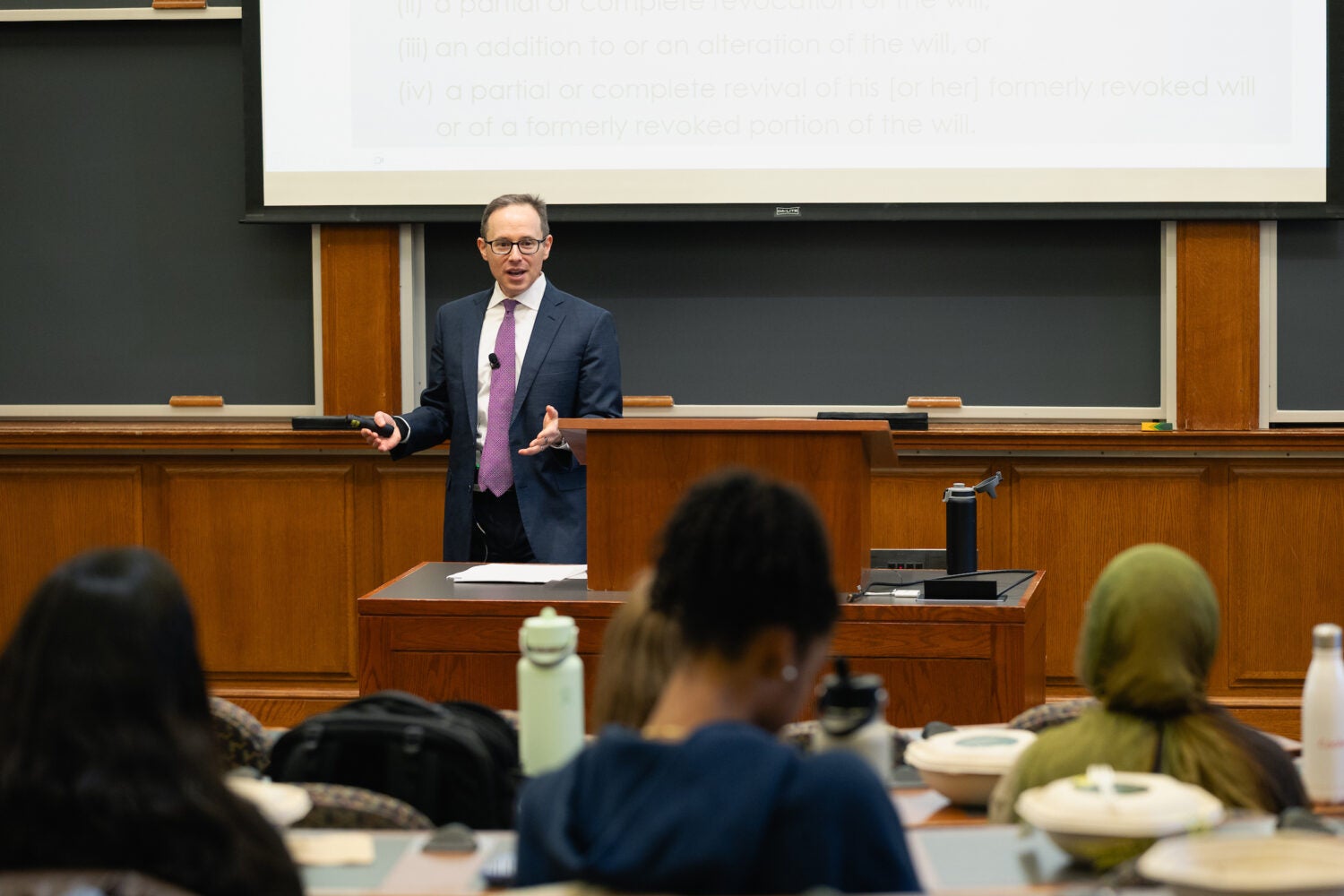
People are rightfully concerned about what happens in public law — how and when governments exercise power. But lawyers working in private law areas — such as property, contracts, torts, corporations, and family law — also play a critical role in securing rights and the integrity of our legal system, according to Robert H. Sitkoff, the Austin Wakeman Scott Professor of Law and John L. Gray Professor of Law at Harvard Law School.
“On a retail level, equally if not more corrosive to a democratic republic’s rule of law is a failure of private law to achieve the private ordering that people are seeking when someone thinks they’ve got a deal and they don’t,” said Sitkoff on March 30.
Sitkoff’s remarks came as part of his Last Lecture to the Class of 2026 — a tradition in which Harvard Law faculty offer parting words of wisdom and advice to graduating students.
Central to Sitkoff’s message was that, like their counterparts in public law, private law practitioners bear a responsibility not only to their clients, but also “to the practice of law, and to society as a member of this learned profession.”
Sitkoff began by thanking his students for making “me a better teacher, a better scholar, a better lawyer.”
He then acknowledged that public law challenges — questions involving the Constitution, administrative bodies, or criminal justice, for example — often garner the most media coverage and popular concern. “This is front-page news,” he said. “This is the law that organizes the state and your relationship to it.”
But in Sitkoff’s view, private law — the type of law “most of you are going to be doing,” he told the soon-to-be graduates — is an underappreciated pillar of stability in American society.
“This is the law organizing your relationships — your relationships with other people, with entities, with organizations,” he said. “This the law of private ordering.”
Private law topics include marriage and family, business and contracts, civil harms, and trusts and estates — the latter being Sitkoff’s own areas of expertise.
“This is retail law. This is what many of your clients are coming to you for in their day-to-day lives,” he said. “We order your personal and professional affairs with other people — and we enforce it, we resolve it, we make it work — through law, rather than through baseball bat.”
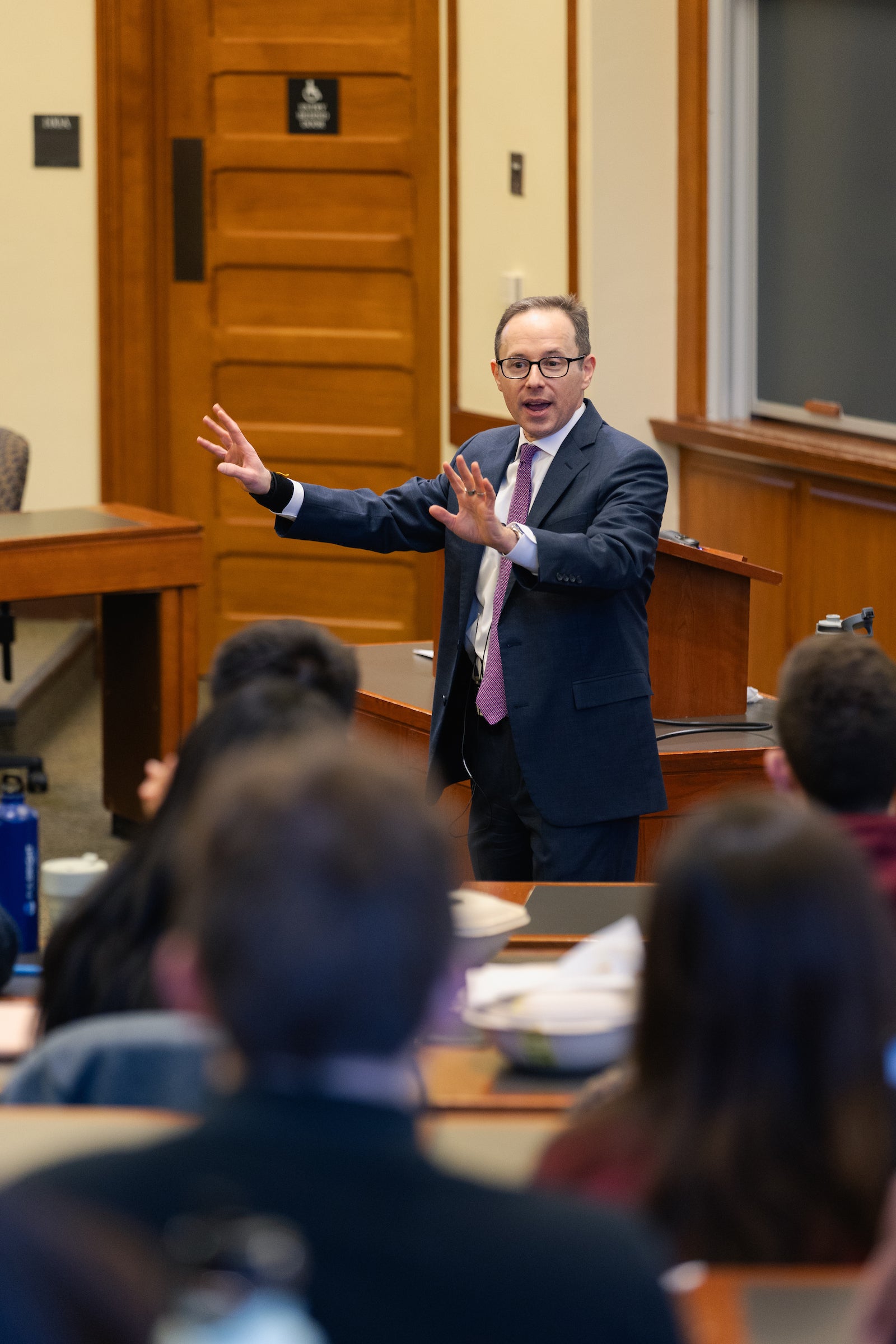
“We order your personal and professional affairs with other people — and we enforce it, we resolve it, we make it work — through law, rather than through baseball bat.”
While private law may not always make for splashy headlines, he continued, it does help people live their lives in the ways they choose. It also provides a nonviolent mechanism for compensation when things go wrong.
“Rule of law is an organized, predictable apparatus for dealing with breakdowns in private ordering,” Sitkoff said. “It’s organization not by force, but by rule of law.”
In fact, he suggested, one of the main reasons for public law is to support this kind of private ordering. “It’s to allow individuals to flourish and organize their affairs,” he said.
In contrast to public law, private law “is facilitative, not regulatory,” Sitkoff argued. To that end, he added, each area of private law has ready-made solutions intended to enable people to achieve a desired aim — whether it is to marry, start a company, provide for loved ones, or resolve disputes.
“There’s something astonishingly beautiful and magical that there is on the shelf all these forms that, if you do the right formation signal, you immediately get all of this stuff that is not regulatory, but it’s facilitative.”
A lawyer’s duty to their client, he said, is to figure out which form will allow them flourish — and customize it to their needs.
“Good transactional work involves listening with an empathetic ear,” he said. “Understand the objective of the client, figure out which one of those forms will get them closest to the objective, and then go make it right. Change the default rules that don’t fit.”
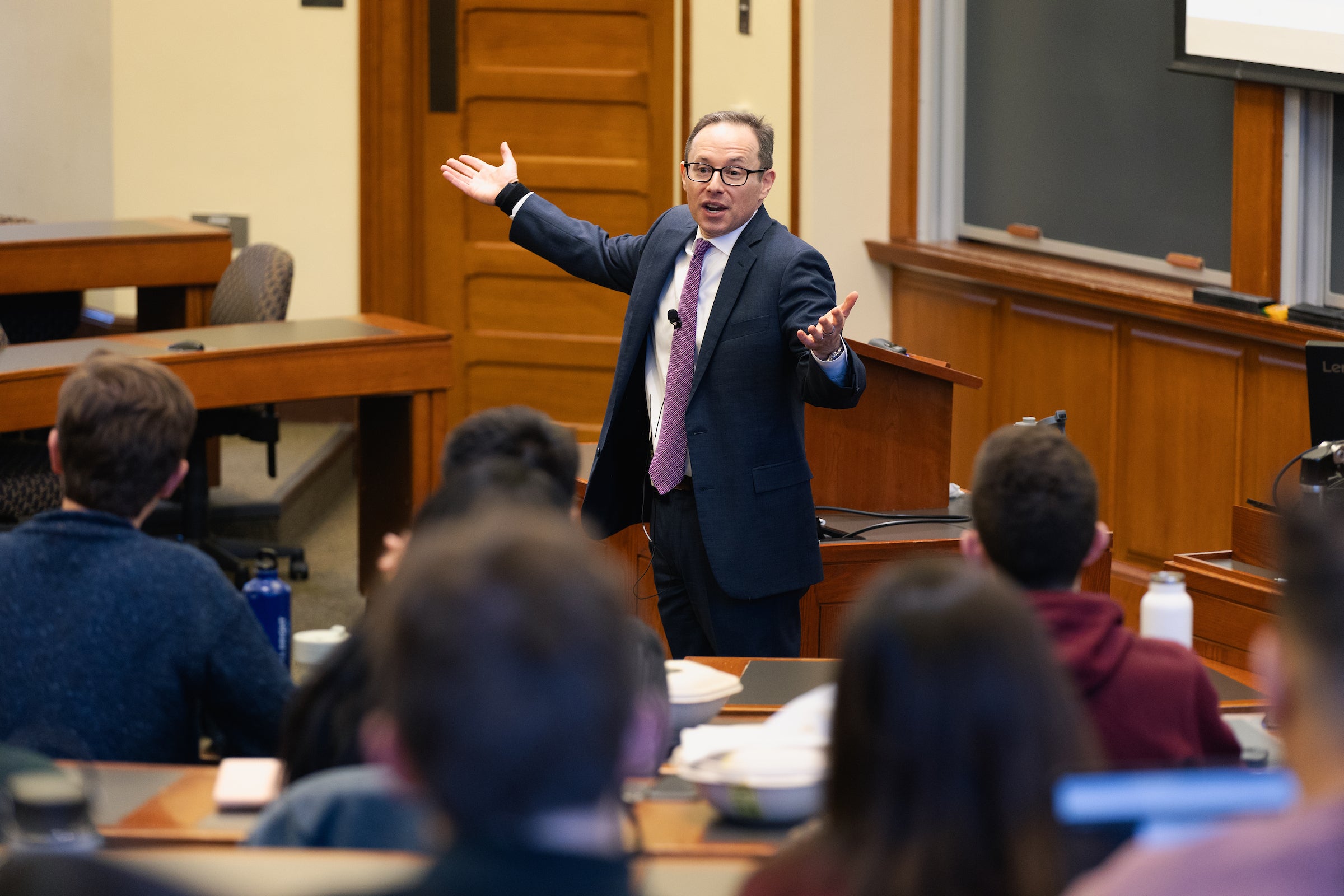

Sitkoff believes that private law practitioners have a secondary responsibility as a member of a learned profession: “The further obligation is to get [problems] fixed.”
“Never in the history of the world has anyone run for governor or state legislature saying, ‘Vote for me because I’m going to update the law of wills,’” he said. “Without the learned profession doing law reform, I think it’s a hopelessly naive understanding of the political structure.”
He encouraged the Class of 2026 to keep an open mind, to be ready to challenge their own assumptions. “You need to keep learning. You need to keep growing. You want to keep reevaluating what you think you know and look at these things afresh.”
He suggested that this may include rethinking what the law means to most people. “All the time, you hear about [how the] rule of law is endangered, and you have to protect the constitutional order. That’s not wrong. But that’s just the predicate to what matters to people on a retail level.”
Ultimately, private lawyers are as important to the preservation of the rule of law as anyone else, he contended.
“People are trying to make payroll. They’re trying to buy groceries. They’re trying to make rent,” Sitkoff said. “And when private law fails, messing up their lives, the law has failed them.”
Want to stay up to date with Harvard Law Today? Sign up for our weekly newsletter.