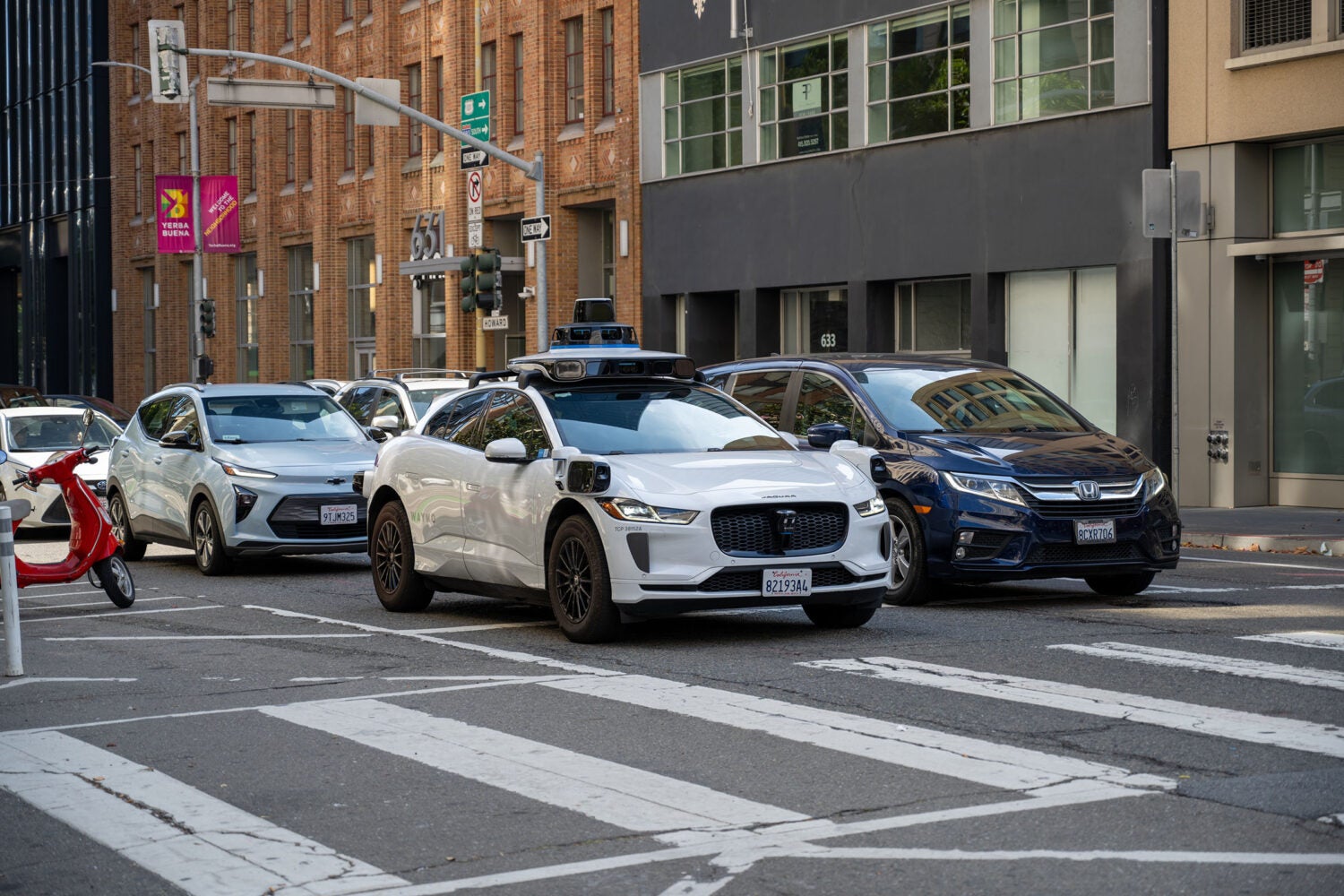
In downtown San Francisco, a car without a driver approaches a four way stop and slows to a halt. On the other side of the street, directly ahead, people hurry through the crosswalk. Just before the last pedestrian reaches the curb, something peculiar happens.
The autonomous vehicle begins to move.
According to California law, vehicles at a stop sign cannot move forward until pedestrians in the crosswalk have reached the other side.
Why would an autonomous vehicle do something against the law?
“Because people don’t follow the law,” explained Harvard Kennedy School Lecturer Mark Fagan at the recent Harvard Law and Technology Society event “Steering the Driverless Revolution: The Law & Regulation of Autonomous Vehicles.”
“When they first were programmed, [autonomous vehicles] didn’t violate the law,” he added. “It’s a change, but if you are introducing a new technology into an environment, you’ve got to follow the norms of that environment. If you stick out like a sore thumb, it will be a miserable experience.”
Fagan, who has studied the regulation of driverless cars for the past decade, currently leads an initiative at The Taubman Center for State and Local Government examining the regulatory impacts of autonomous vehicles. He joined fellow expert Andrew Miller, Ph.D., an author and speaker specializing in mobility innovation, to debate how policymakers should account for emerging trends in driverless technology.
Fagan pointed out that robotaxis have already begun operating in San Francisco, Los Angeles, Las Vegas, Phoenix, Austin, and “are coming soon to Atlanta.” He also acknowledged that the pace of implementation has lagged behind his initial expectations after hosting his first symposium on the subject in 2015.
“Ten years later, we are nowhere near the adoption I’d anticipated. We’ve been sitting in this gulf for a very long time” he said. “But we’re at a really exciting moment because the technology has evolved to a point where the ride seems to have become really good and really safe.”
With the technology vastly improved in a short time, according to Fagan, the biggest obstacle is now opposition from competing industries. He recounted a recent example where a Massachusetts state legislator filed a bill on behalf of Waymo, a leading autonomous vehicle transit company, to support the adoption of driverless cars.
“They had the hearing for the bill, and the hearing was filled to the brim with taxi drivers and rideshare drivers because this is an existential threat to them,” recalled Fagan. “Not only did they show up to the hearing in force, they’ve now been working on [the] Boston City Council and, more importantly, are gathering signatures for a ballot initiative that would require all autonomous vehicles to have a safety driver at all times.”
“Ten years later, we are nowhere near the adoption I’d anticipated. We’ve been sitting in this gulf for a very long time. … But we’re at a really exciting moment because the technology has evolved to a point where the ride seems to have become really good and really safe.”
Mark Fagan
According to Fagan, the proposed safety driver requirement would effectively “kill the industry” in Boston.
Andrew Miller began his remarks echoing Fagan’s account of the current state of affairs in the driverless vehicle industry. “We’re at a point where the problem is no longer technical; it’s political,” said Miller. “Or, to be more precise, it’s legal and regulatory.”
Miller, a native Canadian, voiced staunch support for state and subnational government regulation of automated driving regulations over federal or municipal control. He also noted that the scope of opposition includes other politically active labor groups apart from taxi and rideshare drivers.
“Our friends at the Teamsters don’t like this technology either, because they see it potentially being automated for long haul trucking,” said Miller. “So, they would also prefer policymakers reject autonomous vehicles. There are a lot of forces out there that prefer the status quo, and they’re coming out in force.”
Miller also discussed an emerging trend he has observed whereby the regulatory approaches governments apply to driverless cars tend to follow along political party lines.
“There is an emerging divide in this country on this issue between blue and red cities and states,” he said. “For example, unlike Boston or Seattle, the state of Arizona amended its state constitution to ban cities from imposing barriers to the introduction of driving automation.”
Miller also emphasized the effectiveness of regulatory systems that impose less stringent initial barriers to implementation but hold industry participants fully responsible for any injuries they cause.
“The specific regulatory suggestion I would make is that the only policy or regulation should be that any firm in the business of automated driving should bear responsibility for any incident on the road,” Miller argued. “They certify whether they are safe, and they have to pay the consequences if they are not.”
He used the demise of a former autonomous vehicle company called Cruise to underscore his point.
“[Cruise] had one incident where a joyrider of a stolen vehicle hit a pedestrian who was jaywalking and the poor woman was dragged by the car for about 50 meters,” he said. “The California Public Utilities Commission said, ‘You’re done.’ They revoked their license to operate in California. That company doesn’t exist anymore; that one incident killed them.”
Miller provided additional context by emphasizing the scale of casualties associated with the status quo of human drivers.
“Just in the United States, 40,000 people die annually in road accidents,” he said. “For the most part, people just accept that it’s the cost of living in modern society. It doesn’t have to be that way.”
Fagan agreed that the federal government is not the appropriate venue for autonomous vehicle regulation. However, he departed from Miller’s perspective on the role of regulators generally.
“The danger of regulation is regulatory capture. That’s what I see here: a disruptor coming along and the policies and regulations being used as a cudgel to try to swat it down.”
Andrew Miller
“Here’s where we have a different view: I take the approach that regulator and policymaker are actually serving a constituency, and that’s who they should focus on,” he said.
According to Fagan, the varied approaches taken by states and cities regulating autonomous vehicles simply reflect the differing priorities of citizens living in those areas.
“The constituents in Arizona, for example, care more about the economic opportunity. They’re willing to go forward with fewer regulations and rely on liability,” he said. “In California, they take the approach of ‘safety first,’ then economic opportunity. I don’t think either approach is wrong. I just think these policies are constituent-centric.”
While Miller mostly agreed with Fagan’s constituent-centric view, he also encouraged future policymakers to consider the costs and benefits of regulation relative to the average consumers they represent rather than being overly focused on the perspectives offered by advocates from competing industries, including taxi and rideshare drivers.
“The danger of regulation is regulatory capture,” said Miller. “That’s what I see here: a disruptor coming along and the policies and regulations being used as a cudgel to try to swat it down.”
In closing, Fagan acknowledged the downsides of widespread automated vehicle adoption once it has become the industry standard. Ironically, it seems, the widespread use of driverless cars would inevitably necessitate further regulation.
“In a world of widespread vehicle automation, congestion is going to be amazingly high,” Fagan said. “Once the financial costs and additional costs of taking a car trip decrease, it’s going to explode and put stress on the system. Every trip will take twice as long because they’re all using GPS, which will require its own regulatory response.”
Want to stay up to date with Harvard Law Today? Sign up for our weekly newsletter.