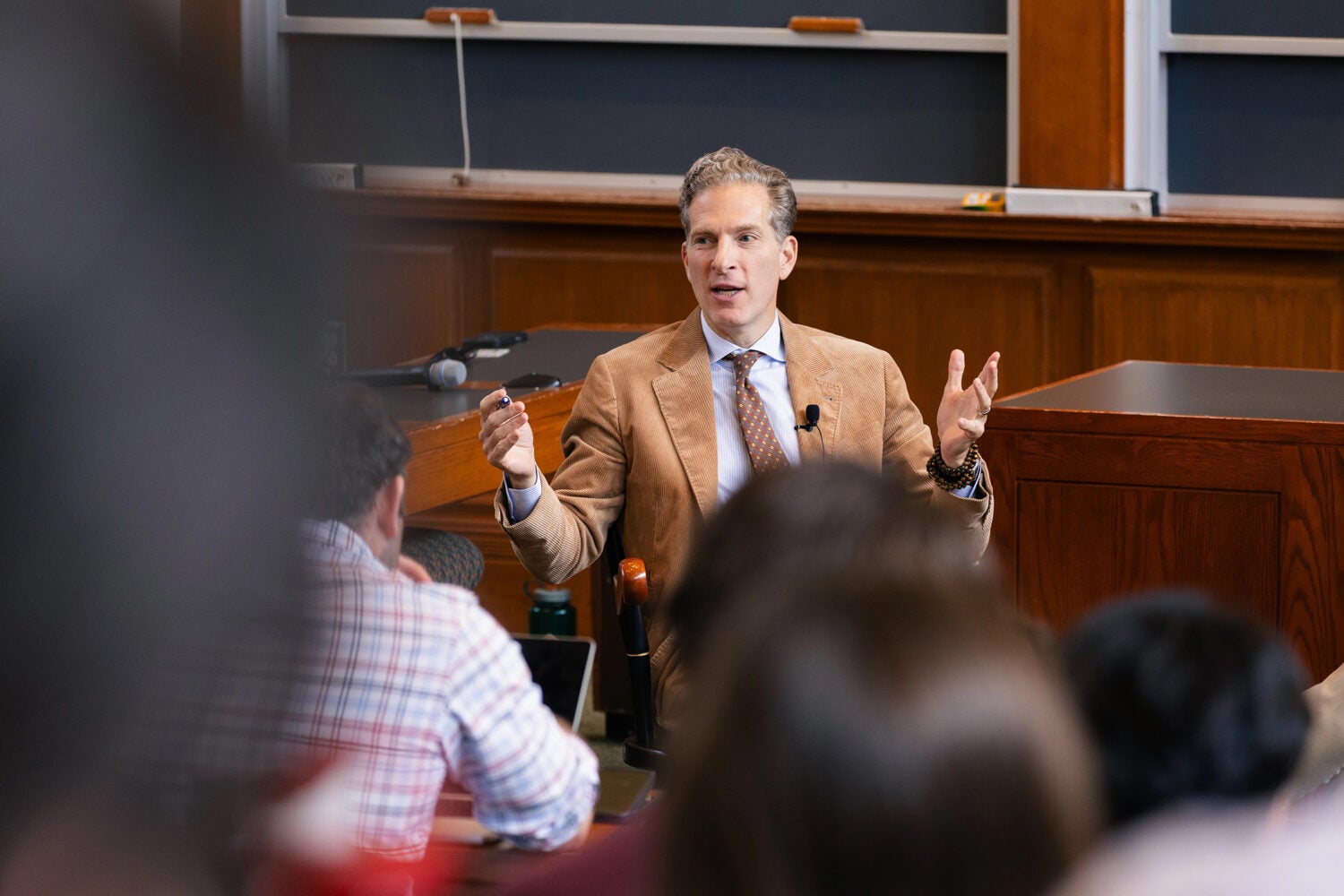
“It is my job, as a constitutional law professor who cares about the rule of law, to worry about a lot of things,” Harvard Law School Professor Noah Feldman told an online audience last week. Examining the rule of law in the second Trump administration, he found some cause for optimism — and, yes, cause for deep worry as well.
Feldman, the Arthur Kingsley Porter University Professor, chair of the Society of Fellows, and founding director of the Julis-Rabinowitz Program on Jewish and Israeli Law, spoke at “The Rule of Law Wars: An Update from the Front,” an event hosted by Harvard’s Office of the Vice Provost for Advances in Learning. He examined the 15 months since President Trump’s second inauguration, and the response by three key constituencies: Congress, the judiciary, and the public.
Feldman noted that it has been an extraordinary period for the rule of law: Not since the first term of Franklin Delano Roosevelt has there been a president who has tried so many speedy initiatives that were received by the other branches of government and by parts of the public “as actively deviating from what were understood to be constitutional norms.” Yet Roosevelt, unlike Trump, had been elected in a landslide, and faced a less friendly Supreme Court.
Feldman pointed to a number of program and policy deviations, including the Trump administration’s executive orders attempting to revoke birthright citizenship; the efforts by a new Department of Governmental Efficiency (DOGE) to shut down parts of the executive branch; the targeting of lawful residents and the removal of student visas on the basis of speech; actions against law firms and universities, including Harvard, that Trump perceived as hostile to his policies; the deployment of Immigration and Customs Enforcement (ICE) personnel against both documented and undocumented people; and finally, the bombing of Iran without congressional authorization. All of this, he said, “flew in the face of what were understood to be existing legal norms.”
Congress, he said, has been the least effective by far in challenging the Trump agenda. The first round of DOGE cuts, he noted, directly contradicted congressional statutes that established the offices that were targeted, including the U.S. Department of Education and the U.S. Agency for International Development.
“It would have been natural for Congress to be the first actor to respond,” Feldman said. Instead, Congress took a back-door approach — allowing the cuts to go through but gradually reinstating some of the funding that the president had cut (for science programs in particular). Congress proved unwilling to challenge the president directly.
This was again the case, he argued, when the president launched the Iran war without waiting for Congress to introduce a war powers resolution — even though the president does not have the constitutional authority to declare war.
“I can’t state strongly enough that one of the important takeaways of the first 15 months of the Trump administration is that under current conditions of partisanship — which could change but at present seem pretty well instantiated — it’s difficult to deny that the separation of powers as designed by the framers [of the Constitution] is not working the way it was meant to work,” he said.
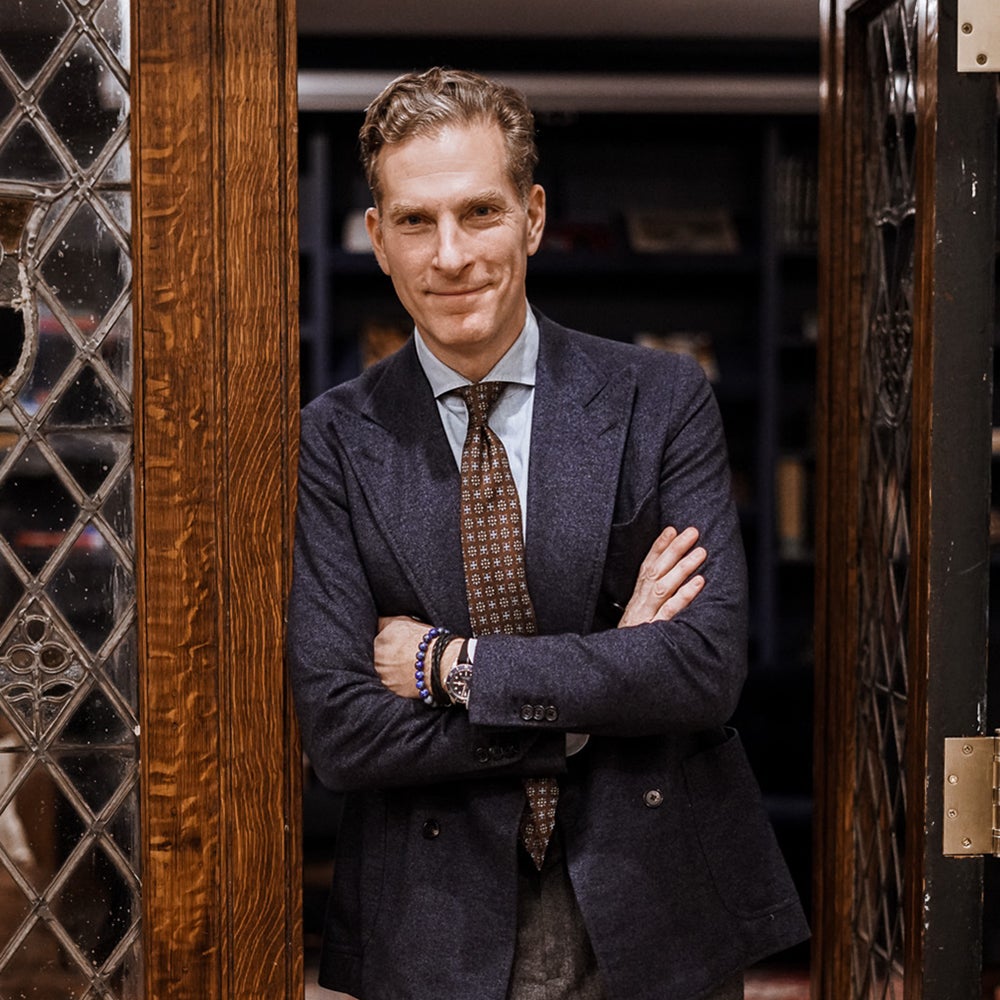
“Under current conditions of partisanship … it’s difficult to deny that the separation of powers as designed by the framers [of the Constitution] is not working the way it was meant to work.”
Moving to the judiciary, he said that federal district courts “have been the frontline in the war I’m describing, the war on the rule of law.” They have, for example, blocked the Trump administration’s efforts against disfavored law firms and universities. The lower courts, he said, also have a “pretty impressive” record in protecting non-citizens from deportation. Yet he noted a potential constitutional crisis, in that Venezuelan detainees were deported to El Salvador even after district courts in the District of Columbia issued an order against that.
“The appellate courts and the Supreme Court in that case have tried to avoid direct confrontation between the judiciary and the executive branch. They’ve kind of ducked the issue,” Feldman said.
They are concerned, he suggested, that the Trump administration could defy a lawful order to return those citizens. “And if that happened, if the courts were unable to force the president to comply, that would very substantially undermine the power and capacity of the judiciary.”
The job of the Supreme Court, he said, “is to function as generals in the defense of the rule of law.” And he saw a “real failure” in that department, particularly in the early stages of this Trump administration, when the Court undercut many lower court decisions.
But he saw a sea change when the Supreme Court struck down Trump’s proposed tariffs, with Associate Justices Neil Gorsuch ’91 and Amy Coney Barrett, both Trump appointees, part of the majority.
This case, he noted, largely represented corporate interests rather than the Court standing up for the underprivileged. Still, he said, “It is crucial to acknowledge that the Court … did meaningfully constrain presidential power under the theory that the president’s actions were not in conformity with statute and therefore were not in conformity with the U.S. Constitution.”
The final constituency is the public, which he said could protect the rule of law by way of peaceful protest. He cited the public response to ICE deployments in Los Angeles and other cities, where agents were authorized to stop people on the basis of speaking Spanish or appearing Latino.
He also noted the resistance to ICE deployments in Minneapolis. Since the deployments themselves were authorized by the Supreme Court, they did not technically violate the rule of law, he said. But Feldman considered the protests a proper public response to the ICE killings of two U.S. citizens.
“The protests in Minnesota and Minneapolis can be understood, and in my view are correctly understood, as a deep vindication of public participation in the battle to preserve the rule of law in the United States. And I think history will reflect that and take that extremely seriously,” he said. “The public, at least the public who has managed to stand up and raise serious and sustained objections the way it did in Minneapolis, to me gets the highest grade and gives me the most reason for optimism, in the long run, about the preservation of the rule of law.”
Want to stay up to date with Harvard Law Today? Sign up for our weekly newsletter.