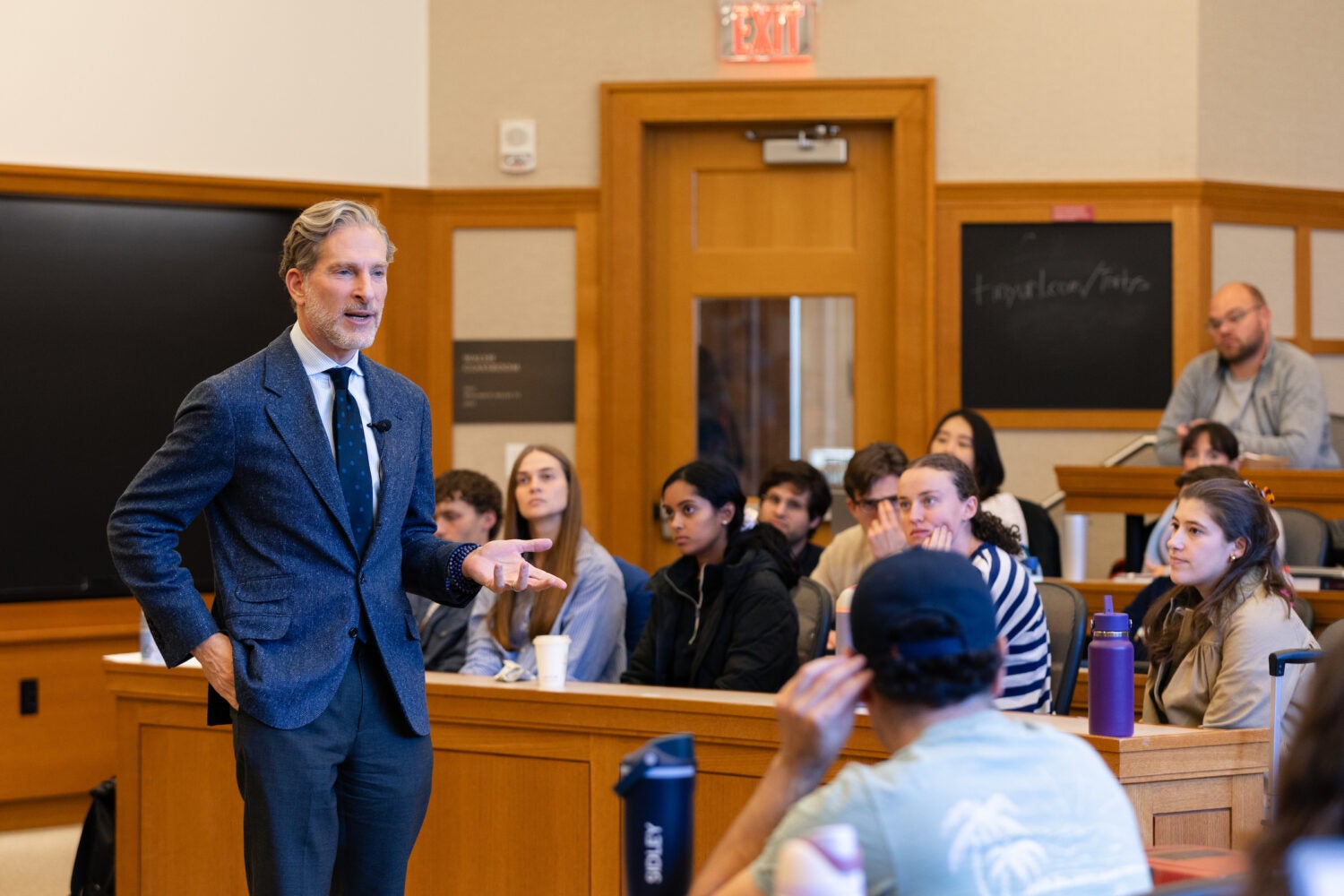
“I think we are at what you might call ‘the end of the beginning’ of the conservative constitutional revolution at the Supreme Court,” said Arthur Kingsley Porter University Professor Noah Feldman.
Addressing a classroom packed with students, Feldman explained why the U.S. Supreme Court suddenly finds itself at a crossroads.
“I call it the end of the beginning because we’re now out of marquee cases that the conservative legal movement has wanted to knock down,” said Feldman.
At the American Constitutional Society event on Oct. 26, Feldman shared his impressions of Supreme Court justices’ priorities and perspectives at the outset of the new October term.
With recent victories on abortion, affirmative action, and the scope of presidential authority fulfilling a slew of longtime conservative goals, according to Feldman, the conservative movement now faces new questions about its future direction.
“If you have a 50-year movement that’s designed to achieve certain results and outcomes, and it does … your big question is: now what?”
Feldman’s Supreme Court preview also addressed concerns over executive power, electoral challenges filed ahead of the recent midterm elections, and predictions on the outcomes of select Supreme Court cases.
The evolution of a constitutional revolution
Feldman began by examining the conservative legal movement’s goals and strategies implemented by supporters. First, he identified two broad categories of objectives: overturning landmark precedents and reshaping doctrine.
“Roe [v. Wade] was one, [Regents of the University of California v.] Bakke was another. That’s the affirmative action case. It was overturned by SFFA [v. Harvard]. That’s one bucket,” said Feldman. “A second bucket is what I would call long-term objectives that were not about overturning recent cases, but about shifting the long-run direction of doctrine. Here, I would say the most significant, by far, was unitary executive theory.”
According to Feldman, the conservative constitutional movement benefited from decades of evolution that preceded having a majority of justices sympathetic to its ideals. During that time, Feldman said, the movement formed both an intellectual framework that could justify its decisions and a political strategy designed to put that framework into practice.
“The cases came first … then, a coherent legal philosophy emerged from the opposition to those cases,” said Feldman. “It’s fair to say that although at any given moment conservative justices would have loved to overturn any of those cases, they were in a sense lucky — perversely lucky — that they didn’t have the votes to do it. Because, if they’d done it quickly, it would have eroded the power of the movement.”
He then identified three principal elements of the conservative legal program: judicial restraint, statutory textualism, and constitutional originalism. Although those approaches do not always fit neatly together, Feldman noted, conservative legal thinkers have sought to present and pursue them as components of a coherent legal philosophy.
Feldman also explained how the movement’s political strategy was informed by early failures after justices appointed by Republican administrations — such as Sandra Day O’Connor, Anthony Kennedy, and David Souter — deviated from the expectations of conservative supporters in their rulings.
By contrast, he said, “Justices Kavanaugh, Gorsuch, and Barrett had been sufficiently embedded in the structure of the legal conservative movement, so that there was very little uncertainty about their personality, their characters, or their jurisprudence.”
The appointments of Associate Justices Brett Kavanaugh, Neil Gorsuch, and Amy Coney Barrett helped establish the six-justice conservative majority needed to pursue the movement’s more ambitious goals. Feldman noted, however, that the movement was not just about conservative justices gaining power. It was about decades of intellectual and political strategy that made that power more likely to produce desired results once secured.
Agency independence post-Slaughter
Feldman then discussed the Supreme Court’s treatment of agency independence and, in particular, the Trump v. Slaughter decision that allowed the president to remove Federal Trade Commission member Rebecca Slaughter.
“The real revolution, which we saw in the Slaughter case, where the court ended agency independence, which has been around since the Interstate Commerce Commission started in the 1880s, is an inflection point in U.S. constitutional history,” he said.
Prior to Slaughter, independent agencies enjoyed legal protections that limited the president’s ability to remove certain officials at will. Feldman argued that weakening those protections could have consequences extending well beyond the formal question of who has the authority to dismiss an agency official.
“It’s actually a much bigger revolutionary change … it’s closely connected to the idea embedded in the Slaughter case that it’s in the constitutional design that anyone who works for the president should be fireable at will by the president,” he said. “The strong implication is that it is their constitutional duty to do anything the president tells them to do or resign.”
Feldman acknowledged that some progressive legal scholars have argued that changes to agency independence may have limited practical effects. Presidents, the argument goes, already wield significant influence over independent agencies as appointments become available.
Feldman rejected that suggestion and argued that the at-will dynamic threatens the independence of prosecutors, regulators, and other officials whose responsibilities require them to make case by case decisions that would otherwise conflict with immediate political demands.
“The fundamental reality is that we’re now in a world where the Trump administration is normalizing, on a daily basis … the practice of everyone in the executive branch feeling that their job is just to salute the president and do whatever he tells them to do,” Feldman said. “That is not part of the formal holding of Trump v. Slaughter, but it is implied.”
Feldman also highlighted implications for the Department of Justice — an institution that historically has relied on its reputation for presenting legal arguments as the position of the United States, rather than merely the political preferences of the president. Rebuilding that eroding credibility, Feldman suggested, could take a generation.
Election challenges
Feldman then discussed recent lawsuits brought by the DOJ to challenge a slew of state election policies ahead of the Nov. 3 midterms. He argued that concerns that the election lawsuits would succeed were overblown.
“What I want to say here is … don’t worry about it. It’s going to be fine. And the reason it’s going to be fine is that the Trump administration’s arguments are not serious ones,” he said.
According to Feldman, election challenges brought by the DOJ exemplify the exact post-Slaughter dynamic described earlier in his remarks. Nevertheless, he reiterated his confidence that the lawsuits would not find traction.
“As long as this cultural style continues in our politics, we will have these kinds of claims. But the Supreme Court has never listened to these claims, and it is not going to listen to these claims,” he said.
To date, Feldman’s prediction regarding the impact of the DOJ election challenges has proven correct.
On Nov. 2, the Supreme Court issued a brief, one-sentence order rejecting the DOJ’s emergency request to temporarily block California from counting mail-in ballots from registered voters alleged to be non-U.S. citizens.
At the federal district court level, judges have ruled against DOJ lawsuits that sought to block the certification of results from the U.S. Senate race in Alaska and compel state officials in Washington to remove ballots cast by voters accused of being noncitizens.
SCOTUS cases this term
Feldman argued that very few cases in the upcoming Supreme Court term “are at the absolute core” of the conservative movement’s priorities, but he identified St. Mary Catholic Parish v. Roy as “one that comes close.”
In St. Mary Catholic Parish, which the Court heard oral arguments for on Nov. 3, the Archdiocese of Denver is challenging Colorado’s decision to refuse to exempt Catholic preschools from rules requiring them to admit all students — including LGBTQ children and children with LGBTQ parents. According to the challengers, the lower court wrongly applied too deferential of a standard in its decision finding that Colorado did not violate their First Amendment free exercise rights.
“It’s a case about the meaning of the Free Exercise Clause,” explained Feldman. “Here, one of the objectives — not of the whole, but a part — of conservative legal thought has been to reestablish Justice Brennan’s rule, the Sherbert rule, for exemptions from neutral and generally applicable laws that incidentally burden your religious practice.”
According to Feldman, the precedent that this case could overturn is ironically from Employment Division v. Smith, a majority opinion written by longstanding conservative Associate Justice Antonin Scalia. At the time of that decision, Feldman noted, liberal jurists tended to favor exemptions while conservative jurists tended to be statists who “liked rules, not standards.”
“Then the political economy of this changed because of the rise of gay rights and Obamacare,” said Feldman. “So, magically, everyone flipped. The conservatives became the liberals; the liberals became the conservatives.”
As to the outcome of the case, Feldman expressed skepticism that existing precedent would be overturned. “I don’t think they’re likely to overturn Smith, honestly, because Justice Barrett, who worked for Justice Scalia, has signaled that she’s not ready to do that,” he said.
Feldman also discussed two cases dealing with federal preemption over state laws. The doctrine of federal preemption derives from the Constitution’s Supremacy Clause and defines the circumstances when federal law displaces state law.
The Court already has heard oral arguments on the first of the two preemption cases, Suncor Energy Inc. v. County Commissioners of Boulder County, which will settle whether federal law prevents the city and the county of Boulder, Colorado from filing state tort claims against oil companies for the effects of greenhouse gas emission pollution. According to Feldman, during oral arguments, Justice Gorsuch raised a question of whether EPA policy prohibiting federal tort claims for damages caused by greenhouse gas emissions could preempt the state tort law.
“What Gorsuch was suggesting is that federal law preempts state law while simultaneously guaranteeing that no one can do anything,” he said. “If that sounds laughable … be aware that, in the AI context … the Trump administration’s original position, backed by the companies, was: We want a federal law that preempts all state laws, but does not regulate at all federally.”
In the second preemption case, Republican National Committee v. Mi Familia Vota, the underlying state law being challenged pertains to voter identification in Arizona. According to Feldman, conservative and liberal justices will likely reverse course on the issue of whether federal law supersedes state law.
“Now it’s the liberals who want to argue that federal law determining voting preempts states and blocks Arizona from adding restrictions on or requirement that you show certain forms of ID to prove citizenship when you get your voter registration,” he said. “It’s the liberals here who are saying preemption, and it’s the conservatives saying, ‘Oh no, there’s no preemption at all. Arizona can do whatever it wants in this space.’”
In closing, Feldman cautioned progressives from relying on the argument that the Court is simply a partisan institution whose legitimacy should be rejected. Instead, he pointed to an alternative critique espoused by Associate Justice Elena Kagan: that the Court’s conservative jurisprudence insufficiently considers the real-world consequences of its decisions.
“Rather than trashing the legitimacy of the Court altogether … you should be formulating a critique of the jurisprudence on its own terms for what’s bad about it, reconstituting it in a better way, and fighting to get justices on the Court who would bring that back on the theory that the Supreme Court is a useful and important component of American constitutional democracy.”
Want to stay up to date with Harvard Law Today? Sign up for our weekly newsletter.