
Learning how to accept other peoples’ feedback — even blistering criticism — and gain something from it is an invaluable skill that can make us better at our jobs and even better citizens, argues Sheila Heen ’93, the Thaddeus R. Beal Professor of Practice at Harvard Law School.
“We need each other to see ourselves and see the impact that we’re having on others,” Heen said at an event on April 6. “We actually need each other in order to learn, to grow, and we need some honest, if sometimes painful, feedback.”
Heen, who is also the deputy director of the Harvard Negotiation Project, was speaking at an event in recognition of her appointment as chairholder.
In his introduction, John C.P. Goldberg, Harvard Law’s Morgan and Helen Chu Dean, called Heen a “world renowned expert on negotiation and conflict resolution,” one who has also “played a leading role in the establishment of some of our most innovative executive education programs.”
Goldberg noted that in addition to her research and teaching, Heen is the cofounder of a negotiation consultancy and the coauthor of several best-selling books. “Takes a lot to be a great lawyer, author, and businesswoman, takes even more to be on top of all those things, a great teacher,” he said.

Heen first thanked the family, friends, colleagues, mentors, and students who had shown up to celebrate with her — and those who weren’t able to be in the room that day, but who had nonetheless also shaped her. “Just appreciating the people that we get to walk alongside in this journey of life and our life’s work is an incredible privilege,” she said.
Heen described how, during her first year as a student at Harvard Law School, she met several people who would change the course of her life: fellow student and future husband, John Richardson; Professors Roger Fisher and Bruce Patton, founders of the Harvard Negotiation Project; and Douglas Stone, who would become her coauthor and frequent collaborator.
During that time, she also discovered her passion for the field of negotiation.
“I just immediately fell in love with the analytical rigor and emotional insight and cross disciplinary nature of this rapidly evolving field, and I thought I could learn something new every day of my life.”
Heen acknowledged that, at the time, she didn’t always fully appreciate what she was learning in class and from feedback from her negotiating counterparts. “What’s interesting to me about learning is that it’s mostly appreciated in hindsight,” she said. “At the time, it can be incredibly painful.”
That paradox became a key focus of Heen and Stone’s later research, particularly as it relates to learning from others’ feedback — the formal and informal, and direct and indirect ways in which people provide information about us, our work, and the impact of our behavior and choices on them.
Feedback is a “double-edged sword,” Heen said. “On one hand, we do want to learn and grow, but we also want to be accepted and respected and loved the way we are now.”

“On one hand, we do want to learn and grow, but we also want to be accepted and respected and loved the way we are now.”
Sheila Heen
She argued that there are three kinds of feedback, each with different purposes, all of which “we need in order to grow.” The first, Heen said, is perhaps the easiest to accept: appreciation. “This keeps us motivated, keeps us engaged. It keeps us trying.”
Then there is coaching, “a big engine for learning,” Heen said. She described this type of feedback as “anything that can help you, get you to improve your knowledge, your skill, your capability, your effectiveness, or the impact that you can have.”
The final type is the one people usually struggle with the most, she suggested. Evaluation “tells you how you’re doing, whether you’re on track, whether you measure up.”
Our defensiveness to this type of feedback can “drown out our ability to hear the other two” to the detriment of our own growth, she said, adding that high-achieving people are frequently less equipped to process negative evaluative comments.
This is because they are good at “wrong-spotting,” Heen said — that is, finding fault with feedback they don’t like for any number of reasons, including distaste for the speaker, or believing that the speaker doesn’t have all the relevant information. The feedback may also offend their sense of themselves, she added.
But while a piece of feedback could, in fact, be mostly wrong, Heen suggested that it might still contain a nugget of truth — one worth paying attention to. “We all have blind spots,” she said. “Particularly as lawyers, where we are trying to persuade other people.”
The ability to learn from feedback can and should be developed, she suggested. “Maybe receiving feedback is a totally independent suite of skills that, if we can get better at understanding and be good at it, you can take charge of and drive your own learning, and you don’t have to wait around for the perfect mentor to show up.”
One way to do that is to separate the speaker from the feedback, Heen said. “Because irritatingly, people we don’t like and don’t respect and don’t want to be like sometimes actually are correct and have good advice, which is really annoying.”
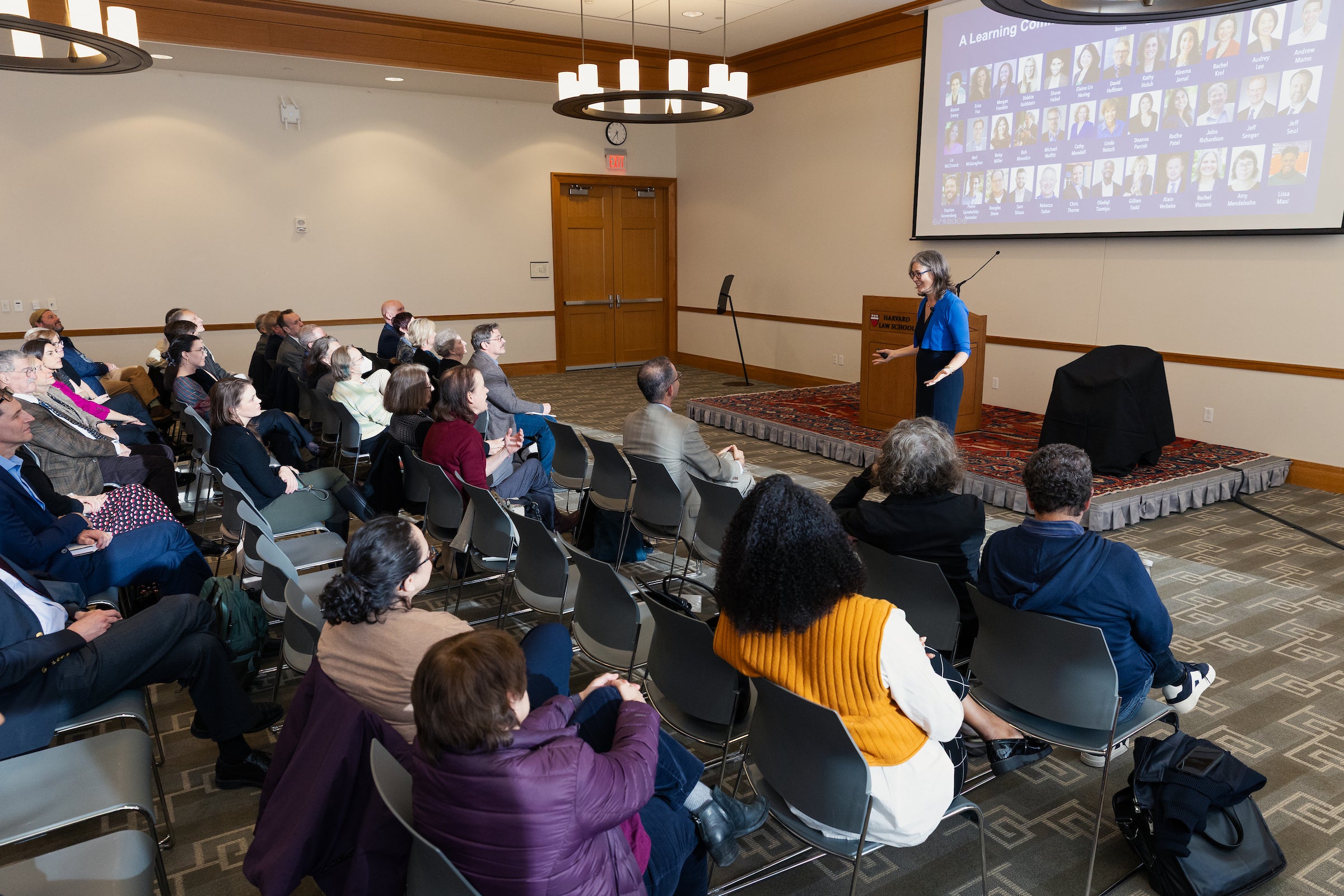
Another trick Heen said she deploys after getting tough feedback is to go to a loyal friend with it. “Ask two questions. The first is, ‘What is wrong with this feedback that I just got?’” she said, calling this the “supportive mirror” role.
But the inquiry can’t end there if one wants to grow, Heen said. Next, she advised, ask what might be right with the feedback. “‘What do you think I need to learn?’ You can unpack that with someone that you like and trust, but who can be honest with you.”
Heen concluded by referencing the life of Thaddeus R. Beal, the professor for whom her title is named, and her mentor, HLS Professor Roger Fisher. Both came out of experiences in war looking for better ways for humans to resolve conflicts. Following a sobering experience serving as a weatherman in World War II, Fisher was an early founder of negotiation programming at Harvard — his way of recognizing the need to develop alternative, nonviolent ways to solve problems.
She suggested that perhaps the time has come once again to build new models of engagement.
“It feels like things are a little dark, both in the United States and globally,” Heen said. “In our democracy right now, we fight over the facts. We fight over what’s true. We don’t trust anything that comes from the other side. We’re trying to figure out who we are, and we’re losing sight of who we are.”
But there are lessons to be gleaned even when things feel unstable and uncertain, Heen said, telling audience members they were “an important part of the process.”
“Is this one of those moments where there’s something that we need to learn?” she asked. “Sometimes it takes being in the dark to be motivated to find the light.”
Want to stay up to date with Harvard Law Today? Sign up for our weekly newsletter.