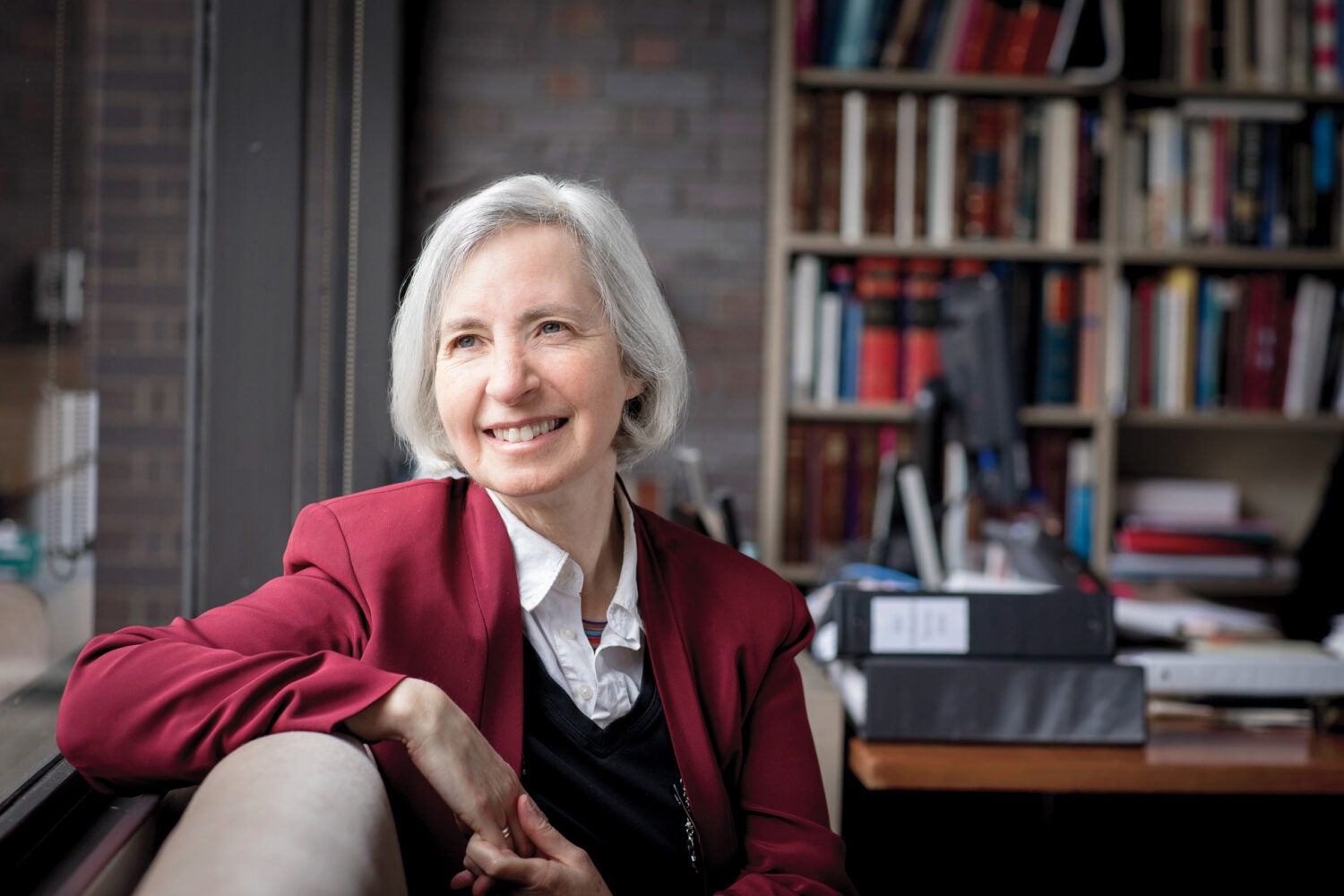
Martha Minow, the 300th Anniversary University Professor at Harvard and former dean of Harvard Law School, has been named a recipient of the 2025 Friedrich Schiedel Prize for Social Sciences and Technology. The award is presented by the TUM School of Social Sciences and Technology at the Technical University of Munich (TUM) and honors outstanding scholars whose work bridges science, technology, ethics, and society. Minow shares the 2025 prize with Professor Ulrike Felt of the University of Vienna.
“This year’s Friedrich Schiedel Prizes honor two visionary thinkers who remind us that scholarship is not only about knowledge, but about service to humanity,” said Urs Gasser LL.M. ’03, a dean of the TUM School of Social Sciences and Technology, who previously served as a professor of practice at Harvard Law School. “Ulrike Felt and Martha Minow exemplify intellectual brilliance joined with moral courage and leadership. Their work redefines how we understand the nexus of technology, justice, and human responsibility — and continues to inspire the values of reflection and responsibility that define our school.”
Minow is a globally recognized scholar in constitutional law and human rights whose research focuses on how societies respond to inequality and injustice, particularly affecting marginalized communities, and how emerging technologies can be governed in ways that protect democratic values and human dignity. In recent work, including “Distrust of Artificial Intelligence: Sources & Responses from Computer Science & Law” with Cynthia Dwork (2022), and “Social Media Companies Should Pursue Serious Self-Supervision,” she advances ethical frameworks for regulating digital technologies and addressing the societal consequences of technological power.
Her books include “Saving the News: Why the Constitution Calls for Government Action to Preserve the Freedom of Speech” (2021); “When Should Law Forgive?” (2019); “In Brown’s Wake: Legacies of America’s Constitutional Landmark” (2010); “Partners, Not Rivals: Privatization and the Public Good” (2002); “Between Vengeance and Forgiveness: Facing History After Genocide and Mass Violence” (1998); and “Making All the Difference: Inclusion, Exclusion, and American Law” (1990).
Recent articles include “Justice in Divided Societies,” (American Journal of Law and Equality, 2024), and “Walls or Bridges: Law’s Role in Conflicts over Religion and Equal Treatment,” (Brigham Young University Law Review, 2023). She is currently writing book for University of California Press addressing the preconditions needed for a sustainable constitutional democracy.
Beyond academia, Minow has played a significant leadership role in global and national initiatives. She has led the UNHCR program Imagine Co-existence, collaborated with the U.S. Department of Education to promote digital inclusion for children with disabilities, and served as chair of the MacArthur Foundation Board, championing innovation, inclusion, and human rights worldwide.
Minow said, “The interdisciplinary approach of the TUM School of Social Sciences and Technology exemplifies the integration of perspectives and disciplines critical to advancing human welfare in this age of rapid technological innovation, and I am humbled and honored by this meaningful award. It inspires me to work globally to center the dignity and potential of human beings amid this transformative time.”
Minow’s contributions have previously been recognized with numerous honors, including the Ruth Bader Ginsburg Lifetime Achievement Award, the Reporters Committee for Freedom of the Press Lifetime Award, and multiple honorary doctorates.
Established in 2023, the Friedrich Schiedel Prize for Social Sciences and Technology is awarded by TUM to strengthen the social sciences and interdisciplinary research, recognizing scholars whose work integrates technological innovation with ethical reflection and societal impact.
Want to stay up to date with Harvard Law Today? Sign up for our weekly newsletter.