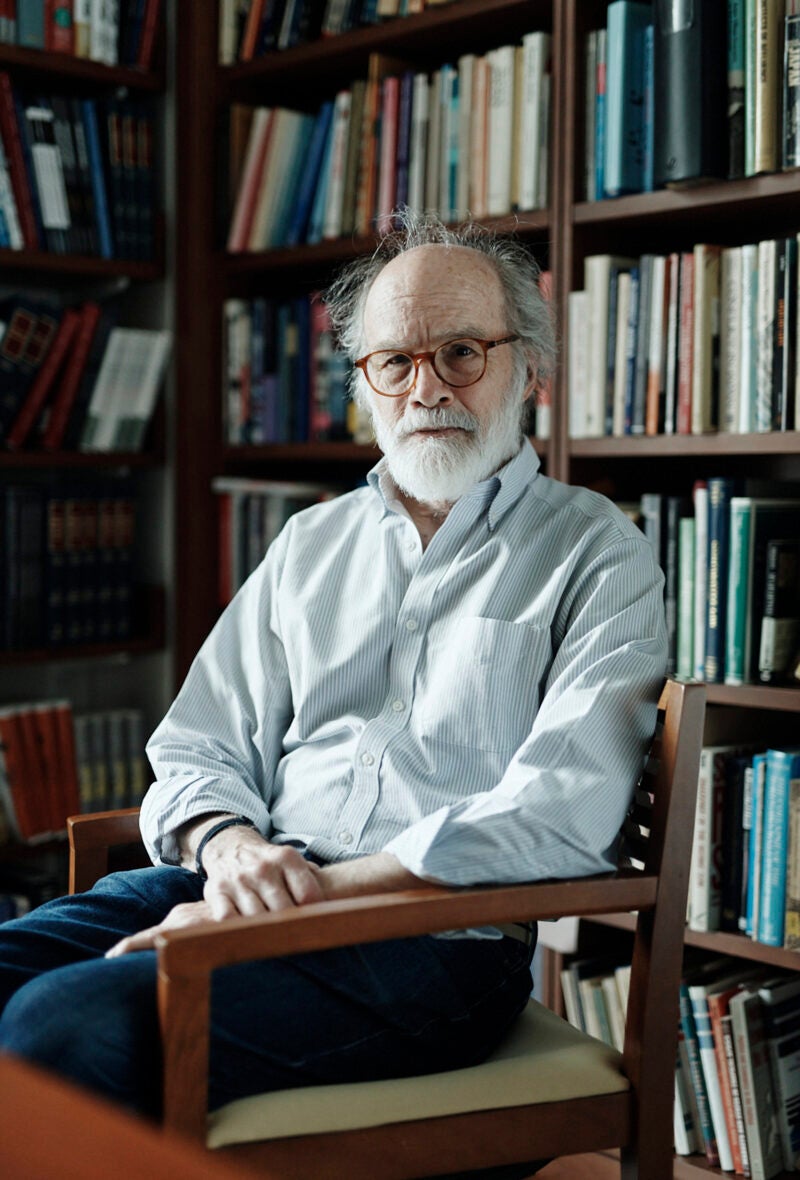
It was a sign of Japan’s emerging importance in the world that, in 1981, my 3L year at HLS, the course offerings included a seminar on Japanese legal documents in which students were expected to read court decisions in the original Japanese. Impressively, a half dozen HLS students capable of reading Japanese at various levels of competence signed up. It quickly became evident that Mark Ramseyer, a fellow 3L who had grown up attending Japanese primary school in Kyushu as the son of Mennonite missionary parents, was the seminar’s ace.
Mark and I both grew up in Japan in the late 1950s and 1960s. Over the course of our childhoods, postwar Japan became the world’s leading exporter of TVs and cars. In 1979, the year Mark and I entered HLS, Ezra Vogel of Harvard’s Sociology Department published the bestseller “Japan as No. 1,” predicting, as many then expected, that Japan would soon overtake the U.S. as the world’s largest economy.
Japan’s rising economic status made America’s law schools pay attention, for the first time, to Japan’s legal system. The leader of our Japanese legal documents seminar, Frank Upham ’74, was one of the pioneers teaching Japanese law in an American law school.
Mark, like many others of our generation, was a “diverted” academic. Before HLS he had spent two years getting a master’s degree in Japanese Studies at the University of Michigan. A “diversion” to HLS offered the prospect of a teaching career in law school if one did well, with a law firm career as Plan B. As it turned out, Mark did very well indeed, earning a place as an editor of the Law Review and, after graduation, clerking for Justice Stephen Breyer ’64 (then on the First Circuit).
In a 1985 article for The Yale Law Journal written shortly before he took his first academic job at UCLA School of Law, Mark displayed his instinctive resistance to received wisdom that we have grown to expect and love. Addressing the mystery of why the Japanese are less litigious than Westerners, Mark first took on Japan’s leading sociologist of law, Tokyo University’s Takeyoshi Kawashima. Mark deftly deconstructed Kawashima’s “cultural” thesis—that Japan abhors litigation because it is un-Japanese, and contrary to traditional social harmony.
In the same article he also politely but firmly attacked John Haley’s then-influential view that Japanese reluctance to litigate was based purely on economics. Given that Haley was among the foremost American scholars of Japanese law at the time, this was probably a rash and unnecessary fight to pick for a young law school graduate who had yet to secure his first teaching job. Not to worry. Haley loved the article and became a fan—he often recounted in later life his excitement at discovering a brilliant mind backed with native language skills.
Mark’s article on Japanese litigation aversion began a lifelong exploration of a vast range of Japanese customs, rules, and institutions, typically seen through the lens of markets. He studied markets for child apprentices, marriage partners, prostitutes, indentured servants, Buddhist funeral services, professional baseball players, and high-grade rice for sake brewing. He found that the evidence usually affirmed the proposition that, on the whole, human beings prefer rational and efficient outcomes.
“Writing at a time when other scholars often described Japanese private law in broad, exceptionalist, or impressionistic terms, he fundamentally reshaped the field,” remarks Alex Evans, a protégé of Mark’s and now an assistant professor at the University of Florida Levin College of Law. “At the same time, he found the time to mentor a generation of scholars in a way that few others could.”
Exchanges with Richard Epstein and other colleagues at the University of Chicago Law School, where Mark taught for six years, helped to advance his thinking about the intersections between law and economics. In parallel he spent semesters teaching and collaborating professionally with colleagues in the University of Tokyo Faculty of Law as well as writing books in Japanese for a Japanese audience.
“The Fable of the Keiretsu,” co-authored with University of Tokyo Professor Yoshiro Miwa in 2006, showed that phenomena such as keiretsu (industrial groups), main bank relationships, and ministerial “administrative guidance”—long assumed to be basic building blocks of Japan’s “unique” economy—were in fact “urban legends” that vanished in the hard light of the evidence. The provocative thesis has been a signature of Mark’s scholarship.
“Contracting for Sex in the Pacific War,” a short article published in 2021, analyzing contracts between sex workers and their employers in Japan and Korea in the 1930s and 1940s, collided with the Great Awokening that followed George Floyd’s death in 2020. The article had a narrow thesis: that Japanese and Korean sex workers were able to negotiate better conditions, combat pay in effect, for working in battle zones compared to peacetime.
“Mark has the sharpest pen, but he is the kindest man in personal interactions.”
Holger Spamann
What followed was organized action by “concerned” fellow academics, including some of Mark’s own Harvard colleagues, seeking formal sanctions for alleged “comfort women denialism” and “academic misconduct.” Mark recounts the ordeal and dissects the accusations against him in “The Comfort Women Hoax,” which his colleague Holger Spamann LL.M. ’01 S.J.D. ’09 describes as “an unorthodox combination in one book of the conditions in which history is produced, the struggles of the individual historian, and the history itself, making for a fascinating, incredibly rich work of history and historiography.” None of the academics who demanded sanctions against Mark has so far offered any rebuttal.
His most recent substantial works, “Second-Best Justice: The Virtues of Japanese Private Law” (2015) and “Contracting in Japan: The Bargains People Make When Information is Costly, Commitment is Hard, Friendships are Unstable, and Suing is Not Worth It” (2023), extend his recurrent themes in handsome prose that somehow reminds me of the plain but elegant styles of Ronald Coase and Frank Easterbrook.
Mark apparently thought our Japanese legal documents seminar was worthwhile. He has continuously led the same seminar since 1986 at UCLA, Chicago, and, since 1998, HLS. He says he would gladly teach it for free. His decision to move to HLS was largely driven by Harvard’s unparalleled resources and tradition in Japan-related studies. His research has critically relied on the extensive Japanese language materials in the Harvard libraries and research assistance from HLS’s Japanese law librarian, Mariko Honshuku.
But Mark’s intellectual interests and accomplishments extend far beyond Japan. He is a founding editor of the Journal of Legal Analysis, which calls itself “the only peer-reviewed journal on all aspects of law.” His credits include an imposing range of treatises, casebooks, and articles on corporations and other subjects that have no immediate connection to Japan. Former students of his Corporations course, which he has taught throughout his tenure at HLS, are today practitioners in leading corporate law firms.
His HLS colleague Louis Kaplow ’81 remarks on Mark’s “broad and distinctive intellectual interests, independence of mind, and willingness to speak his mind when many would not. Even his strongest disagreement is expressed with cheer.” Spamann agrees: “Mark has the sharpest pen, but he is the kindest man in personal interactions.”
Mark sums up his career with characteristic modesty: “I worked as a college teacher. I didn’t get fired. I retired as a college teacher. Now I’m going back to playing with Mr. Milo Davis-Ramseyer.” Milo is Mark and his wife Norma’s first grandson, born earlier this year to his daughter Jenny. One strongly suspects that there will be time in between changing Milo’s diapers for Mark to continue to write provocatively about markets, Japan, human nature, and much else.
—
Stephen Givens ’82 is a corporate transactions lawyer based in Tokyo.