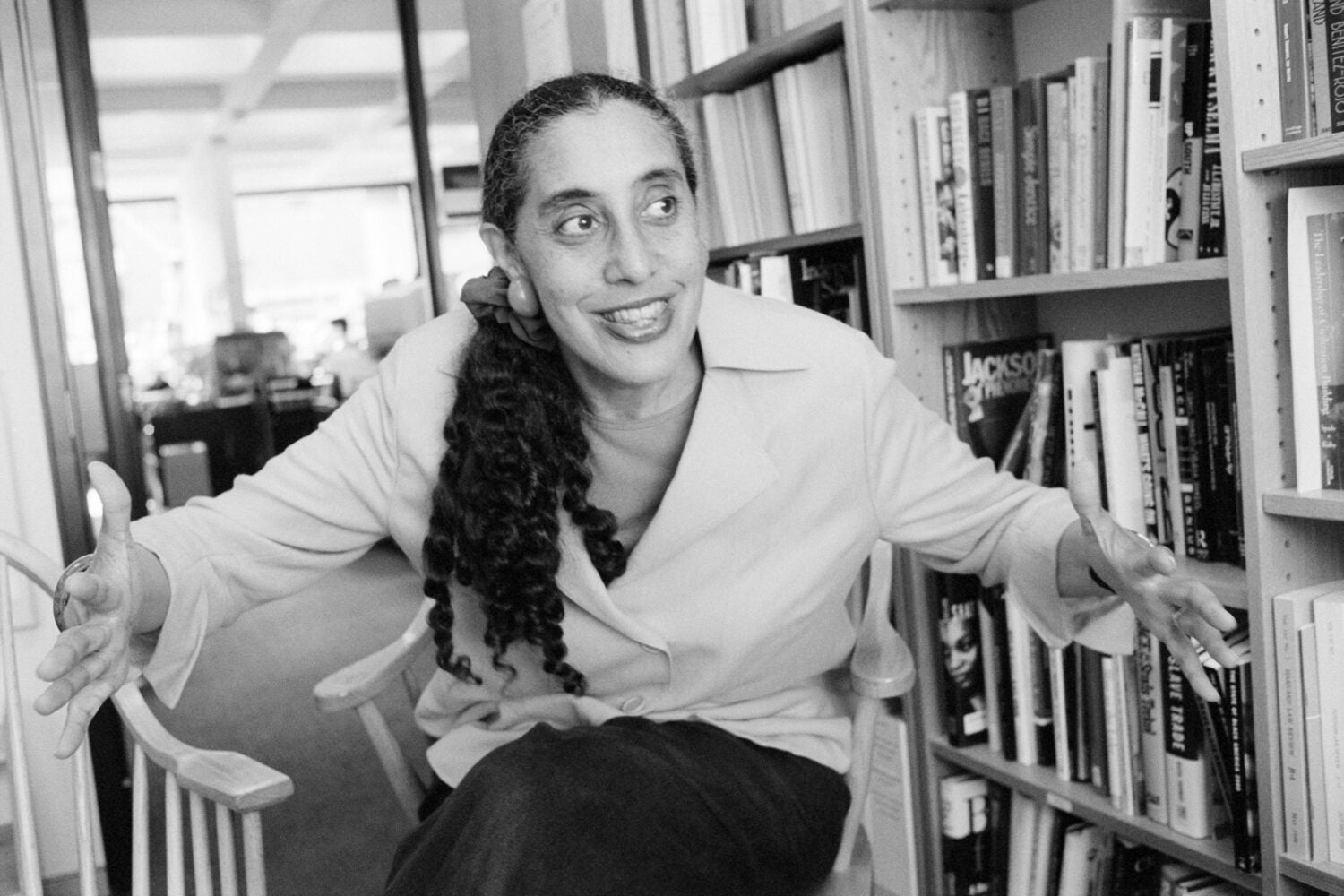
Lani Guinier spent her life and career challenging Americans to rethink voting, race, and representation — to “encourage people not to accept the status quo as the only possible world they have to live in,” says Harvard Law School Professor Nikolas Bowie ’14, who is also her son.
Guinier, a celebrated civil rights lawyer, scholar, and educator, became the first woman of color to hold a tenured professorship at Harvard Law School before her death in 2022 at the age of 71. Her ideas on voting rights, election law, legal education, and democratic representation continue to shape conversations about equality, race, and justice in the United States.
Those who knew her best also remember Guinier as a generous collaborator and mentor. Today, a fresh cohort of scholars and researchers can engage with her work through her personal and professional papers, now available to the public through the Schlesinger Library on the History of Women in America at the Radcliffe Institute for Advanced Study at Harvard University.
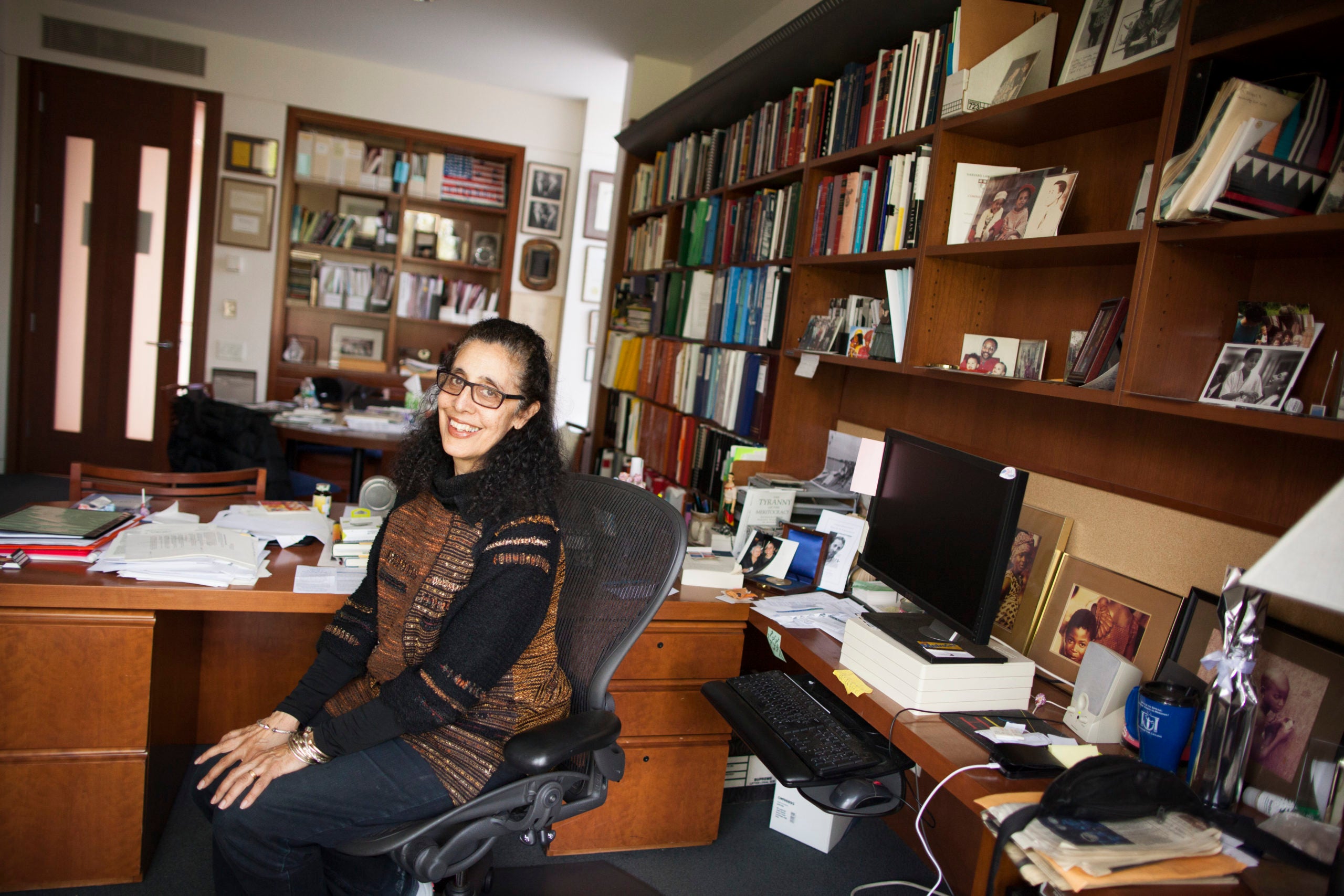
“I have no doubt that generations of researchers, including people who knew her and people who did not know her but were aware of her scholarship and her civil rights lawyering, will take advantage of the collections,” says Tomiko Brown-Nagin, dean of Harvard’s Radcliffe Institute, and a longtime friend and collaborator of Guinier’s. “And the thing that is most promising to me is that the collections will introduce her to new generations of students.”
The Guinier collection includes half a million pages of legal case files, papers, and notes; speeches, drafts, and other writings; lesson plans and course syllabi; and copious photographs and audiovisual materials, says Laura Peimer, an archivist with the Schlesinger Library.
Peimer says the materials span Guinier’s life and career as a civil rights attorney, scholar, teacher, and public figure, and include items from her work leading voting rights cases at the NAACP Legal Defense Fund in the 1980s. The collection also showcases Guinier’s academic career, first at the University of Pennsylvania and then at Harvard Law School, where she was the Bennett Boskey Professor of Law, as well as her work addressing issues related to education reform, race, and equality.
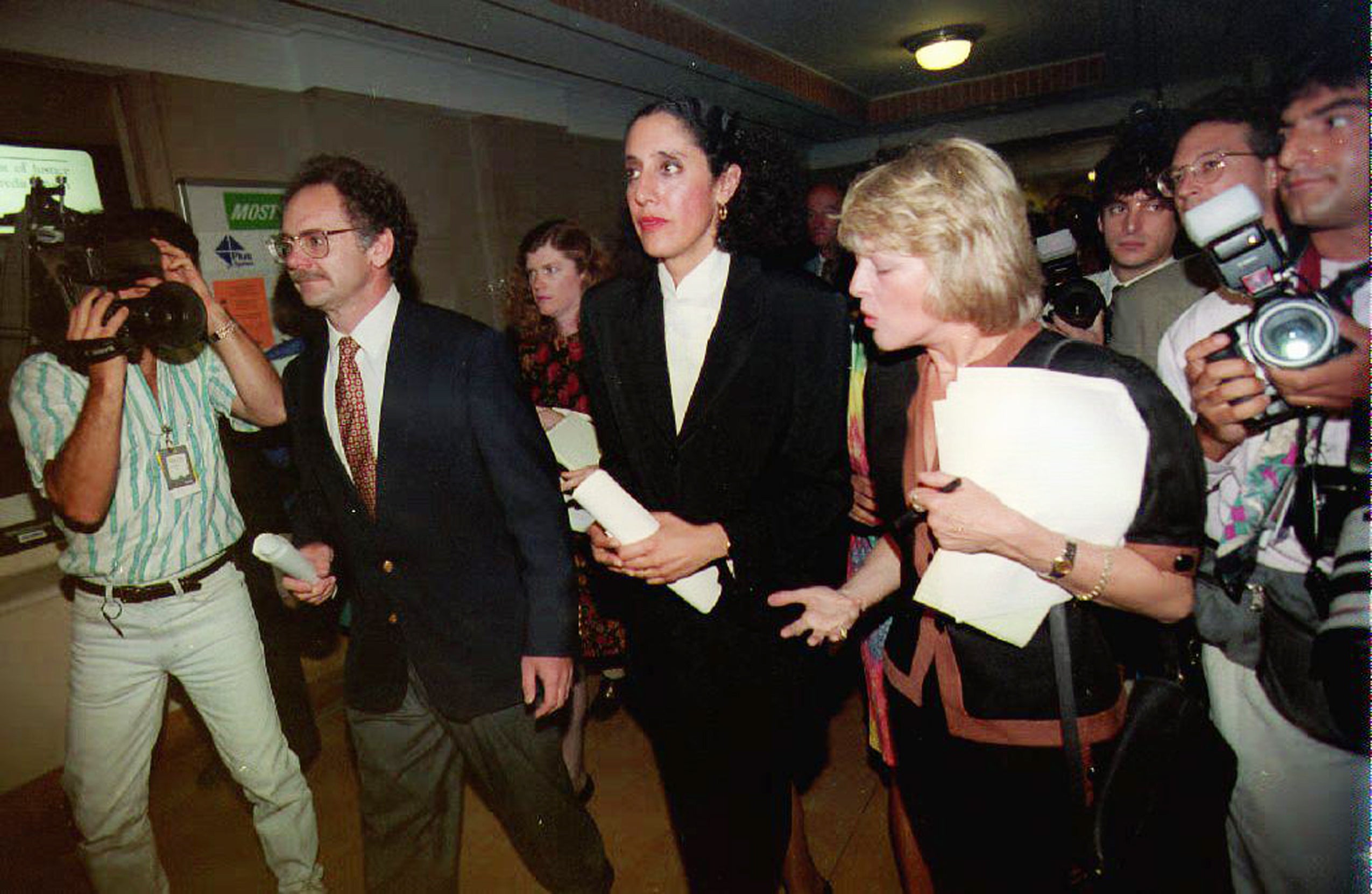
It also documents a painful — yet significant — period in Guinier’s life: her unsuccessful 1993 nomination for assistant attorney general for civil rights, which was withdrawn by President Bill Clinton following a politically charged campaign that many viewed as motivated by partisan opposition.
“This was an incredibly powerful moment in Guinier’s life,” Peimer says. “She spoke and wrote extensively about the impact of this experience, and it’s woven throughout the collection, in conference speeches and in her writings, such as her books ‘Tyranny of the Majority’ and ‘Lift Every Voice.’”
Bowie, the Louis D. Brandeis Professor of Law at Harvard, hopes that scholars who engage with the collection will understand Guinier’s work not as abstract contributions, but as expressions of her identity, experiences, and commitment to building a better world.
“I hope that people engaging with her archives are able to put her scholarship and teaching and professional life in context,” he says. “I hope that they understand that her ideas come from a fundamental, core part of her identity. She didn’t say things because she thought they would get her anything other than a more just, more inclusive society.”
Processed and described by a team of three archivists and three students in archival studies over several years, the Guinier collection now totals more than 550 archival file boxes, which Peimer says she is excited to share with the public.
“I think the collection has wide-ranging significance, especially for those interested in studying legal education and pedagogy, as well as those interested in topics Guinier explored, such as voting rights; the legal implications of race, class, and gender; how to democratize education; and how to reimagine affirmative action,” she says. “All of these areas of study continue to have the same value today as they did then, and I know they’ll have value for future researchers as well.”
Continuing connections
The collection has personal — as well as institutional — significance to Brown-Nagin, who is also the Daniel P.S. Paul Professor of Constitutional Law at Harvard.
Brown-Nagin first met Guinier when she was a young legal fellow at Harvard Law’s Charles Hamilton Houston Institute.
“The thing that stands out to me is how warm and welcoming Lani was, notwithstanding her stature in the profession — she was a rock star,” Brown-Nagin says. “She was wonderful to me. She asked me questions about my research and was interested in my perspective, and I was so blown away.”
Brown-Nagin says the two shared interests in law and inequality, but Guinier’s opinions on issues weren’t always what people assumed. “Lani was very open-minded and approached all questions as a problem solver.”

Over the years, Guinier kept in touch and followed Brown-Nagin’s career, inviting her to events and convenings at Harvard. Eventually, the two became colleagues at Harvard Law School, where their relationship deepened through their work as scholarly collaborators.
“Our relationship grew organically and was driven by our shared intellectual interests as well as the personal warmth,” she says. “I really liked and admired Lani. And she really wanted to be helpful to younger people, whether students or junior faculty members.”
Among the lessons Brown-Nagin took from Guinier’s mentorship, one of the most critical, she says, is a commitment to intellectual rigor. Guinier encouraged her to always consider others’ points of view — even ones delivered in a less-than-charitable manner.
“She really made it clear that one needed to test one’s assumptions. She once told me, ‘When you’re workshopping a paper, you should take seriously everything that anyone says, no matter the spirit in which the comment is given.’”
Brown-Nagin says Guinier’s papers complement the wider Schlesinger Library collection, which focuses on women’s history. “I’m so pleased that Lani Guinier’s papers are available to people across the world,” she says.
‘I’m a big fan of my mom’s’
Bowie, Guinier’s son, helped bring her collection to the Schlesinger Library, where he hopes generations of students and researchers will benefit from his mother’s contributions.
“I’m a big fan of my mom’s,” he says, with a smile.
Bowie says that materials in the collection reflect two key elements of Guinier’s career: her mentorship of students and faculty members, and her dedication to teaching and pedagogy.
“It was important to her that students felt Harvard was a place in which they could graduate feeling equipped to pursue justice, and that they didn’t feel derailed or demoralized on the way,” he says. “She also really cared about ideas, and I think many of those ideas were ahead of their time.”
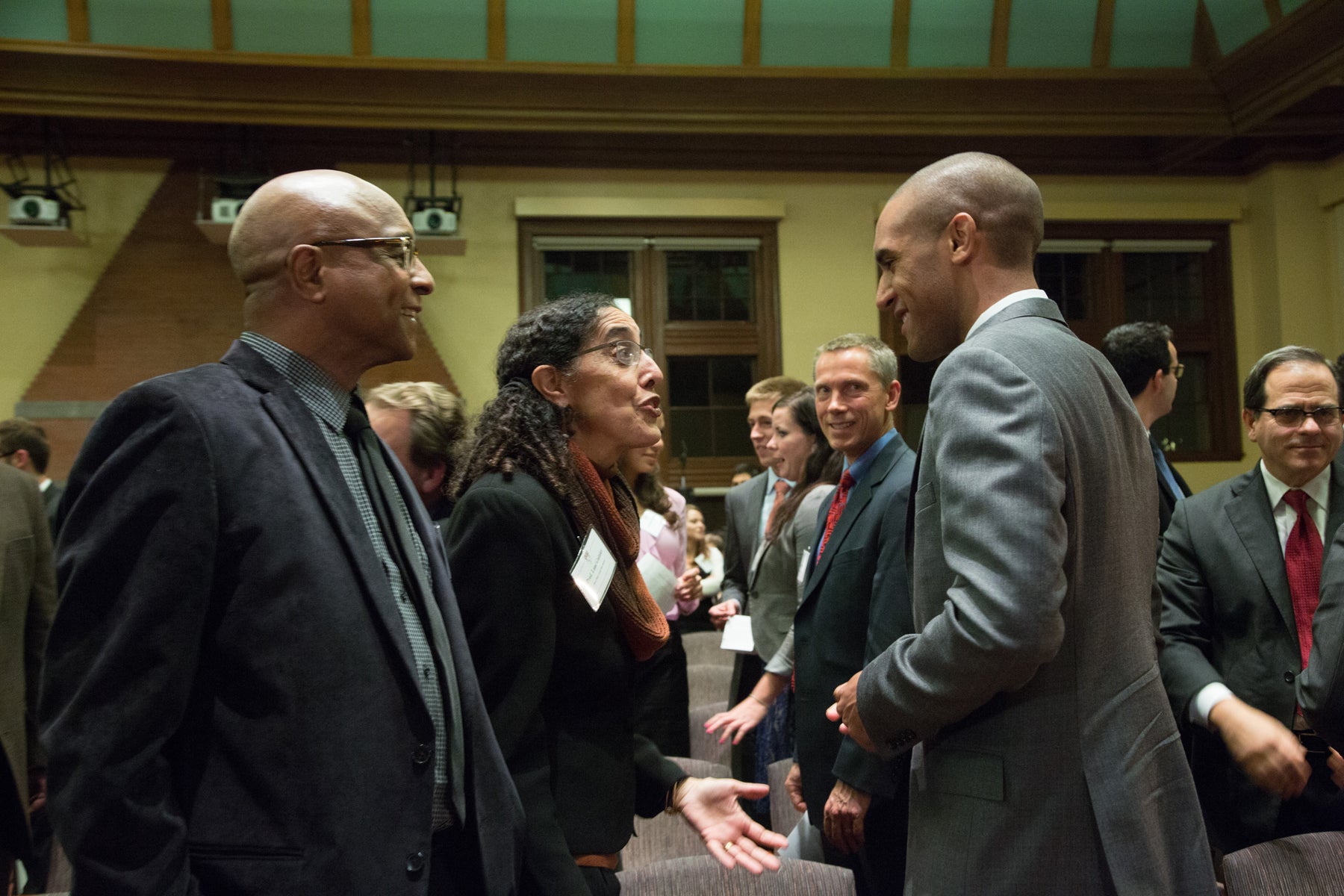
For example, Guinier was an early champion of instituting proportional representation in U.S. elections. “She was interested in how we have a majoritarian democracy that takes all voices seriously,” Bowie says.
Guinier remained committed to those principles despite the attacks that ultimately led to the withdrawal of her nomination in the Clinton administration, he adds. “And today, her ideas are everywhere, because so many people see the flaws of first-past-the-post elections.”
Bowie says he’s grateful for the collection for more personal reasons, too. In exploring his mother’s papers, he says he’s gained a better understanding of the richness of the many professional relationships Guinier cultivated during her life and career — something he does not take for granted.
“I have now learned as a law professor that it is not as though this always happens,” he says. “It takes effort.”
Perhaps most surprisingly, the opportunity to study Guinier’s papers has given Bowie another way to connect with his mother: as an intellectual peer.
Growing up, Bowie says, his mother would often engage him with her ideas and work, “and I would do my best to keep up and try to figure out what she meant.”
But now, as a law professor, Bowie says that he can examine her arguments and appreciate their nuances and reasoning in a way he was unable to as a child. “That’s the great thing about an archive — it’s a way of maintaining a conversation after someone has died.”
Want to stay up to date with Harvard Law Today? Sign up for our weekly newsletter.