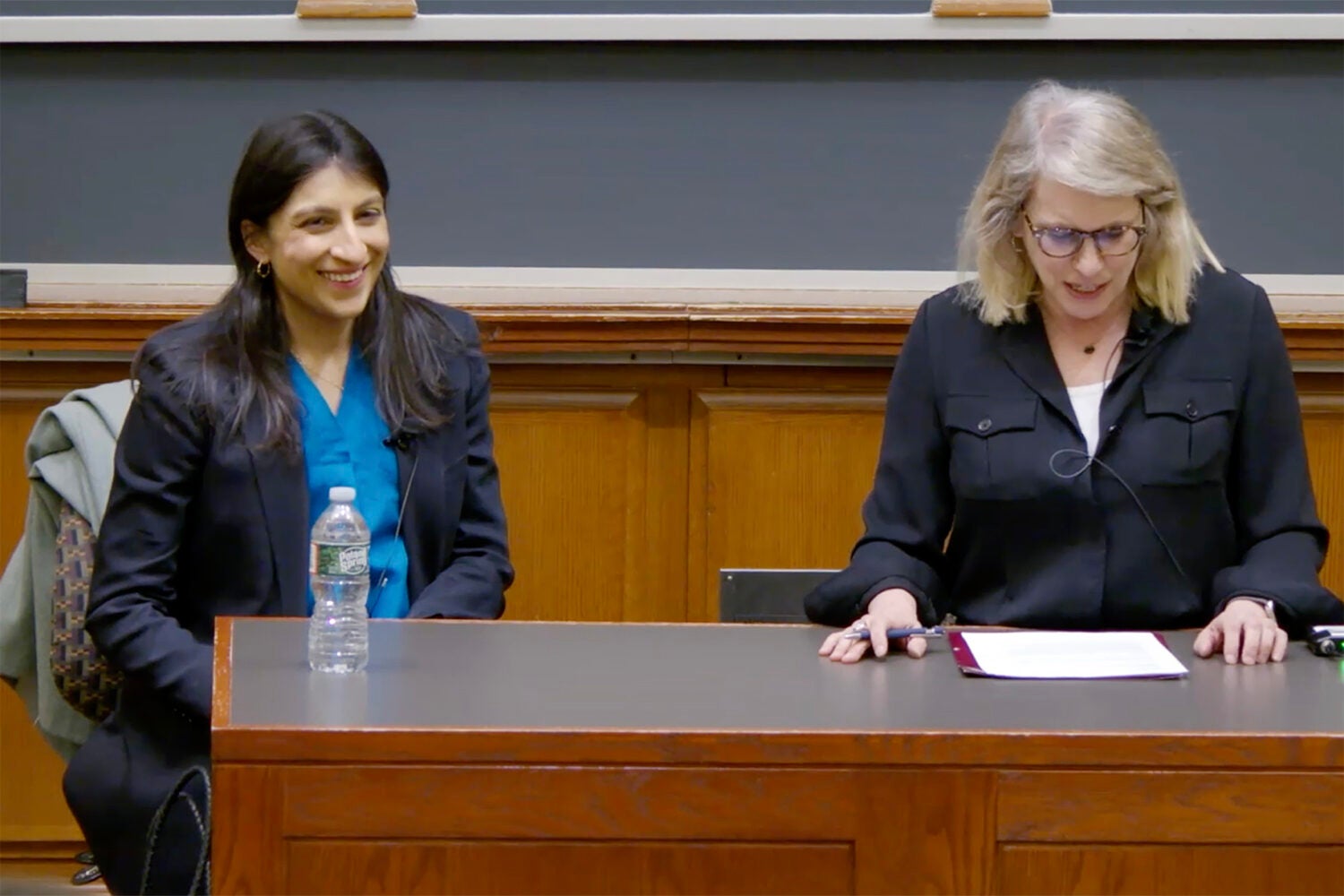
Lina M. Khan’s four-year tenure as Federal Trade Commission chair was marked by her advocacy in enforcing antitrust laws, and in challenging powerful interests on behalf of consumers and workers.
“As a labor lawyer, we miss you,” Center for Labor and a Just Economy director Sharon Block told her during an appearance on campus on Feb. 26.
Khan returned to Harvard Law School for the conversation with Professor Block, following her appearance two years ago in a panel hosted by the CLJE. Since leaving the FTC in January 2025, Khan has since worked on Zohran Mamdani’s New York mayoral campaign and chaired his transition team; she is now an associate professor at Columbia Law School.
As Block pointed out, Khan in her FTC tenure “thought about antitrust in a novel way, when it came to workers.” Khan explained that antitrust laws have traditionally benefitted consumers, yet the word “consumer” doesn’t appear in any of the laws.
“One thing I arrived at the agency with, was a desire to make sure we were enforcing the law in a way that would give appreciation to the way in which unchecked market power actually hurts workers,” said Khan. This, she said, included greater supervision of healthcare mergers along with commercial ones.
She cited the case of Washington v. Kroger et al. (2024), which blocked the largest grocery store merger in U.S. history. “It would have driven up grocery store prices but also, as we uncovered through that investigation, would have really undermined organized labor.”
She also cited work on non-compete agreements and their effect on fast-food workers, janitors, and others. “This was an area where we brought some lawsuits and managed to have non-competes eliminated for thousands of workers … [but] as was true of many rules finalized in the last administration, we were sued on it.”
However, she challenged the idea that such progress will necessarily be lost in the era of Donald Trump’s presidency. “We were always very interested in finding strange coalitions that we could be building, in terms of support for parts of the work that didn’t necessarily fall on partisan lines.” For example, to the surprise of many, the proposed ban on the non-compete rule garnered support from religious conservatives, who felt they’d be prevented from getting another job if they left their first one over objections to the COVID vaccine.
“We were always very interested in finding strange coalitions that we could be building, in terms of support for parts of the work that didn’t necessarily fall on partisan lines.”
Less encouraging, Block suggested, was the September 2025 firing of FTC Commissioner Rebecca Slaughter by President Trump. The U.S. Supreme Court may use the resulting case, Trump v. Slaughter, to overturn Humphrey’s Executor v. United States (1935), which limited the president’s ability to fire the heads of independent agencies.
Khan warned of consequences if the 91-year-old precedent is overturned.
“There is going to be a real question as to, is there going to be any incentive for a president to be appointing commissioners from a minority party in the future, and just how does that reshape the character of these agencies and how they were set up? There is also a question of what it looks like for all of these agencies that had some independence to now be at the direct beck and call of the White House. … Certainly this administration is showcasing what it means for law enforcement to become just an extension of partisan agendas,” Khan said.
Still, she said that the firing of Democratic FTC commissioners Slaughter and Alvaro Bedoya hasn’t caused as dramatic a shift as one might suppose. “[It] highlights a lot more institutional durability of various projects we had put in motion. … The vast majority of lawsuits that we had initiated, especially on the antitrust side, are still continuing and, as far as we can tell, being litigated vigorously.” One proposed rule, she noted, requiring parties to submit a greater amount of information when proposing a merger, is in fact being defended by the Trump administration.
Moving onto the Mamdani transition, Khan said, “was a real crash course in learning a whole new set of agency acronyms and a new org chart.”
But she noted a parallel to her own work with the FTC: “He ran a campaign that was unapologetic about standing up to powerful interests and being laser focused on what are the material drivers of peoples’ lives being more difficult, why is it more expensive, and who is making that happen? Seeing him being fearless, in not just calling out how things were worse, but the actors making it that way, did have some impact on people trusting him.”
Want to stay up to date with Harvard Law Today? Sign up for our weekly newsletter.